
Business
How Aldi is pushing down grocery prices
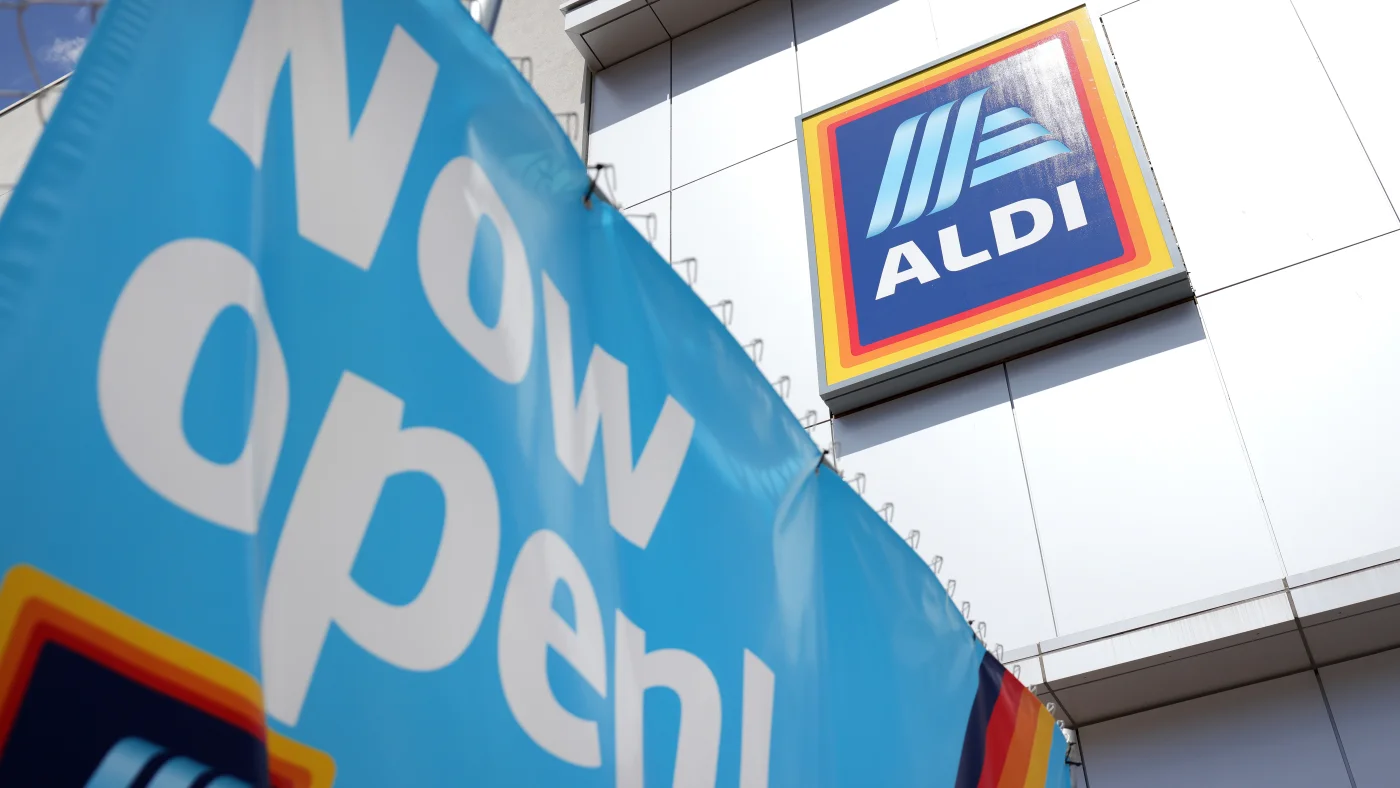
In the summer of 2020, I lived briefly in Ithaca, New York. It’s the only time I’ve lived near Aldi, the grocery store known for low prices. I went twice, and I thought it was fine, but underwhelming. I appreciated the low prices, but it didn’t have everything I needed. The store was small and a bit shabby.
I didn’t know it yet, but those are the exact ingredients that have made Aldi the fastest-growing grocery chain in America. Per Bloomberg, Aldi plans to have more than 3,000 American locations by the end of 2028, which would be more than any other chain but Walmart. In 2024, Aldi generated some $29 billion in U.S. sales, which is more than Trader Joe’s.
Aldi is a German company known for having low, low prices, and it deserves that reputation. Food reporter Deena Shanker told me that her experience comparison shopping over many months was that Aldi either matched Walmart on price or was a bit cheaper. Grocers like Wegmans and Kroger have announced defensive price reductions, and an analysis published in late 2023 of Lidl, another German grocer with a very similar model to Aldi’s but fewer U.S. stores, found that grocery chains reduced their markups ~7 percent in areas where Lidl stores opened.
All to say: Aldi is disrupting the grocery business and actually lowering prices even as the cost of food—at restaurants and other grocery stores—goes up and up.
Maybe this sounds a bit humdrum. But I found it totally intriguing and perplexing, because…
Walmart and Costco’s business models depend on low prices, too, and they can offer low prices by having huge stores, giant warehouses, and incredible economies of scale that allow them to pay less for Oreo’s, baby carrots, and Jif peanut butter than other grocers. So how the heck is Aldi matching or beating them on price?
When a company disrupts a longstanding industry, it’s typically a startup enabled by new technology—like Netflix using online streaming to disrupt Blockbuster and video rental. But Aldi is not staffed by futuristic robots. Its stores just look like grocery stores, and Aldi was founded 80 years ago, in post-war Germany. So what’s going on?
One of the proudest achievements of America’s capitalistic market economy is providing its citizens an abundance of increasingly affordable food. Somewhat famously, Soviet leader Boris Yeltsin toured a grocery store in Houston during the Cold War and was amazed that the average American enjoyed more variety than top Soviet politicians. From 1960 to 2019, Americans spent less and less of their incomeon food each year, even as they enjoyed more frequent restaurant meals, more sushi, and far better beer. But since the pandemic, food has become less affordable. Can American markets no longer provide cheap groceries? Did something break?
One necessary but not sufficient explanation for Aldi’s low prices is that management is obsessed with efficiency and cutting unnecessary costs. There’s no music in stores, because speakers (and licensing fees for muzak) cost money. The staff places products on shelves still in the cardboard boxes they were trucked in on, because artfully unpacking fruits, bread, and jerky sticks would mean higher labor costs. The shabbiness is intentional — it’s the cost of cheaper groceries.
But other grocery chains are similarly obsessed with efficiency. Here’s one of my favorite examples about Costco, courtesy of Zachary Crockett and The Hustle: “In another instance, reengineering a container of cashews from a circle to a square shape allowed Costco to stack more items in a single truck, reducing the number of shipments by 24,000 pallets per year. For shoppers, this meant cheaper nuts.”
Instead, Aldi’s disruptively low prices rely on two primary tactics:
Private label products: On Aldi shelves, you can find cookies that look a heck of a lot like Oreos and boxes of what sure seem like Ritz crackers. But they are “Benton’s Chocolate Sandwich Cookies with Vanilla Filling” and “Savoritz Golden Round crackers.” Both are made by Aldi, and therefore cost less, since Aldi doesn’t have to pay Nabisco’s markup and then add their own. More than 80 percent of Aldi products are these store-brand versions—aka private-label products or, in the case of look-alike Oreos,dupes.
Limited selection: When the Albrecht brothers took over their family’s grocery store in 1946, they had a small store and limited funds for stocking the shelves. But this became their secret sauce: Stocking a very limited selection of items — just essentials like rice and eggs, and just one of each rather than a variety of brands, sizes, and versions — allowed them to keep prices low. They could buy in bulk, which is cheaper, and by not stocking niche products that sit on shelves for weeks or days, they saved even more by avoiding spoilage and limiting shelf space, storage areas, and rent or real-estate costs. Even as the brothers grew rich, they kept stores small and selection limited. This is less convenient— shoppers often have to visit another grocery store to grab things like white pepper that Aldi doesn’t stock. But what Aldi does stock is cheaper.
Aldi’s low prices made their stores very attractive during periods like the Great Recession and today’s inflationary era. The Great Recession, especially, enabled their current growth. But if all Aldi offered was bargain prices in shabby stores, customers might flee to Costco, Kroger, or Whole Foods when the economy recovered.
So another key to Aldi’s success is that it’s fun. Aldi has a famously chaotic-good middle aisle with rotating buys like fun toys, German spätzle, and advent calendars that contain 24 festive cheeses. And its U.S. stores have expanded their offerings (a bit) to attract higher-income customers: Aldi doesn’t just have the cheapest apples, but the cheapest honey crisp apples. Not just super-duper cheap wine but well-priced “premium” wine.
Instead of being a sad place to shop when you’re low on cash, Aldi has more flea-market energy: a place anyone might go to hunt for good deals and fun finds. Aldi is beloved; many customers arecult-like in their devotion. In some cases, customers line up for new store openings like early iPhone releases.
My main takeaway from researching and analyzing Aldi for several weeks (foran episode of Gastronomics!) is that there’s always something new under the sun. American grocery stores are a mature market. They seem pretty stable equilibrium-y. But they are dynamic and always changing. Aldi didn’t need futuristic tech to disrupt the industry; just a strategy developed 80 years ago, then tweaked for the American market. In healthy markets, there’s always a way in for new competitors.
My other takeaway is greater appreciation for the famous business idiom: “There are only two ways to make money in business: One is to bundle; the other is to unbundle.”
The clearest example of bundling and unbundling is probably television. Cable companies bundled hundreds of TV channels together and charged one high fee for all of them. Then streaming services like Netflix made money by unbundling television — by allowing people to pay for just Netflix. Which felt liberating! For a few years. But now customers are annoyed about subscribing to so many streaming services. So streamers are teaming up to form bundles, like getting Disney, Hulu, and HBO Max all for one reduced price. Now, to make money, you gotta bundle.
Even the person who coined the phrase about bundling and unbundling didn’t think it’s literally the only way to make money. Still, I often failed to see (un)bundling as a powerful framework outside of the media industry. Until I realized that Aldi is unbundling the grocery store.
For a long time, grocery stores got more bundled. People once went to the baker, the butcher, and the greengrocer. Then the super market put all those things under one roof. And then Walmart, Target, and Costco created superstores where you could buy groceries and clothes and big-screen TVs.
Now Aldi is reversing this process by unbundling the grocery store. Not only does Aldi not have the big-screen TVs and dupes of Lululemon hoodies and pants, it doesn’t even have everything on your grocery list. Aldi unbundled the part of the grocery business it can do super cheaply, and it intentionally locates Aldi stores near competitor grocery stores so shoppers can easily go grab the last few things on their list (the rest of the bundle).
With this in mind, I’ve started seeing bundling and unbundling at work in more and more industries. If you look closely at your own, I suspect you will, too.
My third takeaway is that I just didn’t live in Ithaca long enough to grok Aldi. If I’d been there longer, I bet I would have made Aldi part of a multi-store strategy. I get it now! Aldi, please come to Colorado (where I live)!
At the start of this post, I asked three questions inspired by Aldi’s expansion. The first two, which are about how Aldi achieved a comparative advantage, I feel like I’ve answered.
The third was whether the American economy can still deliver a bounty of affordable food. I think the way Aldi’s growth pressured competitors to keep prices low shows that grocers are not the right target of our ire over food prices. But grocery stores are just one slice of the food world.
Business
Nvidia Partner Vertiv Soars After AI Data Center Play’s Blowout Earnings, Strong Guidance

Information in Investor’s Business Daily is for informational and educational purposes only and should not be construed as an offer, recommendation, solicitation, or rating to buy or sell securities. The information has been obtained from sources we believe to be reliable, but we make no guarantee as to its accuracy, timeliness, or suitability, including with respect to information that appears in closed captioning. Historical investment performances are no indication or guarantee of future success or performance. Authors/presenters may own the stocks they discuss. We make no representations or warranties regarding the advisability of investing in any particular securities or utilizing any specific investment strategies. Information is subject to change without notice. For information on use of our services, please see our Terms of Use.
*Real-time prices by Nasdaq Last Sale. Real-time quote and/or trade prices are not sourced from all markets. Ownership data provided by LSEG and Estimate data provided by FactSet.
IBD, IBD Digital, IBD Live, IBD Weekly, Investor’s Business Daily, Leaderboard, MarketDiem, MarketSurge and other marks are trademarks owned by Investor’s Business Daily, LLC.
©2026 Investor’s Business Daily, LLC. All Rights Reserved.
Business
Nelson Peltz’s Trian offers to buy Wendy’s for $1.4 billion
A group of investors led by Nelson Peltz’s Trian Fund Management has offered $1.4 billion to buy Wendy’s , according to a regulatory filing Wednesday.
The group has offered $7.35 per share in cash to take the burger chain private, paying a 20% premium to Tuesday’s closing price. In addition to Trian, it includes investment firms BlueFive Capital and Sixth Street Partners, plus Flynn Group, one of Wendy’s largest franchisees.
Wendy’s shares spiked about 15% in morning trading following the offer. The Wall Street Journal first reported Peltz’s proposal.
Wendy’s did not immediately respond to a request for comment from CNBC. Trian declined to comment beyond the filing.
The take-private deal offer comes after a tough two-year stretch for the burger chain. Wendy’s stock has tumbled 65% over that period, including Wednesday’s gains. For six straight quarters, the company has reported same-store sales declines.
Wendy’s is scheduled to report its third-quarter earnings before the bell on Nov. 5.
Wendy’s challenges have made the company a cheaper acquisition target for Peltz, whose history with the brand dates back to an activist campaign he led more than two decades ago.
Budget-conscious diners have been eating out less often, and Wendy’s and its rivals have leaned into discounts to lure consumers into restaurants. Wendy’s has also dealt with a revolving door of chief executives, who have had different ideas about turnaround strategies for the struggling chain.
“In our view, a take private makes sense as Wendy’s turnaround is likely to be prolonged given the challenged state of the lower income consumer and soft state of the quick service burger category,” TD Cowen analyst Andrew Charles wrote in a note to clients on Wednesday.
In May, former Potbelly CEO Bob Wright joined Wendy’s as its latest chief executive, after his former employer went private. In his first earnings conference call with analysts in August, he was candid about what he views as the chain’s biggest issues, like muddled value offerings, inconsistent execution at its restaurants and too many one-off promotions.
Business
Dow Jones Futures Fall, Techs Rise As SK Hynix Crushes Views; Fed, Microsoft, Google On Deck

Information in Investor’s Business Daily is for informational and educational purposes only and should not be construed as an offer, recommendation, solicitation, or rating to buy or sell securities. The information has been obtained from sources we believe to be reliable, but we make no guarantee as to its accuracy, timeliness, or suitability, including with respect to information that appears in closed captioning. Historical investment performances are no indication or guarantee of future success or performance. Authors/presenters may own the stocks they discuss. We make no representations or warranties regarding the advisability of investing in any particular securities or utilizing any specific investment strategies. Information is subject to change without notice. For information on use of our services, please see our Terms of Use.
*Real-time prices by Nasdaq Last Sale. Real-time quote and/or trade prices are not sourced from all markets. Ownership data provided by LSEG and Estimate data provided by FactSet.
IBD, IBD Digital, IBD Live, IBD Weekly, Investor’s Business Daily, Leaderboard, MarketDiem, MarketSurge and other marks are trademarks owned by Investor’s Business Daily, LLC.
©2026 Investor’s Business Daily, LLC. All Rights Reserved.
Business
The income required to retire comfortably in each state

Households around the country are facing financial stress amid persistent inflation, and retirees facing rising expenses need to ensure their income streams can cover costs.
Americans derive their retirement income from a variety of sources, which can include personal retirement savings, such as through a 401(k) plan or IRA, as well as annuities, pension plans and Social Security benefits.
The average annual Social Security benefit amounts to $24,852, based on the monthly average of $2,071 reported by the Social Security Administration in January 2026.
A new analysis by MoneyLion that utilized data from the MIT Living Wage Calculator estimated the annual income required to retire comfortably in each state, which ranges from a high of $64,504 in Hawaii to a low of $40,627 in West Virginia.
SOCIAL SECURITY ANNOUNCES COST-OF-LIVING ADJUSTMENT FOR 2027
Here’s a look at the state-by-state breakdown of the annual income a single adult without children would need to retire comfortably, according to MoneyLion’s analysis of the MIT Living Wage Calculator.
Income requirements by state
Alabama: $43,814
Alaska: $51,965
Arizona: $50,900
Arkansas: $41,615
California: $63,402
Colorado: $54,071
Connecticut: $54,178
Delaware: $49,484
Florida: $50,117
Georgia: $50,351
Hawaii: $64,504
THE AMERICAN DREAM NOW COSTS $5.3M AS HOMEOWNERSHIP, COLLEGE COSTS SURGE
Idaho: $49,091
Illinois: $50,796
Indiana: $45,326
Iowa: $44,273
Kansas: $44,994
Kentucky: $42,040
Louisiana: $42,378
Maine: $51,465
Maryland: $53,949
Massachusetts: $63,610
Michigan: $45,914
Minnesota: $48,475
Mississippi: $43,025
Missouri: $44,244
Montana: $50,409
Nebraska: $45,241
Nevada: $50,259
New Hampshire: $53,604
New Jersey: $56,884
New Mexico: $45,607
New York: $62,167
North Carolina: $46,745
North Dakota: $42,874
AMERICANS’ RETIREMENT SAVINGS GROW AS MORE FAMILIES PARTICIPATE IN PLANS
Ohio: $43,674
Oklahoma: $43,119
Oregon: $55,047
Pennsylvania: $48,515
Rhode Island: $52,024
South Carolina: $46,469
South Dakota: $42,706
Tennessee: $44,959
Texas: $45,290
Utah: $51,407
Vermont: $51,831
Virginia: $53,505
Washington: $55,316
West Virginia: $40,627
Wisconsin: $45,504
Wyoming: $44,614
Business
Why China is desperate to ship cars outside of the country

To understand why China is desperate to ship cars overseas, visit a dealership in Beijing.
Autumn has traditionally been the peak time to buy vehicles in the country, but this year many showrooms are empty or shut.
Car salesman Li Ke said that other than the Covid-19 pandemic, the 2026 “golden September and silver October” season, as it’s known, is the slowest he’s seen in his 26 years on the job.
“In past years, customers would come to the showrooms nonstop,” he told CNBC during an interview in his deserted showroom at a complex of dealerships on the outskirts of the Chinese capital. “We would have deals to sign every day. But nowadays we see only two to three deals a week. It’s a dramatic drop.”
Many people in China aren’t buying cars because an unstable job market and a continued slide in property prices have undercut consumer confidence. The government has also scaled back incentives such as cash-for-clunkers subsidies and tax breaks to go electric, car salespeople said.
Passenger car retail sales for 2026 in China totaled 13.33 million units through September, falling 21.7% from a year ago, according to the China Passenger Car Association. For the full year 2026, China’s domestic passenger car retail sales are set to drop 22% to 18.5 million vehicles, the association said — under the level recorded in the first year of the pandemic.
Even electric vehicles, which were once a bright spot, are down. Gasoline car sales have been declining in China because of the country’s transition to electric vehicles, but sales in China of new-energy vehicles — which includes EVs — dropped by 12.8% from January through September, according to the association.
“Customers are watching every penny,” Li said. “When looking at all the new functions on all these new models, they are weighing what is most practical, economic and worth their money over the long term. We don’t see impulse buying. Because of the bad economy, people are taking more time to replace their cars.”
The fierce competition has led to bruising price wars in recent years, a key reason Chinese carmakers have cast their eyes overseas and why Beijing is fearful of partners like the U.S. and Europe putting up coordinated trade barriers against its massive car exports, analysts said.
Industrial profits for the first nine months of the year were up 15.5% from the same period in 2025, but September showed signs of weakness relative to the prior eight months, according to China’s National Bureau of Statistics. For the auto manufacturing industry specifically, profits from January to September shrank by 22.8% compared with last year.
To preserve cash, Li’s dealership moved out of a pricey streetside space to one with less foot traffic but that rents at a fraction of the cost.
With profit margins eroding, Li said he sees little point in offering further discounts. He said the bigger hurdle is the prevailing Chinese consumer attitude toward big-ticket purchases.
“Chinese buyers would rather wait,” he said.


Flávio Bolsonaro seen landing in Miami with family after Brazil presidential election defeat
Where has Bolsonaro been? By Thomas Copeland and Jake Horton Flavio Bolsonaro has not taken a straightforward route to the...


Nvidia Partner Vertiv Soars After AI Data Center Play’s Blowout Earnings, Strong Guidance
Information in Investor’s Business Daily is for informational and educational purposes only and should not be construed as an offer,...

Nelson Peltz’s Trian offers to buy Wendy’s for $1.4 billion
A group of investors led by Nelson Peltz’s Trian Fund Management has offered $1.4 billion to buy Wendy’s , according...


Dow Jones Futures Fall, Techs Rise As SK Hynix Crushes Views; Fed, Microsoft, Google On Deck
Information in Investor’s Business Daily is for informational and educational purposes only and should not be construed as an offer,...


The income required to retire comfortably in each state
Households around the country are facing financial stress amid persistent inflation, and retirees facing rising expenses need to ensure their...


Why China is desperate to ship cars outside of the country
To understand why China is desperate to ship cars overseas, visit a dealership in Beijing. Autumn has traditionally been the...


Fed meeting today: Live updates
The Federal Reserve’s interest rate decision Wednesday likely will be short on suspense, with markets expecting the central bank to...


Russell Brand Takes Stand in Trial, Says No One Will Testify for Him
Russell Brand took the stand for the first time in his ongoing rape and sexual assault trial on Wednesday and...


Amazon relaxes push for AI use as Anthropic reveals shocking stats
An Amazon memo published Tuesday encouraged its software engineers to stop “tokenmaxxing” and start being more judicious about how they...


Calif. just broke a 28-year-old record for fatal rabies detections
A pair of sick raccoons found this month in a Los Angeles suburb set off alarm bells from California to...
-

 Business1 week ago
‘Black Monday’ fears intensify as prediction markets shrug off 2026 crash
-
Business2 weeks ago
Why BlackRock is suddenly more bearish on stocks
-
Business2 weeks ago
AI Agent Company Decagon Held Early M&A Talks With ServiceNow, Others
-

 Business2 weeks ago
Dow Jones Futures: Stock Market Holds Up As Meta, AMD Lead Buys; ASML, CPI Inflation Due
-

 Business2 weeks ago
CPI inflation report September 2026
-

 Food2 weeks ago
Wall Street Sees Inflation Easing Even With Oil Above $90
-

 HealthNews2 weeks ago
Carefree panty liners face lawsuit over dangerous carcinogenic claim
-

 Entertainment2 weeks ago
Reese Witherspoon Partners With Mediawan To Buy Hello Sunshine