
PM office canada
Canada facing carbon tariff threat from European Union: internal documents
Canada is facing a carbon tariff threat from the European Union within months as the economic bloc fully implements its Carbon Border Adjustment Mechanism (CBAM).
According to internal documents CBC News obtained through an access to information request, Canadian iron, steel and aluminum are not exempt from the carbon tariff even with Canada’s national price on carbon and its decade-old trade deal with the European Union.
The memo from Global Affairs Canada signed on Dec. 10, 2025, describes the CBAM as a “border charge” or “effectively a ‘carbon tariff.'”
With the Canada-EU Summit this week in Montreal, Ottawa’s diplomats continue to seek an agreement with Brussels before Canadian exporters face additional compliance costs and a carbon charge that European importers will have to pay at the border in 2027.
Prime Minister Mark Carney said on Tuesday that the summit marks the start of negotiations for Canada to become a closer strategic partner to the 27-member bloc.
Global Affairs estimates $2.8 billion worth of goods annually are exposed to the carbon import levy — primarily on metals that are already impacted by U.S tariffs.
The internal note flags “risks” with the implementation of the carbon tariff “occurring as Canada seeks to diversify trade away from the U.S. and toward markets like the EU.”
It adds Canada’s exposure to the tariff “appears modest” overall but the “potential impacts vary considerably across provinces and territories” — hitting Newfoundland and Labrador and Quebec particularly hard.
READ the internal note CBC News obtained
The briefing note states that an annual average of $885 million worth of the Atlantic province’s iron and steel exports — almost half — are exposed to the EU’s incoming tariff.
In Quebec the value of aluminum, iron and steel exports that are exposed amounts to about $792 million annually.
Those figures are averages based on data between 2021 and 2024, meaning exposure could be higher as Canadian goods seek new buyers to avoid U.S. tariffs.
‘Big change’ to trade regime
Climate trade experts have been warning about the pending EU carbon charge for some time.
“It’s a big deal conceptually,” said Ross-Linden Fraser, an acting director at the Canadian Climate Institute. “This is a big change in the way that trade gets treated.”
The EU’s carbon border adjustment mechanism is being applied at a low level and will ramp up to fully in 2034. It’s meant to encourage exporters to lower the planet-warming emissions created when producing their industrial goods.
But Canadian steel, aluminum, iron and cement exporters are already incurring costs for compliance, having to measure the emissions embedded in their exports and have those figures reviewed by an accredited verifier.
“That’s a costly prospect,” said Aaron Cosbey, an economist who researches carbon border adjustments at the International Institute for Sustainable Development.
The EU, however, is exempting countries like Switzerland, Norway, Iceland and soon the U.K. That’s because their carbon pricing systems are linked or fall under Europe’s carbon market, the EU Emissions Trading System.
The briefing note obtained by CBC News explicitly states that an “exemption … is not currently possible” for Canada because our carbon price is not linked to Europe’s.
“In 2025, the EU carbon price is approximately $134 per tonne, compared to $95 per tonne [in Canada],” according to the briefing note.
The Carney government’s recent energy accord with Alberta weakened Canada’s carbon price further.
Canadian diplomats and ministers are “focused on minimizing” the impact of the carbon tariff on Canadian exporters in their engagements with the European Commission, according to the documents.
Countries that have a carbon price will get credit for that, according to the internal note, but it’s not clear how the EU will recognize Canada’s.
Canada engages EU on carbon tariffs
Environment and Climate Change Minister Julie Dabrusin will be attending the Canada-EU Summit in Montreal.
Her office previously noted that Canada has been “advocating for recognition of Canada’s industrial carbon pricing systems and streamlined approaches that avoid unnecessary administrative burdens for Canadian exporters.”
In an interview with CBC News on Oct. 22, Dabrusin did not say whether negotiators were making progress.
“My goal always is to make sure that we have an industrial carbon pricing system that’s effective and that works for making sure that our industry is competitive and that we are supporting Canadian jobs,” Dabrusin said.
European Union officials briefing reporters ahead of the summit said both countries are “committed to [tackling] climate change.”
With Europe moving ahead with the carbon border adjustment mechanism, both sides are working to have “the same kind of baselines, the same kind of processes,” the officials said.
It’s unclear though what that looks like.
One producer sees an edge
The threat of carbon tariffs for exporters is growing. The internal note speaks of “CBAM proliferation,” flagging several countries developing or assessing carbon border adjustment mechanisms, including the United Kingdom, Australia, Japan and Turkey.
Canada’s major metals producers Rio Tinto and ArcelorMittal declined to comment. But one exporter sees an upside.
Canada Nickel is advancing a nickel project in Timmins, Ont. With its access to low-carbon electricity and plans to capture carbon and store it underground, the company says it is well positioned to export what the industry calls potentially zero-carbon steel to Europe.
It hasn’t calculated the final costs, including administrative compliance, on its balance sheet. But compared with other global exporters, it estimates it will be minimal.
“We’re looking to ship millions of tonnes of steel per year eventually to Europe … but that’ll translate into pennies per tonne over the long run,” said Canada Nickel CEO Mark Selby.
Not every producer may see it that way.
By the time Europe’s carbon tariff fully kicks in by 2034, Cosbey estimates Canadian steel could cost an additional $150 per tonne.
“That’s more than 10 per cent of the price of a tonne of steel on the open market these days. So that’s a significant cost,” Cosbey said.
PM office canada
Canada, UAE sign trade deal as Carney seeks new trading partners
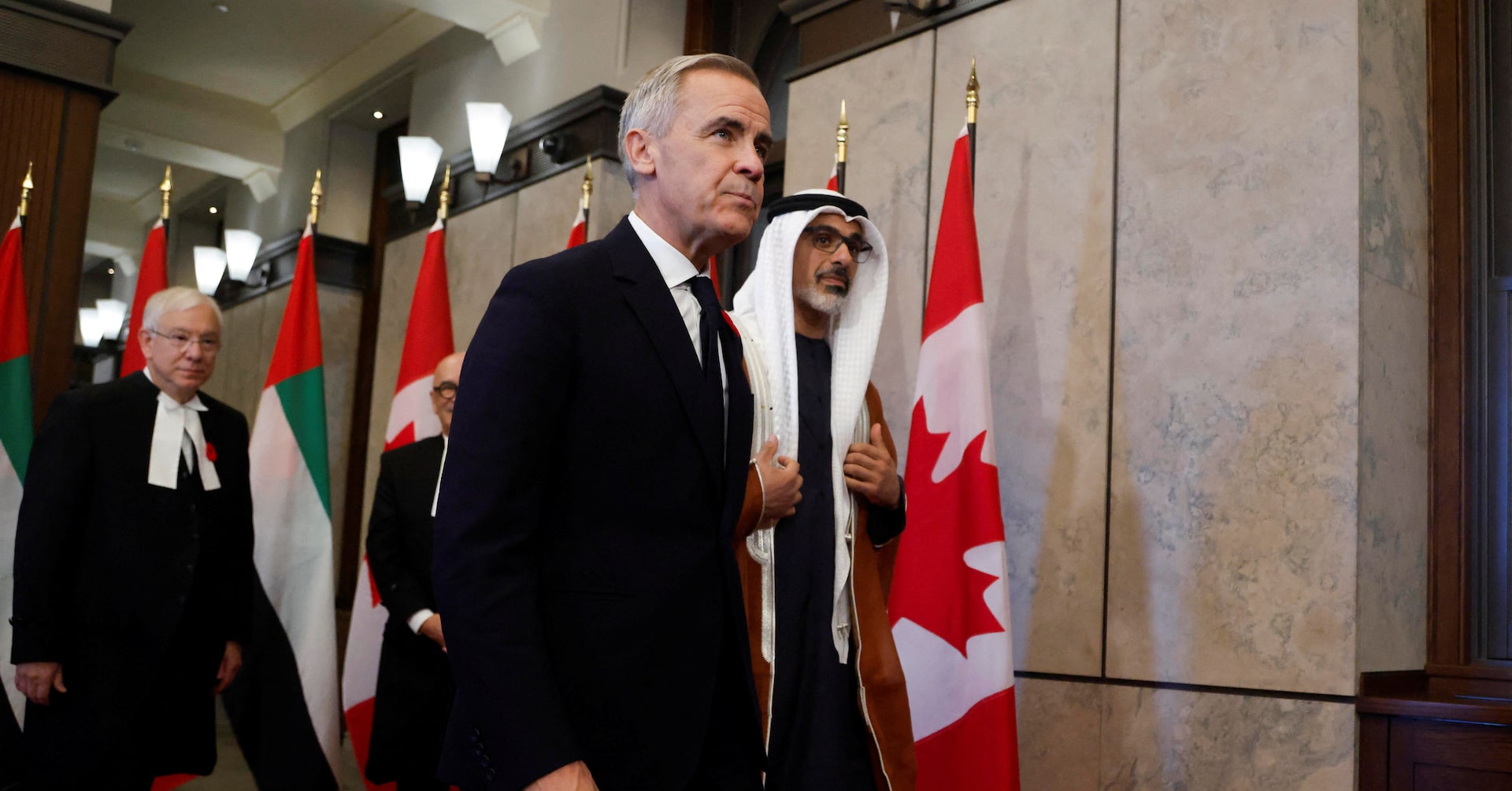
OTTAWA, Oct 27 (Reuters) – Canada and the United Arab Emirates signed a comprehensive trade deal on Tuesday to lower barriers between the two economies and boost investment, the governments said, as Prime Minister Mark Carney seeks to expand trade and investment ties at a time of tension with the United States.
Carney and Abu Dhabi Crown Prince Sheikh Khaled bin Mohamed bin Zayed Al Nahyan presided over the signing of the Comprehensive Economic Partnership Agreement (CEPA), which aims to cut tariffs, reduce red tape and improve market access for businesses in both countries.
Sign up here.
Carney has vowed to double Canada’s non-US trade over the next decade as President Donald Trump’s tariffs have rippled through Canada’s economy. Subsequent attempts for a deal with Washington have broken down, and that has pushed Carney to aggressively pursue trade pacts with countries from the Asia Pacific to Europe and Middle East.
“Once fully implemented, the CEPA will reduce or eliminate tariffs on over 99% of current Canadian exports to the UAE. That means new markets for Canadian farmers growing pulses and canola, for manufacturers of industrial machinery and power generation equipment, for our world-class aerospace sector, and other Canadian innovators,” The Prime Minister’s Office said in a statement.
“The agreement will also address non-tariff barriers, create a more predictable environment for trade and investment, and expand market access for Canadian goods and services, including in the industrial, agricultural, forest, fish and seafood, environmental, and engineering sectors,” it said, adding CEPA is expected to enter into force in 2027.
The two countries also signed preliminary agreements on energy, diplomatic and defence cooperation.
“We see considerable potential for our private sector, whether through improved market access for our exporters or access to investment opportunities in high-growth sectors such as logistics, communications, advanced technology and manufacturing – all of which will support our pursuit of a resilient, diversified and globally connected economy,” UAE’s Foreign Trade Minister Thani Al Zeyoudi said in a statement.
He signed the CEPA deal with his Canadian counterpart Maninder Sidhu.
UAE is the largest Middle Eastern market for Canadian exports and is a big buyer of Canadian motor vehicles and parts, and machinery. Two-way trade between the countries was worth C$3.5 billion ($2.48 billion) last year. It has been growing at 10% annually for the last few years, according to a government data.
The UAE last year also committed up to in Canada.
The signing is the last step before Canada’s Parliament can ratify the agreement, a Canadian government source said.
Reporting by Promit Mukherjee; Editing by Chizu Nomiyama
PM office canada
Carney agrees to extradition treaty talks with UAE as he deepens ties with Gulf state
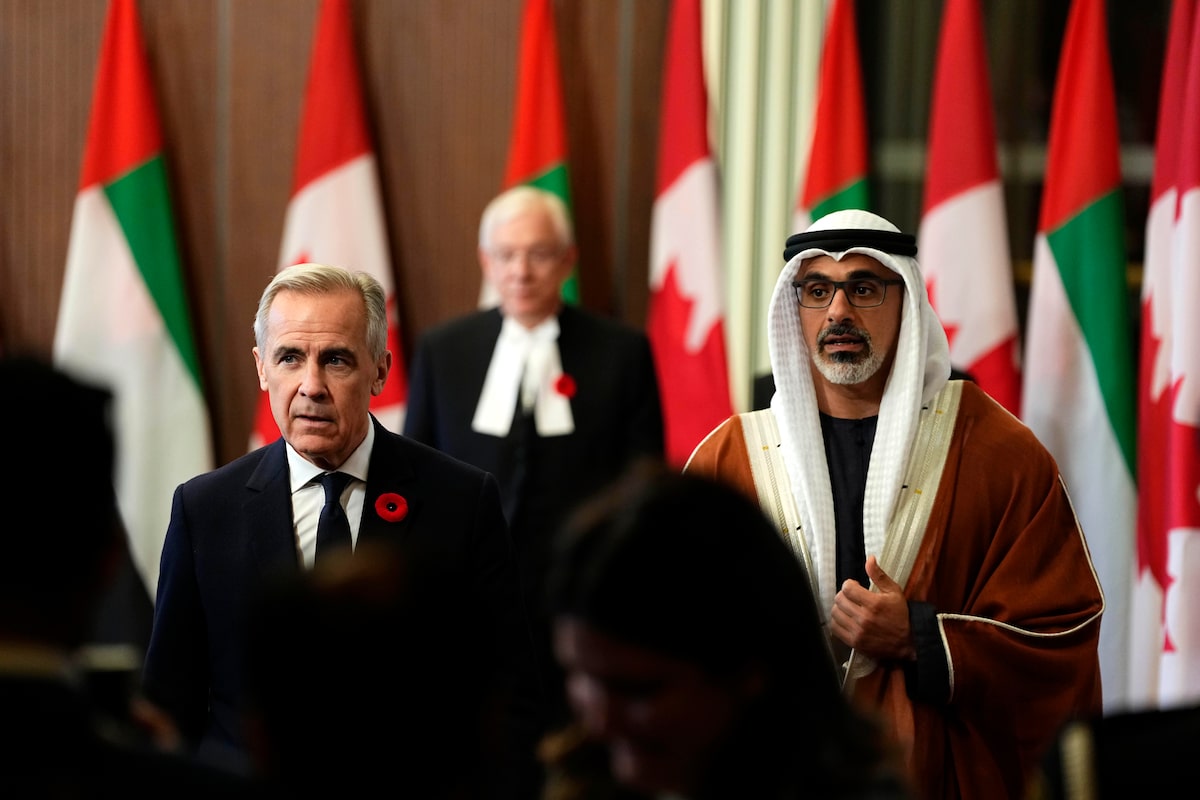
Prime Minister Mark Carney signed a free-trade agreement and defence co-operation pact Tuesday with the United Arab Emirates, and agreed to launch negotiations on an extradition treaty with the Gulf state’s government, one that human-rights groups have accused of jailing dissidents.
An extradition treaty would make the UAE a formal extradition partner. That would give it the ability to ask Canada to hand over people who are wanted in the UAE for conduct considered crimes in both countries.
The Prime Minister, seeking foreign capital as he works to reduce economic reliance on the increasingly protectionist United States, is counting on the UAE to deliver on a pledge made last fall to invest $70-billion in Canada. Ottawa has not clarified over what time period this money will flow into the country.
Crown Prince Sheikh Khaled bin Mohamed bin Zayed Al Nahyan, the son of the UAE president, and other senior Emirati officials were in Ottawa for a two-day visit this week that included a Monday evening dinner hosted by Mr. Carney and attended by Canadian business leaders.
Neither Mr. Carney nor Sheikh Khaled took questions from the media Tuesday as various pacts were signed. The trade deal had been concluded in July.
Canada and UAE sign free trade deal, signal investment deals in energy sector ‘very soon’
Mr. Carney announced a new strategic partnership with the UAE Tuesday, and his office said the defence pact would pave the way for joint exercises, defence industrial co-operation, information exchanges, and co-operation in cybersecurity and military education and training. Canada and the UAE said they would create a “Joint Military Committee” to guide this collaboration.
Civil liberties watchdog Freedom House rates the UAE 18/100 on its freedom index, noting “limited elections are held for a federal advisory body, but political parties are banned, and all executive, legislative, and judicial authority ultimately rests with the seven hereditary rulers.” The civil liberties of both citizens and non-citizens, “who make up an overwhelming majority of the population, are subject to significant restrictions.”
The defence co-operation agreement is already sparking criticism from human-rights activists and Sudan support groups. Many human-rights advocates and other analysts have alleged that the UAE is the main weapons supplier to Sudan’s paramilitary Rapid Support Forces, which have perpetrated massacres and other atrocities in the Darfur region.
The UAE has repeatedly denied that it supports the RSF militia, but United Nations investigators have found that military equipment and mercenaries were sent to the RSF on cargo flights from airports in the Gulf state. One UN report found that the mercenaries were trained and financed in the UAE. Weapons from UAE-based manufacturers have often been documented in the RSF arsenal in Sudan.
UN investigators find evidence of UAE links to Sudan war
“Such serious allegations cannot be sidelined as Canada pursues a closer partnership with Abu Dhabi,” the Montreal-based Raoul Wallenberg Centre for Human Rights said in a statement this week. “Canada must confront this record directly.”
Paul Champ, an Ottawa-based lawyer who often represents Canadians imprisoned abroad, said it was deeply troubling to hear Canada has agreed to begin negotiations on an extradition treaty with the UAE, a country he said is regularly criticized by the United Nations and human-rights groups for its record.
“The UAE craves legitimacy in the West but the reality is that it is not a democracy and does not have the same respect for due process, human rights and the rule of law,” Mr. Champ said in an interview Tuesday. “Signing an extradition treaty would send the wrong message to the UAE as it suggests Canada is comfortable with the UAE’s human-rights record.”
“Canada’s extradition laws allows Canada to negotiate extraditions on a case-by-case basis with any country in the world. There should be some hard questions for the Carney government about why they view this as a wise agreement,” Mr. Champ said.
He said it appears the UAE is on a campaign to sign extradition treaties with Western governments, noting Belgium, Sweden, Ireland and Netherlands all signed extradition treaties with Gulf country in the last couple of years.
Senior Carney aide Angad Singh Dhillon appointed Canada’s next UAE ambassador
If a treaty were concluded, a UAE extradition request would go before a Canadian judge, who would have to be satisfied there is enough evidence that the person would face trial had the alleged crime happened in Canada. The justice minister would then personally decide on whether to surrender the person to the UAE, and the person could appeal both decisions to the provincial court of appeal.
Mr. Carney’s office said the new Canada-UAE trade deal is expected to enter into force in 2027. It said the agreement will reduce or eliminate tariffs on more than 99 per cent of existing Canadian exports to the Gulf country.
That means new markets for Canadian farmers growing pulses and canola, manufacturers of industrial machinery and power generation equipment, the aerospace sector, and other industries, the Prime Minister’s Office said.
“The agreement will also address non-tariff barriers, create a more predictable environment for trade and investment, and expand market access for Canadian goods and services, including in the industrial, agricultural, forest, fish and seafood, environmental, and engineering sectors,” the PMO said.
Dubai ports giant DP World signs memorandum of understanding to help develop Port of Churchill
In 2025, Canada’s two-way merchandise trade with the UAE was $3.5-billion, with $2.8-billion in exports and $679.1-million in imports, the government said.
The Prime Minister’s Office pointed to three UAE investments in Canada as evidence that the Gulf country is delivering on its $70-billion promise, noting that Dubai-based port operator DP World Ltd. has signed a memorandum of understanding with the owner of Manitoba’s Port of Churchill to explore further development of an expanded northern shipping corridor that could include container traffic. The PMO also noted a new energy co-operation agreement between state-owned Abu Dhabi Future Energy Company and Natural Resources Canada, “establishing a cooperation framework in the energy sector,” as well as an agreement between Invest in Canada, the federal investment promotion agency, and the Abu Dhabi Chamber of Commerce and Industry to facilitate business connections and visits.
The PMO did not say how much investment commitment these three announcements comprise.
The Gulf region, with its trillions of investment capital, is one of several priority regions for Canada, along with Europe and Asia, as it seeks to diversify trade away from the increasingly unreliable U.S. under President Donald Trump, and attract foreign investment in energy, infrastructure, artificial intelligence and resources.
Mr. Carney visited the UAE in November, 2025, the first Canadian prime minister to visit the Emirates in more than 40 years.
PM office canada
Von der Leyen’s Canada ‘associate membership’ spurs battle of words with EU capitals
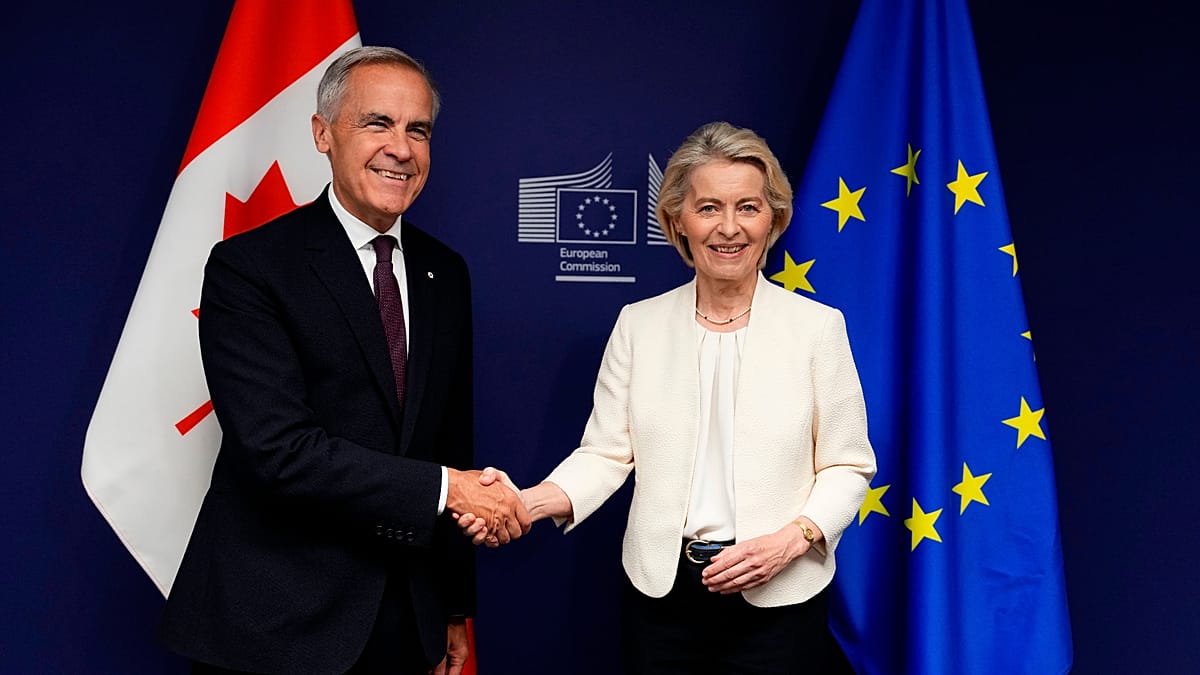
Last month, European Commission President Ursula von der Leyen made a bombshell offer to Canada: to become the first EU “associate member”. Now the term is proving hard to swallow for several member states, including her own Germany.
Ahead of the EU-Canada summit, meant to chart what many see as the closest partnership between the bloc and a non-member country, European capitals led by Berlin have pushed back against a term that has yet to be clearly defined, five EU diplomats told Euronews.
“The main concern is that this is unknown terminology, it might bring up legal uncertainty and expectations from other third countries,” one of the diplomats said. “This was not communicated previously from the Commission. We don’t know what we are talking about.”
Last week, a revised draft of the joint declaration explicitly mentioned the notion, vowing regular exchanges with Canadian authorities on major policy and regulatory initiatives and to define the full scope of the partnership at the 2027 summit.
Naming the term outright in what would be the first EU official document of major political significance to include it has drawn strong pushback from Germany, Italy and Greece, and scepticism from other countries, including France.
A new draft circulated on Monday evening added wording that distanced member states from the concept, specifying that it was “put forward by the European Commission”.
The text was due to be adopted on Tuesday through the so-called silent procedure, under which a document passes unless a member state objects. Germany, Italy, France and Greece all raised objections before the deadline.
The office of European Council President António Costa is now expected to circulate a new version, with another round of talks at ambassador level on Wednesday, before the summit opens in Montreal on Thursday.
Von der Leyen floated the idea of offering associate membership to Canada in her annual State of the Union speech to the European Parliament in September, with Prime Minister Mark Carney as guest of honour.
The idea had been put to the Canadians before, but it was never discussed with member states or within the Commission, catching capitals including Paris and Berlin off guard.
Even Carney did not seem fully sold on the nomenclature, preferring to call it an “alliance of the future”. “What matters is the substance,” he said when asked whether he was comfortable with the term.
With governments now finalising the joint declaration, to be adopted at the summit on Thursday and Friday, that initial lack of consultation is coming back to haunt the bid.
For Berlin, the main issue is that member states should first define what the cooperation package contains, and only then agree the terms for the declaration, not the other way around.
There is broad consensus on seeking closer cooperation with Canada in areas such as defence, critical raw materials, energy, trade and border security. It is the associate membership label that has drawn scrutiny.
Others took aim at its legal implications, arguing these must be carefully studied before the term enters a political declaration.
“It does not mean anything, it is not in the treaties,” a second EU diplomat said, adding that “we want to find a way to make the concept work.”
Von der Leyen is not new to launching new ideas and forging ahead with initiatives without consulting with the member states. In 2023, she announced a migration deal with Tunisia and was criticised for lacking a formal mandate to do so.
“In the case of Tunisia, member states fully agreed with the objective of reducing arrivals, but they had to say that they did not 100% agree with the way it was done. It is a bit the same case here,” a third diplomat told Euronews.
For this diplomat, the EU should not view the label as merely institutional, but as a way of packaging what would otherwise inevitably look like a sector-by-sector technical exercise in bringing Canada closer to the bloc.
For von der Leyen’s critics, she has a habit of making grand announcements before figuring out the implications. For her supporters, her strength is staying ahead of the curve, setting out a political vision and letting the bureaucratic machinery do the rest.
German Chancellor Friedrich Merz was the first to propose associate membership, but pitched it as a way to anchor Ukraine to the EU, with security guarantees, as Kyiv progressed through the accession process.
Applying it to Canada carries a very different connotation: it would offer a blueprint for the closest possible partnership with a non-European country that could never join the bloc.
“A lot of other countries want to come closer to the EU, but we don’t know what to offer them. Whatever deal we reach with Canada might be an important motivator for others,” an EU official told Euronews.
This story was updated with additional information.
PM office canada
Business leaders and Emirati officials on guest list for Carney’s dinner with Abu Dhabi Crown Prince
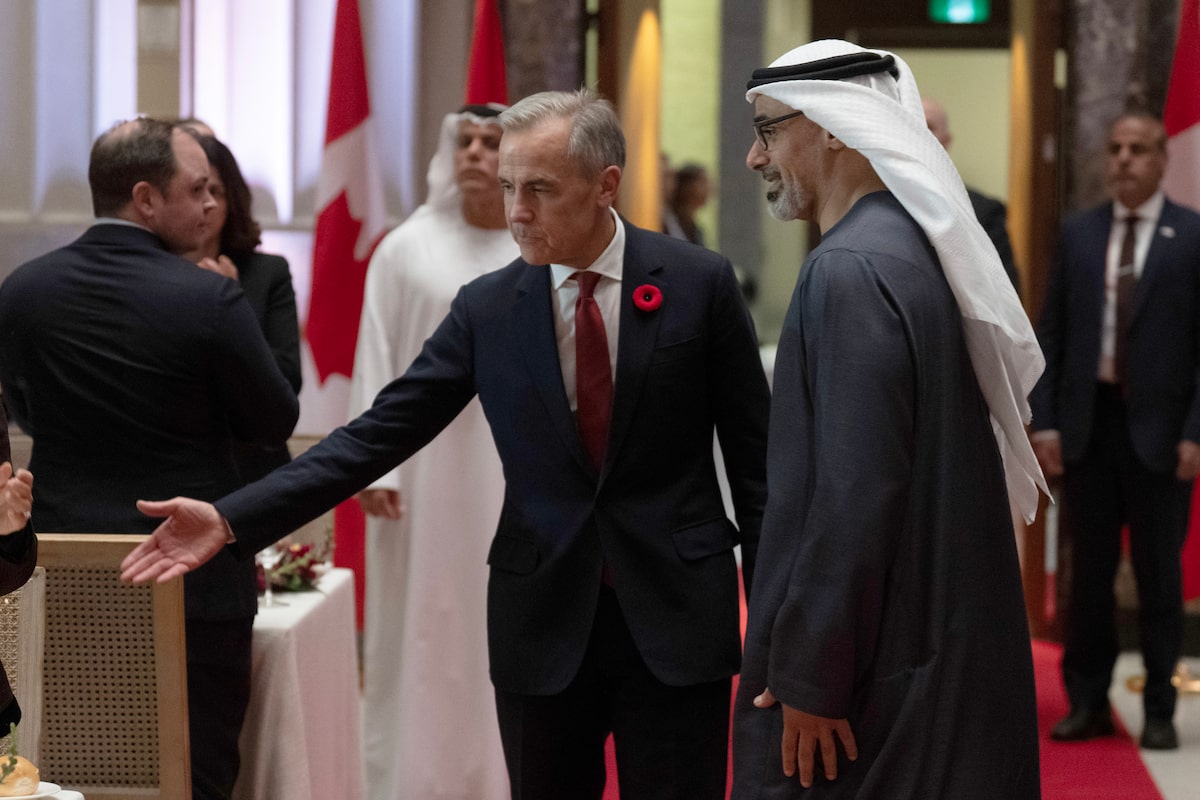
Prime Minister Mark Carney, who is courting wealthy Gulf investors, hosted a dinner in Ottawa on Monday for Crown Prince Sheikh Khaled bin Mohamed bin Zayed Al Nahyan of Abu Dhabi, the oil-rich heart of the United Arab Emirates.
A guest list of nearly 120 names obtained by The Globe and Mail shows many in Canada’s corporate elite were invited to dine with Sheikh Khaled and senior members of Abu Dhabi’s ruling circle.
The dinner capped the first day of a two-day visit to Canada by the Crown Prince, whose father is the president of the UAE.
Canada and UAE sign free trade deal, signal investment deals in energy sector ‘very soon’
The blossoming relationship between Canada and the UAE has included the inking of a free trade agreement in July and an investment protection treaty that went into force in May. Mr. Carney came back from a visit to the country last fall touting a UAE commitment to invest $70-billion in Canada.
Ottawa is deepening ties with the UAE and other foreign trade partners as part of a push by the Prime Minister to lessen Canada’s economic reliance on the United States.
One of the most prominent invitees to the dinner was former prime minister Stephen Harper. The list leaned toward companies and investors with stakes in defence and security, energy, critical minerals, infrastructure, international development, space, advanced communications, quantum computing and artificial intelligence – all areas in which the Prime Minister’s Office has said the two countries will expand relations.
Senior Carney aide Angad Singh Dhillon appointed Canada’s next UAE ambassador
The invitees also included lawyers, consultants and lobbyists representing business interests in Ottawa, as well as provincial representatives, hospital and university leaders, museum administrators and representatives of Indigenous communities.
Members of the Desmarais family, long synonymous with Power Corporation of Canada, were on the list. André Desmarais, deputy chairman of Power Corporation of Canada, and Paul Desmarais III, a senior vice-president, were both listed, along with executives from Power Sustainable, a Power Corp. investment arm.
Also among the invitees were representatives of several large industrial companies, including Gregory Ebel, chief executive of Enbridge Inc.; Ian Edwards of engineering firm AtkinsRéalis; Alexandre L’Heureux of WSP Global; Kieran Hawe of construction company EllisDon; Bruce Power’s chief operating officer, James Scongack; and Eric Desaulniers, head of graphite developer Nouveau Monde Graphite.
Victor Dodig, recently appointed chief executive of Telus Corp., was also listed, as was Éric Martel, chief executive of Bombardier Inc.
Members of the tech industry were invited, including Joelle Pineau, chief AI officer at Cohere, and Valérie Pisano, chief executive of Mila.
Big investors and lenders were also on the list, including Deborah Orida, chief executive of PSP Investments; Alison Nankivell of Export Development Canada; and Geneviève Bouthillier, an executive vice-president at BDC Capital. So were government-relations heads from Ontario Teachers’ Pension Plan, HOOPP and Sun Life, and venture investor Chris Arsenault of Inovia. Gurinder Grewal, named chief executive of Invest in Canada on Aug. 31, was also on the list.
Many members of Mr. Carney’s inner circle were listed, including Marc-André Blanchard, his chief of staff; Michael Sabia, Clerk of the Privy Council; David Morrison, a senior diplomatic adviser; Scott Gilmore, principal secretary; and Jennifer MacIntyre, a deputy chief of staff. The ambassadors to the United States and the UAE, Mark Wiseman and Angad Dhillon, were also on the list. So was Sébastien Carrière, Global Affairs Canada’s chief of protocol.
Many of the Emiratis who were invited work for the Abu Dhabi Crown Prince’s Court. Sheikh Khalifa bin Tahnoon Al Nahyan, the court’s chairman, and Saif Ghobash, chairman of the Crown Prince’s Office and secretary-general of the Abu Dhabi Executive Council, were listed, as was Sultan Al Jaber, who is both the UAE’s minister of industry and advanced technology and chief executive of the Abu Dhabi National Oil Co.
Among the rest of the Emirati contingent on the list were representatives of DP World, a Dubai-based port operator that on Monday announced a memorandum of understanding with the owner of Manitoba’s Port of Churchill to explore further development of an expanded northern shipping corridor. Douglas Smith, chief executive officer of the company’s operations in Canada, was invited, as was Sultan bin Saeed Al Mansoori, chairman of Dubai Chambers, who also sits on DP World’s board.
The full list obtained by The Globe is below.
PM office canada
‘It’s time to abolish the Indian Act,’ Manitoba premier tells PM in historic meeting with chiefs
Manitoba Premier Wab Kinew says he’s calling on the federal government to abolish the Indian Act.
Kinew shared that request during a scrum in Ottawa on Monday, as First Nations leaders and Canada’s first ministers meet to discuss Indigenous rights for the first time in two decades.
“I don’t know how many folks in Canada have seen one of these before, but this is a status card, and it says your friend Wab Kinew is an Indian, within the meaning of the Indian Act,” he said, holding up his own card in front of reporters during a midday break in the historic meeting.
“I’m not sure if that lines up with your vision of Canada, that we still have a race-based form of identification in this country. But this is a reality.”
Kinew said he raised the issue with Prime Minister Mark Carney earlier Monday, calling it “long overdue that we have a relationship with Indigenous Peoples in Canada that reflects who we are as Canadians today.
“I think it’s time to abolish the Indian Act,” Kinew said. “And it needs to be done with First Nations people and First Nations governments.”
The controversial legislation has governed the lives of First Nations people for the last 150 years.
Coming into effect in 1876, the act came to control almost every aspect of First Nations people’s lives, dictating things like how communities were governed and who could be considered an “Indian.”
While the act has had many amendments, it remains the overarching legal document for First Nations in Canada.
‘Nothing to lose but your chains’
Carney and most of the premiers sat down with chiefs from the Assembly of First Nations in Ottawa for a discussion . Cindy Woodhouse Nepinak, the assembly’s national chief, said the meeting is intended to help build prosperity for coming generations.
Monday’s closed-door meeting is the first such gathering since the Kelowna Accord talks of 2005, which brought premiers and then-prime minister Paul Martin together with Indigenous leaders to discuss ways to close the socioeconomic gaps in Indigenous communities.
The Kelowna agreement was not implemented after the Conservative government under former prime minister Stephen Harper took office only a few months later.
Monday’s meeting comes as Carney’s government works to speed up major project approvals and development — efforts some First Nations chiefs have said threaten their rights.
Tensions between Ottawa and First Nations spiked soon after Carney was elected in 2025, when his government passed legislation to create a new office tasked with streamlining major project developments and approving projects within one year.
Kinew said he supports Carney’s work at the international level, “saying that we are going to be a leader when it comes to human rights and democracy, and a leader among middle powers.” But he called the Indian Act’s continued existence inconsistent with that message.
The premier said though doing away with the Indian Act would bring changes, things like treaties and constitutional rights would still be able to exist for First Nations people.
“You can have self-determination, and you can have strong Indigenous nationhood, while at the same time not having the paternalism and the barriers that come with the Indian Act,” Kinew said.
“You have nothing to lose but your chains.”


Ex-TLC Star Karen Derrico’s Ex Claims She’s Hanging with Man Who Inappropriately Touched Their Daughter
Former TLC star Deon Derrico claims his ex-wife, Karen Derrico, is hanging out with a man who crossed the line...
Canada facing carbon tariff threat from European Union: internal documents
Canada is facing a carbon tariff threat from the European Union within months as the economic bloc fully implements its...

US cruise ship ends global voyage due to fuel costs; 200 passengers lose their homes
PHNOM PENH, Cambodia — A U.S. cruise ship on a residential world voyage suspended its operations in Cambodia due to...


Heidi Fleiss’ Showdown With Nevada Officials Erupts Over Prized Parrots
Former Hollywood madam Heidi Fleiss is fighting Nevada officials in court over her precious parrots … TMZ has learned. Heidi...
Val Chmerkovskiy back on ‘DWTS,’ Carrie Ann Inaba compliments him
After a one-week suspension from “Dancing with the Stars,” pro dancer Val Chmerkovskiy returned to the ballroom Tuesday, Oct. 27,...


Tampa Bay comes back in the 12th inning to extend the World Series, holding off Brewers’ championship dreams
The Tampa Bay Rays gave the Milwaukee Brewers a dose of their own medicine in Game 4 to avoid getting...

Global stock markets rise as investors continue to bet on AI
Global stock markets have climbed as investors continue to bet on bright prospects for the tech giants driving the AI...


Anthony Edwards Needs Knee Surgery, Could Miss Two Months
9:38 pm: Edwards will have surgery on Thursday and the club will then have a clearer timeline for his recovery,...

Jessa Duggar Says She and Husband Ben Seewald Are Expecting Baby Number 7
NEED TO KNOW Jessa Duggar Seewald is “expecting again!” The TLC star and her husband Ben Seewald appeared on Wednesday’s...


might be huge waste of money: study
Time to shelve that standing desk. New research suggests ergonomic upgrades for the office — from specialized chairs, desks and...
-

 Business1 week ago
‘Black Monday’ fears intensify as prediction markets shrug off 2026 crash
-
Business2 weeks ago
Why BlackRock is suddenly more bearish on stocks
-
Business2 weeks ago
AI Agent Company Decagon Held Early M&A Talks With ServiceNow, Others
-

 Business2 weeks ago
Dow Jones Futures: Stock Market Holds Up As Meta, AMD Lead Buys; ASML, CPI Inflation Due
-

 Business2 weeks ago
CPI inflation report September 2026
-

 HealthNews2 weeks ago
Carefree panty liners face lawsuit over dangerous carcinogenic claim
-

 Food2 weeks ago
Wall Street Sees Inflation Easing Even With Oil Above $90
-

 Business2 weeks ago
Endeavor Health, Rush University System for Health to merge