

Business
Salesforce acquires AI customer service platform Fin for $3.6 billion

Salesforce announced on Monday that it will acquire AI customer service platform Fin for $3.6 billion. Formerly known as Intercom, Fin offers an AI agent that can resolve customer queries across channels, using live chat, WhatsApp, SMS, phone calls, Slack, and more.
Salesforce says it wants to use Fin’s team and technology to improve Agentforce, its existing enterprise platform that businesses can use to build custom AI agents that automate tasks.
“Fin brings proven agent technology, a deep commitment to customer success, and an incredible AI team that will complement Agentforce with powerful service agent capabilities,” said Salesforce CEO Marc Benioff in a statement. “Together, we’ll help companies of every size seize this opportunity — accelerating time to value with trusted agents that deliver measurable outcomes at scale.”
The transaction is expected to close in the last quarter of Salesforce’s 2027 fiscal year, which is actually slated for the first few months of 2027 because of how the company reports its financials.
“To our customers: Over the past few years we’ve been shipping intensely. Including recently our groundbreaking model, Apex, and our paradigm-defining internal agent, Operator,” wrote Fin co-founder and CEO Eoghan McCabe in an X post. “With the resources of Salesforce this will only accelerate. And yet little will practically change. I’ll still be CEO, Des will still be running R&D, we’ll both still be committed to continuing to lead this category. Thank you very sincerely and deeply for your belief in us.”
Business
Fox to buy streaming pioneer Roku in a $22 billion deal
Fox Corp. has agreed to buy the streaming pioneer Roku in a cash-and-stock deal valued at approximately $22 billion, including debt.
Roku will continue to be run as an open, partner-friendly platform, the companies said Monday, and there appears to be no immediate changes that customers will see. Fox and Roku said that the combined company will become the third-largest player in U.S. television by share of viewing.
Media reports had surfaced on Friday that Roku was looking at its strategic options, including a possible sale. Speculation was rampant as to which companies might be interested in an acquisition. Aside from Fox, names being tossed about as potential buyers included Netflix, Amazon, Comcast and Disney.
The deal will give Fox access to more than 100 million global households, along with the Roku channel and its first-party data. Fox oversees a massive sports, news and entertainment network, as well as Tubi, which it acquired in 2020.
Roku founder Anthony Wood had initially worked within Netflix in the early 2000s as that company attempted to make the seismic shift from renting DVDs, to streaming.
Roku was spun off by Netflix, however, and the company released its first set-top box in 2008.
Wood, who is Roku’s chairman and CEO, said his motivation in pursuing the technology was his desire to record and play his favorite show, “Star Trek.”
Fox Corp. CEO Lachlan Murdoch said in a statement that combining the businesses will bring together Fox’s live news and sports content with a streaming platform with large viewership. It will also give Fox more exposure to advertising and streaming subscriptions.
“The combination with FOX is an extraordinary opportunity to accelerate our vision, scale faster and innovate more aggressively for viewers, partners and advertisers,” Wood said in prepared remarks.
Wood will have an ongoing role at the company and will join the Fox board of directors after the transaction closes.
Murdoch said during a conference call that the combined company will be better positioned for the next decade of video than either company would’ve been alone.
“We are confident this is the right transaction, at the right moment, for all the right reasons,” he said.
Fox will pay $96 in cash and 0.9693 shares of its Class A common stock for each Roku Class A and Class B share outstanding. The transaction is valued at $160 per Roku share.
Existing Fox shareholders are expected to own approximately 73% of the combined company and Roku shareholders will own about 27%, once the deal closes.
The deal is expected to close in the first half of next year. It still needs approval from Fox and Roku shareholders and also regulatory approval.
Fox’s stock declined before the market open, while shares of Roku rose slightly.
Business
Cybersecurity vets protest ‘dangerous’ US government ban on Anthropic’s most powerful models


A group made up of dozens of cybersecurity experts, including several well-known veterans of the industry, published an open letter to the U.S. government asking it to lift the export control order on Anthropic’s Fable and Mythos models.
According to the open letter, “this action has taken the best models away from [cybersecurity] defenders” who now can’t use the models to find vulnerabilities and make their software and products more secure.
“To pull the best capabilities away from defenders without a good reason when our adversaries are rapidly advancing is dangerous,” read the letter.
On Friday, the U.S. government ordered Anthropic to limit the export of Fable and Mythos, citing national security concerns, without explaining the specific reasons behind the order, according to Anthropic. In response, the company suspended access to the models to all users worldwide.
As of this writing, the letter is signed by 76 cybersecurity experts, including Alex Stamos, former Facebook chief of security; Casey Ellis, the founder bug bounty platform Bugcrowd; Jon Callas, famed cryptographer and former Apple security design and architecture manager; Paul Vixie, computer scientist ; Dino Dai Zovi, the former head of applied security engineering at Block; Katie Moussouris, the founder of Luta Security; and Rachel Tobac, the CEO of the security awareness training firm SocialProof Security.
When Mythos launched as a preview in April, Anthropic claimed it was so powerful at finding security vulnerabilities that the company needed to tightly restrict access to prevent malicious hackers or foreign adversaries from using it to cause havoc on the internet. In practice, that meant Anthropic gave around 50 companies initial access to Mythos, recently expanding that group to include around 150 organizations in 15 countries.
Last week, Anthropic released Fable, a public version of Mythos that the company said had strict guardrails to block its use in the fields of biology, chemistry, and cybersecurity, as well as to stop others from distilling the model in order to re-create it. The guardrails on Fable were so strict that many cybersecurity experts found that it stopped essentially any prompts related to cybersecurity.
Anthropic said that the White House export control order may have been based on a report that there was a method to bypass — or jailbreak — Fable to unlock its powerful Mythos-level capabilities.
According to Katie Moussouris, one of the signatories of the open letter, the method was demonstrated by Amazon researchers in a paper that is not public but that she has reviewed.
But Moussouris said in a blog post that the paper did not actually demonstrate a real jailbreak. Instead, she wrote, the researchers simply asked Fable to fix open source code with public and known vulnerabilities along with “deliberately planted vulnerabilities,” after the model initially refused to “review the code for security issues.”
“The behavior described in the paper cannot meaningfully be fixed, and any attempt would only weaken the model for defense,” Moussouris wrote. “Defenders need to be able to ask AI to fix the bugs in a file, explain why the fix matters, and write tests that confirm the patch works. That is not a guardrail bypass. It is the most valuable thing an AI model can do for defensive security: executing the find, fix, and test loop defenders run every day.”
Moussouris’ critique was echoed in the open letter, which also said that the group of experts believe the model capabilities in the Amazon paper “can be replicated” on OpenAI’s GPT-5.5, on Anthropic’s own publicly available Claude Opus 4.8 and Sonnet, “and even Chinese models like Kimi 2.7.”
Moussouris told TechCrunch that “the bugs used to demonstrate the techniques in the paper can be found using the other models. The method in the paper is a guardrail bypass technique. Other models that lack the Fable guardrails often won’t refuse the straightforward request to look for security bugs, so they don’t need a bypass.”
The letter also asked for transparently and fairly enforced regulations created by “a democratic rule-making process” that are based on scientific research done by industry and academic experts, and “used only to the minimal extent necessary to ensure the safety of the American public.”
Business
SpaceX’s Stock Rises on First Full Day of Trading


SpaceX’s share price continued to rise on Monday, the company’s first full day of trading, adding to its sharp move higher on Friday after its record-breaking public listing.
Elon’s Musk’s rocket maker and artificial intelligence company rose about 6 percent in early trading on Monday. In a frenzied few hours of trading on Friday, the day of the company’s market debut, SpaceX rose nearly 20 percent.
The gain crowned Mr. Musk, 54, as the world’s first trillionaire and quelled jitters on Wall Street about whether investors would accept the company’s lofty valuation.
SpaceX’s initial public offering raised $75 billion at a valuation of $1.77 trillion, the largest I.P.O. on record. It has come to be seen as bellwether for other giant technology companies, namely Anthropic and OpenAI, seeking to go public this year.
After its latest gains, SpaceX was worth over $2.2 trillion in market value. Anthropic and OpenAI, which have developed foundational A.I. models and chatbots, are each expected to go public with valuations approaching $1 trillion.
SpaceX’s giant I.P.O. topped the previous record set by Saudi Aramco, Saudi Arabia’s state-owned oil company, that raised more than $29 billion when it went public in 2019.
Mr. Musk and SpaceX redefined the space industry with partly reusable rockets and a satellite internet service, Starlink. In February, SpaceX bought Mr. Musk’s A.I. company, xAI, which also owned the social media platform, X, in a sweeping move to consolidate his business empire. By merging the companies, Mr. Musk provided a financial lifeline to xAI, which has spent billions of dollars trying to catch up with its rivals.
SpaceX, which has contracts with NASA and other federal agencies, had long been something of a financial mystery and functioned, at times, as a kind of piggy bank for Mr. Musk since 2002, when the company was founded.
But last month, the company revealed a full picture of its finances for the first time in preparation of the market debut. It reported that it had lost more than $4.9 billion last year, compared with a $791 million profit in 2024, because of increased expenditures on A.I. Revenue was $18.7 billion last year, up 33 percent from the previous year.
Business
3,600 stock trades in 3 months: Breaking down Trump’s flurry of investment moves

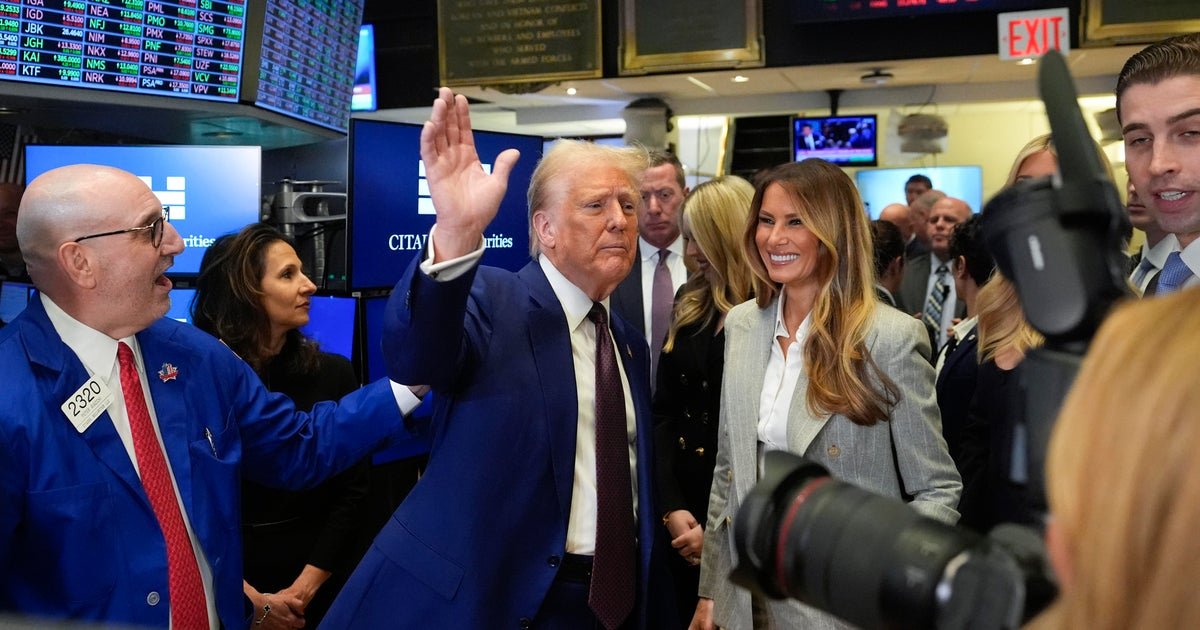
Washington — President Trump’s investment accounts traded between $212 million and $695 million in stocks and other securities over the first three months of the year — an unprecedented sum for a sitting president.
CBS News is presenting the data from the president’s most recent financial disclosure in a new interactive dashboard here. It shows that the president’s investment accounts made 2,346 purchases and 1,296 sales between Jan. 6 and March 30, 2026. The figures for individual transactions were presented in a range, which is reflected in the wide disparity between the minimum and maximum values of the trades overall.
The sheer volume of the trades, and the timing of certain transactions, has prompted ethics experts and Democrats in Congress to criticize the president for maintaining an active portfolio. Democratic Sen. Elizabeth Warren of Massachusetts has called for an investigation into “potential insider trading.” One investment professional, who reviewed the transactions at CBS News’ request, said the trades likely reflect a strategy by Mr. Trump’s money managers to reduce his tax bill. Another said he had “never seen a strategy out there that would warrant that amount of trading.”
The Trump Organization, meanwhile, said neither the president nor his family have any influence over his portfolio, which it said is managed by “independent third-party investment managers.”
Trump’s stock trades, by the numbers
CBS News extracted and organized the data from the scanned disclosure form, known as an OGE Form 278-T, to produce the fullest picture yet of the thousands of trades on the president’s behalf.
Federal officials, including the president, are required under the law to report any securities transactions worth more than $1,000 within 45 days to the Office of Government Ethics, which publishes the reports.
The president’s document, which he signed on May 8, includes 3,642 transactions across 1,026 individual firms and funds, with technology giants and popular exchange-traded funds topping the list of the most frequent and highest-volume transactions.
Microsoft, Amazon, Meta, Netflix, Oracle and AMD appeared most frequently in the document, with between 17 and 22 trades each:
The total value of stock purchases was between $126 million and $399 million. Sales totaled between $86 million and $296 million.
The most common transactions were trades valued at between $15,001 and $50,000, with 998 purchases and 393 sales falling in that range. The highest value range — $5,000,001 to $25 million — included four sales of Amazon, Meta, Microsoft and a Vanguard ETF.
The companies were sorted into 11 sectors using classifications from Yahoo Finance, plus separate categories for ETFs, funds and unclassified transactions. The data shows that technology firms were the most frequently bought-and-sold securities, followed by financial, consumer, industrial and healthcare companies. The transactions involving tech companies included at least $43 million in purchases and $24 million in sales:
The data reveals several spikes in trades in February and March. On Feb. 10, the president’s accounts sold large amounts of Microsoft, Amazon and Meta, with each transaction valued between $5,000,001 and $25,000,000.
Buying increased sharply in March. The accounts made 1,565 purchases in that month, compared to roughly 400 buys in each of the previous two months. On March 23 alone, the accounts made 283 purchases and 17 sales.
The disclosure represents the highest volume of stock trades on the president’s behalf since he took office last year. Previous disclosures showed that his investment accounts mainly bought and sold municipal and corporate bonds at a much slower pace. His January disclosure, for example, listed just 191 transactions over the last two months of 2025, compared with the 3,642 transactions in his May filing. (Another filing signed on May 8 also lists 69 other transactions, most of which appear to be bonds.)
Timing of trades
Some of the trades in the latest disclosure preceded policy moves by the administration or public statements about the companies by the president himself, prompting a flurry of headlines about the timing of certain trades shortly after the disclosure form was released in May.
For instance, the president’s financial managers bought between $500,001 and $1,000,000 of Nvidia stock on Jan. 6, 2026, the first of a total of 15 transactions — nine purchases and six sales — over the three months covered in the disclosure. The next week, the administration relaxed export controls on Nvidia’s highly prized AI chips, clearing the way for the company to sell them to China.
The president’s accounts also purchased hundreds of thousands of dollars worth of stock in Palantir, the defense contractor with extensive government business, over the course of March. On April 7, Mr. Trump praised the company in a post on Truth Social that included its stock ticker: “Palantir Technologies (PLTR) has proven to have great war fighting capabilities and equipment. Just ask our enemies!!! President DJT”
Mr. Trump’s accounts also bought stock in drugmaker Eli Lilly, and the timing coincided “with several favorable government decisions benefiting the drugmaker’s GLP-1 business,” according to KFF Health News. The data shows that Mr. Trump’s accounts bought as much as $730,000 in Eli Lilly stock over the first quarter.
Warren, the senator, pointed to the Nvidia trades and other transactions at a recent hearing on Capitol Hill, alleging that the president “is enriching himself by taking advantage of his position.” She pressed Treasury Secretary Scott Bessent to open an investigation.
Professional investment managers who reviewed the data for CBS News said the volume of trading makes it hard to discern whether any transactions were prompted by insider information. The data also shows that the accounts bought and sold stakes in Nvidia, Palantir and Eli Lilly at various times, beyond the instances that raised possible suspicions, making it harder to allege that certain transactions were prompted by insider trading.
David Salem, a portfolio manager at Hedgeye Asset Management in Cambridge, Massachusetts, said he believes the trades represent “classic tax-loss harvesting activity,” in which investment managers sell some securities at a loss to offset gains elsewhere. Salem said he believes the president’s advisers were pursuing a strategy of “direct indexing,” or buying and selling individual securities in a way that mimics the composition of large index funds.
“There are actually computers that can automate the whole thing for me. I can program these computers to buy and sell. I can sell and realize the loss, and I can also simultaneously sell something that’s up a lot and have the losses on the one that’s down offset the taxes that are from the stocks that are up,” Salem said.
Salem said the strategy can result in a smaller tax bill over time.
“The manager and managers, plural, who are doing this for Trump are probably doing it for tens of thousands of other customers. You can’t do this kind of direct indexing you see in the filing unless you have pretty sophisticated computers, and legal and tax gurus to figure all this out,” he said, adding that the strategy is “a service that is available only to high-net-worth or ultra-high-net-worth individuals.”
Salem said the spike in activity on March 23, the day with the most purchases, was an indication of the strategy.
“That happened to be the day that the major index providers, S&P 500 and FTSE, did their rebalancing,” he said. “If you were following an indexed approach where you were trying to hug a benchmark in a tax-sensitive manner, you would expect to see trades captured by that rebalancing, and we did. That’s prima facie proof of tax-loss harvesting.”
Salem said he saw no evidence of insider trading, but noted that he “can’t prove a negative.”
Eric Diton, who has spent the past 40 years as a financial adviser to high-net worth individuals, said he could not explain the volume of the trades.
“I can’t come up with a rationale for that amount of trading for anyone. Even if people were trying to pin him for … trading on information, you still wouldn’t trade thousands of times. There’s not enough information swirling to trade that many times,” said Diton, who is president and managing director of the firm the Wealth Alliance.
“It’s also tax inefficient. If the goal is maybe to create short-term losses, again, I have not seen a strategy that would warrant that kind of trading, ever,” he added. “I build my life on giving advice and giving explanation. I truly can’t explain it. It makes no sense to me. Maybe there is some sophisticated trade out there for tax purchases, I’ve never seen a strategy out there that would warrant that amount of trading. Thousands of trades in a quarter.”
Diton concluded: “I don’t think the president can sit there and day trade. To do thousands of trades in a quarter, that’s a full-time job and then some.”
The Trump Organization said in a statement that “[n]either President Trump, his family, nor The Trump Organization plays any role in selecting, directing, or approving specific investments.”
“They receive no advance notice of trading activity and provide no input regarding investment decisions or portfolio management,” the statement said. “This structure was intentionally designed to maintain a clear separation between President Trump and the independent third-party investment managers overseeing the accounts and avoid even the appearance of any conflict of interest.”
Ethics concerns
Stock trading by a sitting president is not illegal, and presidents are exempt from a key conflict of interest law that requires other federal officials to recuse themselves from matters that might affect their own finances.
But the sitting president having an active stake in certain companies has raised alarms among ethics experts and Democrats on Capitol Hill, who say the arrangement leaves the door open for corruption.
“The concern is he is in a position to make all kinds of decisions that can affect stock prices. Not even decisions — tweets. He gets on Truth Social and says a deal with Iran is near. That’s going to affect prices, and he then gets on the next day and says, ‘No, they’re being difficult. We have to bomb again,’ and that’s going to affect stock prices in a different way,” said Richard Briffault, a Columbia Law School professor who specializes in government ethics. “In the meantime, he could have bought or sold stocks that are affected by these decisions.”
Most presidents in the modern era have placed their assets in a blind trust before taking office, or limited their holdings to diversified funds. A blind trust prevents the beneficiaries from having insight into the day-to-day management of their money. The move is meant to avoid any conflicts of interest, or even the appearance of a conflict.
Mr. Trump declined to place his assets in a truly blind trust. His decision to have his investment accounts managed by advisers without those constraints means he likely has visibility into the transactions, Briffault said.
“He must know — or he could know — what his holdings are, and he could know how his actions and statements affect them,” he said. “One [concern] is you just have to trust them. There’s no independent monitor.”
In an exchange with Warren at a Senate hearing on June 3, Bessent, the treasury secretary, deflected calls for an investigation, saying that “President Trump is not sitting in the Oval Office engaging in a high-frequency trading strategy. Clearly, he had an outside manager who was doing that.”
But Warren pointed to the possibility that the president could be influencing the positions his advisers take.
“The investments that President Trump has made are not blind. President Trump literally signed the 113-page document publicly listing all of his individual stock trades at the same time that he is making decisions affecting those stocks,” Warren said at the hearing with Bessent.
The focus on banning active stock trading has mostly centered on allegations of insider trading by members of Congress in recent years, and there have been various proposals on Capitol Hill to outlaw trading by lawmakers. Some of those proposals would also ban trading by members of the executive branch and judiciary.
Sen. Andy Kim, a Democrat from New Jersey, has pointed to the trades to push his Restoring Trust in Public Servants Act, which would ban officials in all three branches of government from owning or trading stocks.
The HONEST Act, a bipartisan proposal in the Senate, would ban trading by members of Congress as well as the president and vice president. It would also require officials to divest their assets upon taking office for their next term. The bill advanced out of a Senate committee last year but has not made it to the floor in the GOP-controlled chamber.
The proposal was sponsored by Sen. Josh Hawley, a Republican from Missouri. The president singled Hawley out for criticism when he joined Democrats on the Senate Homeland Security Committee to advance the bill.
“I don’t think real Republicans want to see their President, who has had unprecedented success, TARGETED, because of the ‘whims’ of a second-tier Senator named Josh Hawley,” Mr. Trump wrote on Truth Social in July 2025.
Hawley reiterated his support for the legislation in comments to CBS News last week, while noting that he “would support anything that we can get passed and signed into law.”
“I’m supportive of any stock trading ban we could get. My legislation would not apply to this president or anybody currently in office. It would take effect for the executive branch in January of 2029,” Hawley said. “But, you know, I’ve long been a proponent of banning stock trading, and we should start with members of Congress.”
Gabriella Biello, Maria Sullivan, Arden Farhi, Melissa Quinn and Kaia Hubbard contributed to this report.
Business
SpaceX shares rise after Musk predicts $1 trillion in yearly revenue


SpaceX shares rise after Musk predicts $1 trillion in yearly revenue
Jun 15, 2026, 8:53 AM ETSpace Exploration Technologies Corp. (SPCX) StockBy : Rob Williams, SA News Editor
Comments
(59)
SpaceX (SPCX) shares rose about 6% in premarket trading Monday after Chief Executive Elon Musk outlined an extraordinarily ambitious revenue target that would require the company to expand at a pace far beyond current Wall Street expectations.
In
Newsletters for Every Investor
Get daily, sector-specific newsletters packed with expert insights, fresh ideas, and new opportunities.
Subscribe to Newsletters




Why is the UK banning social media for children? | BBC Newscast
Today, the prime minister has announced under-16s will be banned from social media. Speaking at Downing Street Keir Starmer …


'Volnado' spotted during Kīlauea eruption in Hawaii
A "volando" was seen swirling next to lava fountains during the Kilauea volcano's latest eruption on Hawaii's Big Island.


Fan bikes 1,200 miles to watch Japan play World Cup game
Yuto, a 22-year-old student from Japan studying in the US, decided to bike his way from Pittsburgh to Dallas to...


Iranian-Americans face complicated World Cup
CNN's Julia Vargas Jones spoke with players on Arya FC, a Los Angeles-based mostly Iranian rec league soccer team, about...


G7 'family photo' moment
G7 leaders participate in an official greeting and 'family photo' to start the annual summit. The meeting at the French...


'No f**king judgment': Trump blasts Netanyahu for Lebanon strike
President Donald Trump was enraged with Israeli Prime Minister Benjamin Netanyahu for striking Beirut hours before the …


Trump says Strait of Hormuz will be 'completely opened' Friday
While President Donald Trump was meeting with French President Emmanuel Macron, he said the Strait of Hormuz would be …


"I never thought this day would come", students finish GCSEs. #GCSE #Exams #BBCNews


West Wilson Not Returning to ‘Summer House’ Next Season
West Wilson’s run on “Summer House” is coming to an end … ’cause TMZ has learned he won’t be returning...


White House refuses to condemn UFC fighter who smeared Michelle Obama
UFC fighter Josh Hokit insulted former first lady Michelle Obama at Sunday's UFC Freedom 250 event. When asked about Hokit's...
-

 LifestyleNews2 weeks ago
120 minutes of strength training per week may help extend lifespan
-

 Business2 days ago
How much of Musk’s wealth comes from government help? Virtually all of it
-

 Politics4 days ago
What to know about the stabbing that set off fiery riots in Northern Ireland
-

 Video3 days ago
Download fans say what they love about the festival. #DownloadFestival #BBCNews
-

 Video3 days ago
Why SpaceX IPO isn't about space. #SpaceX #ElonMusk #BBCNews
-

 HealthNews3 days ago
The people of Okinawa, Japan only eat until they are about 80 percent full, then stop — and the practice has been linked in multiple peer-reviewed studies to lower rates of cardiovascular disease, slo
-

 TravelNews3 days ago
My Paternal Instinct Should’ve Warned Me About Netflix’s Maternal Instinct
-

 Food3 days ago
Pope Leo’s plane was grounded. Then the King of Spain stepped in to help