
Politics
Higher prices could last for eight months after Iran war, minister says

Higher prices could last for eight months after Iran war, minister says
 BBC
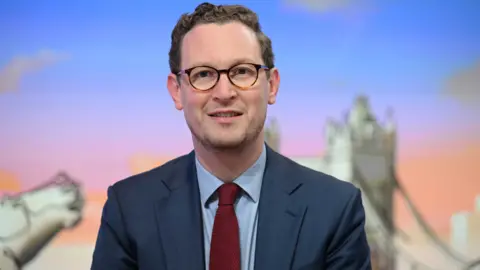
BBCPeople in the UK could face higher energy, food, and flight ticket prices for at least eight months after the end of the US-Israel war with Iran, a senior minister has said.
Darren Jones, Chief Secretary to the Prime Minister, told the BBC the government was “looking at all of those things” as it steps up plans to offset potential food and fuel shortages caused by the war.
Energy production and transportation across the Middle East has slowed or stopped entirely due to the conflict, causing supply chain issues and price rises globally.
Earlier this month, government officials drew up a worst case scenario of food shortages by the summer, including chicken and pork, should the war continue.
The government has also been seeking to calm the public, urging drivers to keep filling up with petrol and using cars as usual and not to change their travel plans amid fears over potential jet fuel shortages.
Speaking on the BBC’s Sunday with Laura Kuenssberg, Jones said he was looking at the economic impact of the war “very closely”, but said that “price pressure” was more likely than gaps on supermarket shelves.
“Our best guess is eight plus months from the point of resolution that you’ll see economic impacts coming through the system,” he said.
“So people will see higher energy prices, food prices […] flight ticket prices as a consequence of what Donald Trump has done in the Middle East.”
Prime Minister Sir Keir Starmer will chair another meeting of a Cabinet committee on Tuesday set up to deal with any shortfalls, while a group of ministers is meeting twice a week to monitor stock levels and any disruptions to the supply chain.
Twice weekly meetings of the contingency planning group of ministers are being led by Jones.
He has previously said:”This is not our war. The government made the right call to stay out of the conflict and only take defensive action to protect Britain’s interests.
“We’re acting now to prepare for, and mitigate where possible, the impact on our economy and domestic security as a result of the conflict.”
Last week, the International Monetary Fund (IMF) predicted the energy shock from the war would hit the UK the hardest of the world’s advanced economies, and cut its estimate for UK growth this year from to 0.8% from its previous prediction of 1.3%.
Jones has previously said that while the government would do everything in its power to find a permanent solution to the crisis and offset its impact, “what happens abroad will still affect us here at home”.
A government source previously told the BBC it was planning for a scenario which would involve breakdowns in the supply of carbon dioxide (CO2), which is used in the slaughter of some animals and in food preservation, should the strait remain closed.
The government has provided funding to reactivate the Ensus bioethanol plant, which makes CO2 as a by-product, in order to shore up supplies of the gas.
A spokesperson for the plant told the BBC they were “confident we can continue to produce CO2 for the country’s needs for the foreseeable future”.
Jones told the BBC on Sunday he had raised the issue of UK pubs potentially running out of draught beer during the Men’s Football World Cup in the summer due to a shortage of CO2.
“We are doing everything we can to make sure that is not the case,” he said.
The majority of the UK’s CO2 is imported from Europe but it is often produced as a by-product when companies make fertiliser, which needs natural gas.
 Getty Images
Supermarkets have said they are working with the government to help plan for a worst-case scenario.
And, last month, the National Farmers’ Union said cucumber and tomato prices could rise over the next six weeks, with the cost of other crops and milk increasing in the next three to six months.
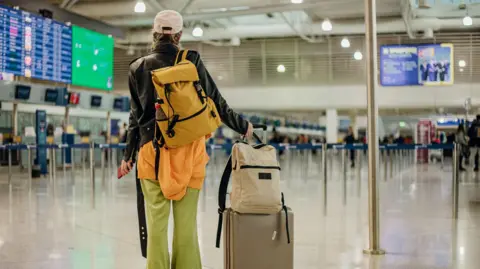
UK airlines have insisted they are “not currently seeing a shortage of jet fuel” as they buy it in advance and airports maintain stocks.
The Liberal Democrats have urged the government to include a bill in the next King’s Speech which puts food security at the top of the government’s agenda.
The party’s Cabinet Office spokeswoman Lisa Smart said “the government also needs to wake up and provide more support to people who simply cannot afford the sky-high cost of getting around”.
She added that the Lib Dems have proposed a 10p cut on fuel duty as well as reducing public transport costs.
Iran’s top negotiator said earlier this week that reopening the Strait of Hormuz was “impossible” if the US continues its naval blockade of Iranian ports.
US President Donald Trump hopes to put pressure on Iran by targeting two economic drivers – the tolls the country was demanding ships pay to pass through the Strait of Hormuz, and Iran’s oil revenue.
Iran has responded by calling the blockade “piracy”. Negotiators from the country were in Islamabad, Pakistan, on Saturday for talks on ending the conflict.

Politics
King will have ‘appropriate security’ for US trip, minister says
King will have ‘appropriate security’ for US trip, minister says
 Getty Images
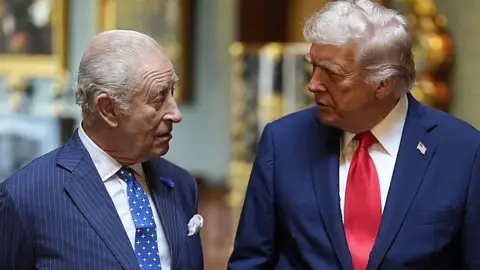
King Charles III’s state visit to the US will have “appropriate security in place in relation to the risk”, a minister told the BBC after shots were fired at the White House Correspondents’ Dinner in Washington.
Chief Secretary to the Prime Minister Darren Jones said the government and Buckingham Palace had been in “close co-operation” with US officials before the trip, which begins on Monday.
“Further discussions will be taking place today ahead of next week,” Jones told BBC One’s Sunday with Laura Kuenssberg programme.
US President Donald Trump and First Lady Melania Trump were evacuated from the dinner in Washington DC on Saturday night after a man rushed past a checkpoint and shots were fired.
Speaking later on the same programme as Jones, shadow home secretary Chris Philp said it was “vital” to ensure the King is properly protected and urged US and UK teams to review the monarch’s security overnight.
He said security arrangements on such visits were ordinarily very tight but they should be reviewed afresh “to make sure there are no loopholes at all”.
But Philp said the trip should “absolutely go ahead” as violence should not be allowed to stop diplomatic relations and politics from continuing as normal.
Videos from the event at showed US Vice-President JD Vance and Trump being evacuated off the stage by armed officers.
Trump later told reporters that one Secret Service agent was shot at very close range, but was saved by his bullet-proof vest.
The Secret Service, which protects the president and other key officials, confirmed no one else had been injured and said one person had been taken into custody.
The 31-year-old suspect is from Torrance in the Los Angeles region, California, police said.
Sir Keir Starmer wrote on X that he was shocked by the incident said it was a relief everyone attending the event, including Trump and the first lady Melania, was safe.
“Any attack on democratic institutions or on the freedom of the press must be condemned in the strongest possible terms” the prime minister added.
Liberal Democrat leader Sir Ed Davey likewise condemned the “really shocking scenes”.
He wrote on X: “Political violence is wrong. We must all condemn this attack and be thankful no lives were lost.”
King Charles III and Queen Camilla will be hosted by the president on the four-day trip – the first UK state visit to the US since Elizabeth II’s in 2007.
The King is expected to address both houses of Congress, visit the 9/11 memorial in New York, and attend a wreath laying to honour fallen US and UK soldiers in Virginia.
Broadcaster and historian Jonathan Dimbleby, who is a close friend of the King, told the BBC the trip should be postponed because of the “uncertainty of the president” – whom he said had “systematically mocked” the UK.
“Sound judgement is to deploy that asset, that soft power, at the right time,” he told BBC Radio 4’s Broadcasting House. “I think this is not the right time.”
“The problem is the uncertainty of the president… he will be very effusive about the King, the Royal Family, as he always is, one day. Next day, he rubbishes the prime minister, he goes back again into the feebleness, as he sees it, of the British Navy.”
Politics
Starmer insists ‘majority’ of Labour MPs back his leadership

Starmer insists ‘majority’ of Labour MPs back his leadership
 Reuters
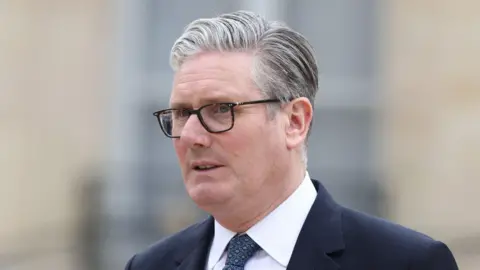
Prime Minister Sir Keir Stamer has insisted the “vast majority” of Labour MPs support him and want him to continue doing his job as prime minister.
He was speaking to the Sunday Times at the end of a week in which speculation has grown that the possibility of him facing a challenge to his leadership from within his own party was rising.
Sir Keir told the paper “in politics, you get this sort of thing all of the time, there is always talk”.
Conservative shadow home secretary Chris Philp said the prime minister should resign over his decision to appoint Lord Mandelson as the UK’s ambassador to the US, adding that if he didn’t step down Labour MPs should “develop a backbone and get rid of him”.
Speaking to the BBC’s Sunday with Laura Kuenssberg programme, Philp said some ministers were “equivocating” over Sir Keir’s future and a couple of MPs were publicly calling on him to go.
He said it was in “the national interest” for MPs to remove the prime minister.
In his interview with the Sunday Times, Sir Keir said “what you never hear from are all the people who are supportive, loyal and just want to get on with the job. And that is the vast majority of people in the Parliamentary Labour Party.”
“They’re pleased to be in power,” said Sir Keir, speaking about what he said was most Labour MPs.
“They’ve waited a long time to be in power. And they just want to get on with their job. They don’t make a lot of noise about it. They don’t talk to journalists about it. It’s really important that is reflected in these debates.”
The prime minister has faced calls from across opposition parties to resign, and criticism from within his own party, after it emerged that UK security officials had flagged concerns about giving vetting clearance to Lord Mandelson.
Sir Keir told MPs this week that the security officials had recommended against vetting approval being granted but that had not been passed on to him.
Speaking to the Sunday Times he said he did not regret his decision last week to sack the most senior civil servant in the Foreign Office, Sir Olly Robbins, who had not informed him about the security vetting concerns.
“When there’s a double red flag not to give clearance and [showing] high concern, then I’m sorry. I’m sorry. But I do not accept the argument that that is something which should not be told to the prime minister,” Sir Keir said.
Sir Olly Robbins told MPs this week that he had not been told that there was a recommendation to deny Lord Mandelson security clearance, only that officials were “leaning against” it. Sir Olly decided to approve the vetting subject to mitigation being put in place.
Sir Keir dismissed the suggestion he should have done more to inquire about the outcome of Lord Mandelson’s vetting process.
“When I’m told there’s security clearance, should I go back and quiz officials and say, ‘Are you telling me the truth?'”
“If I questioned every bit of information put in front of me I would never get anything done. The number of decisions that have to be made each day is huge.”
The prime minister told the paper he wanted to focus on the wars in Ukraine and Iran rather than speculation about possible challenges to his leadership, as the implications for the UK of those conflicts was the most important issue facing the country.
“This is the urgent issue of our time,” Sir Keir told the paper, “this is going to reshape our country.”
“The conflict with Iran has not just been fought out in Iran. There are increasingly the use of proxies in this country. Of course there’s lots of discussion in parliament about who’s up, who’s down and all the rest of it. But this is the serious work of being the prime minister.”
Darren Jones, the chief secretary to the prime minister, told the BBC the government had “nothing to hide” over the appointment of Lord Mandelson and added it was “frustrating that so much time is being spent on this”.
He said the upcoming elections in May were “going to be difficult” for Labour and that the “latest round of issues has made this slightly harder”.
However, he said that, during his time campaigning, “not one person” had raised the subject of Lord Mandelson.
Politics
Key figure in Mandelson vetting row will not give evidence before MPs

Key figure in Mandelson vetting row will not give evidence before MPs
 PA Media
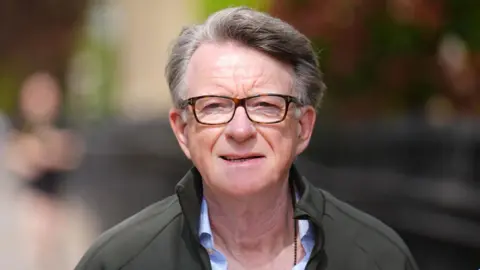
A key figure in the row over Lord Mandelson’s vetting will not appear before a parliamentary committee of MPs to give evidence.
The Foreign Affairs Committee had asked the Foreign Office if Ian Collard, a civil servant who ran the security team within the department, could attend next week.
But the committee’s chair Dame Emily Thornberry said the department made the “decision to decline” the request and Collard will only be giving evidence in writing.
She added, on X: “To be clear, I am satisfied by the reasons behind Ian Collard not giving oral evidence.
“If we have further questions, we will consider at that point whether we need to ask him to give evidence orally, or whether a further written statement is sufficient”.
Collard was the official who briefed the then-Foreign Office boss Sir Olly Robbins about UK Security Vetting’s (UKSV) recommendation not to give clearance to Mandelson.
Sir Olly was sacked last week after it emerged that he had granted clearance against the recommendation and had not informed No 10.
The government says UKSV gave an explicit recommendation to the Foreign Office not to approve vetting for Lord Mandelson ahead of his confirmation as ambassador to the US.
But speaking to MPs on Parliament’s Foreign Affairs Committee this week, Sir Olly said he had never seen that explicit recommendation and only received a verbal briefing which described UKSV’s view as “borderline” and “leaning towards recommending that clearance be denied”.
The government is investigating whether Sir Olly was given the correct information before he approved security clearance for the peer.
Sir Adrian Fulford, a retired judge, is conducting a review into the process and it is understood he will look at whether the briefing given by Collard correctly summed up the vetting team’s view.
That information could be crucial to determine whether Sir Keir Starmer was right to sack Sir Olly last week.
In a letter to the interim Foreign Office boss, Dame Emily set out some questions for Collard to answer in writing, including: “How often did his team make a different recommendation on vetting to that contained in the UKSV report?”
The Foreign Office has not commented on Collard not appearing in front of the committee.
Sir Keir’s former chief of staff Morgan McSweeney will give evidence to the committee on Tuesday.
McSweeney, who advised the prime minister to appoint Lord Mandelson as the UK’s ambassador to the US, is likely to face questions about whether he put pressure on civil servants to speed up the vetting.
It comes after Sir Olly accused No 10 of a “dismissive” attitude towards the process – a claim Downing Street has denied.
The row over Lord Mandelson’s vetting has reignited questions among Labour MPs about Sir Keir’s judgement and leadership.
In an interview with the Sunday Times, Sir Keir said Sir Olly faced only the “everyday pressure of government” during the process.
“There are different types of pressure,” he said. “There’s pressure, ‘Can we get this done quickly,’ which is not an unusual pressure.”
And asked whether he regretted sacking Sir Olly so quickly, Sir Keir said: “I do not accept the argument that that is something which should not be told to the prime minister.”
Politics
Relish and dread as Starmer ‘shambles’ hangs over Scotland and Wales elections

Relish and dread as Starmer ‘shambles’ hangs over Scotland and Wales elections

 BBC
BBC“We’re living the dream,” a minister jokes.
Labour might have to rely on black humour over the next couple of weeks.
Each day brings a vast set of elections closer – local tests in England, and national ballots in Wales and Scotland – votes that another cabinet minister frets “will be a disaster”.
We’ve been travelling around Wales this week, and Scotland last week, talking to the politicians vying for power, and the most important people of all – the public who’ll make the choice on 7 May.
Just when Labour needs to be going hammer and tongs in a campaign, instead, almost every day brings fresh embarrassment to the prime minister over his decision to give Lord Mandelson one of the finest jobs in the land – our man in Washington.
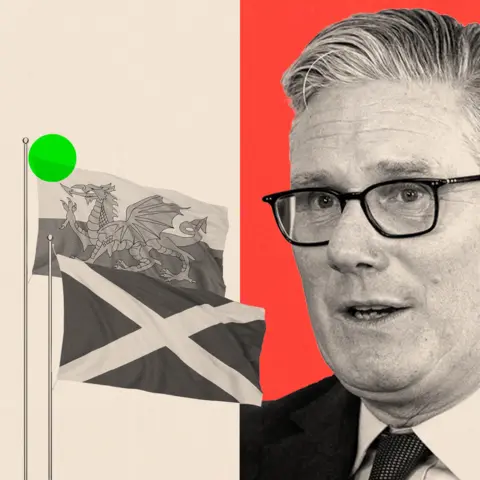
Ructions in Whitehall. Rancour in Labour. A sense the government doesn’t seem to have a grip. How big is the impact in Wales and Scotland of Sir Keir Starmer’s woes?
“It’s just so huge,” says a senior Labour MP who’s been knocking on voters’ doors in recent days.
But these elections aren’t remotely all about the government’s recent horror show – we’ll come to that in a second.
Voters will decide who makes important devolved decisions affecting the lives of millions of people – the kind of schools kids go to; the standard of the care patients receive when they are sick; even income tax rates.
Both the Labour administration in Cardiff and the SNP government in Edinburgh have been in charge for a remarkably long time – Labour since 1999, the SNP since 2007. It’s perhaps not surprising, then, that voters we met in both countries expressed a similar level of disillusion with the status quo, frustration with a patchy track record on public services, and a sense devolution itself has not been all it was cracked up to be.
The two countries are poised to make very different decisions on what’s next.
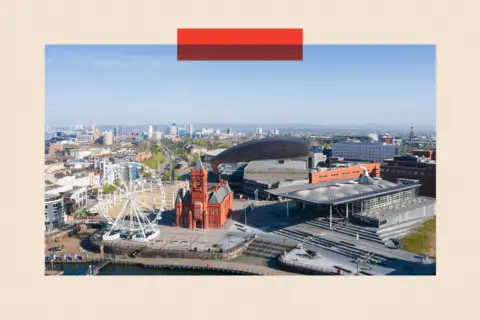
Wales saw red – but no more?
 Getty Images
In Wales, it feels like Labour’s time is more or less up. Canvassers report back praise on the doorstep for how Starmer held off from going to war with the US in Iran. But beyond that, the mood is bleak. One party source tells me “it’s been a long time coming – the failures of the Welsh government keep coming up on the doors”.
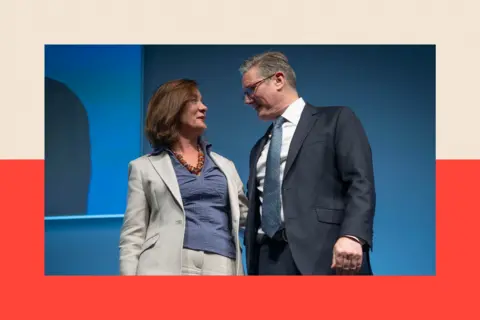
In the blazing spring sunshine on a Swansea rooftop, Welsh First Minister Eluned Morgan tells me she’ll keep “fighting and fighting”, but accepts the election might be so tough for Labour that she could lose her seat. I don’t remember covering another election where a party leader admitted their own perch in Parliament might disappear.
Don’t underestimate how totemic a Labour loss would be if it happens. The party has been winning in Wales for a century. Plaid Cymru leader, Rhun ap Iorwerth, and Dan Thomas of Reform are bouncing around the country, both believing they have a real shot at power. If either wins it would be the first time the post of first minister has been under their party’s stripe – and the first time anyone other than a Labour politician has been in charge.
Be prepared for haggling after the results themselves, mind. A new proportional voting system in Wales makes it unlikely any one party will have a majority this time around, and it’s hard to make accurate predictions.
 Getty Images
Plaid’s ap Iorwerth says he’d happily run a minority government – a calculation that the Lib Dems, Greens and Labour would allow Plaid to form an administration, because they’d never dream of backing Reform.
Tory leader Darren Millar has suggested he’d be open to working with Reform, while Reform leader Thomas – who also seems to be relishing the campaign – insists he’s campaigning to win a majority.
Let’s see. There’s also the possibility either Reform or Plaid wins the most seats, but the other wins the most votes. Under that headscratcher the party with the most seats would be the winner, theoretically, but you can already imagine the narrative of unfairness that the loser could spin.
The old certainties have gone and parties who were tiny outfits not so long ago stand to gain.
SNP confidence in Scotland – but can they be sure?
Several hundred miles away, the traditional order in Scotland was turned over in 2007, when the SNP stunned the political establishment by beating Labour in another of its spiritual homelands.
The party has won every Holyrood election since. Despite all sorts of scandals and a less than glowing record on public services, it looks like voters will let them enter their 20th year of power.
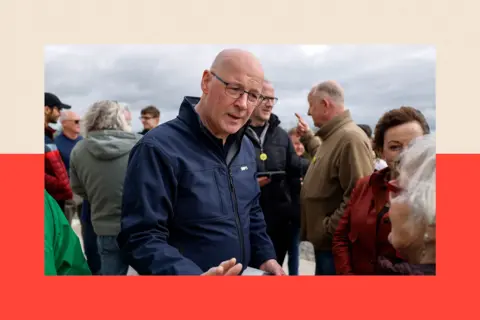
Scottish First Minister John Swinney is credited with restoring calm to the party after a crazy few years when its two big stars – Alex Salmond, then Nicola Sturgeon – crashed.
 Getty Images
Swinney told us last week he was “confident to predict” the SNP would win a majority, but as in Wales, the political system makes it hard for any one group to get over that threshold, and it’s tough to make predictions. One Labour minister tells me they are “gobsmacked by [the SNP’s] lack of expectation management”.
Reform is snapping at the heels of both the SNP and Labour, and looks to make big advances. Nigel Farage’s party is campaigning hard on immigration, particularly in Glasgow where a high number of asylum seekers have been housed. That said, Reform’s rivals have described their campaign as a “binfire”, with candidates lost over offensive views and Scottish party leader Malcolm Offord having to apologise for a homophobic joke years ago.
The Greens have plenty of new members, though the zip of the party in England doesn’t feel matched here following a bruising experience of being in government with the SNP.
Meanwhile, Lib Dem and Conservative leaders’ campaigns have been very on-brand – the former making frangipane tarts at a cookery school in Edinburgh’s fancy New Town; the latter knocking doors alongside a labrador in a comfortable Glasgow suburb. No longer the big players they once were, the Lib Dems and Tories are trying to max out on a second ballot where voters select a party to represent their whole area, not the individual politician for their constituency – known as the “peach vote” because it’s cast on a peach-coloured piece of paper.
Plus, the Lib Dems and Tories are trying to avoid the independence-backing SNP and Greens winning enough votes to claim majority support for Scottish independence.
It’s worth noting an irony in both Wales and Scotland. The nationalist parties are likely to prosper, but independence hasn’t been a major part of the political conversation in either country this time. Plaid admits independence isn’t on the table for now. The SNP still believes it would have a mandate for a new independence referendum if it got a majority. But for voters, the cost of living, the NHS and immigration have been the topics of concern in the run-up to polling day – not constitutional issues.
‘Shambles after shambles’
And then there was Labour. A year ago, it looked like Scottish Labour leader Anas Sarwar had a good shot at returning to power in Holyrood, but in 2026 that seems out of reach.
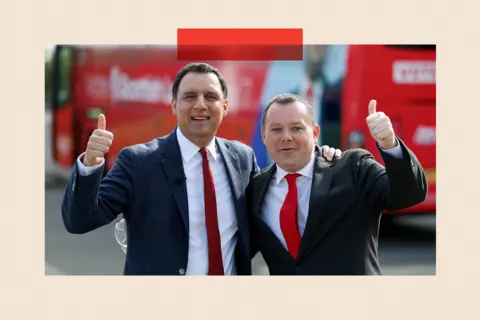
We meet him leaping off his battle bus in another well-to-do Glasgow suburb, where he’s making his repeated plea to voters: “The SNP have had 20 [years], give me five.”
Noise down in Westminster could put paid to that. Labour up here in Scotland believes it has been thoroughly hobbled by the mistakes and mishaps of Starmer’s time in office so far – Sarwar went public in February to proclaim Starmer the wrong man for prime minister.
 Getty Images
Sarwar’s idea was to distinguish himself from the bitter disappointment many Scots feel with UK Labour. That gamble has not translated into a big bounce in the party’s chances. As one of many disaffected Labour or former Labour voters in Scotland tells me: “It’s been shambles after shambles.” He used to deliver leaflets for Sarwar.
This election isn’t a simple health check on the UK government, but it’s impossible to separate the mood of gloom around Downing Street from Labour’s sense of dread in Scotland and Wales.
One experienced SNP campaigner, grinning ear to ear, tells me Labour’s UK performance has “been an absolute gift”.
Is Keir Starmer a good prime minister, I ask Welsh First Minister Morgan? There’s a tiny, but telling pause, before her more diplomatic than enthusiastic answer.
“He’s helped us in Wales.”
She then talks about nuclear investment, sticking carefully to the party line. She’s also keen to point out the moments when she has disagreed with the Westminster party, like on the winter fuel allowance decision.
As ever, much of the Westminster bubble seems like it is eating itself.
 Getty Images
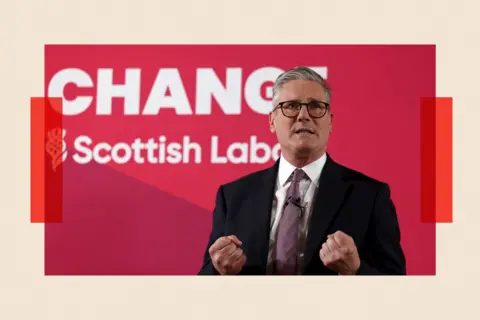
Ministers disagree on whether there will be a challenge to Starmer after the May elections. Some reckon “it’s terminal”, a challenge is on the way. Others say the fundamental lack of agreement on a successor is a huge block, making a change in leader self-indulgent and a huge risk.
A poll by the consultancy Portland Communications of 2,042 people suggests the public echo that dilemma. The research, shared with us this weekend, suggests 12% of voters believe Starmer should stay on as prime minister if Labour loses a significant number of council seats in May.
But the same research, from 16-20 April, suggests that among Labour voters, Starmer outpolls all of the other possible contenders for the job on a variety of factors.
The Labour Party is in an unhappy state of suspended animation – unsure whether to stick with a troubled status quo, or unleash the potential chaos of a leadership election.
The outcome of the coming elections could determine whether the unhappy contingents find the courage to move, or whether Starmer and what feels like his diminishing group of allies use the moment to draw a line under disappointments and crack on with new zeal.
Whatever the intrigue of the next ten days bring in Westminster, the public’s decisions around the UK will come first.

BBC InDepth is the home on the website and app for the best analysis, with fresh perspectives that challenge assumptions and deep reporting on the biggest issues of the day. Emma Barnett and John Simpson bring their pick of the most thought-provoking deep reads and analysis, every Saturday. Sign up for the newsletter here
Politics
No 10 says Falklands sovereignty rests with UK after report of US ‘review’
No 10 says Falklands sovereignty rests with UK after report of US ‘review’
 Getty Images
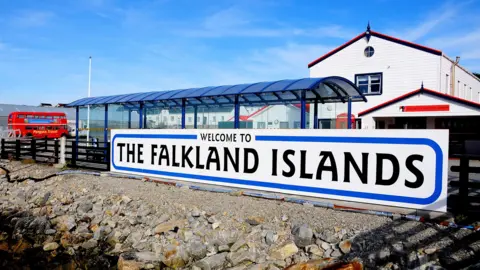
Sovereignty of the Falkland Islands “rests with the UK”, Downing Street has said, following a report the US could review its position on Britain’s claim to the territory.
An internal Pentagon email reported by Reuters suggested the US was considering options to punish Nato allies it believed had failed to support its war on Iran.
The options discussed also included seeking Spain’s suspension from Nato over its opposition to the war. BBC News has not been able to review the email.
A Pentagon spokesperson did not comment on the email’s existence, but said it would “ensure that the president has credible options to ensure that our allies are no longer a paper tiger and instead do their part”.
“As President [Donald] Trump has said, despite everything that the United States has done for our Nato allies, they were not there for us,” the spokesperson added.
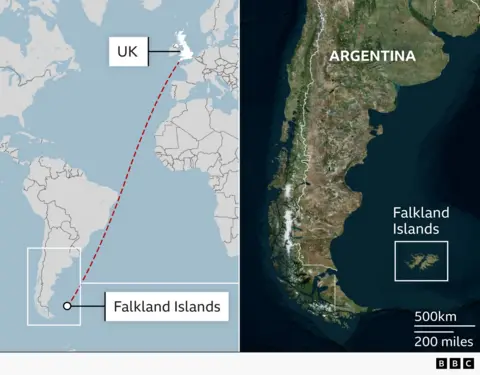
The Falkland Islands, a British overseas territory in the south-west Atlantic Ocean, remain the subject of a sovereignty dispute between Britain and Argentina.
Asked about the report, a No 10 spokesman on Friday said: “The Falkland Islands have previously voted overwhelmingly in favour of remaining a UK overseas territory, and we’ve always stood behind the islanders’ right to self-determination and the fact that sovereignty rests with the UK.”
The prime minister’s official spokesman also said the government “could not be clearer about the UK’s position”, and that “sovereignty rests with the UK and the islanders’ right to self-determination is paramount”.
He continued: “We’ve expressed this position previously clearly and consistently to successive US administrations and nothing is going to change that.”
Former Labour security minister Lord West BBC Radio 4’s The World Tonight programme the Pentagon leak on the Falklands was “quite extraordinary” and showed “a lack of understanding”.
Lord West, who was an officer commanding HMS Ardent during the Falklands War, went on to describe US Defence Secretary Pete Hegseth as “thick” and accused him of having a total lack of understanding about Nato.
“Hegseth talks about the fact that Nato’s never done anything for America, America’s done so much for Nato, but the only time that Article 5 was invoked was by Nato and it was to defend the United States,” he said.
“I’m afraid he’s thick actually, and he doesn’t seem to have a very good knowledge of a lot of these things, but to say that is stupid.”
Under Nato’s Article 5, an armed attack against one or more members is considered an attack against all, and in response each other member would take “such action as it deems necessary, including the use of armed force, to restore and maintain the security of the North Atlantic area”.
The only time Article 5 has been invoked was after the 9/11 attacks on the US in 2001.
Previous US administrations have formally recognised the UK’s de facto administration of the islands, but have not taken a formal position regarding sovereignty.
“The Falkland Islands has complete confidence in the commitment made by the UK government to uphold and defend our right of self-determination,” the islands’ government said in a statement.
Conservative leader Kemi Badenoch said the reported US stance on the Falkland Islands was “absolute nonsense”, adding: “We need to make sure that we back the Falklands. They are British territory.”
Reform UK’s Nigel Farage said: “This is utterly non-negotiable. There is no way we’re even going to have a debate about the sovereignty of the Falkland Islands.”
He also said he would raise the issue with Argentina’s President Javier Milei when he meets him later this year.
Liberal Democrat leader Sir Ed Davey has once again called for the King’s forthcoming visit to the US to be cancelled.
“This unreliable, damaging president cannot keep insulting our country,” Sir Ed said.
The report emerged three days before King Charles III and Queen Camilla are due to travel to the US and meet Trump at the White House.
While the White House is yet to comment on the report, it could prove to be another point of friction between the US and UK at a time of diplomatic tension.
Trump has previously said he is “not happy” with the level of support offered by the UK during its war in Iran, while Sir Keir Starmer has repeatedly said Britain will not be drawn into a wider conflict.
Meanwhile, an official from Nato – responding to the suggestion in the report that the US could push for Spain’s expulsion from the military alliance – said its founding treaty “does not foresee any provision for suspension of Nato membership, or expulsion”.
Earlier, Spain’s Prime Minister Pedro Sanchez said: “We do not work based on emails. We work with official documents and official positions taken, in this case, by the government of the United States.”
The Falkland Islands have been under British rule since 1833, but Argentina has historically said it has a right to them on the basis it inherited them from the Spanish crown, as well as the islands’ proximity to the South American mainland.
In 1982, a 10-week conflict between the UK and Argentina over the islands was triggered when the latter’s military dictator, Leopoldo Galtieri, ordered his country’s forces to invade them.
The then UK Prime Minister Margaret Thatcher’s government sent a naval task force to recapture the islands.
Argentine forces surrendered, but the country still claims sovereignty over the Falklands, which it calls the Malvinas and which lie about 300 miles (483km) east of Argentina.
In the course of the conflict, 649 Argentine military personnel and 255 British military personnel lost their lives, as well as three Falkland Islanders.
More recently, Falkland Islanders have overwhelmingly expressed their desire to remain as a British territory.
A 2013 referendum among the island’s 1,672 eligible voters saw all but three voting to continue as an overseas territory, on a turnout of more than 90%.
Successive British governments have long maintained that the island’s population has a right to self-determination under international law established by the United Nations Charter.
Argentina’s foreign minister Pablo Quirno wrote on X on Friday that his country rejected this, stating that those living in the Falkland Islands had never been recognised as a people by the UN.
“Argentina reaffirms its sovereign rights over the Malvinas Islands”, Quirno wrote, adding: “The Argentine Republic once again expresses its willingness to resume bilateral negotiations with the United Kingdom that will allow for finding a peaceful and definitive solution to the sovereignty dispute.”
Milei, who is a close ally of Trump, previouslysaid it would take decades for the dispute to be resolved, and criticised Argentine politicians who “beat their chests demanding sovereignty of the islands, but without any result”.


Blanche says it appears suspect was targeting Trump admin. members
In an interview with CNN’s Dana Bash, Acting Attorney General Todd Blanche said that the suspect who tried to break...


Son warns suspected killer may ‘get away with murder’ after conviction tossed in mom’s execution-style slaying
NEWYou can now listen to Fox News articles! A Wisconsin family is reeling after a judge vacated the conviction...


Timeline of shooting incident at the White house Correspondents’ Dinner
After shots were heard during the White House Correspondents’ Dinner, President Donald Trump was rushed off the stage unhurt, …


Mass shooting near Indiana University injures 9, no arrests made yet
NEWYou can now listen to Fox News articles! Nine people were injured in a mass shooting near Indiana University...


Sawe smashes two-hour barrier to make history in London
ByHarry Poole BBC Sport journalist 26 April 2026, 11:44 BST 463 Comments Updated Just now Sabastian Sawe made history...


Police ‘aware’ of video appearing to show York player punching fan
Image source, Getty Images 19 minutes ago Police say they are aware of a video circulating online that appears...

What we know about Cole Tomas Allen, the WHCD shooting suspect
The man suspected of opening fire at the White House Correspondents’ Association Dinner on Saturday night worked as a …

Going inside the Chernobyl nuclear power plant, 40 years on from the disaster. #BBCNews


Titan submersible widow says remains of husband and son came back in what looked like small ‘shoeboxes’
NEWYou can now listen to Fox News articles! Christine Dawood, the widow who lost her husband and son in...

How is wildlife surviving in Chernobyl? #Chernobyl #Ukraine #BBCNews
-

 Theboldnews video2 weeks ago
RADDI AKHBAR 2 | क्या हुआ?
-
 Entertainment1 week ago
Kiss Cam Woman Kristin Cabot Says Chris Martin ‘Never’ Checked On Her After Viral Boss Scandal Ruined Her Career
-

 Video2 weeks ago
Israel is losing US support – even among Republicans
-

 Video1 week ago
Tell me how to feel about space | The Assignment
-
 BBC News World1 week ago
Turkish police detain 162 people over online posts about school shootings
-
 Video1 week ago
Keir Starmer 'furious' he wasn't told about Mandelson failed security vetting | BBC Newscast
-

 Video1 week ago
Let grief be messy: NYTimes writer talks to Anderson Cooper about the life and death of her daughter
-

 Video1 week ago
Debate: Who's right about gas prices, Trump or Americans?