
Sports
James leads Lakers to brink of play-off series win

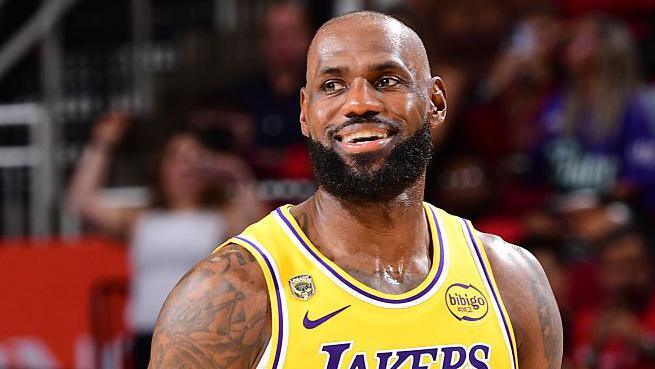 Image source, Getty Images
LeBron James made a three-pointer to force overtime before the Los Angeles Lakers moved to the brink of a series victory in the NBA play-offs.
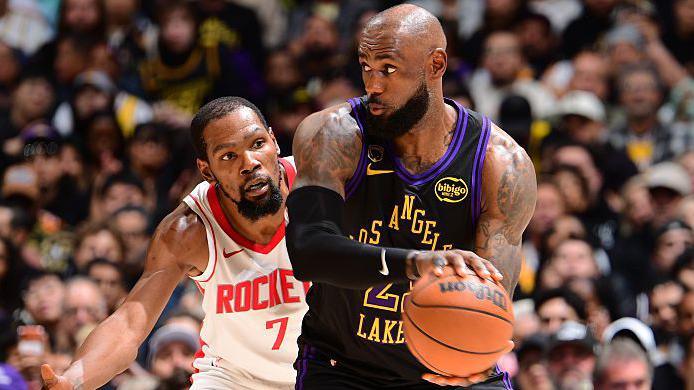
The NBA’s four-time Most Valuable Player levelled the score with 13 seconds left against the Houston Rockets and almost clinched victory as he hit the rim with a three-pointer on the buzzer.
But the Lakers went on to win 112-108 in overtime to claim a 3-0 lead in the best-of-seven first round of the play-offs.
James, 41, again stepped up in the absence of the injured Luka Doncic and Austin Reaves, claiming a team-high 29 points and 13 rebounds.
Marcus Smart also recorded a double-double, scoring eight of his 21 points in overtime and adding a team-high 10 assists.
“With two of our best players down, we’ve got to play desperate,” said Smart. “We’ve got to be the most desperate team.
“That’s how we’ve been playing, and that’s how we’re winning, right? The chemistry has been good, and you’re starting to see guys’ confidence go up because of that.”
An ankle sprain ruled out Houston’s leading scorer Kevin Durant for the second time in the series.
The Rockets also host game four on Sunday and must win to prevent the Lakers earning a sweep of the series and booking their place in the Western Conference semi-finals.
Conference rivals San Antonio lead the Portland Trail Blazers 2-1 after fighting back to claim a 120-108 win on the road.
Stephon Castle scored 33 points for the Spurs while rookie reserve Dylan Harper added career bests of 27 points and 10 rebounds.
Victor Wembanyama was on the Spurs bench but could not play as this season’s defensive player of the year remained in concussion protocol after suffering a head injury in game two on Tuesday.
The Boston Celtics took a 2-1 lead over Eastern Conference rivals Philadelphia as they claimed a 108-100 win at the 76ers.
Jayson Tatum scored 11 of his 25 points in the fourth quarter while Jaylen Brown also scored 25 points for Boston.
Related topics
Sports
How Newcastle’s ‘bullies’ became too nice

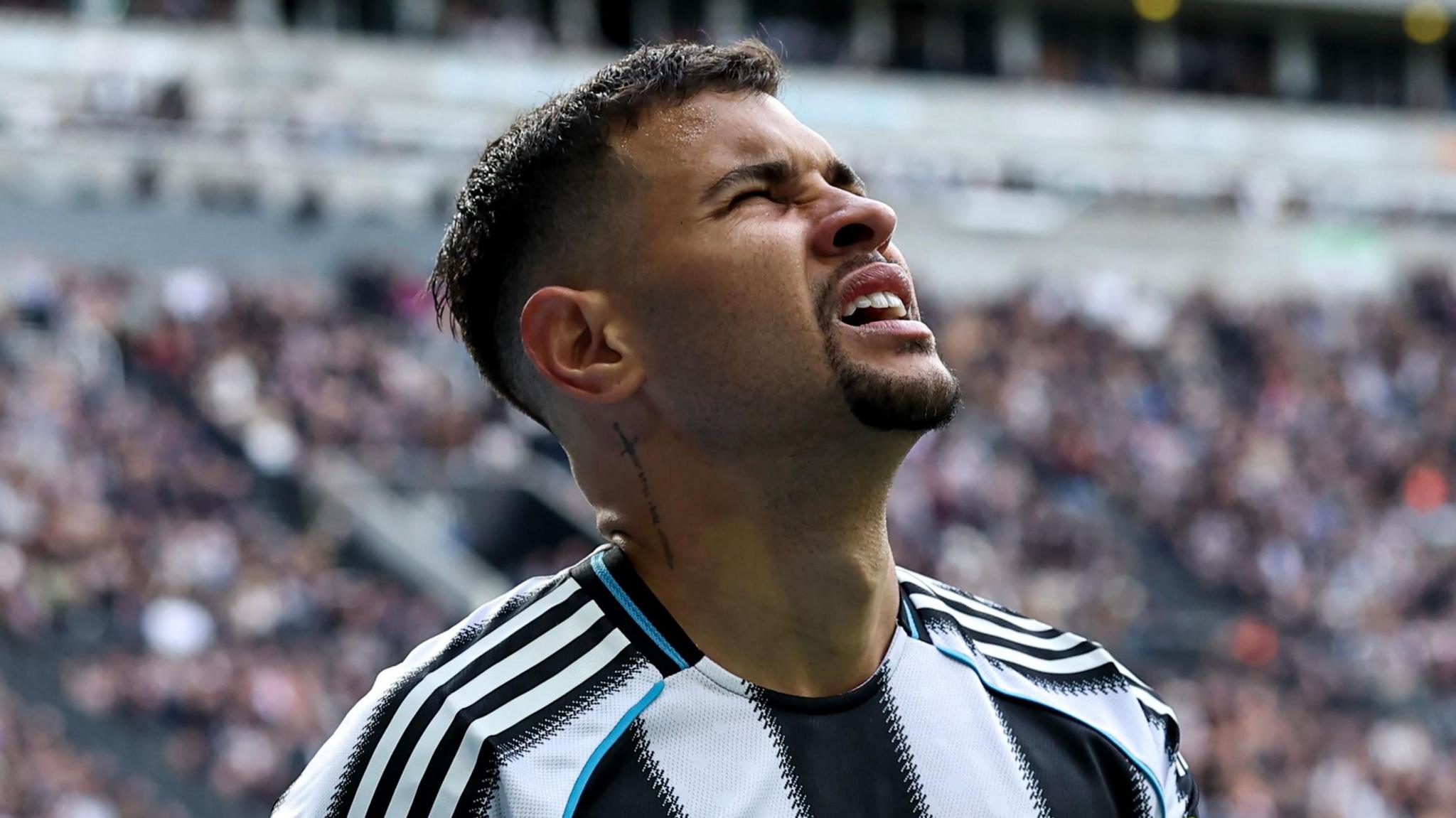 Image source, Getty Images
“They haven’t played against any team like this.”
This was not the Newcastle United that a frustrated Mikel Arteta was used to facing at Emirates Stadium, as the Arsenal manager reflected on a goalless draw in January 2023.
Newcastle have had far more memorable results under Eddie Howe against the Premier League title challengers.
But this particular stalemate was viewed as a significant step forward internally, after dogged Newcastle refused to roll over, as they had previously, in north London.
It was a night when Newcastle ruffled one or two feathers.
Such was the visitors’ determination to get a result, unused substitute Jamaal Lascelles was booked for obstructing an Arsenal throw-in late on, while the usually measured Howe confronted Arteta on the touchline after growing tired of the Spaniard’s incessant complaints to the fourth official.
Just a few days later, the Newcastle head coach declared: “We’re not here to be popular and get other teams to like us – we’re here to compete.”
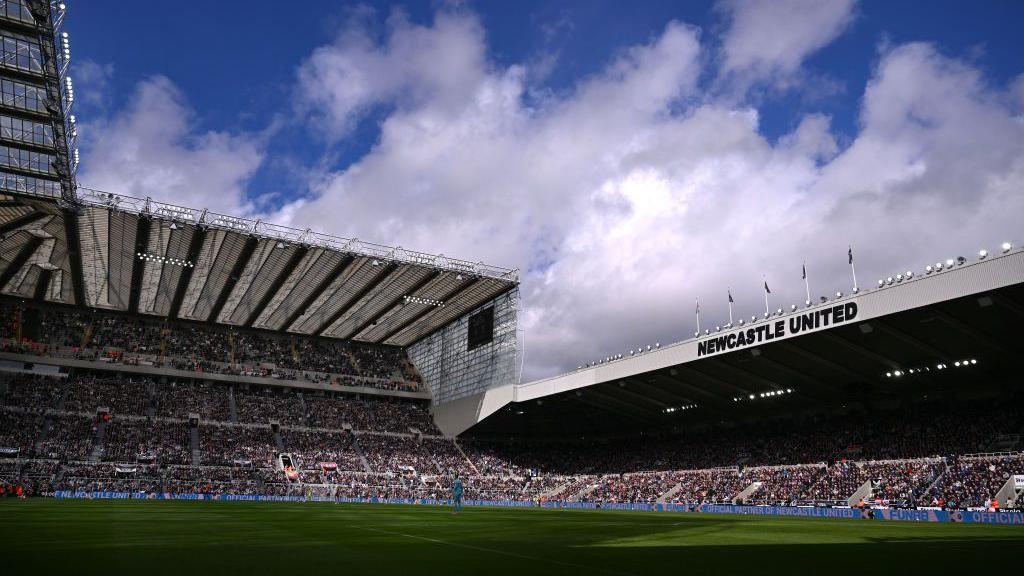
However, his side have lost that edge as they prepare to return to the same ground on Saturday (17:30 BST).
With Newcastle languishing in 14th, and his future coming under increased scrutiny, Howe accepts they have become too easy to beat.
So what’s going wrong?
Arsenal v Newcastle
Premier League
Saturday, 25 April at 17:30 BST
Listen to full match commentary on BBC Radio 5 Live and BBC Sounds, with live text updates on the BBC Sport website and app.
‘Players need to take responsibility’
It was just last month that Newcastle defeated Manchester United with 10 men, recorded a rare away win at Chelsea and came within seconds of a famous victory against Barcelona at St James’ Park.
But this flaky team have since suffered a series of damaging losses, including a 2-1 home defeat by in-form Bournemouth last week.
The momentum of that game should have been with the hosts following William Osula’s equaliser midway through the second half.
However, fragile Newcastle have conceded the most goals after the 75-minute mark (19) in the Premier League for a reason.
The sight of so many Newcastle players jogging back as goalscorer Adrien Truffert drifted into the box undetected in the 85th minute summed up the listlessness that has gripped them.
So, too, did the bowing of heads after the ball hit the net as this side’s confidence plummeted further.
Kieran Trippier was the only player to visibly recoil before the substitute grabbed the ball and beckoned his dazed team-mates forward in an attempt to quickly get the game back under way.
Trippier felt it was his down to him to front up and speak to reporters in the immediate aftermath of the defeat, and he did so again in a separate round of interviews before the trip to Arsenal.
The former England international is leaving the club at the end of the season, but he remains one of the few vocal leaders in the building.
“It’s tough,” Trippier said. “Especially at home, since I’ve been at the club, we have been a real force. We have been tough to beat. We have been feared.
“I just feel we have come away from that a little bit. I don’t know why.
“I’m not going to stand here and make excuses. We have conceded too many goals late on and it’s us players who need to take responsibility – nobody else.”
Loss of steeliness under Howe
So many of these players made history by ending a 70-year wait for a major domestic trophy, and qualifying for the Champions League.
But this side currently look a pale imitation of the team who won the Carabao Cup at Wembley last season.
The number of games drained Newcastle have played, the uncertainty surrounding the futures of key players and the consequences of a turbulent window last summer should not completely excuse a run of eight defeats in 11 in the Premier League.
Newcastle once “bullied teams”, in the words of defender Dan Burn, but recent defeats against Bournemouth and Crystal Palace were all the more striking given the increased recovery and training time Howe has been afforded this month, after a relentless schedule eased.
The head coach recognised on Friday that “we have to find ways to get the players to respond better to us”.
Just as Newcastle struggle to build on goals, they are also leaky at the back – which is a dangerous combination.
No wonder, then, no other team has thrown away more points from winning positions (25) in the top flight this season.
That is a sobering statistic for any manager – regardless of previous achievements.
The system, the substitutions and the seemingly inevitable drop-off are now becoming a little too predictable.
By contrast, Newcastle‘s once trademark ability to bounce back from a bruising defeat has deserted them under Howe in recent weeks.
How the head coach needs to summon a response and oversee a battling performance at Emirates Stadium on Saturday.
“The team always performs in line with the individuals within it,” Howe said. “I think we have lost a little bit of our experience, a little bit of our know-how.
“The duel aspect, we certainly haven’t performed as well as we have in previous seasons, so they’re things that we’re fully aware of.
“Our hallmark in previous seasons was that and we need to retain that to be successful.”
Related topics

Sports
How Guardiola found his best Man City XI

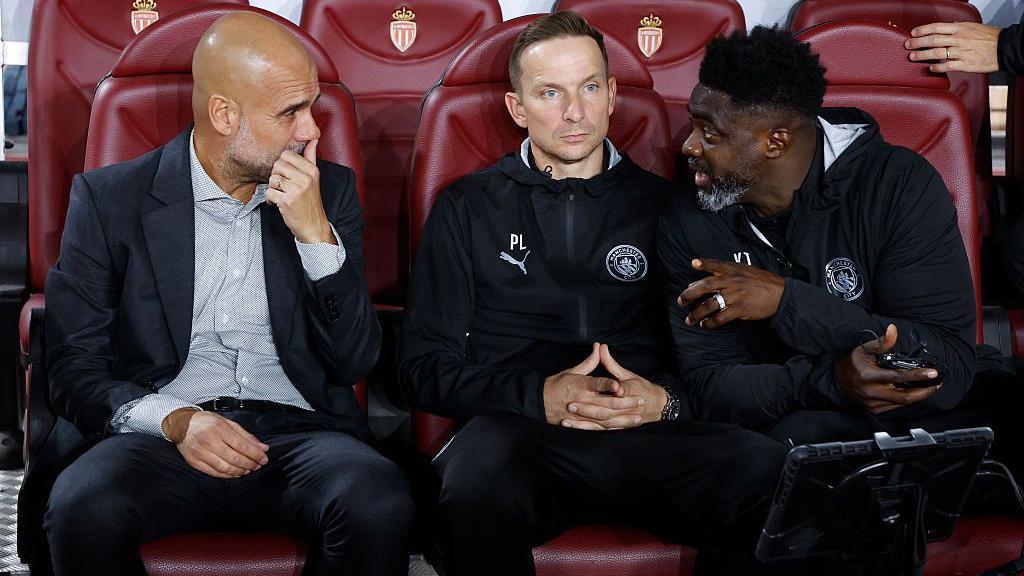 Image source, Getty Images
Pep Guardiola has an uncanny ability to time his season right.
Like a long-standing sitcom, much of Guardiola’s Manchester City career follows the same story arc: a bright September before his side begin to struggle.
As fans and pundits begin to predict City’s downfall, Guardiola tinkers with his squad before a long winning streak results in his club being crowned Premier League champions.
Whether that storyline plays out at the end of this season is yet to be seen but Guardiola has finally landed on a system he trusts for the run-in.
Getting here, however, hasn’t been easy.
Manchester City v Southampton
FA Cup semi-final
Saturday, 25 April at 17:15 BST
Wembley
Watch live on BBC One and BBC iPlayer and listen on BBC Radio 5 Sports Extra and BBC Sounds (both UK users only). Follow both and live text commentary on the BBC Sport website and app.
Gameweek one
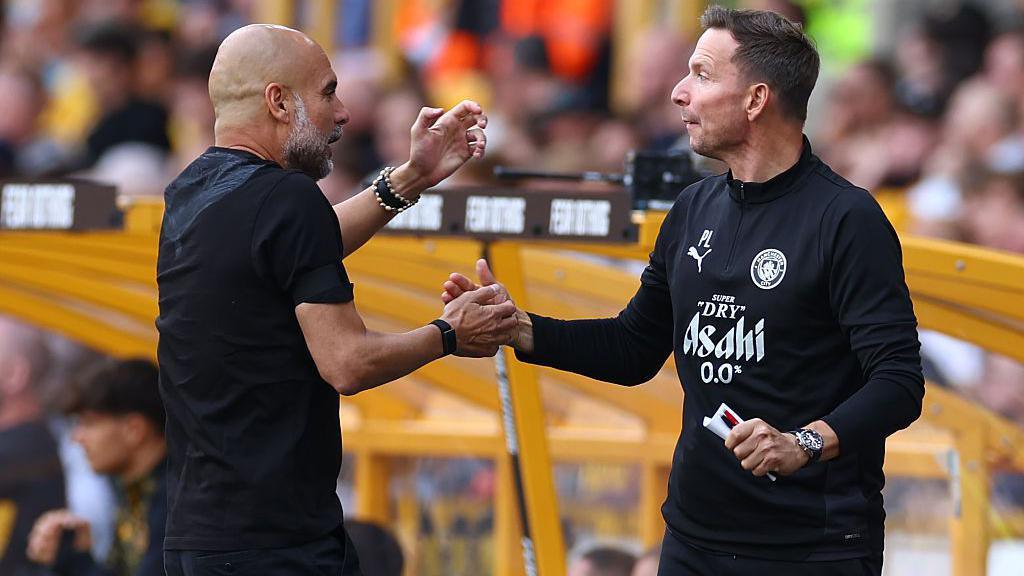 Image source, Getty Images
Of the team that started last Sunday’s win over Arsenal, only three started their opening league match on 16 August – Erling Haaland, Jeremy Doku and captain Bernardo Silva.
City won 4-0 against now relegated Wolves.
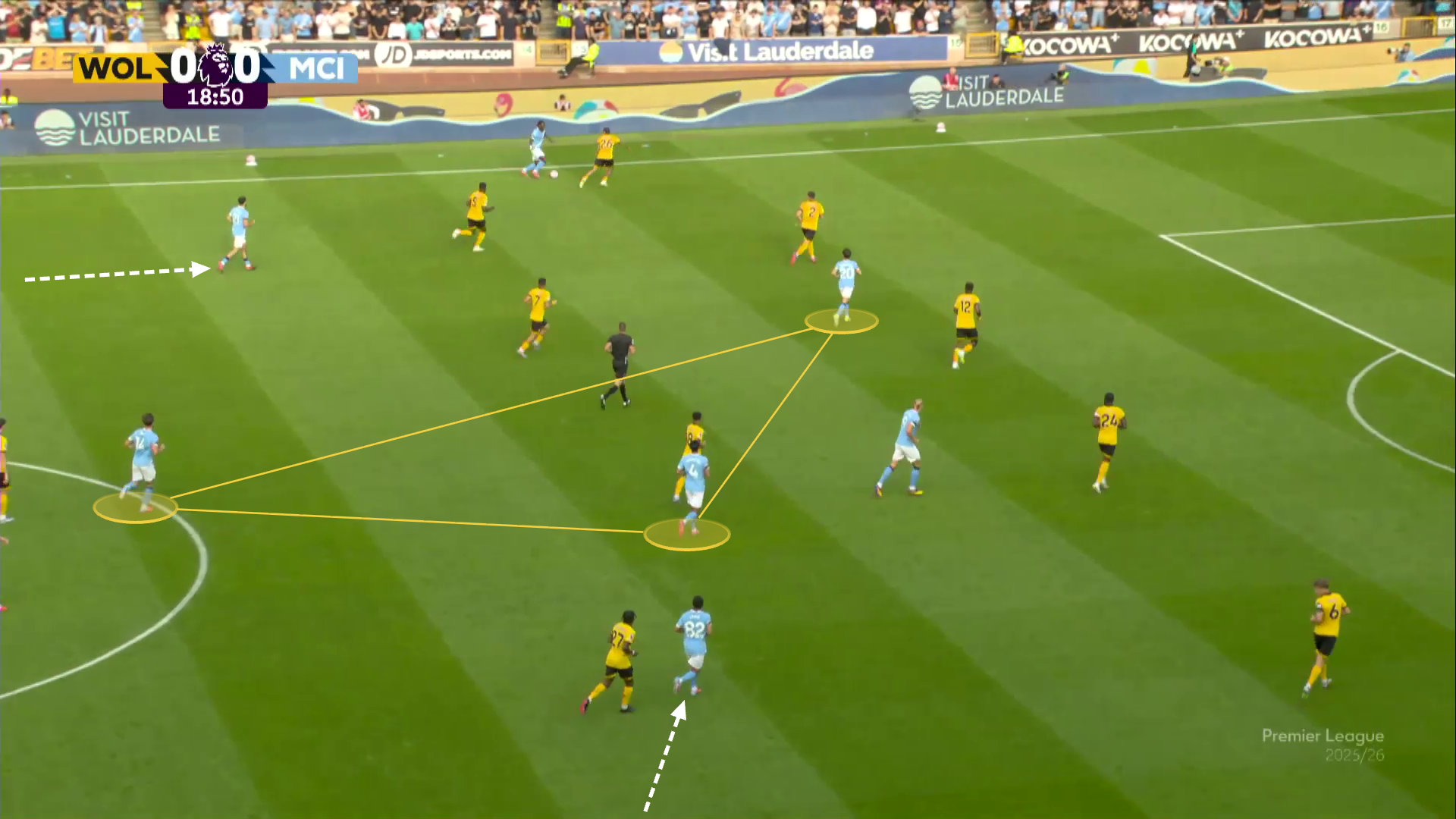
The key differences then were that Rico Lewis and Rayan Ait-Nouri moved in-field from their full-back positions to support Nico Gonzalez while Silva moved into a more attacking midfield position alongside Tijjani Reijnders.
Out of possession, City pressed high. Doku and Oscar Bobb defended close to Haaland, but that often left Wolves‘ full-backs free.
That detail would become important. Across the season, City would repeatedly tweak their defensive structure as opponents found various ways to find the spare man.
Early on, City leaned into attacking transitions.
Inspired by assistant Pep Lijnders and signings like Reijnders, they attacked quicker than previous Guardiola sides, destroying Wolves on the counter. This also suited Haaland, who started the season in impressive scoring form but was something Guardiola later reeled in, preferring more measured games.
Gameweek two
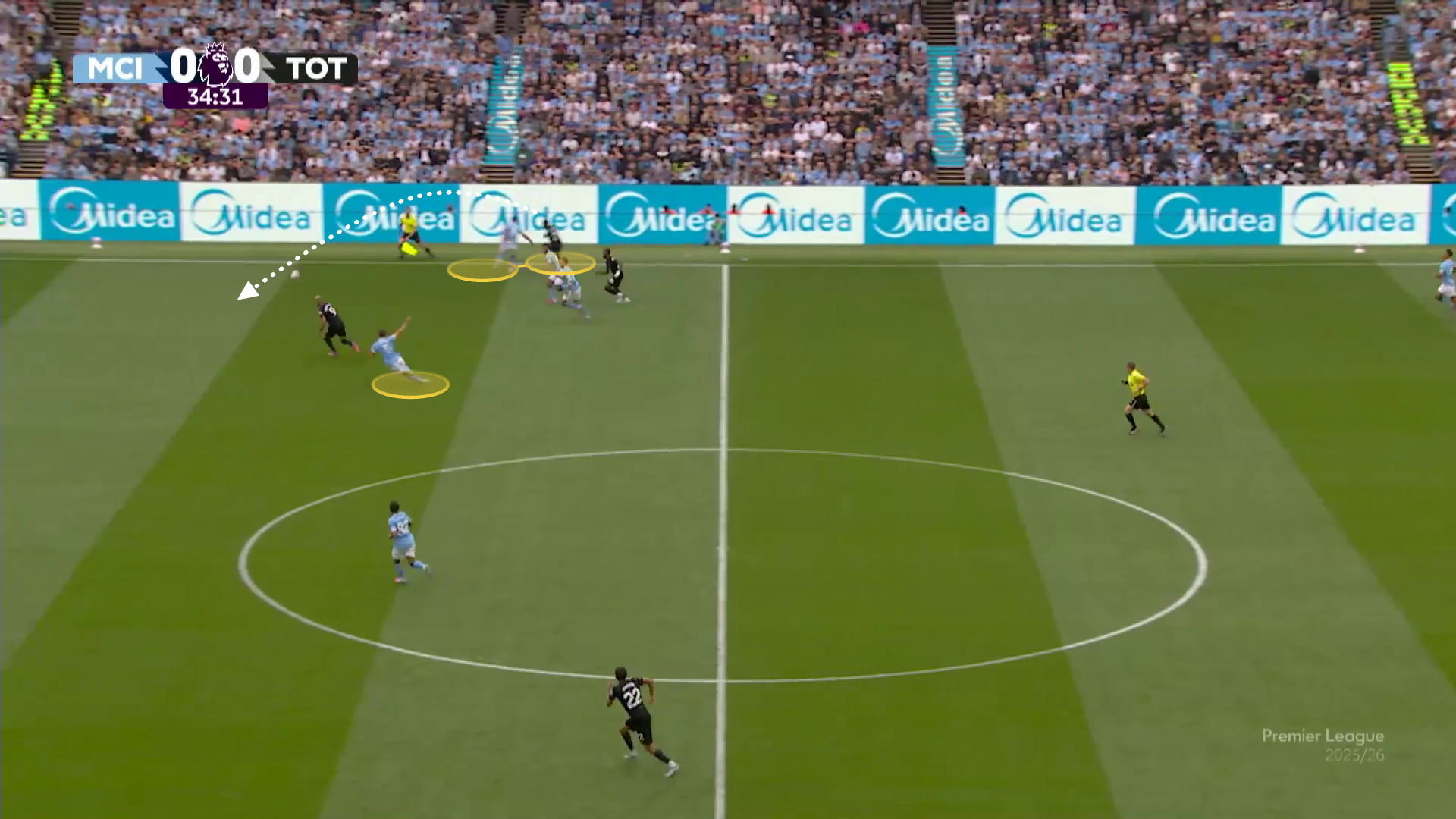
On 23 August, City lost 2-0 at home to a Tottenham side who are now battling relegation.
Omar Marmoush replaced Doku, while Rayan Cherki came into midfield instead of Silva alongside Gonzalez and Reijnders.
The principles stayed the same – invite pressure before looking to release fast attackers into space.
As the season progressed, man-to-man pressure has been a key trend. Guardiola’s early attempts to deal with this lay in drawing opponents on to City before launching the ball early, looking to find Haaland and Marmoush two against two in the opposing half.
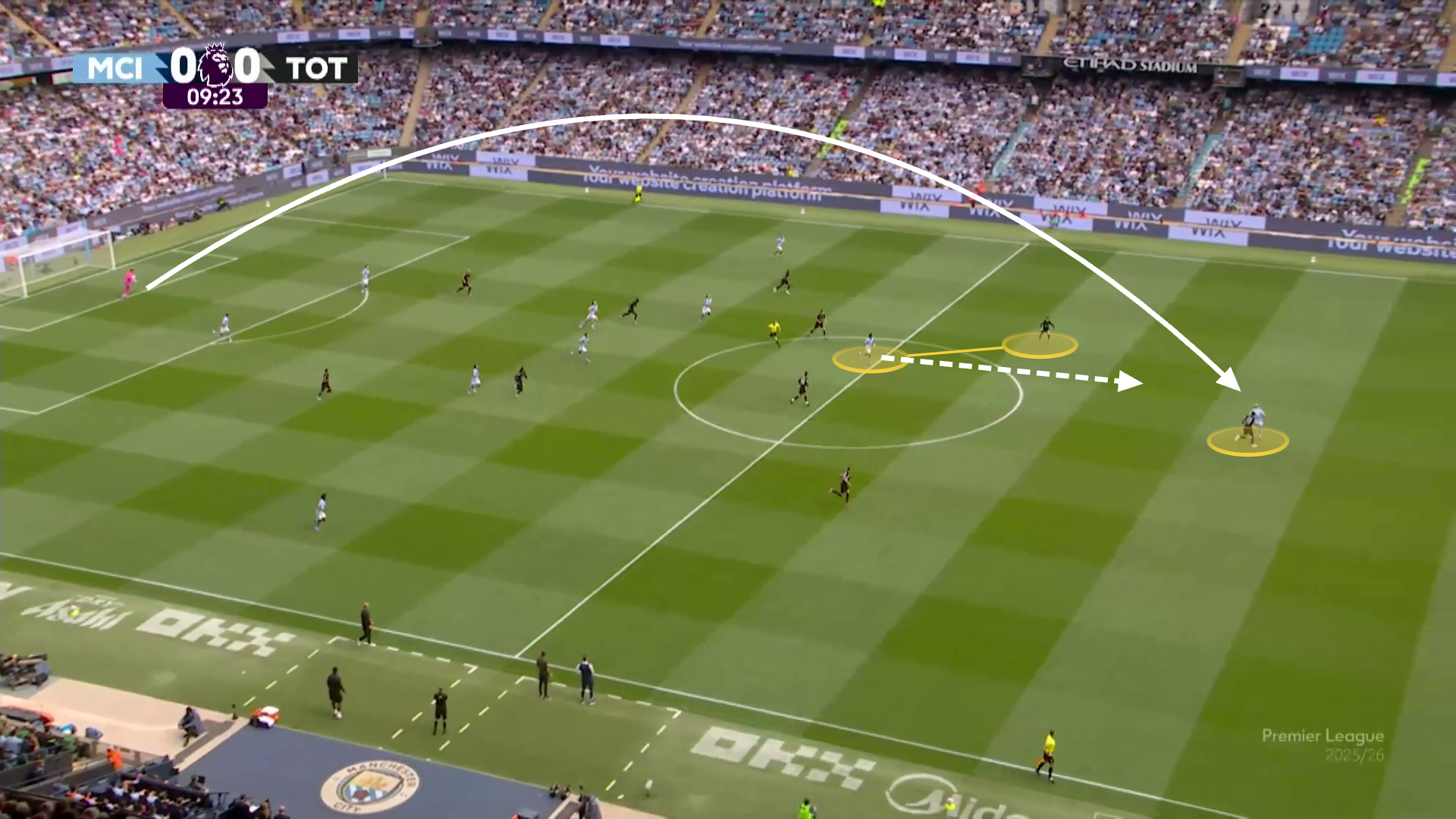
City pressed in what looked like a 2-3 shape. Haaland jumped to the centre-back in possession while Bobb and Marmoush started narrow before being asked to press the full-backs. At times they were slow to get across, allowing Pedro Porro to play accurate long balls down the line.
Spurs vacated the centre and overloaded the flanks, resulting in Gonzalez often finding himself with nobody to mark while the defence played a high line and offside trap to minimal success.
Gameweek three
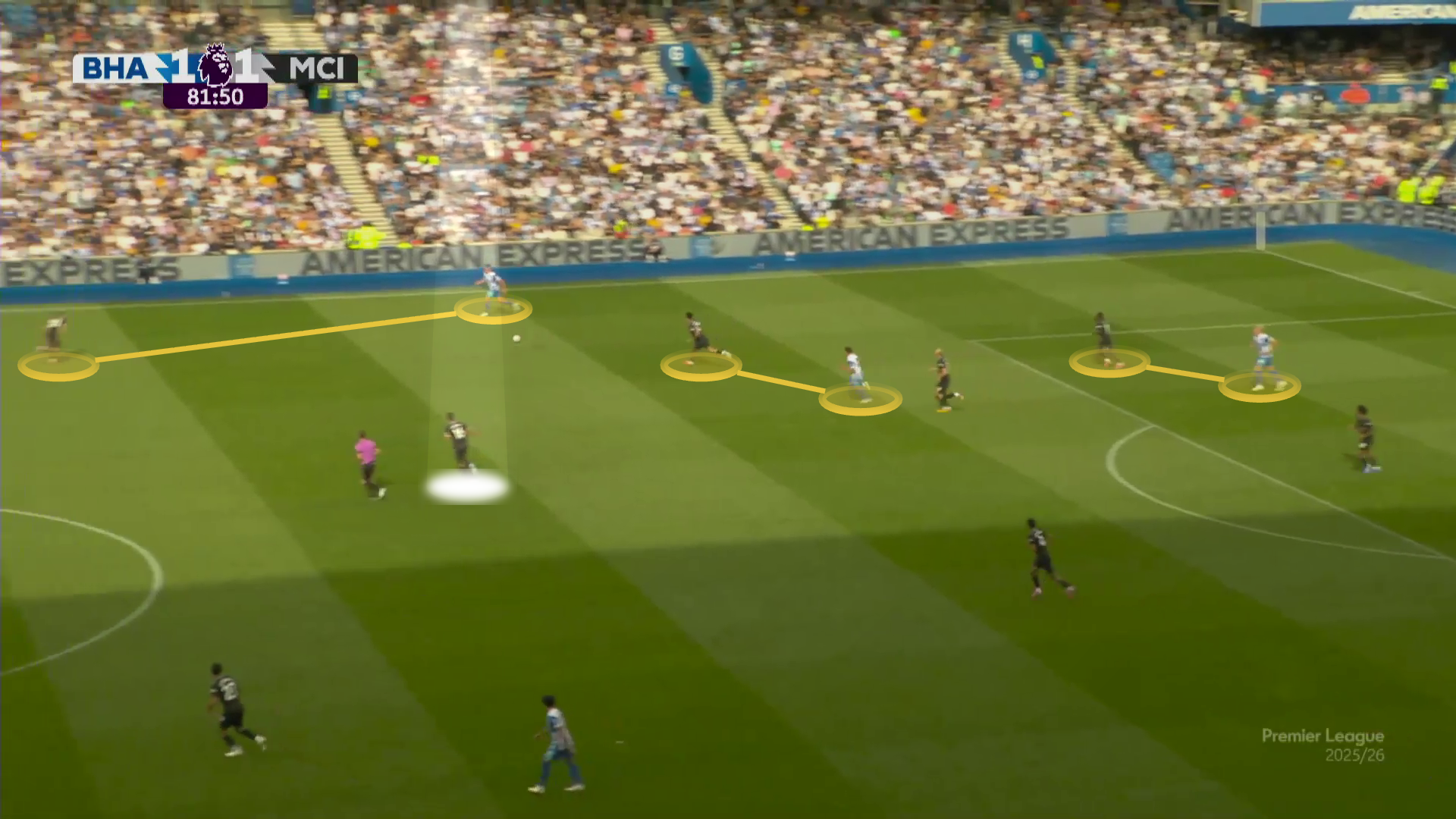
Problems, particularly in defence, continued to grow as City lost to Brighton on 31 August.
City tweaked their press again. The wingers now pressed the centre-backs instead of the full-backs.
The left winger pressed Jan Paul van Hecke while left-back Ait-Nouri had to sprint long distances to reach Brighton‘s right-back Joel Veltman once Brighton progressed the ball.
A Rodri short of rhythm after injury returned but found himself on the same island Gonzalez did the week prior, disconnected from both defence and midfield, without a player to mark.
Brighton outnumbered City’s defenders with their forward line, a damning indictment of the visitors’ set-up.
Gameweek four
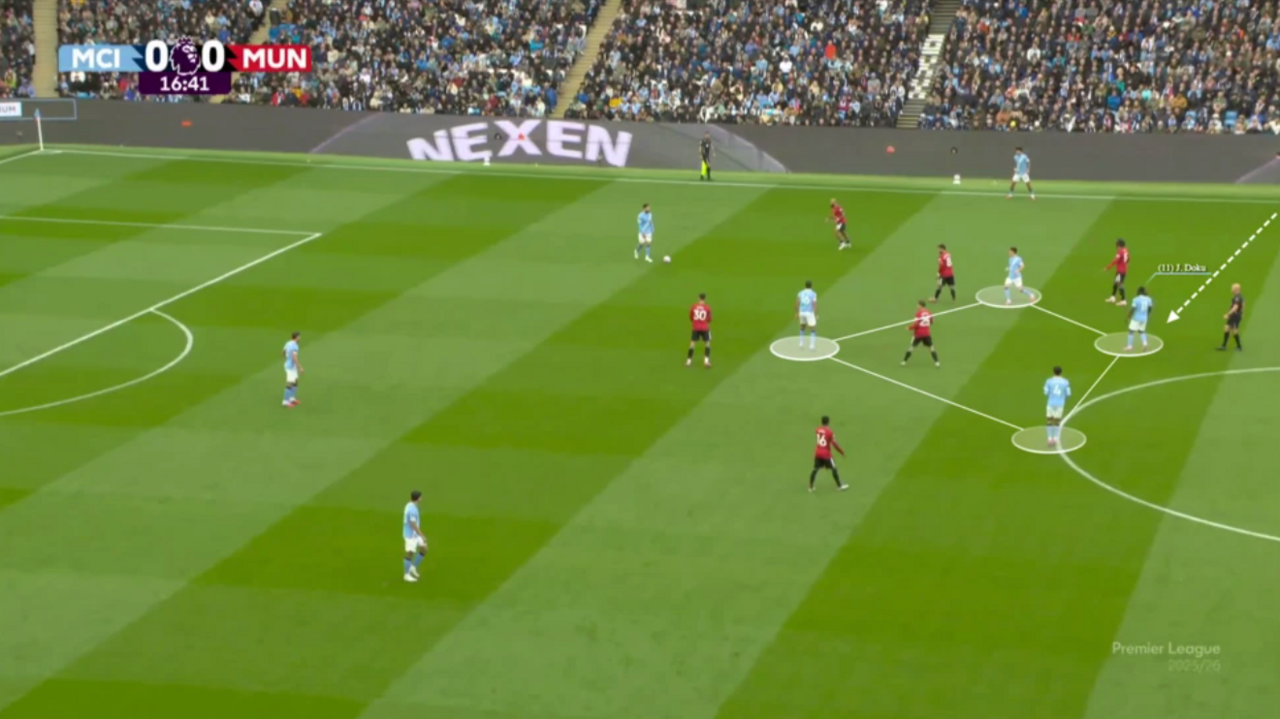
City responded with a 3-0 derby win over Manchester United on 14 September.
Reijnders started his fourth game in a row, this time alongside Phil Foden, both playing in front of Rodri. The pair would form a key partnership in the opening months.
Doku drifted inside from his left-wing position in build-up play, while Nico O’Reilly, starting at left-back for the first time that season, pinned Noussair Mazraoui back.
This worked remarkably well and Doku’s narrow and roaming winger role became a key Guardiola weapon for the rest of the season.
It helped City create a four-man overload against United’s midfield two and nudged Guardiola’s men in the right direction.
Gameweek six
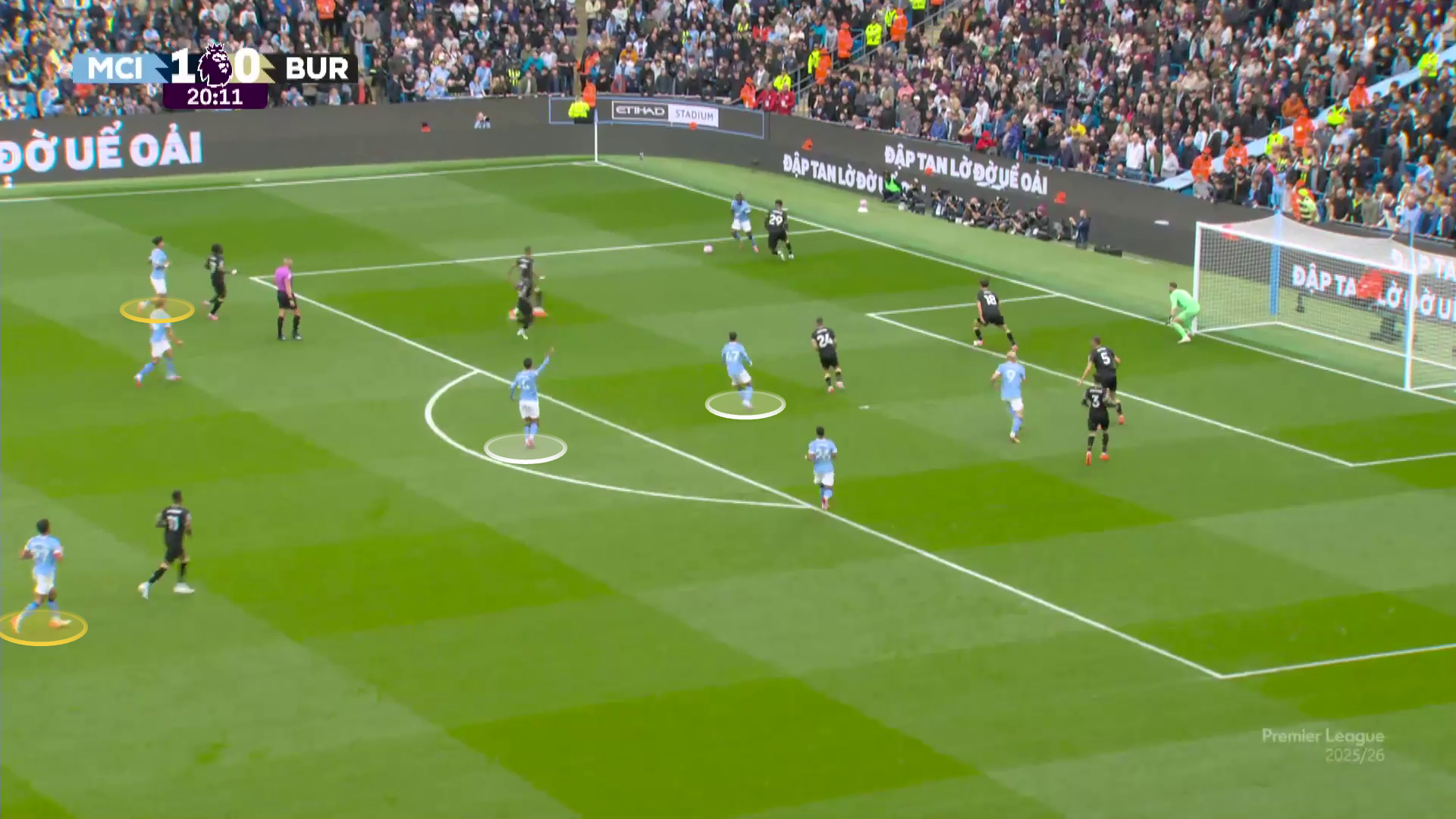
City beat Burnley 5-1 on 27 September with Gonzalez, Foden and Reijnders in midfield. O’Reilly kept his place at left-back with Josko Gvardiol, Dias and Matheus Nunes making up the back four.
Guardiola was beginning to identify pieces he liked.
Doku and Haaland were mainstays in the front three now. The right-wing position, subject to change, was filled by Savinho.
Pep’s thinking at this point was to deploy traditional wingers – Doku and Savinho, who could get to the byline with Foden and Reijnders expected to arrive into the box to help Haaland score goals.
City’s full-backs could rotate out wide but generally tucked into midfield aiming to support attacks and protect City from counters.
Protection centrally and late runs into the box have been key principles for Guardiola throughout his career.
As the season progressed, Guardiola altered his instructions hoping to find the right combination of players to carry out these tasks. O’Reilly, the manager realised with time, was far more valuable as a scorer than a player who prevented counter-attacks.
Gameweek nine
In City’s 1-0 loss to Villa on 26 October, Guardiola started with a midfield of Silva, Reijnder and Foden and an attack of Savinho, Haaland and Bobb.
Villa were able to pass around City’s high press and it was telling that Guardiola changed things in the 61st minute with a triple substitution.
Gonzalez, Doku and O’Reilly came on together, a nod to what Guardiola now knew mattered more than ever. Given the current state of the Premier League, embodied by an imposing Villa side, City’s had learned a valuable lesson around the value of physicality.
Gameweeks 10 and 11
Guardiola outclassed Bournemouth 3-1 on 2 November and Doku again was given his free role in-field. O’Reilly and Doku were beginning to form an impressive and rotating partnership that Guardiola would rely on for the run-in.
Bournemouth pressed in a strict, aggressive man-to-man fashion and as they followed the winger into awkward positions, O’Reilly burst into the open space.
Cherki started on the right moving in-field too. The Frenchman’s influence gradually began to increase from this point on and in the small spaces, alongside Doku and Foden, Bournemouth struggled to find any reference against their fluidity.
With Andoni Iraola’s men stepping up, City were able to find Haaland running in behind and won comfortably.
City persisted with this narrow front three against Liverpool on 9 November with the full-backs tracking Doku and Cherki into their own half before O’Reilly again showcased his dynamic running ability with Guardiola taking note of just how effective this was.
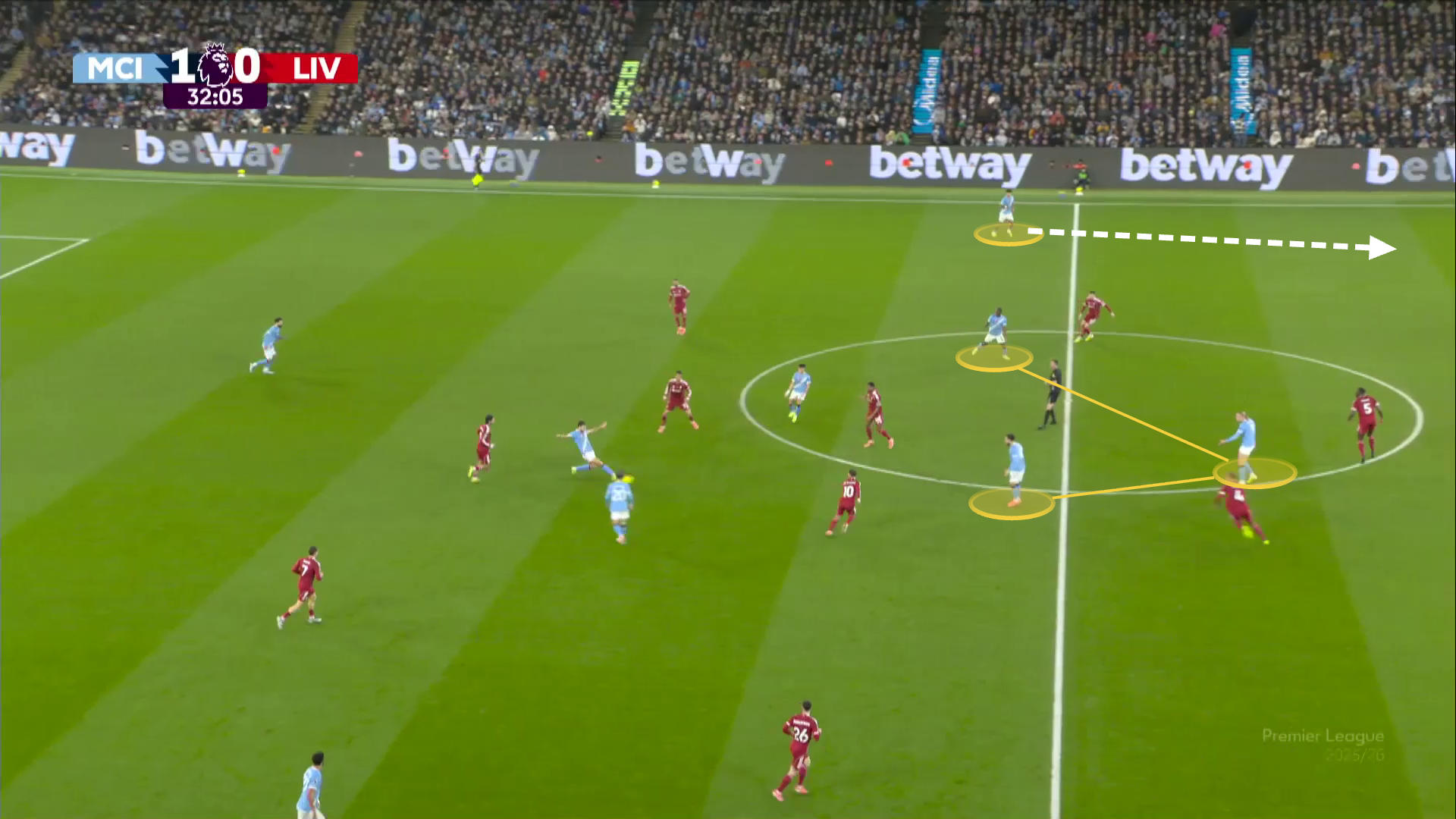
Gameweeks 13 to 17
Guardiola began to experiment with Foden’s role.
Concerns were growing over City’s over-reliance on Haaland for goals, so the manager looked to get both Foden and Reijnders in attacking positions while retaining defensive balance. Before now, Foden’s role was more of an all-action box-to-box midfielder.
Silva paired Reijnders ahead of a duelling Gonzalez. Foden was played as a right winger allowed to move centrally with Doku mirroring him on the left.
This worked. Foden scored twice, including the winner, in a 3-2 victory over Leeds on 29 November.
Following Doku’s injury in Decemeber, Foden’s position change to a narrow winger became more permanent. Reijnders crashed the box to score against West Ham with Silva providing cover, with Haaland picking up two in City’s 3-0 win on 20 December.
Gameweeks 21 to 24
The new year brought changes.
City signed Marc Guehi and Antoine Semenyo, with Guardiola quickly trusting the latter. With Doku, Marmoush, Cherki and Semenyo competing for wing spots, Foden was moved back into midfield, tasked with scoring and assisting.
With Bernardo Silva now undroppable as the box-to-box midfielder, the two positions that had suited Foden were occupied. The Englishman’s minutes began to dwindle.
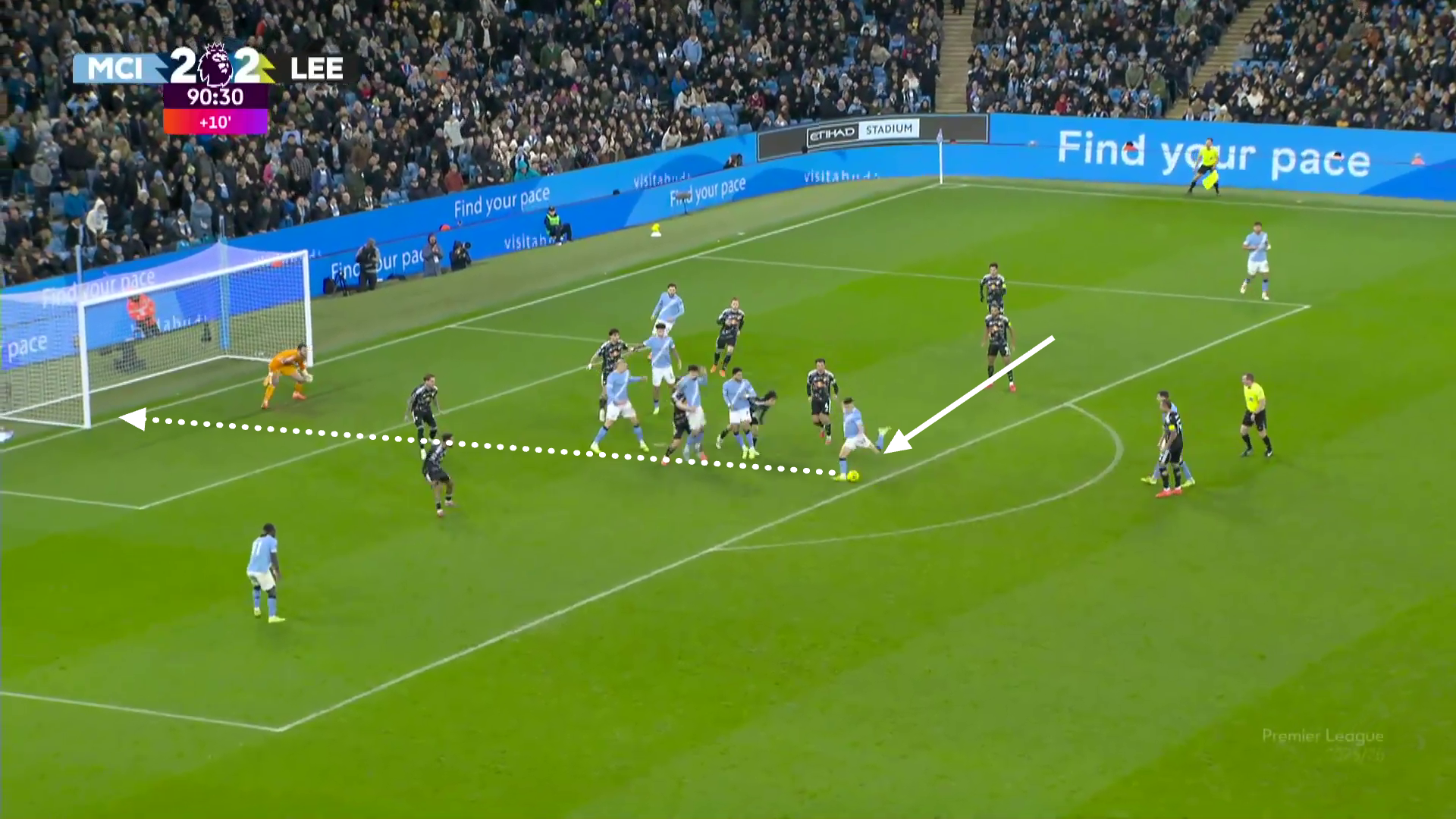
City were struggling to put away their chances and with no wins in four consecutive league games, Guardiola shook things up by looking for security in midfield and goals from the attackers, rather than midfielders.
Gameweeks 25 to 30
With his main out-and-out winger Doku missing much of February and March, Guardiola needed another solution.
He leaned into wingers that played more like strikers, using Marmoush or Semenyo alongside Haaland – sometimes in a front two. Defenders focused on Haaland, leaving spaces for others.
In a pivotal 2-1 win at Anfield on 8 February, City used a narrow front three of Marmoush, Haaland and Semenyo with a physical midfield trio of O’Reilly, Silva and Rodri behind them.
In their 3-0 win against Fulham on 11 February, O’Reilly kept his midfield position as Guardiola realised the value of both his scoring and his physical defending here. O’Reilly’s ability to do both reduced the need for Reijnders in midfield whose minutes began to dry up too.
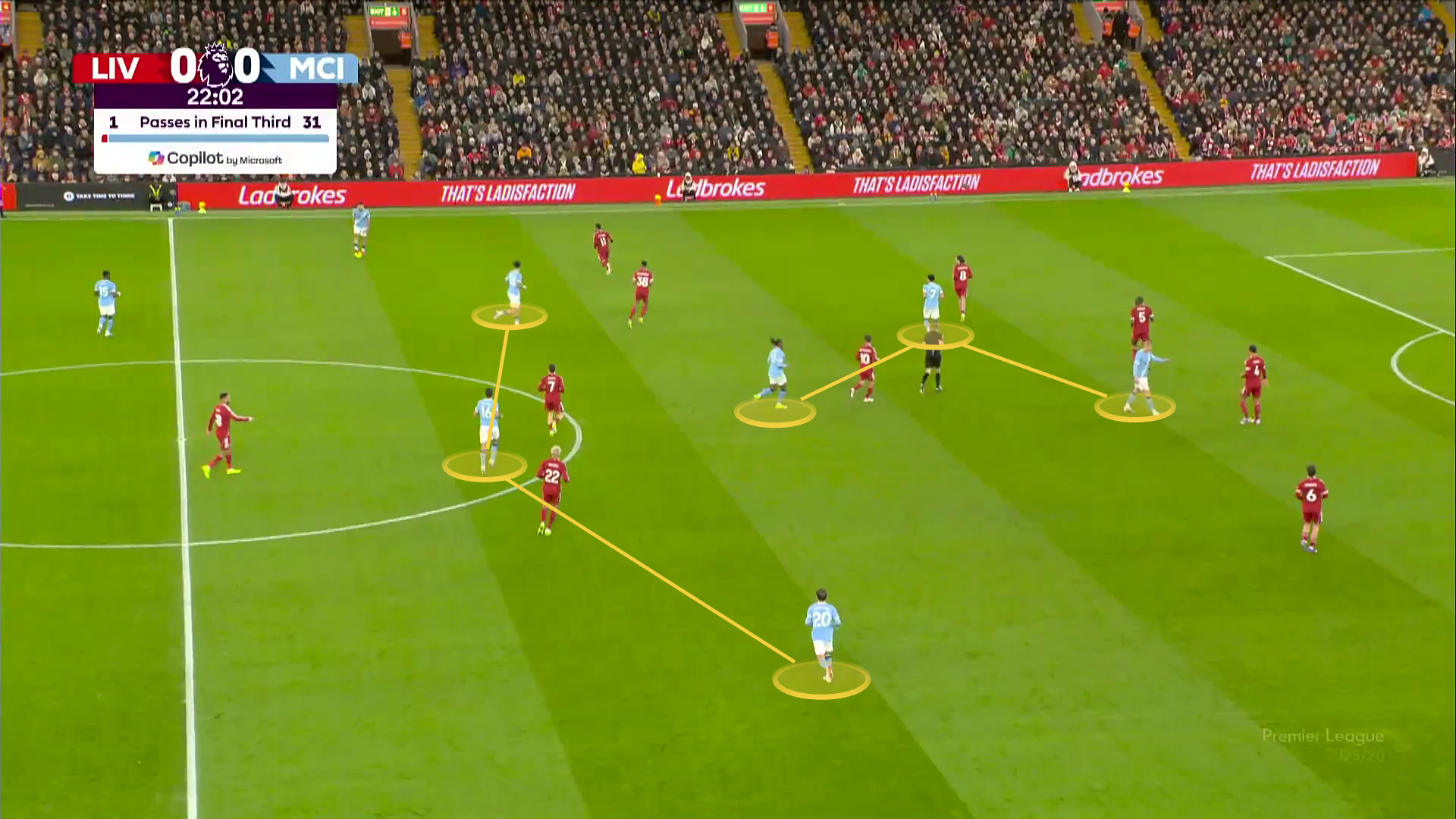
City’s current system
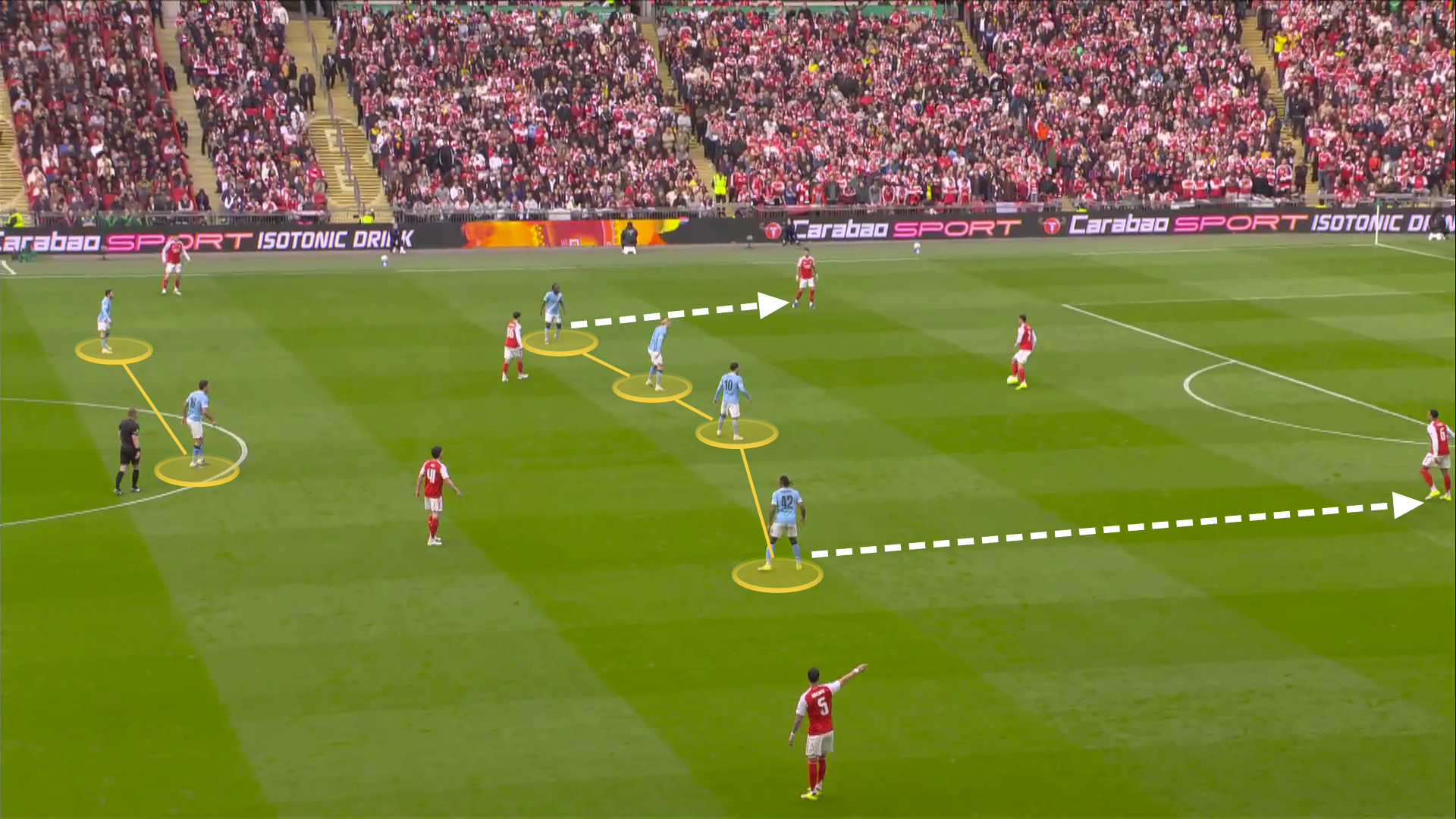
Guardiola finally landed on arguably his best system in the 2-0 Carabao Cup final win against Arsenal on 22 March.
Cherki stood out in a 2-1 Champions League last-16 second-leg loss against Real Madrid on 17 March as City aimed to overturn a 3-0 deficit. The extent of the deficit probably contributed to Guardiola opting to reintroduce the Frenchman into the side – a lucky decision in retrospect.
Doku’s return to fitness and Semenyo’s output kept them in the team either side of him.
Behind them sat Silva and Rodri. O’Reilly and Nunes played at full-back, and Abdukodir Khusanov was a mainstay in defence following Gvardiol and Dias’ injuries.
The pieces had clicked.
Pep Guardiola’s greatest strength
Looking back, clues to this final system had been there all season.
Doku’s one-against-one threat on the left had required teams to double up on him since August. O’Reilly’s runs began to bear fruit as early as September.
Silva’s intelligent pressing and build-up helped mitigate City’s areas of weakness from November onwards.
Haaland and Semenyo moving in-field as Nunes pushed up to provide width, supplied by the two-footed Cherki, gave City solutions teams were unable to prepare for.
Behind them, Khusanov’s pace provided City with a get-out-of-jail free card when they held their high line.
Their press evolved too. Guardiola tried several versions through the year before settling on one where the wingers pressed centre-backs while blocking passes wide, with Haaland and Cherki blocking the middle of the pitch. Those roles suited the more physical wingers and protected the less defensive Haaland and Cherki.
City were compact and Silva and Rodri swept up any second balls too.
A common myth in football is that “playing like Guardiola” is creating a side that looks like Barcelona did in 2009.
Guardiola has admitted that he wins because of the players he has which is partly down to City’s ability to spend big.
His ability to continually reinvent his squads in response to the players he has available and the tactical trends of the league, however, remains second to none.
Related topics
Sports
‘Something special’ – O’Sullivan & Higgins renew rivalry

It was 30 years ago, but John Higgins remembers it as if it was yesterday.
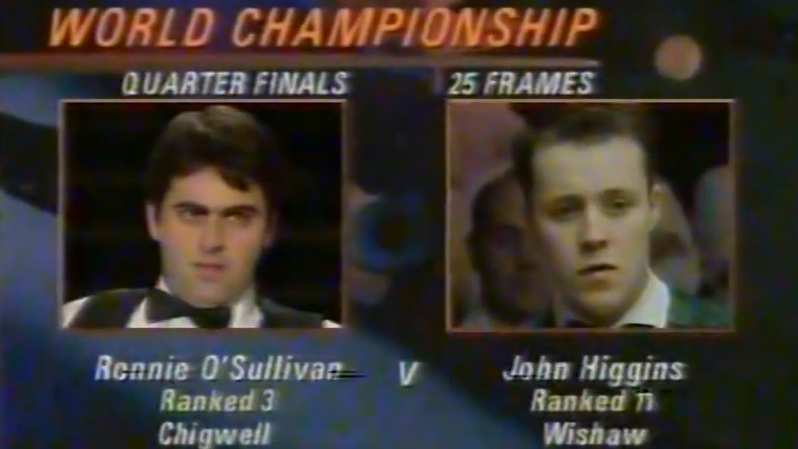
Two fresh-faced 20-year-olds going head-to-head in an epic quarter-final at the 1996 World Snooker Championship, with the Scot one frame away from defeating England’s Ronnie O’Sullivan.
“That is one match that sticks in my mind,” said Higgins. “I was 12-11 in front and I remember it as clear as day.”
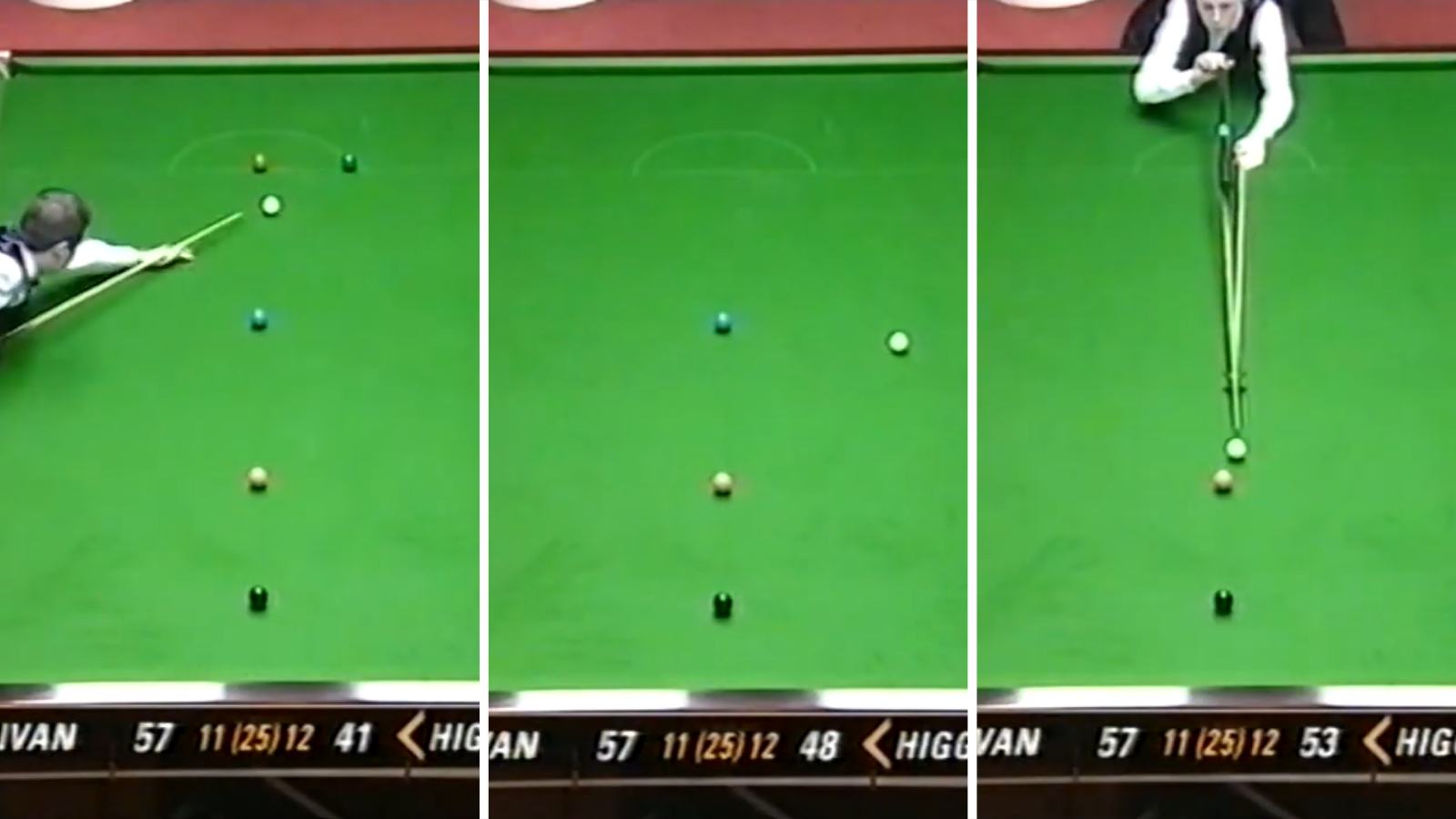
The colours are all on their spots – a regular training programme usually dispatched with ease for a man of his talent. Pot them all and he is in the semi-finals for the first time.
Legendary BBC commentator Ted Lowe, predicting trouble may be ahead in the Crucible cauldron, says: “The butterflies must be floating around his tummy.”
Higgins, with perfect memory 30 years on, takes up the story: “I’ve got an easy clearance with the colours. I normally pot the brown and just play off the side cushion and be above the blue.
“This time I decided just to stun the blue down when you’re under a bit of pressure. I was well below the blue. I went round the cushion, went round the angles and landed a very tough rest shot.”
Still, Higgins is only two shots from the semi-finals. But the tricky pink is missed, O’Sullivan cleans up, wins the decider and Higgins is out.
In the semi-final, O’Sullivan then lost to Peter Ebdon, who was beaten by Stephen Hendry in the final.
“I might have won the World Championship two years earlier than I did,” said a rueful Higgins, who admitted that was one of his most painful losses in his 34-year professional career.
“It was a brilliant game. We were only 20 and it was a slugfest, shot for shot. They are the ones that give you a bit of steel going forward, the games that make you as a player.
“You never think of your good wins. It’d be great if you thought of your good wins, but you always think of the ones that got away.”
John Higgins v Ronnie O’Sullivan
World Snooker Championship
Match starts at 19:00 BST on Saturday, 25 April
Watch live coverage of the opening frames on BBC Four and BBC iPlayer, with live text updates on the BBC Sport website and app
‘There were reports he was going to get thrown out’
What made the pair’s first Crucible match even more remarkable were the circumstances going into it.
The night before, O’Sullivan faced a disciplinary hearing after he had assaulted a World Snooker press officer and could have been thrown out of the tournament.
While Higgins waited in his hotel to see if he would be given an automatic victory, O’Sullivan was getting fined £20,000 and being handed a suspended two-year ban.
“There were conflicting reports that he was going to get thrown out,” said Higgins. “I was lying in my bed at night thinking: ‘Am I going to get a bye to the semi-finals here?'”
“I didn’t know until one o’clock in the morning whether I was going to play Ronnie at 10am.
“I got a phone call in the hotel. I was staying at the old Grosvenor that’s not there any more and it basically says: ‘Yeah, you’re playing Ronnie at 10.’
“So it’s just funny how you remember things. That was many years ago, 30 years ago. I remember it as clear as day.”
‘We deserve a great pat on the back’
In a truly remarkable story of hard work, endurance, talent and dedication, the pair are still at the top of the sport three decades later and will go head-to-head in the last 16 on Saturday.
Thirty years on from that first memorable Crucible meeting, O’Sullivan has seven world titles, Higgins has four, both having long cemented their positions as two of the greatest players the sport has ever seen.
“We deserve a great pat on the back,” added Higgins, who admitted he never thought he would still be playing so well at this age.
Higgins and O’Sullivan are both now 50, while they are joined in the last 16 by the third member of snooker’s fabled ‘Class of 92’, with 51-year-old Mark Williams still in contention for a fourth title.
O’Sullivan holds the record for being the oldest world champion after his most recent success four years ago, aged 46, but that could be beaten in the next week and a half.
After that first World Championship meeting in 1996, Higgins beat O’Sullivan 17-9 in the 1998 semi-finals on his way to his first title, before the Rocket got his revenge, winning 18-14 in the 2001 final for his first success.
Higgins then gained 13-9 and 13-10 wins in the quarter-finals of 2007 and 2011 respectively, before O’Sullivan won their most recent Crucible tie, 17-11 in the 2022 semi-finals.
They have played six times at the famous Sheffield theatre, with three wins apiece.
‘A big chance this could be our final game’
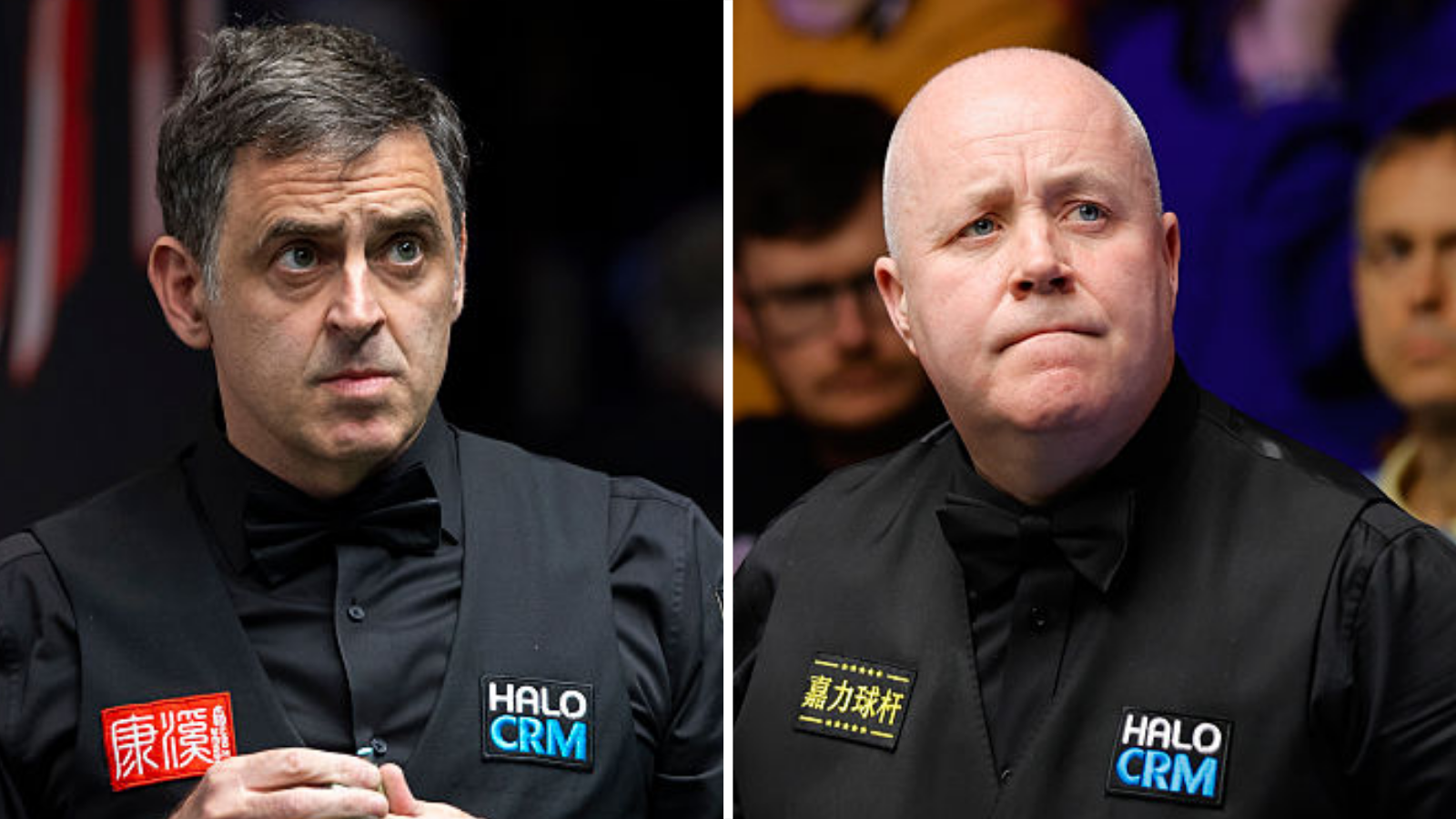 Image source, Getty Images
O’Sullivan felt any meeting between the ‘Class of 92’ members was a big occasion.
“I find it easier playing Mark than I do John,” said O’Sullivan. “John enjoys playing me, I enjoy playing Mark, and Mark enjoys playing John. John doesn’t like playing Mark.
“I first played John at Pontins, we were 14 [at the Pontins Autumn Open juniors competition]. I had never heard of him until that tournament, but you knew then that he was an unbelievable player.
“Now it’s a couple a oldies that are just hanging around. John plays better against me than I do against him so I will be a bit of an underdog – the pressure is off me and more on him, hopefully I can give him a good game.”
O’Sullivan has tried to claim he should be called ‘Rusty Ron’ because of not regularly playing in 2026, although he then crushed China’s He Guoqiang 10-2 in the first round, using a different cue in the two sessions.
Higgins defeated Ali Carter 10-7 in round one and said the fact this could be his last Crucible match against O’Sullivan made the occasion even more memorable.
“That’s what the rest of my career is all about – to savour these nights,” added Higgins.
“But you’ve got to put that to one side because you’re there to win. It’s only the second round as well, so you’re there to make it through. So I’ll look forward to it.
“There’s a big, big chance this could be our final game, so it will be something to savour – it will be special.”
Related topics
Sports
Turkey to return to F1 calendar in 2027

Sports
The Women’s Six Nations is faster and smarter – but is it better?

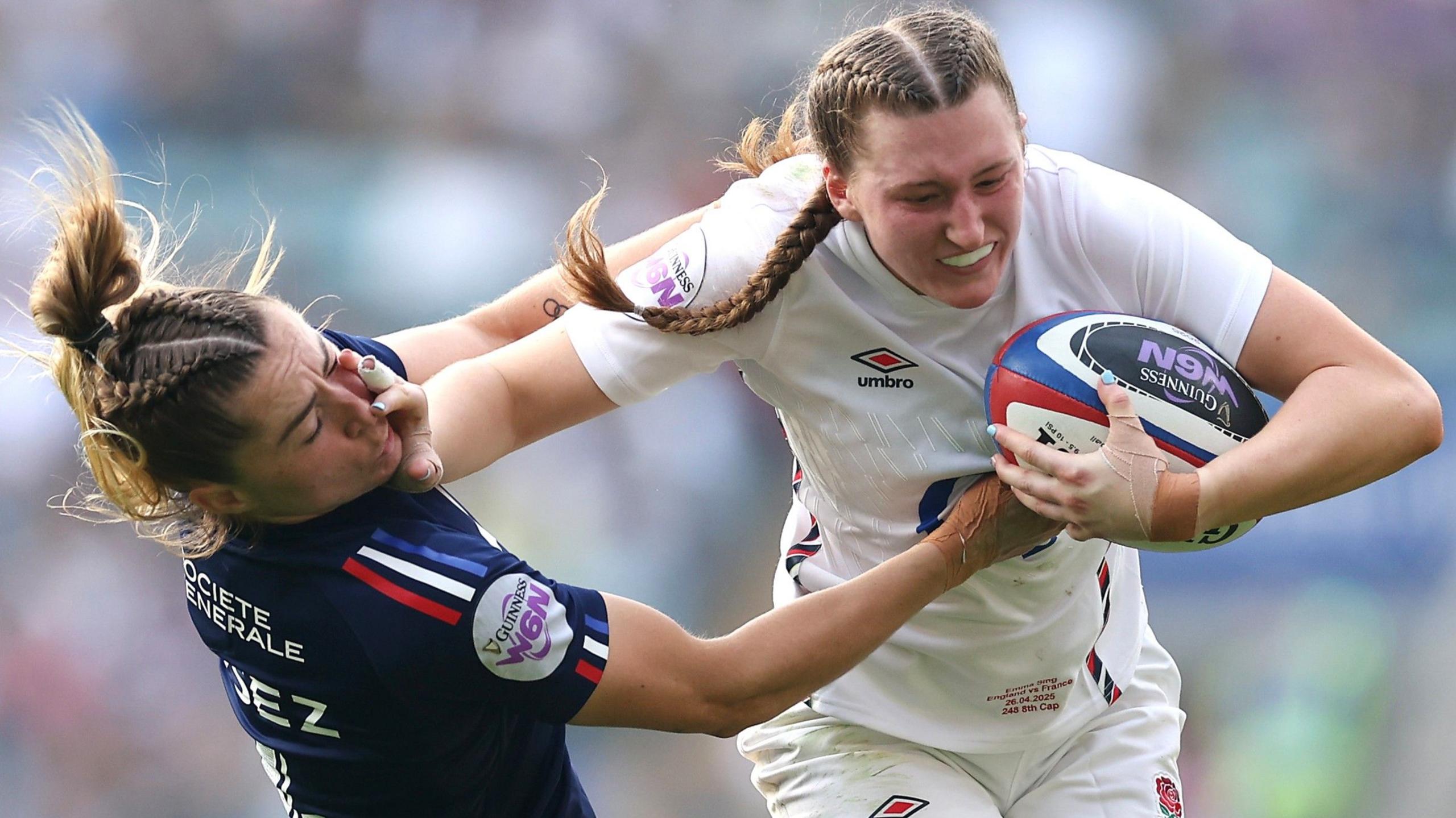 Image source, Getty Images
The first 40 minutes of the Women’s Six Nations was, at best, a half for the purists.
Estelle Sartini, a PE teacher from Caen, kicked the only points as France, one of the favourites for the inaugural title, headed for the dressing rooms with a 3-0 lead over Spain, who contested the first five editions before being replaced by Italy in 2007.
This year will be the 25th staging of the competition. And the game has changed. But has it been for the better?
Does increased athleticism and tactical nous risk losing the distinctive character of the women’s game?
Simon Middleton, who was England’s head coach for eight years before standing down after the 2023 Six Nations, saw the change firsthand.
“The women’s game doesn’t want to be the men’s game – and that’s how it should be,” he said.
But, first, what do the numbers say?
Points win prizes
The 2025 Women’s Six Nations was the highest scoring ever, with an average of 55.9 points per game. It is part of trend, rather than an anomaly.
The five highest-scoring tournaments have all taken place since 2019.
After two rounds of this season’s tournament, the average stands at 58 points a game – on track for another record.
Is it simply the fact that England, world champions and seven-time defending champions, are running amok and pushing up the average?
The Red Roses have certainly been dominant. They racked up winning margins of 55 and 52 points against Wales and Scotland respectively last year.
So far in this year’s tournament they have seen off Ireland by 21 points and Scotland by a whopping 77-point margin.
But even if you remove England’s results from the calculations, teams are scoring more.
Take the Red Roses’ fixtures out of consideration and there was still a record average of 51.2 points per match in 2025, matching the high set for the same metric in 2021.
The growth in points has outstripped the rise in the winning margin as well.
The average number of points per match in 2007, when Italy first joined the tournament, was just shy of 30, nearly half of what it was in 2025.
The average winning margin meanwhile has risen, but only slightly, from 19.5 points to 25.4 over the same period.
In this year’s tournament the average winning margin is currently higher than usual at 34 points, but an incomplete fixture list make it an imperfect comparison.
Kicks and decreased recovery time
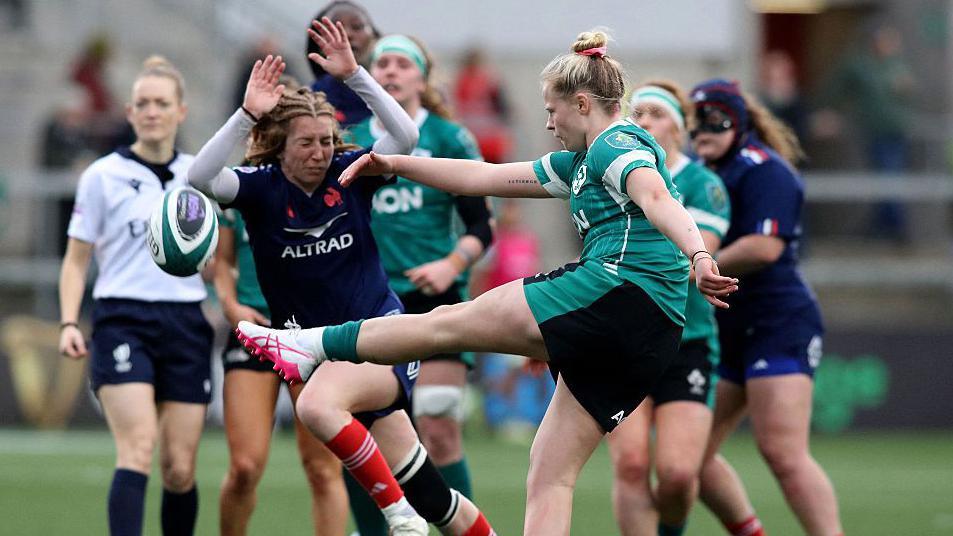 Image source, Getty Images
That record high in points being scored has come despite teams keeping the ball in hand less.
Over the past five years, the ball has been kicked more than ever in the Women’s Six Nations, with a steady and consistent rise from an average of 26.1 kicks per game in 2021 to 44.7 in 2025.
The number of kick metres has doubled.
“I certainly was blessed with England when I came in, because I had so many really technically good players, who could kick the ball really well – Emily Scarratt, Katy Daley-Mclean and a number of other players – and that fit perfectly with how we wanted to play,” Middleton told BBC Sport.
“Other teams didn’t have that for a long time.
“The whole staffing group level has risen significantly across all the nations, with an increase in coaching standards and a tactical awareness of playing a territory-based game, rather than a possession-based game.
“Over the last four or five years certainly, a lot of teams have probably shaped their key players to fit that.
“You look at Dannah O’Brien – she’s got a fantastic kicking game and Ireland built all their game around her, kick-chasing from inside their own half.
“Wales with Lleucu George and Keira Bevan – they play a very kick-dominated game.
“During my time with England, France became a team that kicked more than we did.
“Two things have changed – the game understanding and the technical ability of players to be able to play that way.”
Teams are using the boot more, putting the ball in behind defences sooner, rather than playing though multiple passages in search of an opening.
The share of possessions with five or more phases has dropped year-on-year in the Women’s Six Nations since 2020.
There has been a parallel change however.
Those passages of play are coming quicker and quicker, with 62.8% of rucks completed in under three seconds in last year’s competition, up 10% on the 2020 competition.
That rapid-fire ruck speed was a feature of the Women’s Rugby World Cup last year as well, with Canada and England both getting through 45% of their rucks in less than two seconds in their semi-finals, quicker than the average men’s Test side.
In the 2021 tournament, England’s equivalent figure was only 21%.
“High ruck speed delivers momentum, quick ball is good attacking ball, cutting down the defence’s time to organise,” says Middleton.
“These are all things we know, but I think there are a couple of things at the root of the game getting faster.
“Firstly there is the technical development in players – body position in the clear out and the like – but also, and probably just as significant if not more so, there is the physical capacity of players now to go again and again and again. There are some tremendous athletes out there.”
Perhaps the most predictable change to have coincided with the women’s game becoming more professional has been at the set-piece.
Line-outs and scrums are becoming more reliable sources of ball for all teams with success rates of 89% and 95% respectively in last year’s tournament.
Goal-kicking, a similarly repeatable skill which benefits from training time, is also up with a 70.1% success rate representing a post-pandemic high.
Kickers are landing more from out wide too. Their success rate from within 10m of the touchline was 41% in 2025, another rise on the previous five years.
More reliable goal-kickers and a greater emphasis on kicking out of hand has made the women’s game closer to the men’s in some respects.
Middleton warns that it needs to keep some of its catch-pass creativity and distinct difference.
“It is a different type of brand and it’s played for a different type of audience and I don’t think a game too heavily based on kicking will suit it,” he said.
“That’s fine coming from me and the way we played!
“But if everybody goes down the route of being really tactical and playing territory rather than possession, being really prescriptive, rather than with heads up and eyes open, you could see a lot of ball being kicked away and the ball pinging back and forth and nobody really wants to see that.”
Related topics


Father recalls horror after son murdered his 5 grandchildren: ‘I knew he killed them’
NEWYou can now listen to Fox News articles! When Timothy Jones Sr. learned his grandchildren were missing, a deep,...


Seven dead in major Russian attack on Ukraine | BBC News
At least seven people were killed in Russian strikes across Ukraine overnight, including five in the central city of Dnipro,...


New York bills could abolish life without parole for serial killers and cop killers, critics warn
NEWYou can now listen to Fox News articles! State lawmakers in New York are considering a series of “four...


Pope condemns death penalty as Trump admin pushes for firing squads
Pope Leo XIV condemned capital punishment in a video to DePaul University in Illinois on Friday to mark the 15th...


Owner's warning after dog's tulip festival death. #Yorkshire #BBCNews


CBP joins forces with Coast Guard to intercept 3 smuggling boats, apprehend 60 people off California coast
NEWYou can now listen to Fox News articles! U.S. Customs and Border Protection said it apprehended 60 smugglers off...


How do you write a new James Bond theme? | BBC News
The composer behind many James Bond films, David Arnold, has written a new 007 theme. But this time, it’s for...


Masked burglary crews terrorizing ritzy neighborhoods show ‘they’re doing their homework,’ veteran cop warns
NEWYou can now listen to Fox News articles! A fast-moving burglary spree is unfolding across Los Angeles, with thieves...


Retired generals break down Iran war strategy after week 8
A flurry of developments across the Middle East is intensifying an already volatile regional landscape, with diplomacy, military …


Matt Friend pokes fun at Gen Z in the military
Comedian Matt Friend poked fun at himself and the rest of Gen Z enlisting in the US military. ‘America Laughs...
-

 Theboldnews video1 week ago
RADDI AKHBAR 2 | क्या हुआ?
-

 Entertainment1 week ago
Kiss Cam Woman Kristin Cabot Says Chris Martin ‘Never’ Checked On Her After Viral Boss Scandal Ruined Her Career
-

 Video2 weeks ago
Israel is losing US support – even among Republicans
-

 Video1 week ago
Tell me how to feel about space | The Assignment
-

 Video1 week ago
Let grief be messy: NYTimes writer talks to Anderson Cooper about the life and death of her daughter
-

 BBC News World1 week ago
Turkish police detain 162 people over online posts about school shootings
-

 Video1 week ago
Debate: Who's right about gas prices, Trump or Americans?
-

 Video2 weeks ago
Students flee shooting at high school in Turkey