
Politics
Mandelson under formal investigation by EU’s anti-fraud office

Mandelson under formal investigation by EU’s anti-fraud office
 Getty Images
The EU’s anti-fraud office has begun a formal investigation into Lord Peter Mandelson, who was sacked as UK ambassador to the US over his ties to late sex offender Jeffrey Epstein.
Lord Mandelson served as European trade commissioner from 2004 to 2008. The European Commission asked the European Anti-Fraud Office (Olaf) two months ago to look into allegations of misconduct during that four-year period.
Olaf confirmed on Friday that it had recently had “sufficient information” to launch an investigation, but said it was too early to say whether or not it involved allegations of fraud.
After Lord Mandelson left Brussels, he became UK business secretary until 2010.
Olaf is expected to look at exchanges with Epstein from Lord Mandelson’s time as EU commissioner. It has confirmed its mandate covers all four years, and is limited to staff and members of EU institutions.
However, emails to Epstein have also surfaced surrounding the eurozone crisis in 2010. Among the allegations are that Lord Mandelson gave Epstein advance notice of an impending €500bn (£434bn) bailout, when EU governments decided to do “whatever it takes” to stop Greece’s financial crisis spreading to other countries in the eurozone.
Lord Mandelson has not commented on the allegations but the BBC understands he has denied acting in any criminal manner and was not motivated by financial gain.
The anti-fraud office said it had no jurisdiction to prosecute and made clear that “if there is a criminal element we will pass it to the European Prosecutor’s Office”.
Olaf’s role is to investigate allegations of fraud that relate to the EU’s budget, as well as corruption and serious misconduct within EU institutions.
It can recommend sanctions against someone under investigation, but the decision has to be taken by relevant EU authorities. Among the recommendations possible are judicial, financial, administrative and disciplinary, so that could include revoking the former commissioner’s pension.
Olaf told the BBC that any documents would now be analysed and that “IT forensics” would be done, insofar as they were available after so many years. It could not confirm whether further allegations had come to light since February.
Earlier this year, email exchanges between Lord Mandelson and Epstein emerged from that period, prompting the UK’s Metropolitan Police to launch a criminal investigation into suggestions that he had passed on market-sensitive information during his time as business secretary in 2009.
Lord Mandelson was sacked as UK ambassador to the US in September 2025 as the extent of his friendship with Jeffrey Epstein became clear.
The scandal surrounding the peer’s ties to Epstein continue to reverberate through UK politics, and this week the former top civil servant at the Foreign Office, Sir Olly Robbins, said he had been pressured to rush through Lord Mandelson’s appointment as ambassador to the US.
Politics
No 10 says Falklands sovereignty rests with UK after report of US ‘review’

No 10 says Falklands sovereignty rests with UK after report of US ‘review’
 Getty Images
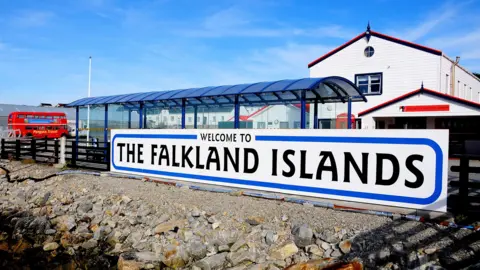
Sovereignty of the Falkland Islands “rests with the UK”, Downing Street has said, following a report the US could review its position on Britain’s claim to the territory.
An internal Pentagon email reported by Reuters suggested the US was considering options to punish Nato allies it believed had failed to support its war on Iran.
The options discussed also included seeking Spain’s suspension from Nato over its opposition to the war. BBC News has not been able to review the email.
A Pentagon spokesperson did not comment on the email’s existence, but said it would “ensure that the president has credible options to ensure that our allies are no longer a paper tiger and instead do their part”.
“As President [Donald] Trump has said, despite everything that the United States has done for our Nato allies, they were not there for us,” the spokesperson added.
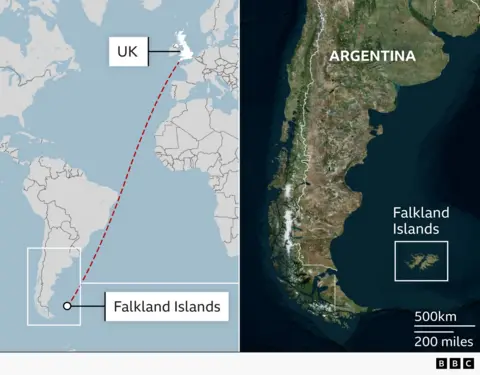
The Falkland Islands, a British overseas territory in the south-west Atlantic Ocean, remain the subject of a sovereignty dispute between Britain and Argentina.
Asked about the report, a No 10 spokesman on Friday said: “The Falkland Islands have previously voted overwhelmingly in favour of remaining a UK overseas territory, and we’ve always stood behind the islanders’ right to self-determination and the fact that sovereignty rests with the UK.”
The prime minister’s official spokesman also said the government “could not be clearer about the UK’s position”, and that “sovereignty rests with the UK and the islanders’ right to self-determination is paramount”.
He continued: “We’ve expressed this position previously clearly and consistently to successive US administrations and nothing is going to change that.”
Former Labour security minister Lord West BBC Radio 4’s The World Tonight programme the Pentagon leak on the Falklands was “quite extraordinary” and showed “a lack of understanding”.
Lord West, who was an officer commanding HMS Ardent during the Falklands War, went on to describe US Defence Secretary Pete Hegseth as “thick” and accused him of having a total lack of understanding about Nato.
“Hegseth talks about the fact that Nato’s never done anything for America, America’s done so much for Nato, but the only time that Article 5 was invoked was by Nato and it was to defend the United States,” he said.
“I’m afraid he’s thick actually, and he doesn’t seem to have a very good knowledge of a lot of these things, but to say that is stupid.”
Under Nato’s Article 5, an armed attack against one or more members is considered an attack against all, and in response each other member would take “such action as it deems necessary, including the use of armed force, to restore and maintain the security of the North Atlantic area”.
The only time Article 5 has been invoked was after the 9/11 attacks on the US in 2001.
Previous US administrations have formally recognised the UK’s de facto administration of the islands, but have not taken a formal position regarding sovereignty.
“The Falkland Islands has complete confidence in the commitment made by the UK government to uphold and defend our right of self-determination,” the islands’ government said in a statement.
Conservative leader Kemi Badenoch said the reported US stance on the Falkland Islands was “absolute nonsense”, adding: “We need to make sure that we back the Falklands. They are British territory.”
Reform UK’s Nigel Farage said: “This is utterly non-negotiable. There is no way we’re even going to have a debate about the sovereignty of the Falkland Islands.”
He also said he would raise the issue with Argentina’s President Javier Milei when he meets him later this year.
Liberal Democrat leader Sir Ed Davey has once again called for the King’s forthcoming visit to the US to be cancelled.
“This unreliable, damaging president cannot keep insulting our country,” Sir Ed said.
The report emerged three days before King Charles III and Queen Camilla are due to travel to the US and meet Trump at the White House.
While the White House is yet to comment on the report, it could prove to be another point of friction between the US and UK at a time of diplomatic tension.
Trump has previously said he is “not happy” with the level of support offered by the UK during its war in Iran, while Sir Keir Starmer has repeatedly said Britain will not be drawn into a wider conflict.
Meanwhile, an official from Nato – responding to the suggestion in the report that the US could push for Spain’s expulsion from the military alliance – said its founding treaty “does not foresee any provision for suspension of Nato membership, or expulsion”.
Earlier, Spain’s Prime Minister Pedro Sanchez said: “We do not work based on emails. We work with official documents and official positions taken, in this case, by the government of the United States.”
The Falkland Islands have been under British rule since 1833, but Argentina has historically said it has a right to them on the basis it inherited them from the Spanish crown, as well as the islands’ proximity to the South American mainland.
In 1982, a 10-week conflict between the UK and Argentina over the islands was triggered when the latter’s military dictator, Leopoldo Galtieri, ordered his country’s forces to invade them.
The then UK Prime Minister Margaret Thatcher’s government sent a naval task force to recapture the islands.
Argentine forces surrendered, but the country still claims sovereignty over the Falklands, which it calls the Malvinas and which lie about 300 miles (483km) east of Argentina.
In the course of the conflict, 649 Argentine military personnel and 255 British military personnel lost their lives, as well as three Falkland Islanders.
More recently, Falkland Islanders have overwhelmingly expressed their desire to remain as a British territory.
A 2013 referendum among the island’s 1,672 eligible voters saw all but three voting to continue as an overseas territory, on a turnout of more than 90%.
Successive British governments have long maintained that the island’s population has a right to self-determination under international law established by the United Nations Charter.
Argentina’s foreign minister Pablo Quirno wrote on X on Friday that his country rejected this, stating that those living in the Falkland Islands had never been recognised as a people by the UN.
“Argentina reaffirms its sovereign rights over the Malvinas Islands”, Quirno wrote, adding: “The Argentine Republic once again expresses its willingness to resume bilateral negotiations with the United Kingdom that will allow for finding a peaceful and definitive solution to the sovereignty dispute.”
Milei, who is a close ally of Trump, previouslysaid it would take decades for the dispute to be resolved, and criticised Argentine politicians who “beat their chests demanding sovereignty of the islands, but without any result”.
Politics
Chris Mason: A grim week for Starmer – but things could be about to get worse

A grim week for Starmer – but things could be about to get worse
 PA Media
This was the week questions about the future of the prime minister took a turn for the worse for Sir Keir Starmer.
If you had asked me a fortnight ago about the sentiment we were picking up from Labour MPs about Sir Keir’s future in Downing Street, I would have told you that pressure from them appeared to have eased.
Perhaps, some pondered, after the prime minister’s political near death experience in February – the moment the Energy Secretary Ed Miliband said the party “looked over the precipice” – the appetite to take another peek over the edge had gone, at least for now.
Labour MPs were still looking towards the elections around Britain a week on Thursday with trepidation bordering on horror, but many talked with pride about how their leader was handling the war in the Middle East and the fervent leadership chatter had eased, at least a bit.
But all of this was before mid-afternoon on Thursday of last week, when the Guardian’s investigation about Lord Mandelson’s security vetting dropped.
Since then, an unremittingly, relentlessly, incessantly grim story, if you think of it from the perspective of the Labour Party, has been squatting on the news agenda, expelling the potential for anything they would rather be talking about getting any attention.
And yes, just days before those crucial elections to the Scottish and Welsh parliaments and to many English local authorities.
So you won’t be remotely surprised when I tell you that it has left Labour folk from the cabinet down gloomy, run down and irritated.
We have seen an element of that play out publicly.
Ministers deployed on what is known as the morning round, where they trundle from one studio to the next, often in possession of a government announcement but also braced for an avalanche of questions on the story of the day, haven’t hidden their frustrations as assiduously as they might once have done.
The aforementioned Miliband, a former party leader, acknowledged on Sky News that when Lord Mandelson was appointed to the ambassador’s job in Washington he had worried “it could blow up” and he had discussed those concerns with cabinet colleague David Lammy, who he said shared them.
What is telling is less that that was his view at the time, and more that it is something he is willing to share publicly now.
He also said, on Good Morning Britain, that it was “a fair point” that enough was already known about Lord Mandelson when he got the job that it would have been possible to conclude at the time that his appointment was not just risky but wrong.
Later in the week it was the turn of Work and Pensions Secretary Pat McFadden to head from camera to camera.
He is, usually, a doughty defender of the government and he still was.
But he was managing to put a noticeable distance between himself and the news No 10 had been hawking their former director of communications Lord Doyle for a job as an ambassador.
Foreign Secretary Yvette Cooper went further – she was publicly aghast at this particular revelation.
Each example here felt to me like straws in the wind – easily dismissed in isolation but alongside everything else an indicator of the prime minister’s declining authority.
Then there was this week’s cabinet meeting, where ministers were happy to let it be known to journalists that they had expressed concern about the government’s relationship with the Civil Service, after the unceremonious dumping of the top official at the Foreign Office, Sir Olly Robbins.
Chancellor Rachel Reeves and Health Secretary Wes Streeting were among those who spoke up on this.
There is nuance here – the prime minister himself had expressed concern too, we are told.
And of course cabinet ministers will fret about this – they deal daily with their permanent secretary and senior civil servants and rely on them to deliver their agenda.
But again, and yes it’s subtle, there was a willingness to let it be known the consequences of No 10’s actions had been raised.
 Reuters
We then had Labour backbencher Jonathan Brash telling GB News Sir Keir’s time was up and his colleague Dan Carden on BBC Newsnight being a little less blunt but nonetheless saying “there is definitely a question about the future of the Labour government.”
The left-wing political magazine the New Statesman chimed in too. Its editor, Tom McTague, a thoughtful writer not known for hyperbole, said of Sir Keir: “The clamour is growing: he cannot do the job.”
His article quoted Boris Johnson’s public reflection when the time was up for him in Downing Street, when he said “when the herd moves it moves”.
It was a reference to his parliamentary party, the crucial electorate for any party leader: it is their MPs who decide their fate.
And this week, the Labour herd is chuntering; it is chewing the leadership cud again.
It is worth reflecting that the fundamentals that brought about Labour’s big wobble over Sir Keir in February are still there, as are the fundamentals that meant he survived that moment.
Let’s take each in turn: the government is deeply unpopular and Sir Keir is more so.
This, alongside the evergreen critique made of this government, by those on its own side and its opponents, that it lacks a clear sense of direction and purpose, is the fundamental that makes Labour folk ponder how long he should have left.
But there is another fundamental too. The party cannot agree who it would like to replace him and plenty of the leading candidates have tricky things to overcome.
The former Deputy Prime Minister Angela Rayner is still in a wrangle with the taxman.
The mayor of Greater Manchester Andy Burnham isn’t an MP.
And Streeting, the health secretary, is trying to shake off his connection and previous friendship with Lord Mandelson.
He voluntarily published his messages with the peer two months ago to try to prove he “doesn’t have skeletons in his closet”, as one of his allies put it.
The prospect of a leadership race, while in office, horrifies many Labour MPs because critics would label it self-indulgent and navel-gazing – and it would deliver a new prime minister with no mandate from the electorate.
It feels then something like that classic philosophical paradox of an immovable object encountering an unstoppable force: logically impossible because the existence of one precludes the other.
So far at least, the fundamentals standing in the way of toppling the prime minister have proved stronger than those arguing for change.
The huge question now is whether that changes when the Labour Party confronts the likely grisly reality of the electorate’s verdict early next month.

Sign up for our Politics Essential newsletter to keep up with the inner workings of Westminster and beyond.
Politics
Starmer plans new powers to ban state-backed terror groups

Starmer plans new powers to ban state-backed terror groups
 EPA
EPAMinisters are planning to introduce new anti-terror powers that would enable them to ban state threats such as Iran’s Islamic Revolutionary Guards Corps (IRGC) in the next parliamentary session.
The new powers would allow the UK government to label state-backed groups as terrorist organisations.
The legal change is expected to create new criminal offences for people who support or promote groups formally listed as state-supported threats.
The BBC understands the new powers will be included in the government’s plans for legislation, which will be set out in the King’s Speech on 13 May.
The IRGC was set up to defend Iran’s Islamic system and has become a major military, political and economic force in the country.
It is estimated to have tens of thousands of active personnel and has consistently been accused by Western nations of sponsoring terrorism abroad.
Labour MPs have been urging the UK government to ban the IRGC following a series of antisemitic attacks since the war in Iran started.
An Islamist group suspected of having Iranian links – Harakat Ashab al-Yamin al-Islamia – claimed responsibility for a recent attack on Jewish community ambulances in north London, along with other incidents in the UK and Europe.
Other European countries and the EU have already added the IRGC to their lists of proscribed terrorist organisations.
This week, Prime Minister Sir Keir Starmer said the UK must “deal with malign state actors” and suggested his government would bring forward legislation “as quickly as possible”.
The Jewish Chronicle newspaper also quoted Sir Keir as saying he was “very worried” about the increasing use of proxies by the Iranian government.
“In relation to malign state actors more generally, we do need legislation in order to take necessary measures and that is legislation we’re bringing forward as soon as we can,” Sir Keir said, in a video posted by the newspaper.
“We’re going into a new session in a few weeks’ time and we’re going to bring that legislation forward.”
The previous Conservative government did not proscribe the IRGC, despite suggesting it would do so in 2023.
Maintaining diplomatic relations with Iran has been cited as a reason for not proscribing the IRGC in the past.
Conservative shadow foreign secretary Priti Patel said: “Labour promised action on IRGC proscription but, despite reviews and rising threats, they have failed to deliver.
“Our allies from Europe to Canada and the Gulf have already acted, and the UK is lagging behind.”
Labour had promised to proscribe the IRGC as a terrorist organisation before the general election in 2024.
But once in power, the Labour government stepped back from doing so while ministers reviewed options for dealing with state-linked organisations.
The government already has powers to proscribe organisations under the Terrorism Act 2000.
Other groups like the Iran-backed Hezbollah have been banned under that law.
But last year, the government’s independent reviewer of terror legislation, Jonathan Hall KC, said new powers were needed to tackle state-sponsored organisations.
In a report, Hall recommended a law change that would give the government powers “equivalent to proscription under the Terrorism Act 2000”.
“By way of example, this strong power would be available for use against the Islamic Revolutionary Guard Corps,” Hall said.
Yvette Cooper, when she was home secretary last year, said the government had accepted Hall’s recommendations.
In May last year, Cooper said the government would “draw up new powers modelled on counter terrorism powers in a series of areas to tackle these state threats”.
She added: “And crucially I can tell the House we will create a new power of proscription to cover state threats – a power that is stronger than current national security act powers in allowing us to restrict the activity and operations of foreign state backed organisations in the UK.”
Politics
Assisted dying bill runs out of time but supporters vow to try again

Assisted dying bill runs out of time but supporters vow to try again
 Getty Images
A proposed law to legalise assisted dying in England and Wales has run out of time to become law, almost 17 months after MPs first voted in favour of it.
The bill stalled in the House of Lords after the House of Commons supported allowing terminally ill adults expected to die within six months to seek medical help to end their life, subject to certain safeguards.
But supporters said they would not give up and were confident the legislation would return in the next session of Parliament, which will begin on 13 May.
They have accused some peers of using delaying tactics to block the bill’s progress but critics have argued it does not have sufficient safeguards to protect vulnerable people.
More than 1,200 amendments were tabled in the Lords, which is believed to be a record high for a bill introduced by a backbench MP.
The Terminally Ill Adults (End of Life) Bill was supported in principle by MPs on 29 November 2024 by a majority of 55 and cleared the Commons on 20 June last year with a majority of 23.
In the Lords, the bill did not clear all its stages and Friday marked the 14th and final day of committee stage – which allowed the legislation to be assessed line by line and for changes to be considered.
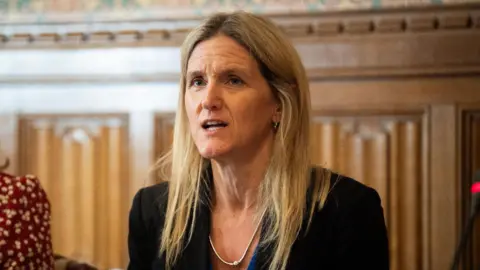
Labour MP Kim Leadbeater who introduced the bill in the Commons, said there was a “real sense of sadness and sorrow” at its failure to pass.
However, she insisted there was was “appetite” for the legislation to return and said she was “confident” it would do so.
Speaking at a news conference after the bill fell, she argued that peers in the House of Lords had held up the legislation adding: “This isn’t what democracy looks like”.
Leadbeater said there were MPs willing to take the same bill on during the next session should they be successful in the Private Members’ Bill ballot, which allow MPs to propose legislation and can guarantee debating time on Friday sittings.
Supporters of assisted dying say they have so many MPs lined up they are confident it will come back in the next session. One told the BBC more than 100 are ready – and another 100 could be persuaded.
Leadbeater said she hoped the bill would then clear the Commons again and agreement could be reached with peers over amendments.
She also acknowledged the powers in the Parliament Acts could be used to prevent peers blocking the legislation.
Under the terms of the rarely used legislation, if an identical bill passes the Commons a second time then the Lords cannot prevent it progressing again and it would become law at the end of that second session even without peers’ approval.
The Parliament Acts were last used in 2004 to push through a ban on fox hunting.
 PA Media
Baroness Grey-Thompson said the bill, which she opposed, failed as there were “tonnes of holes in it” and it had arrived in the Lords with a “very clear message” from MPs to make improvements.
The independent crossbench peer, who is also an 11-time Paralympic gold medallist, told the BBC: “It doesn’t give me any sense of satisfaction that this bill has failed because it doesn’t fix the problem that we’re trying to solve.
“In the chamber today we repeatedly heard about the voices of terminally ill people, yes that’s important, but also the voices of those who feel they have no choice.”
Baroness Grey-Thompson said she had received thousands of emails, adding many of them were from disabled people saying “thank you for protecting our rights and looking out for us”.
Leadbeater was joined after the debate in the Lords by Sophie Blake, who has stage four secondary breast cancer and Rebecca Wilcox, the daughter of broadcaster Esther Rantzen, who has lung cancer.
Blake said she felt that the “hope” she and other supporters of the bill had felt when the bill was first backed by MP “had been taken away” by an “unelected and accountable group of individuals”.
Wilcox said she was hopeful the same bill would get through in the future telling reporters: “We’ve got the stamina, we’ve got the energy, we will do it.”
However, she said she was not sure if her mother would live to see the bill become law, adding: “I’m a bit furious about that.”
Lord Falconer, who was leading the bill through the House of Lords, opened the final day of debate by telling peers he felt “despondent”.
He said the bill had not failed “on its merits” but as a result of “procedural wrangling”.
Baroness Coffey was one of the peers who had tabled several amendments to the bill.
The former Conservative minister said her amendments had tried to “draw out how the bill would work in practice – whether the safeguards claimed would really provide safeguards in practice”.
“I do fear that many peers and many MPs are putting choice for some, ahead of concern on coercion for others,” she added.
Baroness Campbell of Surbiton, a former commissioner at the Equality and Human Rights Commission (EHRC), said the bill “frightens” disabled people and that concerns were “real and repeated”.
She said the amendments she had contributed to had “sought to strengthen safeguards”, adding: “That is not obstruction; it is our duty.”
During the debate several peers echoed Lord Falconer’s criticism that opponents had deliberately held up the bill.
Crossbench peer Lord Pannick said the Lords’ “failure” to get to the point of holding a vote on the bill was “a stain on the reputation of this House”, while Conservative Lord Baker described it as a “constitutional farrago”.

Sign up for our Politics Essential newsletter to keep up with the inner workings of Westminster and beyond.
Politics
The assisted dying bill has failed – but the debate isn’t over

The assisted dying bill has failed – but the debate isn’t over
 Getty Images
Friday 20 June 2025 felt like a day of history in the House of Commons.
MPs approved a bill which would have legalised assisted dying in England and Wales. After a passionate and thoughtful debate, 314 MPs backed the bill – 291 voted against.
The decision was compared to some of the biggest votes on matters of conscience; the Abortion Act, legalising homosexuality and allowing gay marriage.
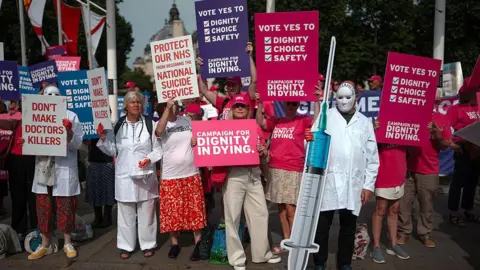
Campaigners outside Parliament, who had wanted the choice to end their own lives, were emotional and delighted.
Beside them in Westminster, opponents of the bill were disappointed. But they insisted the debate was not over.
Fast forward to today. After months of debate in the House of Lords, there was no moment where Parliament made its final decision in an historic vote.
Instead, time has simply run out. It had become increasingly clear as time went on that the Lords would not pass the bill in time.
Now, its journey is officially over.
To some, that will be a democratic outrage. Supporters of assisted dying are extremely frustrated at the way this process has played out in the Lords.
Hundreds upon hundreds of amendments were put forward.
The Lords does not work like the Commons – so they were all due to be discussed.
There simply wasn’t the time to debate or vote on all the changes being suggested.
For backers of the bill, that is a sign that a small number of peers were able to frustrate the process – and effectively kibosh the will of MPs in the democratic elected part of Parliament.
But that isn’t everyone’s view. Others argue it is the job of the Lords to find problems with legislation – and try to solve them.
It might be frustrating to some – they argue – but it is how Parliament is supposed to work.
They also point out that some MPs who backed the bill proceeding didn’t do so uncritically – they wanted to see more scrutiny and changes. Without them, they may not have backed the bill in a final vote in the Commons.
Remember too, this was a free vote. MPs weren’t ordered to vote along party lines. But because it’s seen as a matter of individual conscience it’s not a change that was promised at the general election by Labour or the other larger parties.
So what now?
This is a Private Members’ Bill – which was brought forward by Labour MP Kim Leadbeater. It can’t simply be brought back in the next session of Parliament, like a government bill.
It could however be brought back by another backbencher.
Every year, there is a ballot of MPs – with whoever wins getting the chance to suggest new legislation and priority for it to be debated on Fridays.
If another MP was so minded, they could bring back the exact same bill in the next Parliament.
In fact, supporters of assisted dying say they have so many MPs lined up, they are confident it will come back in the next session. One tells me more than 100 are ready – and another 100 could be persuaded.
It’s possible the Parliament Act could be used, meaning peers could not block the bill a second time.
It would be unprecedented for a bill put forward by a backbench MP.
Would Parliament be comfortable using this rare process? And would MPs be comfortable with a piece of legislation they couldn’t change again?
Perhaps a bigger question – do MPs actually want to focus their attentions on something else? Some have suggested Parliament should be focusing on the cost of living and defence – instead of another debate on this complicated and often divisive issue.
The assisted dying debate is complicated and difficult. The Scottish Parliament, with its one chamber, decided to reject assisted dying. The Isle of Man and Jersey have both backed it – but their bills have yet to receive royal assent.
This bill has reached the end of the road, when it comes to the law in England and Wales. The debate though is not over – and Parliament may yet revisit this important issue.
Sign up for our Politics Essential newsletter to keep up with the inner workings of Westminster and beyond.


Barricaded suspect faces murder charges after 2 doctoral students vanished from campus, 1 body remains missing
NEWYou can now listen to Fox News articles! The towel-wearing suspect who barricaded himself inside a home amid an...


The tiger who came for CT. #BBCNews


Father recalls horror after son murdered his 5 grandchildren: ‘I knew he killed them’
NEWYou can now listen to Fox News articles! When Timothy Jones Sr. learned his grandchildren were missing, a deep,...


Seven dead in major Russian attack on Ukraine | BBC News
At least seven people were killed in Russian strikes across Ukraine overnight, including five in the central city of Dnipro,...


New York bills could abolish life without parole for serial killers and cop killers, critics warn
NEWYou can now listen to Fox News articles! State lawmakers in New York are considering a series of “four...


Pope condemns death penalty as Trump admin pushes for firing squads
Pope Leo XIV condemned capital punishment in a video to DePaul University in Illinois on Friday to mark the 15th...


Owner's warning after dog's tulip festival death. #Yorkshire #BBCNews


CBP joins forces with Coast Guard to intercept 3 smuggling boats, apprehend 60 people off California coast
NEWYou can now listen to Fox News articles! U.S. Customs and Border Protection said it apprehended 60 smugglers off...


How do you write a new James Bond theme? | BBC News
The composer behind many James Bond films, David Arnold, has written a new 007 theme. But this time, it’s for...


Masked burglary crews terrorizing ritzy neighborhoods show ‘they’re doing their homework,’ veteran cop warns
NEWYou can now listen to Fox News articles! A fast-moving burglary spree is unfolding across Los Angeles, with thieves...
-

 Theboldnews video1 week ago
RADDI AKHBAR 2 | क्या हुआ?
-

 Entertainment1 week ago
Kiss Cam Woman Kristin Cabot Says Chris Martin ‘Never’ Checked On Her After Viral Boss Scandal Ruined Her Career
-

 Video2 weeks ago
Israel is losing US support – even among Republicans
-

 Video1 week ago
Tell me how to feel about space | The Assignment
-

 Video1 week ago
Let grief be messy: NYTimes writer talks to Anderson Cooper about the life and death of her daughter
-

 BBC News World1 week ago
Turkish police detain 162 people over online posts about school shootings
-

 Video1 week ago
Debate: Who's right about gas prices, Trump or Americans?
-

 Video2 weeks ago
Students flee shooting at high school in Turkey