
Politics
What you need to know about the 7 May elections in England, Scotland and Wales

What you need to know about the 7 May elections in England, Scotland and Wales
 BBC
BBCThe biggest set of elections since the 2024 general election will see millions of people head to the polls on 7 May.
Voters in Scotland and Wales will elect representatives to their national parliaments, while a number of local council and mayoral polls will take place in England.
In Northern Ireland, local council and Assembly elections are scheduled for May 2027.
Which elections are taking place in England on 7 May?
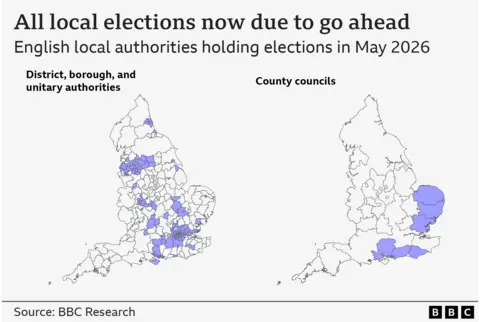
Around 5,000 seats across 136 local councils will be up for grabs.
Initially, polls were set to go ahead in just 106 areas, as ministers had granted 30 authorities permission to postpone their elections until May 2027. This included five areas where they had already been put back from May 2025.
But in February, the government said elections would also go ahead in these areas on May, following legal advice in the wake of a challenge from Reform UK.
Ministers had previously said that postponing the polls would help deliver a major shake-up of local government. The two-tier system of district and county councils that exists in many parts of England will be replaced with new “unitary” councils.
Six mayoral contests will also run on 7 May – in Croydon, Hackney, Lewisham, Newham, Tower Hamlets and Watford.
Elections to select new mayors in Cumbria and Cheshire & Warrington have been postponed until 2027, whilst polls to pick new mayors in Greater Essex, Norfolk and Suffolk, Hampshire and the Solent, and Sussex and Brighton, have been pushed back until May 2028.
In council elections, voters generally have one vote for each available seat in an election area – known as a ward or division.
As in general elections, the first past the post system means whoever receives the most votes wins.
Councils are responsible for local services including care for the elderly and disabled, rubbish collection and recycling, housing, education and road maintenance.
Many councils face a funding crisis and have cut services while increasing council tax.
Which elections are taking place in Scotland on 7 May?
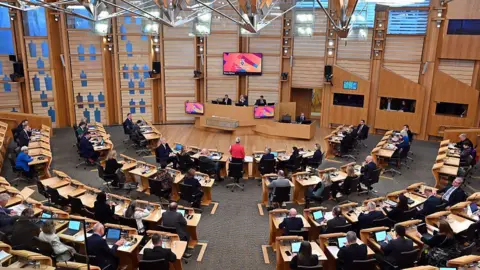
The Scottish Parliament election will decide who governs the country in key areas such as health and education and, as a result, the direction it takes on many issues.
All 129 Members of the Scottish Parliament (MSPs) are up for re-election.
There are 73 constituency MSPs, and 56 regional MSPs (seven per region) in Holyrood.
Each voter has two ballot papers and casts two votes, one to elect their constituency MSP and one to elect their area’s regional MSPs.
Constituency MSPs are selected directly under first past the post, with the winner being the candidate who receives the most votes.
The process to select regional MSPs uses a type of proportional representation.
Voters choose either a political party or an individual candidate from a list. Political parties are allocated regional seats according to a formula which includes the number of votes they receive in each region and the number of constituencies they win outright.
Usually the party with the most MSPs forms the Scottish government, and its leader becomes first minister.
 Getty Images
The current Scottish Parliament was set up in 1999, when Scotland already had its own legal and education system.
Holyrood is now responsible for a much broader range of issues including health, housing, policing and prisons, as well as many aspects of transport, welfare and tax.
It can pass laws in any areas not “reserved” to the UK parliament at Westminster.
Which elections are taking place in Wales on 7 May?
The 2026 Senedd election represents the biggest change to the parliament since powers began to be transferred to Wales in 1999. It will determine who governs Wales on many key issues.
The number of Members of the Senedd (MSs) will be expanded from the current 60 to 96 representatives from 16 newly devised constituencies.
Political parties can list up to eight candidates for each constituency. Independent candidates can also stand. Voters choose one party or one independent candidate.
The 96 seats will then be allocated according to the share of votes received by each party or independent candidate.
The party that wins the most seats in the Senedd election would expect to lead the government. However, no party has ever won a majority in the Welsh Parliament and the new system makes it highly unlikely that will change at this election.
Any MS can nominate any member to be first minister. If there are two or more candidates, MSs will vote to decide who they want to fill the role.
 Getty Images
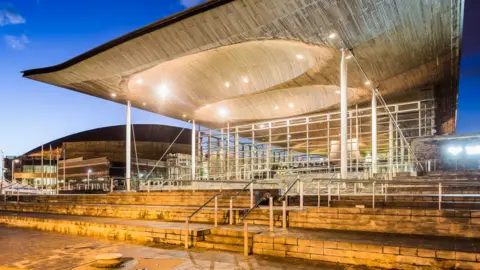
The National Assembly for Wales opened in 1999.
Renamed Senedd Cymru or Welsh Parliament in 2020, its responsibilities now include health, schools, transport and farming, as well as some tax powers.
How can I vote in the May elections?
You must be 18 to vote in the local elections in England, or 16 to vote in the Scottish Parliament and Senedd elections.
You must be either a British or Irish citizen, or a qualifying foreign national – the rules vary according to which country you are from and the type of election.
For all the elections taking place you need to be registered to vote. The deadline for registering has now passed.
There are three ways to vote:
- in person at your local polling station on election day between 0700 BST and 2200 BST
- by postal vote
- by nominating someone to vote on your behalf – a proxy
If you realise at the last minute that you will not be able to vote in person, you can apply for an emergency proxy vote until 1700 BST on polling day. Both you and your proxy must already have registered to vote.
People in four parts of England will be able to vote in different places or ahead of polling day, as part of a pilot exploring ways to make it easier to participate in elections.
Voters in Milton Keynes will be able to cast their ballot in the centre:mk shopping centre. Voters in Cambridge, North Hertfordshire and Tunbridge Wells will be able to vote in person in a variety of locations in the days running up to 7 May, including the previous weekend.
What ID do I need to vote?
You do not need ID to vote in person in the Scottish Parliament or Senedd elections on 7 May.
Everyone voting in person in the local elections in England will need valid photo ID, such as a passport or driving licence.
You can use out-of-date ID as long as you are still recognisable.
Anyone who is already registered to vote but doesn’t have the correct ID – or who no longer looks like their photo – can apply for a free voter authority certificate.
The deadline to apply for one for the May elections has passed.
Voters in England whose ID is lost or stolen can apply for an emergency proxy vote up until 17:00 on polling day. Your proxy will need to have the correct ID.

Sign up for our Politics Essential newsletter to keep up with the inner workings of Westminster and beyond.
Politics
MP rejects rumour he could stand aside for Burnham
MP rejects rumour he could stand aside for Burnham
 BBC
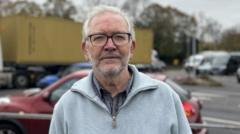
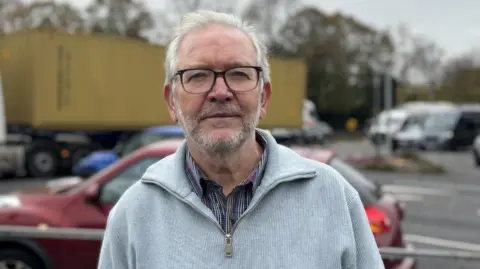
BBCA Merseyside MP has rejected reports suggesting he would stand down to make way for Andy Burnham to return to Parliament.
Peter Dowd, who has represented Bootle since 2015, said speculation he would step aside for the Greater Manchester mayor was “unfounded” and his intention to remain as the constituency’s MP was “absolutely unequivocal”.
Speculation about a possible path back to Westminster for Burnham has been swirling for months – amid suggestions he could mount a leadership challenge to Sir Keir Starmer.
However, he was blocked by Labour’s ruling committee from standing as the party’s candidate in the recent Gorton and Denton by election.
Several veteran MPs have been mentioned as likely candidates to retire and create a vacancy for the former cabinet minister, but Dowd said it was “tittle tattle” that he wanted to “put to bed”.
“I was elected to represent and serve the people of the Bootle constituency at the last election and intend to continue doing so,” he told BBC Radio Merseyside.
He added speculation about Sir Keir’s leadership and constant rumours about who might replace him “distracts and detracts” from the job Labour MPs were trying to do.
“We just need to end the speculation, and certainly in my case, I’ve ended it,” he said.
Bootle has long been regarded as Labour’s safest seat and in 2024 handed the party its biggest majority.
The speculation around Burnham’s link with the constituency is tied to him being born in Aintree, which is in the neighbouring constituency of Walton.
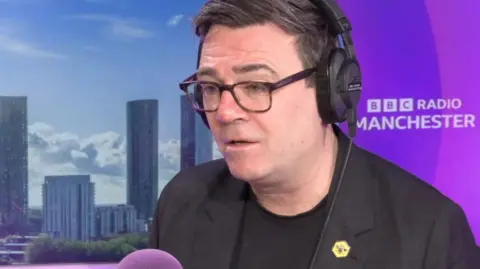
Last month, Burnham told BBC Radio Manchester that suggestions St Helens South MP Marie Rimmer was being pressured to “step aside” were “fiction”.
Some reports had claimed Rimmer was being pressed by Burnham’s supporters to step down in return for a seat in the House of Lords.
Listen to the best of BBC Radio Merseyside on Sounds and follow BBC Merseyside on Facebook, X, and Instagram. You can also send story ideas via Whatsapp to 0808 100 2230.
Politics
Reform is not racist, Welsh leader says in heated election debate
Reform is not racist, Welsh leader says in heated election debate
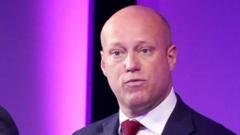
Reform’s Welsh leader has said his party is not racist in a heated Senedd election debate where leaders clashed over immigration.
Dan Thomas made the comments while criticising the Welsh government’s Nation of Sanctuary policy, which aims to help refugees and asylum seekers placed in Wales to integrate and access public services.
On BBC Wales’ Your Voice Live: The Leaders’ Debate the leaders of four left-wing parties ruled out working with Reform to form a government, but did not rule out working with each other.
Meanwhile Thomas challenged all the main parties to publish the full costs of their promises to voters ahead of next week’s Senedd election on 7 May.
Immigration is not something which the Welsh government controls, but in recent years it has had policies to assist asylum seekers and refugees, which it has labelled the “Nation of Sanctuary”.
Official figures say it makes up a small proportion of the government’s overall budget, with the vast majority of the cash being spent on supporting Ukrainians in Wales who are fleeing the war with Russia.
The debate on Tuesday evening saw strong exchanges on the policy, which is opposed by both the Conservatives and Reform.
Wales Green leader Anthony Slaughter accused the two parties of playing a “dangerous game” in which immigrants get blamed for “decaying” public services.
Reform’s Thomas rejected this: “Listening to the majority of the people in Wales isn’t a dangerous game.
“It’s called democracy and it’s called listening to people.”
He was challenged on comments made when he was leader of Barnet Council in 2021 that it had a “proud history of providing sanctuary”.
“That was before the floodgates were opened”, he said.
“The fact that I welcomed that showed that we’re not racist, we’re very reasonable people”.
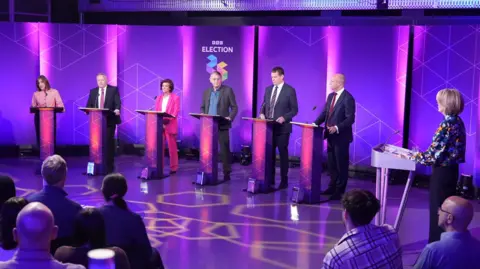
Thomas was asked by presenter Bethan Rhys Roberts whether he “distanced” himself from a social media comment made by a prominent member of the party, Arron Banks, which sparked accusations of racism from Plaid Cymru.
Banks is not standing in the Senedd election and told BBC Wales that his comment was ” a joke”, adding that “Plaid have understandably lost their sense of humour”.
Thomas did not respond directly but said: “I’ve had my Welshness questioned by supporters of Plaid Cymru. They’ve called me a plastic Taffy because I happened to live in England.
“I’ve been called an English nationalist, because I happen to be a member of Reform. I am Welsh through and through”.
Plaid Cymru leader Rhun ap Iorwerth criticised Thomas’ response, saying: “Outright racism from a righthand man of Nigel Farage and Dan Thomas chooses to play the victim.”
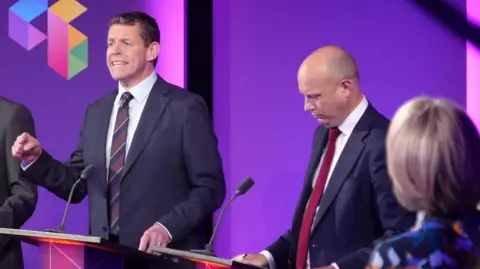
Referencing the Nation of Sanctuary policy, Tory Senedd leader Millar said: “The Welsh government needs to spend the money on the things that it is responsible for.”
Welsh Liberal Democrats leader Jane Dodds accused Reform of “stoking division”, while Welsh Labour leader and First Minister of Wales Eluned Morgan said: “I think it’s really important that what we do is we address the reality, not the myth, that the Conservatives and Reform are trying to create.
“The numbers of asylum-seekers in Wales are incredibly low.”
Parties rule out working with Reform
No party is expected to win a majority of seats in the next Welsh Parliament, and some level of co-operation could be needed to form Wales’ next government or help pass laws.
There have been calls for parties on the left to work together to lock Reform out of power, including from former first minister Mark Drakeford earlier in the campaign.
And on Tuesday night the leaders of Plaid Cymru, Liberal Democrats, Labour and the Greens all said they could not work with Dan Thomas’ Reform party to form a government – but did not rule out working with each other.
Plaid’s ap Iorwerth said Reform stood in “diametric opposition to all the values that I stand for”.
Labour’s Morgan said she did not think her party had “enough in common” with Reform, and Green leader Slaughter said his party will not work with “Reform or the Conservatives in any shape or form”.
He said he agreed with comments by the UK leader that it would be a “relief” if Plaid did well in the election.
Dodds said the Lib Dems would also not work with Reform or the Tories.
“We are willing to be a responsible partner to stop Reform UK trashing our services,” she said.
Thomas said Reform would work with any party “that will help deliver our manifesto”.
He accused Labour and Plaid of stitching up the new voting system for the expanded Senedd “to make sure they end up in power one way or another”.
Tory Senedd leader Millar also said would not rule out working with Reform or any other party if it could help deliver Tory policies like cutting income tax.
The Institute for Fiscal Studies (IFS) has said the incoming Welsh government will face a severe financial squeeze, with day-to-day funding and investment growth slowing significantly.
The experts warn that many of the manifesto pledges by the parties will be likely to require tax rises or cuts to public services.
In the sometimes bad tempered debate, the calls for the leaders to fully publish their spending plans were greeted with a round of applause by the studio audience.
None of the six larger parties have released full details, with independent analysts criticising the lack of transparency on how manifesto pledges would be funded.
Thomas said he would publish his plans if the others would follow suit, saying: “I challenge every leader on this panel to publish your costings.
“Ours are ready to go so we can have a full transparent election.”
The Tory and Labour leaders both said they would publish the cost of their plans, while Plaid leader ap Iorwerth and Green leader Slaughter said some theirs had already been published.
Only Welsh Lib Dem leader Dodds said she would not publish her spending plans, saying she knew she would not end up as first minister and she instead wanted to “influence government”.
Additional reporting by Mark Palmer

Politics
Starmer sees off inquiry call – but he doesn’t escape unscathed
Starmer sees off inquiry call – but he doesn’t escape unscathed
 Getty Images
There can be moments of high jeopardy in Parliament when Westminster holds its breath to await the outcome of a crucial debate that could determine a government’s future.
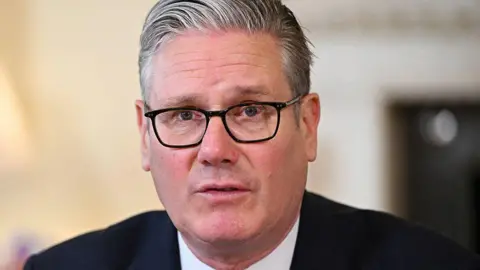
In the end this didn’t feel like one of them, but that doesn’t mean Sir Keir Starmer has escaped unscathed.
Ultimately he won the vote pretty comfortably with a clear majority of MPs rejecting the idea that he should be referred to a parliamentary committee for investigation over his statements about Lord Mandelson’s appointment as US ambassador.
But beyond the headline win, this was not a victorious moment.
No 10 expended considerable political capital in keeping its troops onside.
There was a ring-round by cabinet ministers, interventions from Labour big beasts including the former Prime Minister Gordon Brown, and Scottish MPs were called back from the campaign trail to bolster the ranks – all signs that Downing Street doesn’t feel it can automatically count on the loyalty of its own MPs.
There was undoubtedly support from some Labour backbenchers, pointing to ongoing work to shed light on the process surrounding Lord Mandelson’s appointment and rejecting the notion another inquiry was necessary.
Others said opposition parties were playing political games ahead of crucial elections, something denied by the Conservatives who insisted this was about the integrity of parliament.
In the end, 14 Labour MPs voted against the government, and while they were predominantly people who’ve previously criticised the prime minister, some of their interventions were scathing.
There was particular anger at the fact Downing Street had whipped its MPs in an attempt to guarantee their backing – with one claiming Labour backbenchers could be accused in being complicit of a “cover-up”.
Ultimately Downing Street chose not to take a risk and deployed the full weight of the Number 10 operation to rally MPs.
For some it was savvy to avoid a referral to the same committee that was instrumental in the downfall of Boris Johnson, for others it was a heavy-handed approach at a time when Downing Street doesn’t have political capital to spare.
There will be relief in No 10 that there won’t be another parliamentary committee poring over every detail of Sir Keir’s decisions and subsequent statements about the Lord Mandelson saga.
The post-vote spin from government insiders was undoubtedly an attempt to be positive, with one saying it showed the Parliamentary Labour Party was still “pretty together”, though they added “for now”.
Among Labour MPs there was no sense of jubilation at having seen off a challenge from opposition parties, rather a weary resignation and deep frustration that this issue keeps consuming parliamentary time and public attention when they would much rather be talking about something – anything – else.
Sir Keir might have won the vote in Parliament, but each time the issue of Lord Mandelson’s appointment arises again he risks losing more authority among his own MPs.

Sign up for our Politics Essential newsletter to keep up with the inner workings of Westminster and beyond.
Politics
PM won’t face inquiry over claims he misled MPs on Mandelson vetting

PM won’t face inquiry over claims he misled MPs on Mandelson vetting
 AFP via Getty Images
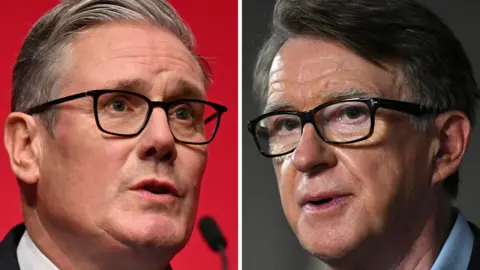
Sir Keir Starmer will not face a parliamentary investigation over claims he misled MPs about the process to appoint Lord Mandelson as US ambassador.
The House of Commons voted 335 to 223 against a Conservative-led motion which sought to trigger the inquiry.
Some Labour MPs on the left of the party said the PM should have referred himself to the Privileges Committee, but the majority voted to reject the motion after a concerted operation by No 10 to ensure they were on side.
Sir Keir has denied accusations he misled MPs over whether vetting for the role of US ambassador followed “full due process” and his assertion that “no pressure whatsoever” was applied to officials at the Foreign Office.
Conservative Party leader Kemi Badenoch tabled a motion which sought to have the PM’s remarks assessed by the cross-party committee responsible for looking into cases of MPs breaking parliamentary rules.
The Ministerial Code states that ministers who knowingly mislead Parliament are expected to resign, while any inadvertent error should be corrected “at the earliest opportunity”.
Badenoch had suggested Labour MPs were “acting like sheep” for labelling the motion a “stunt”.
But some Labour MPs questioned why they had been instructed to oppose it and suggested it risked looking similar to a “cover-up”.
The division list showed 14 Labour MPs rebelled to support the motion while another voted both aye and no, which is usually regarded as a formal abstention.
It is not yet clear what action those Labour MPs who did not follow No 10’s orders to oppose the motion will face.
The Lib Dems, SNP, Greens, DUP, Plaid Cymru, Reform and nine independent MPs were among those who also voted with the Tories in favour of the motion.
A total of 53 Labour MPs did not have a vote recorded – this can be because they have been given permission to miss the vote or are on government business, and does not mean they are abstaining.
South Shields MP Emma Lewell, who was among the rebels, told the debate that the government’s handling of the vote “smacks, once again, of being out of touch and disconnected from the public mood”.
She said: “It has played into the terrible narrative that there is something to hide and good, decent colleagues will be accused of being complicit in a cover-up.”
Lewell said Sir Keir should have referred himself to the committee “with a clear statement that he is doing so to clear his name”.
Speaking to the BBC’s Politics Live, Labour MP Rebecca Long-Bailey suggested there would be a “moment of reckoning after the local elections” on 7 May for Sir Keir’s future.
But several Labour MPs defended the government’s approach during the debate, with Gurinder Singh Josan describing the call for a Privileges Committee referral “premature” given the vetting process was being scrutinised elsewhere in Parliament.
Cardiff West MP Alex Barros-Curtis said he did “not believe the case was made out” for the motion by the Conservatives.
In a sign of the government effort to ensure the motion was rejected, Labour MPs campaigning in Scotland ahead of next week’s elections were summoned back to Westminster.
‘Cannot outrun Mandelson’
Opening the debate, Badenoch examined Sir Keir’s defence of his remarks before noting the Ministerial Code is “very clear” in the need for the record to be corrected at the earliest opportunity.
She said: “It is very obvious that what the prime minister said at the despatch box was not correct. It’s clear that full due process was not followed.”
Senior cabinet minister Darren Jones accused Badenoch of “ranting incoherence” as he defended Sir Keir’s handling of the issue.
Pressed by Badenoch to repeat the PM’s assertion that “no pressure existed whatsoever” in the case, Jones said Sir Keir’s words should be placed “in the right context”.
Jones was heckled by opposition MPs as he said Sir Keir was “specifically responding to the allegation that there was pressure that Peter Mandelson should not be vetted at all and that he should be sent to Washington regardless of the vetting outcome”.
Liberal Democrat leader Sir Ed Davey earlier said the country needed a government focused on dealing with cost-of-living concerns, adding: “Crucially it needs a government that it can trust.”
SNP Westminster leader Stephen Flynn said Labour MPs “cannot outrun Peter Mandelson, they cannot outrun their own prime minister and his record”.
Reform UK deputy leader Richard Tice said Sir Keir “prides himself on process” but anecdotally it “seems that there is a culture that does not exist around him and within him”; while Green MP Ellie Chowns said “it is clear that there is a case to answer here” for the PM.
Lord Mandelson began the Washington ambassadorial role in February 2025 but was sacked in September after Downing Street said new information about the depth of his relationship with late sex offender Jeffrey Epstein had emerged.
Sir Keir has faced repeated questions over the appointment, including on why the peer was given security clearance for the role by the Foreign Office despite concerns being raised by vetting officials.
The Commons debate on Tuesday came after the Foreign Affairs Committee heard further evidence about the vetting process, including from the senior civil servant at the Foreign Office when the PM decided to send Lord Mandelson to the US.
Sir Philip Barton said no-one in Downing Street consulted him before making the decision and also noted he thought the appointment could be a “potentially difficult issue” because of the peer’s known links to Esptein.
He said he was “presented with a decision” made by Sir Keir and “told to get on with it”.
And Morgan McSweeney, the PM’s former chief of staff, told MPs he made “a serious mistake” in recommending the appointment of Lord Mandelson.
McSweeney said that No 10 wanted Lord Mandelson in post “quickly” but insisted officials were never asked to “skip steps”.
Sign up for our Politics Essential newsletter to keep up with the inner workings of Westminster and beyond.
Politics
I made ‘serious mistake’ advising Starmer to appoint Mandelson, PM’s ex-top adviser says
I made ‘serious mistake’ advising Starmer to appoint Mandelson, PM’s ex-top adviser says
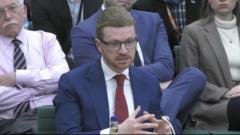
The PM’s former chief of staff has said he made “a serious mistake” in recommending the appointment of Lord Mandelson as the UK’s ambassador to the US.
Morgan McSweeney, who resigned in February over the advice, said he felt the peer’s experience as an EU trade envoy would help the UK secure a US trade deal.
However, he told MPs on the Foreign Affairs Committee that after fresh revelations about Lord Mandelson’s friendship with the late convicted sex offender Jeffrey Epstein emerged, it “dawned” on him that he had not given the “full truth” about their friendship.
McSweeney admitted No 10 wanted Lord Mandelson in post “quickly” but insisted officials were never asked to “skip steps”.
In a rare public appearance by a senior advisor, he also denied telling the Foreign Office “explicitly or implicitly” that security checks “should be cleared at all costs”.
The decision to appoint Lord Mandelson has dogged the prime minister for months but anger was reignited over the issue after it emerged the peer was given security clearance for the role by the Foreign Office, despite concerns being raised by vetting officials.
The prime minister has said no one in Downing Street – including himself and McSweeney – were aware the Foreign Office had gone against the vetting recommendation until recently.
On Tuesday evening, MPs rejected the call to hold a parliamentary investigation over claims he misled the House of Commons about Lord Mandelson’s vetting.
While he was unlikely to lose the vote, some MPs did express discontent, with some unhappy that they have spent the week before crucial elections discussing the appointment of Lord Mandelson rather than campaigning.
Lord Mandelson was sacked as ambassador in September 2025, after new information came to light about the depth of his relationship with Epstein.
This included photos of the pair together and supportive emails he sent to Epstein as he faced charges for sex offences in 2008.
McSweeney told the committee that when he saw the revelations “it was like a knife through my soul”.
“The nature of the relationship that I understood he had with Epstein was not a close friendship,” he said.
“How I understood it at the time was a passing acquaintance that he regretted having and that he apologised for.
“What has emerged since then was way, way, way worse than I had expected at the time.”
Before Lord Mandelson was appointed, a due diligence check – a separate process to the security vetting – was carried out by a team at the Cabinet Office and sent to the prime minister.
This flagged Lord Mandelson’s continued relationship with Epstein after his conviction as a potential “reputational risk”.
McSweeney was subsequently asked by the PM to send three follow-up questions to Lord Mandelson about his association with Epstein.
While at the time McSweeney said he believed the answers were truthful, he later realised he was not given the “full truth” and that revelations in the Epstein files showed Lord Mandelson was “unfit” for the job.
The BBC understands Lord Mandelson’s view is that he answered questions about his relationship with Epstein in the vetting process accurately.
In-depth security vetting was not carried out until after Lord Mandelson’s appointment was announced.
McSweeney said this “didn’t jump out to me as a problem at the time” although he acknowledged it would have been “very embarrassing” if the appointment had to be pulled because Lord Mandelson failed vetting.
He insisted that if Downing Street had been aware of any problems with his vetting, his ambassador job would have been withdrawn.
Earlier, Sir Philip Barton, the top civil servant at the Foreign Office at the time, told the committee Downing Street had been “uninterested” in the vetting process and the focus was on making sure Lord Mandelson was able to start his job by the time of Donald Trump’s inauguration.
This backed up the account of his successor, Sir Olly Robbins, that there was “pressure” from Downing Street to complete vetting quickly and that No 10 had been “dismissive” about the process.
However, both men denied this affected the vetting decision.
In response to the claims, McSweeney acknowledged that the PM’s private office would have chased the Foreign Office for updates on Lord Mandelson’s vetting.
He added that Downing Street wanted the process completed “quickly” so Lord Mandelson was in post by the time of Trump’s inauguration.
However, he insisted nobody was asked to “skip steps” in any part of the process.
“Yes we wanted it done quickly but at no point did I witness anyone being dismissive about DV [developed vetting] or national security,” he added.
McSweeney denied reports he had sworn at the top civil servant at the Foreign Office while asking him to approve the appointment.
Sir Philip also said he had no recollection of being sworn at by McSweeney.
While he was a key figure in Sir Keir’s rise to power and within the Number 10 operation, McSweeney was rarely seen in public and had not spoken about his role in Lord Mandelson’s appointment since his resignation statement.
McSweeney denied accusations he had tried to push through the appointment of the former Labour minister and closed his eyes to the risks because he was a friend.
“Like everyone else, I could see there were pros and cons in the appointment, and I worried that it would go wrong, so I didn’t try to push anything through,” he said.
McSweeney said the PM considered “a wide range of views” before making the decision, adding: “If everybody else was opposed to this appointment but me, he would not have made an appointment such as that.”
While he acknowledged the Labour veteran was a “confidant”, who he went to for advice, he insisted: “I didn’t regard him as my mentor.”
McSweeney also sought to downplay claims about Lord Mandelson’s influence over the current Labour government, arguing that while he would offer up advice he was far from the only figure to do this.
Sign up for our Politics Essential newsletter to keep up with the inner workings of Westminster and beyond.

David Blaine’s friendship with Jeffrey Epstein unveiled
Magician David Blaine is mentioned throughout the Justice Department’s Epstein files, and CNN discovered that he once filmed a …

Students steer bus after driver passes out
Five middle schoolers in Mississippi worked together to help steer a bus to safety and call for help after the...

DNA cracks 35-year cold case mystery as accused killer’s new name melts under cops’ heat
NEWYou can now listen to Fox News articles! California authorities have announced an arrest in a 35-year-old cold case...


Live: Trump greets Artemis II astronauts
President Trump participates in a greeting with Artemis II astronauts at the White House. Watch more CNN here: …

US President Donald Trump says King Charles ‘agrees’ Iran must never have nuclear weapon. #BBCNews
Subscribe to our channel here: https://bbc.in/bbcnews For the latest news download the BBC News app or visit BBC.com/news …

Expert worries chatbot 'accomplices' could become a trend
CNN spoke to expert Dr. Bryanna Fox about her fear that using AI to commit violent crimes is becoming a...


Illinois no-cash bail law ‘utterly manipulated’ by violent offenders, Dem alderman says after cop’s killing
NEWYou can now listen to Fox News articles! A Chicago alderman says the state’s no-cash bail law has been...

Trump appears to break royal protocol during speech
President Donald Trump suggested King Charles III agreed with his stance on Iran during a state dinner, raising questions about...

Two Jewish men seriously injured after being stabbed in north London | BBC News
Two people have been stabbed in Golders Green in north London after a man with a knife was seen running...

Man accused of repeatedly trespassing at CIA headquarters in Virginia
NEWYou can now listen to Fox News articles! A Texas man was arrested after repeatedly trying to breach CIA...
-

 Theboldnews video2 weeks ago
RADDI AKHBAR 2 | क्या हुआ?
-
 Entertainment2 weeks ago
Kiss Cam Woman Kristin Cabot Says Chris Martin ‘Never’ Checked On Her After Viral Boss Scandal Ruined Her Career
-
 Video2 weeks ago
Keir Starmer 'furious' he wasn't told about Mandelson failed security vetting | BBC Newscast
-

 Video2 weeks ago
Israel is losing US support – even among Republicans
-

 Video2 weeks ago
Debate: Who's right about gas prices, Trump or Americans?
-

 Video2 weeks ago
Tell me how to feel about space | The Assignment
-

 BBC News World2 weeks ago
Turkish police detain 162 people over online posts about school shootings
-
 Video2 weeks ago
Let grief be messy: NYTimes writer talks to Anderson Cooper about the life and death of her daughter