

Business
Centene to offer buyouts to some employees

Centene said it offered buyouts to some employees on Monday, as the health insurer grapples with higher medical costs, funding cuts and membership declines.
“Centene is positioning the company to lead the future of healthcare — working to deliver a simpler and better experience for our members and partners while meeting the realities of today’s healthcare environment,” a company spokesperson said in a statement. “Today we announced a Voluntary Separation Program to support employees who may be considering a transition.”
The company did not indicate how many employees were offered buyouts or how much it is aiming to reduce its workforce. Shares initially fell 4% after Bloomberg first reported the news on Monday.
Layoffs could follow if the company doesn’t meet the target for voluntary separations, Bloomberg reported.
Centene is the largest Medicaid provider and is focused on other federal health plans through Medicare and the Affordable Care Act. The buyouts come after the company reported a decline in membership in the first quarter, down 6% year over year to 26.3 million, according to a filing.
Centene’s ACA business lost about 2 million members in the first quarter compared with the end of 2025, primarily because Congress let enhanced federal subsidies in the program expire at the start of the year. The company in March also said it expects ACA membership to fall nearly 40% by the end of 2026, executives said in March at a Barclays conference.
Centene is bracing for the impact of more than $900 billion in cuts to Medicaid over a decade, and the broader insurance industry is still managing higher-than-expected medical costs in privately-run Medicare plans.
Business
Paramount-Warner Bros Deal Has States Eyeing More Than Just Antitrust Issue

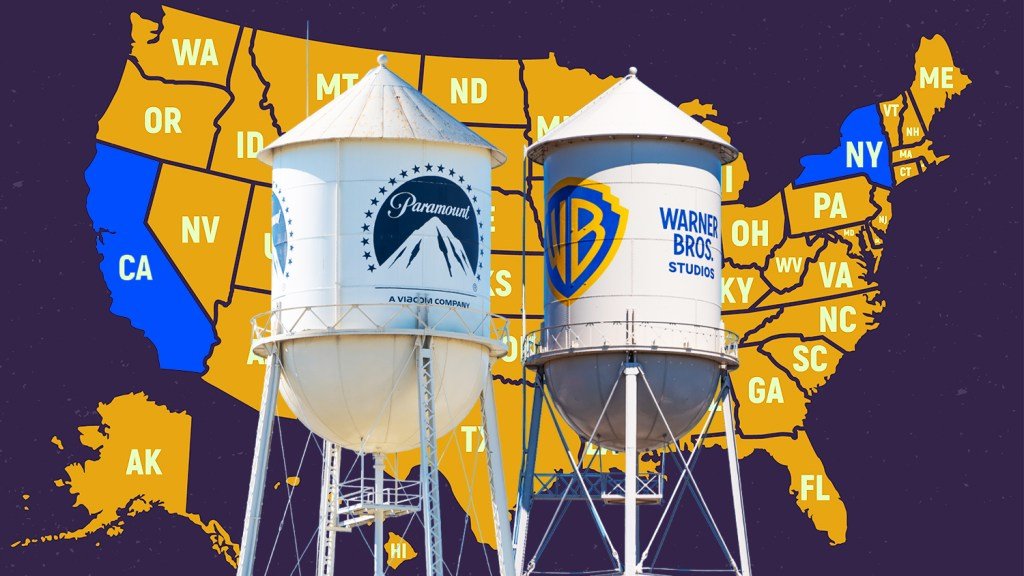
EXCLUSIVE: In a tough and rough election year for incumbents, Paramount’s $111 billion acquisition of Warner Bros Discovery has become a political football in California and across the nation.
Just a few feet from Donald Trump, a smiling David Ellison was front and center last night for the UFC’s controversial and inflammatory Freedom250 cage matches on the White House lawn. Still, even with the Justice Department approving the WBD merger late last week without any concessions, the Paramount Skydance’s CEO’s happy face masked some spikey obstacles to the merger from overseas and in state houses over Ellison’s strategic bear hug with the ex-Apprentice host.
“The Ellisons’ haste to get their deal done by Trump has a lot of enemies,” an individual close to power players in Sacramento told Deadline after the June 12 sign-off by the federal DOJ. “They may think they’re home free, but that’s wishful thinking and not political reality.”
Led by California’s reelection-seeking Rob Bonta, nearly a dozen state attorneys general are poised to launch a lawsuit in the next few weeks to derail the ParaBros deal or at least take a bite out of it, Deadline can confirm. However, for all the antitrust threats opponents to the merger have floated, the mainly unspoken but real battle in this year of midterm elections seems to be about old-fashioned politics and firing up the base.
Having told Deadline ages ago that his office was pondering an antitrust action over the WBD meld, AG Bonta threw cold water on the Trump DOJ’s signoff last week with a curt “the merger of Warner Bros and Paramount is not a done deal and remains under investigation by my office” tweet.
At the same time, the Ellisons have retained Jeffrey Kessler to get in the legal octagon for them if the state throws down.
Having fought alongside Bonta, New York AG Letitia James and others recently in successfully pinning Live Nation in the antitrust suit the Trump administration had walked away from, Kessler is an inspired choice by Paramount on many levels. Kessler won’t tip his hand to the electoral backroom moves at play, but the Winston & Strawn litigator is very skeptical the states have an antitrust suit when it comes to ParaBros.
“I have great respect for the states,” Kessler told Deadline in true diplomatic fashion. From the lawyer’s POV there will be no “reduction in competition” in Hollywood if the two companies become one. “I think they’re very talented lawyers there, and I think they do a lot of wonderful things for the public good. I will not criticize the states in any way, shape or form.”
With the precision of a closing argument, he adds: “What I would say is what I would hope they are doing, and I believe they are doing is seeing if they actually have an antitrust case to bring that has a reasonable chance for success. My hope is that they keep an open mind, that they don’t make a decision based on politics on an antitrust case, and that they only file an action if they really think that they can prove an antitrust violation. That process takes a long time, so it doesn’t surprise me that they haven’t filed anything yet.”
Certainly, besides the midterms in November, there are some other real time calendars issues coming up fast for Paramount.
As a multi-phased review by UK regulators may have thrown their own spanner in Para-WBD works last week, there is some serious money on the table for Ellison and his Oracle founder father if the merger isn’t locked in by September 30. At that point, a ticking fee kicks in and Paramount would be paying hundreds of millions out to WBD shareholders every subsequent month.
For a merger already weighed down by debt and foreign interest concerns, that real money is a big deal.
Adhering the illusion of still being on the fence over the ParaBros merger even as they are sitting down with potential outside counsel and have received a newly flush antitrust-fighting war chest from Gov. Gavin Newsom, Bonta’s team will only say they are “taking a very close look and intend to be vigorous in our review of the proposed Paramount and Warner Bros merger.”
In a vigorous(ish) AG race against Republican Michael Gates this year, Bonta has been showing up almost everywhere, including a very partisan IATSE attended mock hearing in Burbank by Sen. Adam Schiff in March, pounding the Ellisons, to be seen in the warm glow of anti-merger activists and layoff fearing Hollywood workers.
“Our office will take necessary action if we find that the transaction is unlawful under antitrust law,” a circumspect spokesperson for the Golden State AG told Deadline this week as anticipation of their expect action has only grown in the last week. “The opposite is also true: we will give it a fair review on the merits, and if it looks good for California consumers, there won’t be further action. California DOJ has been doing this work for a long time: our office has intervened in mergers in the grocery, broadcast market, and healthcare industries and has no qualms about stepping in and stopping deals we find illegal — and stepping back if those deals pass regulatory scrutiny.”
“Beyond this, the Paramount acquisition of Warner Brothers remains an active investigation, and we do not have any updates to share at this time.”
On the other side of the country, NY AG James faces far lesser GOP rivals as the Trump foe heads into her own primary later this month. To that, James has played less of a role publicly in any Paramount-WBD legal action, while being a “big player” behind the scenes, I’m told. In that context, a spokesperson from the New York Attorney General’s office confirmed New York was part of the coalition of states lining up in opposition to the big bucks and seemingly fast-tracked merger but declined to discuss any potential lawsuit.
“Paramount is going to have to give something up, maybe control of CNN, if they want this deal to happen,” a well-placed political operative asserts. “They could have handled it differently from the start and maybe, maybe, have gotten buy-in from Democrats, They went full MAGA and there too many objections, too many minefields now.”
With big names like Mark Ruffalo, Jane Fonda and others taking to podiums and Zoom calls to invoke the First Amendment and decry the Ellisons’ links to MAGA (with the future of CNN eating up a lot of the spotlight after the ongoing chaos at the Bari Weiss-led CBS News), a follow-the-money game separate from the state AGs has emerged. As over 5,000 Tinseltowners signed an open letter praising Bonta and other mainly Blue State AGs for “scrutinizing the merger and considering legal action to block it,” the Block the Merger movement has been swatted with allegations it’s all being masterminded by MAGA boogieman George Soros and a cadre of socialist billionaires and antisemites.
Closer to home in the Democrats civil war that is the L.A. mayoral race between vulnerable incumbent Karen Bass and her ex-ally Councilmember Nithya Raman, the takeover of the David Zaslav-run WBD by Paramount has become a major campaign issue In a city pummeled by a massive decline in production, the loss of over 40,000 industry jobs the past couple of years and worries over deep cuts once ParaBros occurs.
Personally connected to Hollywood through her producer/writer spouse, Raman was blunt about where she sees this all going.
“This merger is bad for Los Angeles, and its math only works through mass layoffs,” the two-term Hollywood heavy District 4 councilor says. “When Skydance bought Paramount, over 2,000 people lost their jobs, many of them in Los Angeles,” she adds. “This is what consolidation looks like on the ground. Billionaires will benefit, while the workers who built this industry get left behind. I’m grateful the attorneys general are acting to block it, and as mayor I’ll make sure Los Angeles does everything in its power to support their case.”
Bass, who has lashed out at Raman over inaction for Hollywood even before her political pal beat Hills alum Spencer Pratt to secure a second spot in the fall runoff, was more measured, kinda.
“The entertainment industry is at the core of who we are as a city, LA’s place on the global stage, and to our entire economy,” the ex-Congresswoman told Deadline. “I cannot support a deal that results in massive job losses,” Bass, who has family members of her own working in the industry, went on to say.
“I urge regulators to enforce job protections and creative freedom, and I call on Paramount’s leadership to redouble its commitment to the industry workers in our city.”
That’s a helluva lotta trust.
Business
Chase Sapphire Preferred Card Introduces New Perk for Apple Customers


Chase this week announced new perks for its Sapphire Preferred credit card, and one of them is a complimentary one-year Apple TV streaming subscription.
To get the free year of Apple TV, which typically costs $12.99 per month in the U.S., you must activate the card by December 31, 2026.
If you are already subscribed to Apple TV directly through Apple, the complimentary subscription from Chase will automatically supersede your paid subscription until it ends, at which point the paid subscription will resume at the going price.
As noted by 9to5Mac, Apple One subscribers can receive a $7.50 discount per month instead.
If you are subscribed to Apple One directly through Apple, and activate your complimentary Apple TV access on Chase.com or the Chase Mobile app with the same Apple Account connected to your Apple One billing, you will automatically receive a $7.50 discount on your Apple One subscription for 12 months starting on your next billing period.
Chase’s Sapphire Preferred card continues to have a $95 annual fee. New and existing cardholders have access to these new benefits starting today.
The other new benefits include 3× points on gas, EV charging, and Airbnb and Vrbo bookings, while the card’s annual hotel statement credit has been doubled to $100. There is also a new $120 Global Entry, TSA PreCheck, or NEXUS credit every four years, along with new “emergency evacuation and transportation” coverage.
On the other hand, the 10% anniversary bonus benefit is being discontinued, and Ultimate Rewards points will transfer to World of Hyatt at a rate of 4:3.
More details are available in Chase’s press release. For a limited time, new cardholders can earn 100,000 points after spending $5,000 in the first three months.
Business
Chase adds free Apple TV, discounted Apple One benefit to popular credit card


Chase announced new benefits for its Sapphire Preferred card today, including free Apple TV for a year or discounted Apple One. Here are the details.
Chase Sapphire Preferred now offers free Apple TV for a year, with Apple One credit alternately available
Apple TV has long been included as a benefit for Chase Sapphire Reserve cardholders. But that credit card has a very pricey $795 annual fee.
Today though, Chase announced that Sapphire Preferred cardholders now get free Apple TV too.
Chase Sapphire Preferred is a popular travel-focused card, with a much more affordable $95/year annual fee than the pricier Reserve card.
To get Apple TV free for a year, Sapphire Preferred cardholders need to activate the offer by December 31, 2026.
It’s available to new and existing cardholders. You just have to link your Apple Account to Chase via the Benefits portal on Chase’s app or website.
The free year of Apple TV is a $156 value overall, and joins a variety of other Sapphire Preferred benefits.
In a nice touch, existing Apple One subscribers can alternately get a $7.50/month credit to make Apple’s bundle more affordable.
Just connect your Apple Account to Chase in the same way, and the credit will be applied every month you’re subscribed to any Apple One plan for up to 12 months.
So if you already subscribe to Apple One, or want to start, you’ll still benefit from Chase’s new offer.
Additionally, if you do have the pricier Chase Sapphire Reserve, you can now get a $15/month credit as an Apple One subscriber, since the card includes free Apple TV and Apple Music. Previously, Apple One subscribers essentially missed out on the bonus.
Apple TV is available for $12.99 per month, or you can get it discounted through the Apple One bundle.
Best iPhone accessories
Business
Fox to buy streaming pioneer Roku in a $22 billion deal
Fox Corp. has agreed to buy the streaming pioneer Roku in a cash-and-stock deal valued at approximately $22 billion, including debt.
Roku will continue to be run as an open, partner-friendly platform, the companies said Monday, and there appears to be no immediate changes that customers will see. Fox and Roku said that the combined company will become the third-largest player in U.S. television by share of viewing.
Media reports had surfaced on Friday that Roku was looking at its strategic options, including a possible sale. Speculation was rampant as to which companies might be interested in an acquisition. Aside from Fox, names being tossed about as potential buyers included Netflix, Amazon, Comcast and Disney.
The deal will give Fox access to more than 100 million global households, along with the Roku channel and its first-party data. Fox oversees a massive sports, news and entertainment network, as well as Tubi, which it acquired in 2020.
Roku founder Anthony Wood had initially worked within Netflix in the early 2000s as that company attempted to make the seismic shift from renting DVDs, to streaming.
Roku was spun off by Netflix, however, and the company released its first set-top box in 2008.
Wood, who is Roku’s chairman and CEO, said his motivation in pursuing the technology was his desire to record and play his favorite show, “Star Trek.”
Fox Corp. CEO Lachlan Murdoch said in a statement that combining the businesses will bring together Fox’s live news and sports content with a streaming platform with large viewership. It will also give Fox more exposure to advertising and streaming subscriptions.
“The combination with FOX is an extraordinary opportunity to accelerate our vision, scale faster and innovate more aggressively for viewers, partners and advertisers,” Wood said in prepared remarks.
Wood will have an ongoing role at the company and will join the Fox board of directors after the transaction closes.
Murdoch said during a conference call that the combined company will be better positioned for the next decade of video than either company would’ve been alone.
“We are confident this is the right transaction, at the right moment, for all the right reasons,” he said.
Fox will pay $96 in cash and 0.9693 shares of its Class A common stock for each Roku Class A and Class B share outstanding. The transaction is valued at $160 per Roku share.
Existing Fox shareholders are expected to own approximately 73% of the combined company and Roku shareholders will own about 27%, once the deal closes.
The deal is expected to close in the first half of next year. It still needs approval from Fox and Roku shareholders and also regulatory approval.
Fox’s stock declined before the market open, while shares of Roku rose slightly.
Business
Cybersecurity vets protest ‘dangerous’ US government ban on Anthropic’s most powerful models


A group made up of dozens of cybersecurity experts, including several well-known veterans of the industry, published an open letter to the U.S. government asking it to lift the export control order on Anthropic’s Fable and Mythos models.
According to the open letter, “this action has taken the best models away from [cybersecurity] defenders” who now can’t use the models to find vulnerabilities and make their software and products more secure.
“To pull the best capabilities away from defenders without a good reason when our adversaries are rapidly advancing is dangerous,” read the letter.
On Friday, the U.S. government ordered Anthropic to limit the export of Fable and Mythos, citing national security concerns, without explaining the specific reasons behind the order, according to Anthropic. In response, the company suspended access to the models to all users worldwide.
As of this writing, the letter is signed by 76 cybersecurity experts, including Alex Stamos, former Facebook chief of security; Casey Ellis, the founder bug bounty platform Bugcrowd; Jon Callas, famed cryptographer and former Apple security design and architecture manager; Paul Vixie, computer scientist ; Dino Dai Zovi, the former head of applied security engineering at Block; Katie Moussouris, the founder of Luta Security; and Rachel Tobac, the CEO of the security awareness training firm SocialProof Security.
When Mythos launched as a preview in April, Anthropic claimed it was so powerful at finding security vulnerabilities that the company needed to tightly restrict access to prevent malicious hackers or foreign adversaries from using it to cause havoc on the internet. In practice, that meant Anthropic gave around 50 companies initial access to Mythos, recently expanding that group to include around 150 organizations in 15 countries.
Last week, Anthropic released Fable, a public version of Mythos that the company said had strict guardrails to block its use in the fields of biology, chemistry, and cybersecurity, as well as to stop others from distilling the model in order to re-create it. The guardrails on Fable were so strict that many cybersecurity experts found that it stopped essentially any prompts related to cybersecurity.
Anthropic said that the White House export control order may have been based on a report that there was a method to bypass — or jailbreak — Fable to unlock its powerful Mythos-level capabilities.
According to Katie Moussouris, one of the signatories of the open letter, the method was demonstrated by Amazon researchers in a paper that is not public but that she has reviewed.
But Moussouris said in a blog post that the paper did not actually demonstrate a real jailbreak. Instead, she wrote, the researchers simply asked Fable to fix open source code with public and known vulnerabilities along with “deliberately planted vulnerabilities,” after the model initially refused to “review the code for security issues.”
“The behavior described in the paper cannot meaningfully be fixed, and any attempt would only weaken the model for defense,” Moussouris wrote. “Defenders need to be able to ask AI to fix the bugs in a file, explain why the fix matters, and write tests that confirm the patch works. That is not a guardrail bypass. It is the most valuable thing an AI model can do for defensive security: executing the find, fix, and test loop defenders run every day.”
Moussouris’ critique was echoed in the open letter, which also said that the group of experts believe the model capabilities in the Amazon paper “can be replicated” on OpenAI’s GPT-5.5, on Anthropic’s own publicly available Claude Opus 4.8 and Sonnet, “and even Chinese models like Kimi 2.7.”
Moussouris told TechCrunch that “the bugs used to demonstrate the techniques in the paper can be found using the other models. The method in the paper is a guardrail bypass technique. Other models that lack the Fable guardrails often won’t refuse the straightforward request to look for security bugs, so they don’t need a bypass.”
The letter also asked for transparently and fairly enforced regulations created by “a democratic rule-making process” that are based on scientific research done by industry and academic experts, and “used only to the minimal extent necessary to ensure the safety of the American public.”


8 dead in B-52 crash: Air Force presser gives early details
Eight crew members are dead in a B-52 bomber crash shortly after takeoff from Edwards Air Force Base, northeast of...


‘Spider-Man of Yemen’ dies after fall into volcanic crater
A Yemeni climber known on social media as the “Spider-Man of Yemen” died after falling into a volcanic crater, according...


8 crew members dead after B-52 bomber crashes in California
Eight crew members are dead in a B-52 bomber crash shortly after takeoff from Edwards Air Force Base, northeast of...


Fans react to Cape Verde’s shocking draw against Spain in World Cup debut
The island nation of Cape Verde shocked fans in their first-ever World Cup match by earning a draw against reigning...


Live: B-52 crash site at Andrews Air Force base, CA
Eight crew members are dead in a B-52 bomber crash shortly after takeoff from Edwards Air Force Base, northeast of...


Why did 1.9M people leave California? | Fareed’s Take
CNN's Fareed Zakaria looks at why California's economy has stayed strong while its system of governance has become strained …


BBC tests out England and Argentina's World Cup training grounds in Kansas City | BBC News
The BBC's Will Grant has been taking a look around the base camps that England and defending champions Argentina will...


Marine jet crashes into mountain, erupts in fireball
A Marine pilot ejected from an F/A-18 Hornet shortly before it crashed into a mountainside during a routine training exercise...


US and Iran agree to strike a deal to end their conflict. #US #Iran #BBCNews


JD Vance defends Iran agreement from Republican criticism
Vice President JD Vance gives CNN's @jaketapper insight into the Trump administration's Iran agreement, and defends it from …
-
 Business2 days ago
How much of Musk’s wealth comes from government help? Virtually all of it
-

 LifestyleNews2 weeks ago
120 minutes of strength training per week may help extend lifespan
-

 Politics4 days ago
What to know about the stabbing that set off fiery riots in Northern Ireland
-
 Video3 days ago
Download fans say what they love about the festival. #DownloadFestival #BBCNews
-

 Video3 days ago
Why SpaceX IPO isn't about space. #SpaceX #ElonMusk #BBCNews
-

 HealthNews4 days ago
The people of Okinawa, Japan only eat until they are about 80 percent full, then stop — and the practice has been linked in multiple peer-reviewed studies to lower rates of cardiovascular disease, slo
-

 TravelNews3 days ago
My Paternal Instinct Should’ve Warned Me About Netflix’s Maternal Instinct
-

 Food3 days ago
Pope Leo’s plane was grounded. Then the King of Spain stepped in to help