

PM office canada
G7 summit: US to focus again on Ukraine after deal with Iran, Trump says

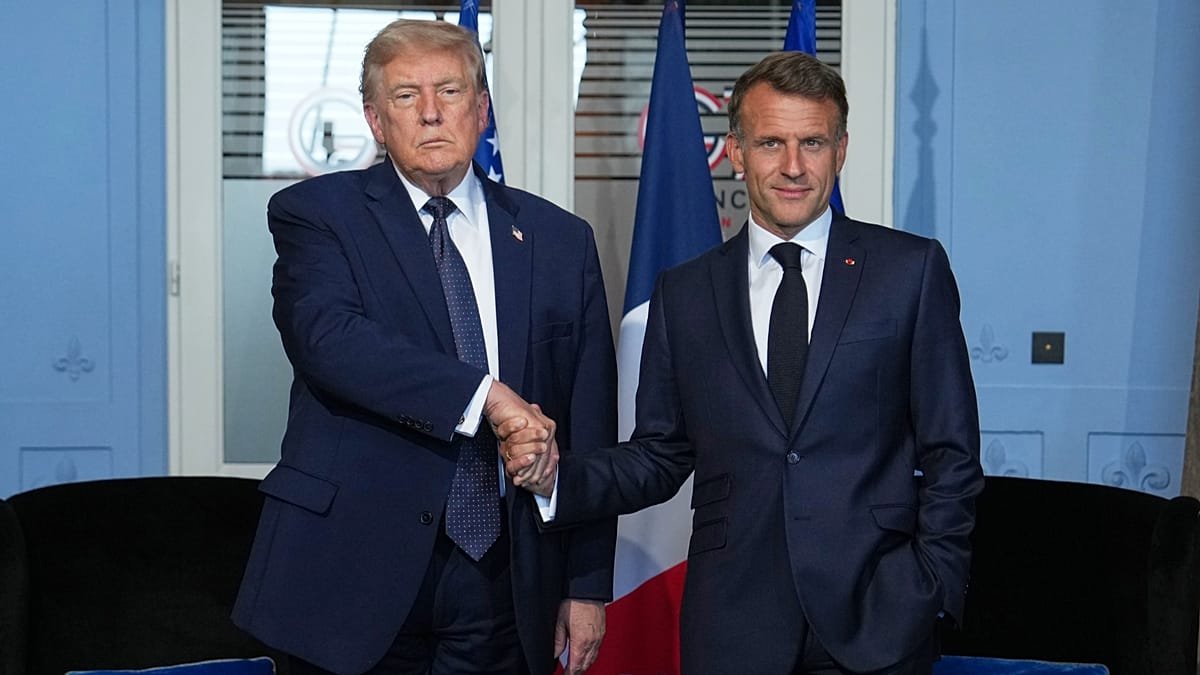
G7 leaders head to dinner
The day in Évian draws to an end with a working dinner among the leaders focused on “major international challenges”.
Thank you for reading our live blog today.
We’ll be back tomorrow with more updates!
Credit: Associated Press
The Iranians have played Trump ‘like a violin,’ John Bolton tells Euronews
The framework deal reached on Sunday between the United States and Iran is a “very bad deal”, John Bolton has told Euronews’ Maria Tadeo, who says Tehran played Donald Trump “like a violin”.
Bolton, who served as national security advisor under Trump in his first term, says the US president did not take into account the “geo-strategic implications” of the negotiations and simply focused on reopening the Strait of Hormuz to bring down energy prices ahead of the crucial midterm elections.
“If it were a great deal, it would be out in public, and I think that tells you pretty much all you need to know,” Bolton said.
“I think it’s embarrassing for the president. I think there will be some indication of unfreezing Iranian assets (..) and I think it’s a mistake to give this brutal theocracy any of the assets,” he went on.
Bolton noted the US and Israel had inflicted “enormous damage” to Iran’s military capabilities but dismissed the prospect of a new nuclear deal as a “fantasy” due to previous failed attempts.
The Iranians have seen “for weeks, if not months, that Trump is desperate for a deal. He’s desperate for a deal, and they have manoeuvred him, they have played him like a violin, that’s why they got the deal that they wanted,” Bolton said.
The Macrons greet the leaders
Emmanuel Macron and his wife Brigitte are currently greeting the G7 leaders and their spouses and posing for photographers.
But not everybody brought a +1!
Credit: Associated Press
Trump praises Iran’s ‘different set of leaders’ and says Hormuz ‘completely open’ on Friday
Seated alongside French President Emmanuel Macron at a press conference ahead of the G7 summit in Evian, U.S. President Donald Trump praised the framework agreement reached between the United States and Iran the previous night. Trump remarked that “we got on very well with Iran,” adding that the country now has “a different set of leaders.”
Referring to the Strait of Hormuz—through which roughly 20% of the world’s oil and liquefied natural gas supplies typically pass—Trump said the waterway would be “completely open” by Friday.
He stated that most of the mines would have been cleared by then, adding, “We already have a lot of lanes open right now.” Trump also described the strait as “toll free” and suggested that additional assistance might not be necessary, saying, “I don’t think we’re going to need help, a ship or two…”
Earlier, Macron indicated that France stood ready to contribute to any international effort, noting that it could deploy aircraft and a mine-clearing frigate “within two to three days” if an agreement among partners is reached.
Watch: Euronews special report, live from Évian with Maria Tadeo
Trump calls Macron a ‘special friend of mine’ and France a ‘great country’
The bilateral meeting between Donald Trump and Emmanuel Macron is off to a good start, it seems.
“Emmanuel has been a special friend of mine. We’ve had a fantastic relationship. We’ve worked on many deals together,” Trump told Macron in front of reporters in Évian.
“I want to thank you for your help. You’ve always been a help,” he added.
The US president also talked about the UFC fight night that he hosted on the White House grounds on Sunday as part of his country’s 250th anniversary celebrations.
“I called last night, very late last night, to congratulate you because in the heavyweight division, the French fighter won. I don’t know, is that maybe more important than the World Cup? To some people, it might,” Trump told Macron, who laughed.
“You have a good team in the World Cup, a very good team. But you have good fighters too. And you’re a great country, and it’s an honour to be with you. Thank you very much.”
Credits: Associated Press.
US will focus on Ukraine after deal with Iran, Trump says
Donald Trump and Emmanuel Macron just had a brief interaction with the media before their bilateral meeting.
During his introductory remarks, the US president hailed the framework deal with Iran and said that, as a result of that, his administration will turn the diplomatic focus back to Russia’s war on Ukraine. The US-led peace talks have stalled since the start of the conflict in the Middle East.
Trump spoke separately with Ukrainian President Volodymyr Zelenskyy and Russian President Vladimir Putin on Sunday.
“We had a very good conversation yesterday with President Zelensky and President Putin, and I see maybe we can do something, I really do. I think they’re both open to it,” Trump said next to Macron. “So, you know, now that this (Iran) is finished, we’re going to be focusing on that (and) see if we can get that one done.”
IMF chief Kristalina Georgieva cautious over Iran deal
International Monetary Fund chief Kristalina Georgieva welcomed the ceasefire announcement in the Middle East on Monday but emphasized that restoring stability to energy supplies remains a critical priority.
“Much depends on the duration and intensity of the energy supply shock,” she wrote in an IMF blog post, adding that “the sooner it is resolved, the better—especially as supply will take time to recover given the significant infrastructure damage.”
“Should the conflict or disruptions intensify, this is a clear risk to global growth.”
The IMF will present its forecasts for the global economy on 8 July, she said.
“More than three months into the war in the Middle East, the global economy appears to be holding up,” she added, saying that commodity prices, inflation and financial conditions had been affected, “but not yet in ways that signal a global slowdown.”
Analysis: What do other leaders expect from Trump?
It’s fair to say that Donald Trump will be the centre of attention at this G7 summit. He governs the world’s largest economy and has the power to effect geopolitical change at will, often without consulting with his (supposedly) closest allies.
The host, Emmanuel Macron, is chiefly focused on keeping the discussions on track, avoiding headline-making fiascos and ensuring that Trump stays until the end of the summit. Remember: Trump left last year’s G7 meeting in Canada halfway through, adding to the impression of a fractured alliance.
To head off another such incident, Macron has flattered Trump’s penchant for gold-plated luxury with an invitation to dinner at the Palace of Versailles on Wednesday night.
Macron is keen to portray the G7 as unified in the face of unfair Chinese competition – but Trump’s China policy continues to baffle Europeans. His zeal for aggressive action appears to have dwindled considerably since his much-publicised meeting with Xi Jinping in May, where the two men lavished praise on each other.
It is unclear how far the other G7 members will dare to go if Trump refuses to jump on board. At any rate, no concrete decision is expected this week. But the talks could pave the way for something tangible down the line.
Meanwhile, the leaders of France, the UK and Germany intend to get Trump discussing new ways to reinvigorate the peace negotiations between Russia and Ukraine, which have been stalled for months.
Ukrainian President Volodymyr Zelenskyy will attend a dedicated session in Évian tomorrow morning, when the elephant in the room will be the sanctions waiver that the US has granted to Russian oil in response to the closure of the Strait of Hormuz.
The question is whether Trump will change his mind following a preliminary deal with Iran and be convinced to tighten the screws on Moscow. Trump still resents the fact that Europeans ignored his calls for military support during his strikes on Iran, so public recriminations cannot be ruled out this week.
Watch: Ursula von der Leyen says EU sanctions on Iran will stay until ‘real change on the ground’
Trump arrives at G7 summit in Évian
Donald Trump has arrived at the G7 summit in Évian.
“Everything is very nice,” he told reporters who shouted questions at him.
The US president then stepped inside the hotel.
Trade relationship with China needs ‘reset’, EU trade chief says
EU Trade Commissioner Maroš Šefčovič said on Monday that EU-China relations needed a “reset” and that engagement with Beijing had to deliver “concrete outcomes.”
“Our trading relationship with China has reached a point that requires a reset, not confrontation, but rebalancing,” Šefčovič said after a meeting of EU foreign ministers in Luxembourg, adding that the “status quo” was no longer sustainable “economically or politically.”
He also said the EU must engage with China and that dialogue had to be “open and structured so that it drives concrete outcomes and notably better market access with fairer conditions, level playing fields while preventing escalation.”
The EU faces a €1 billion-a-day trade deficit with China, with the European accusing Beijing of unfair trade practices, including dumping.
The commissioner said the situation requires both “sharpened instruments like anti-subsidy, anti-dumping and safeguards” and “member states unity behind them”.
Donald Trump lands in Geneva
US President Donald Trump has landed at Geneva Airport, from where he will head to the G7 summit in Évian, right across the border.
Upon exiting Air Force One, Trump was welcomed by Guy Parmelin, the president of the Swiss Confederation.
Newt Gingrich, the former speaker of the US House of Representatives, and his wife, Callista Gingrich, were seen alongside Trump.
Credit: Associated Press
UK Prime Minister Keir Starmer arrives at G7
UK Prime Minister Keir Starmer has arrived at Évian-les-Bains, joined by his wife Victoria.
Like almost all of the politicians arriving for the talks at the lakeside Hotel Royal, he did not take questions from journalists upon arrival.
Yesterday, Starmer met with Japanese Prime Minister Sanae Takaichi, who is also present at the G7, at Number 10 Downing Street. A readout from the meeting celebrated “upgrading the strategic partnership” between London and Tokyo.
EU must explore alternative trade routes to Strait of Hormuz, von der Leyen says
During the press conference ahead of the G7 summit, Ursula von der Leyen said the EU should draw the lessons from the closure of the Strait of Hormuz, which disrupted worldwide energy supplies and sent prices soaring for industry and households, and explore alternative routes.
“Once again, we’ve seen our energy dependency being weaponised. So we will, in this framework, discuss how to reduce our dependence on transit through the strait,” the European Commission president said. “Alternative export routes have been created that are more resilient and offer choices, and other routes will be built.”
Von der Leyen used the planned connectivity project between Europe, Saudi Arabia and India, known as IMEC, as an example.
Italy and Japan to deepen ties amid ‘systemic instability’
Italian Prime Minister Giorgia Meloni and Japanese Prime Minister Sanae Takaichi have pledged to strengthen bilateral cooperation in sectors that will define the next decade, including energy, robotics, semiconductors and defence.
The leaders met in Rome on Monday ahead of the G7 summit, signing an intergovernmental memorandum of understanding aimed at reinforcing supply chain resilience in technology and semiconductors.
“Italy and Japan are, of course, strategic allies destined to work together because they know that together they can shape the present and the future,” Meloni said.
Takaichi welcomed the memorandum and said both countries aimed to deepen strategic cooperation on economic security. She also underlined the importance of building stronger connections between the Indo-Pacific and the Mediterranean to boost resilience in energy security and defence.
The two leaders announced plans to launch joint initiatives in Africa and the Arctic, with more concrete details expected to be unveiled at the margin of the G20 later this year.
‘No lasting peace while Lebanon remains in flames’, von der Leyen says
There can be no lasting peace in the Middle East “while Lebanon remains in flames”, Ursula von der Leyen said ahead of the G7 summit.
“Let me also underline that there can be no lasting peace while Lebanon remains in flames,” the European Commission president said. “We call for a genuine ceasefire and the full respect for Lebanon’s sovereignty.”
Standing by her side, António Costa, the president of the European Council, said the preliminary deal must ensure Lebanon’s “full and integral” sovereignty.
Soon after the US and Iran reached a framework deal to end the war on “all fronts,” Israeli authorities said the army would not withdraw from the parts of southern Lebanon it has seized.
The EU has invested considerably in Lebanon’s stability, and fears that a deterioration in the situation could cause a new wave of Mediterranean migration.
Credit: Associated Press
Von der Leyen calls for G7 unity to address Chinese distortions
Ursula von der Leyen has urged G7 allies to close ranks to effectively address the multiple challenges posed by China’s state-led economy, one of the summit’s key topics.
“There is a general understanding that unity and coordination among G7 is paramount in this topic. We all experience the same patterns in our economies,” the European Commission president said at a press conference ahead of the meeting in Évian. “Unity is the precondition for G7 to achieve a level playing field globally.”
She noted that 2025 was the first time in history that all the 27 members of the European Union had recorded a trade deficit with China.
“This is, of course, not sustainable,” she said.
The Commission is currently looking into ways to diversify supply chains, boost domestic production of strategic sectors and address trade distortions, such as subsidies and coercion. Critical raw materials, an industry that Beijing comfortably dominates, will feature prominently in the G7 talks.
‘Russia must understand that time is not on its side’, Costa says
António Costa, the president of the European Council, has urged Russia to engage in “serious” peace negotiations to stop its full-scale invasion of Ukraine.
“This conflict has now lasted longer than the First World War. The human cost is immense and continues to rise,” Costa said at a press conference ahead of the G7 summit. “Russia must understand that time is not on its side.”
Standing by his side, Ursula von der Leyen praised Ukraine for “holding the frontline and even partially regaining territory”, and inflicting pain on Russia’s economy with long-range attacks.
“Russia is feeling the strain and pressure. Our sanctions are biting and cutting deep. Putin’s war economy has never been as weak,” the European Commission president said.
Von der Leyen noted that Kyiv will soon receive the first payment under the EU’s €90 billion support loan, which is designed to cover “two-thirds” of Ukraine’s needs for 2026 and 2027. The remaining third, she stressed, should be covered by the other Western allies.
Credit: Associated Press
‘Real change’ needed ‘on the ground’ before lifting EU sanctions against Iran, von der Leyen says
Speaking at a press conference on the sidelines of the G7 in Évian, European Commission President Ursula von der Leyen said that any EU decision to lift sanctions on Iran—following the US–Iran framework deal agreed the previous night—would depend on “real change on the ground.”
The EU has a number of sanctions against Iran in place including on the violation of human rights, and on weapons of mass destruction, Von der Leyen said. “And the principle of sanctions is that we need real change on the ground before we can think about lifting them”.
“Sanctions are in place to change behaviour. So if behaviour is changing credibly and verifiably, then you can lift sanctions,” she added.
The United States and Iran announced a framework agreement to end the war. The deal is set to be formally signed in Switzerland on Friday.
Energy security is Japan’s top priority at the G7, Takaichi says
Japanese Prime Minister Sanae Takaichi said that Japan’s top priority at the G7 is the situation in the Middle East and the need to ensure energy and food security.
“As a country with limited natural resources, Japan intends to make an active contribution to G7 discussions by drawing on its extensive experience and strong expertise in energy security,” Takaichi told French newspaper Le Figaro.
She added that Japan was working on both an “emergency response” to supply Asia with oil and petroleum products and a “structural response” to optimise industrial systems through the storage and release of strategic reserves.
Tokyo’s objective is also to help secure critical minerals and diversify energy sources, she said.
It launched “Powerr Asia” last April, a framework aimed at helping Asian countries work together, as they are among the most affected by disruptions to energy and resource flows through the Strait of Hormuz.
Peace efforts stall as Russia rejects acceptable terms, Latvian foreign minister told Euronews
The peace process aimed at ending Russia’s war against Ukraine is faltering “not for lack of trying”, Baiba Braže, Latvia’s foreign minister said on Monday, as G7 leaders gathered in France.
Speaking to Euronews on the sidelines of an EU foreign ministers’ meeting in Luxembourg, Braže said that “everybody has tried” to advance diplomacy, including Ukraine, the US and the European Union.
“There is no outcome because of Russia’s unwillingness to put forward acceptable proposals,” she said.
Braže highlighted Moscow’s efforts to obtain at the negotiating table territorial gains it has been unable to secure militarily, along with what she described as demands that would weaken Ukrainian identity.
She said that a new wave of Russian strikes overnight on June 15 reinforced her argument, particularly as they followed Donald Trump’s back-to-back calls with Volodymyr Zelenskyy and Vladimir Putin.
“For me, it is a sign that Russia is not able to take Ukraine or occupy Kyiv by force – so it is trying to eliminate Ukrainian identity,” she said.
Braže added that the attacks had targeted one of Ukraine’s most significant religious and cultural landmarks, the Kyiv Pechersk Lavra.
“The complex is older than Notre-Dame in Paris, older than the Russian state itself,” she said. “Unable to take it by force, they are trying to erase it.”
Clearing naval mines in the Strait of Hormuz could take 40 to 50 days
Shipping and maritime security experts warn that even after an agreement to reopen the Strait of Hormuz, regular vessel traffic may not fully resume for several weeks, as authorities still need to confirm that the waterway is free of naval mines.
Five western maritime security sources told Reuters that mine-clearing operations — using both conventional minesweepers and advanced underwater drones — could take between 40 and 50 days. Until then, insurers, shipping companies and energy firms are unlikely to have sufficient confidence to restore regular transit through the strait.
“We still consider it very risky for ships to commence transits at this point,” said Jakob Larsen, chief safety and security officer at BIMCO. “The threat of mines in the area remains a concern, both in the immediate term and further ahead, and safe, mine-free shipping routes must first be established.”
‘Lebanon is key for the reconciliation process,’ Iran’s Foreign Ministry says
Iranian Foreign Ministry spokesman Esmail Baghaei says regional visits to Lebanon are foreseen before the signing of the agreement with the US in Switzerland on Friday.
Baghaei said Lebanon is a critical part of the memorandum of understanding, which repeatedly refers to ‘Lebanon’, reflecting the country’s strategic importance in the reconciliation process.
“As the agreement was reaching its final stages, the Israeli regime carried out a terrorist attack on a residential area in Lebanon, killing a senior Hezbollah commander along with a number of civilians,” Baghaei told reporters.
“Despite this act, the Islamic Republic of Iran, prioritising its broader interests and those of the resistance front, did not allow diplomatic momentum to be derailed, and the crime ultimately became an opportunity to further strengthen unity within this front,” the Iranian spokesman added.
Zelenskyy says he offered to meet Putin at G7
Ukrainian President Volodymyr Zelenskyy said on Monday that he offered to meet Russian President Vladimir Putin at this week’s G7 summit for talks to put an end to Russia’s war against Ukraine – but that Putin rejected the idea.
Speaking at the Kyiv-Pechersk Lavra, which hit by Russia in an overnight attack, Ukraine’s president said the US had agreed to invite Putin to the gathering, which starts on Monday in Évian-les-Bains.
“We gave message that we are ready to meet with Putin during (the) G7, because Trump is there and Macron is there, so Europeans plus America. This is a good, I think, very good opportunity to meet all together,” Zelenskyy told reporters in Kyiv.
“Europe and the United States were agreed and Russia demonstrated again that…they are not ready to speak,” he said.
Kyiv reportedly told Washington and Paris about the proposal for talks at the G7 and delivered the invitation directly to Russian counterparts, but received no clear answer.
Zelenskyy also sent an open letter earlier this month inviting Putin to hold face-to-face talks, suggesting Switzerland as a possible venue.
Macron ‘optimistic’ about a deal on critical raw materials
Emmanuel Macron said today he is “optimistic” that G7 leaders would reach an agreement on critical raw materials, with a text currently being discussed among the seven countries.
“We all need access to critical minerals and rare earths. Existing dependencies remain,” Macron said, adding that the future agreement would allow countries to “cooperate to diversify” sources of supply.
Last year, the world was forced to confront China’s export controls on rare earths, which are essential for green technologies and defence industries, during a trade war with the US.
Macron said he was “optimistic” about reaching such a deal to avoid the kind of disruptions to daily life that the world experienced during the Covid pandemic.
‘International Atomic Energy Agency will be key to ensure stability in the Middle East’, Macron says
French President Emmanuel Macron said the International Atomic Energy Agency (IAEA) must play a key role in ensuring that Iran won’t enrich uranium above the levels seen as “peaceful”.
Macron said “the enriched uranium must either be removed and placed in a third country, or diluted on-site. It is then essential to ensure IAEA oversight. There must be monitoring of the sites.”
The French leader and host of the G7 summit, stressed the IAEA’s role in maintaining stability in the Middle East a few days after the Austrian-based atomic agency backed a US resolution ordering Iran to account for its remaining enriched uranium and grant inspectors access to verify its stockpiles.
The agreement between the United States and Iran must include a chapter “on Iranian nuclear and ballistic missile capabilities,” Macron said. “Our priority is that a solid and serious agreement be finalised.”
Despite the news of an imminent end of the conflict, Macron said that the EU-led mission to ensure stability across the Strait of Hormuz could be deployed within 2-3 days after the United States and Iran sign an official peace deal in Switzerland on Friday.
G7 arrivals trickle in after Geneva overrun by protesters
Ahead of today’s G7 summit, the Swiss city of Geneva has seen significant unrest, with protesters taking to the streets to voice their opposition to the gathering. Some of the world’s wealthiest nations are in attendance with a swag of business people, particularly those working in the realm of artificial intelligence.
A violent standoff extended late Sunday afternoon in Geneva after a series of incidents — including a car set ablaze and a bank’s windows smashed — along the route of a march that drew an estimated 20,000 people.
Early on during the march, firefighters extinguished a Tesla that was set ablaze next to the central bus stop and a troop of riot police cordoned off a secure area as a crowd congregated nearby.
The demonstration had been previously organised by activist groups after weeks of negotiations with local authorities was otherwise peaceful.
On Sunday evening, Euronews reported a sharp, peppery smell lingering on Platform 6 at Geneva Cornavin station, a clear indication that tear gas had drifted through parts of the city.
As the train departed the station, protesters carrying anti-G7 placards could be seen on other platforms, presumably making their way home after a day of demonstrations and activism.
Credit: Associated Press
Macron calls for ‘respectful’ but ‘firm’ discussions on tariffs
Emmanuel Macron has called for “firm discussions” with Donald Trump after the US president threatened to impose tariffs on French champagne and wine over the digital tax Paris levies on big tech companies.
“That’s not how it works. We have reached an agreement on tariffs, and now what is needed is stability,” Macron said in an interview with French media, adding that the G7 would seek to resolve the issue through “firm” and “respectful” discussions.
Europeans are due to vote on Tuesday on the EU-US trade deal struck last summer, which caps US tariffs on EU goods at 15 percent.
“Tariffs do no one any good, including the United States,” Macron said.
On Monday, Trump said the US would impose a 100 percent tariff on French champagne and wine if France does not scrap its 3 percent tax on revenue generated in France by US-based big tech companies.
Macron : We must ‘do everything’ to implement the US Iran framework deal
French President Emmanuel Macron told French broadcaster TF1 that “we must do everything” to implement the framework agreement reached between Washington and Tehran yesterday evening.
As part of those efforts, France could deploy aircraft and a mine-clearing frigate, which Macron said could be sent “within two to three days” if an international agreement is reached.
Macron also stressed that the Strait of Hormuz should remain open to free navigation after U.S. President Donald Trump said the deal with Iran would ensure the waterway remained “permanently toll-free.”
“We’ll do everything we can to make sure there are no tolls,” the French president said.
Von der Leyen and Costa arrive
We have more arrivals: this time, it’s Ursula von der Leyen, the president of the European Commission, and António Costa, the president of the European Council.
Credit: Associated Press
Meloni and Takaichi meet ahead of G7 in France
Italian Prime Minister Giorgia Meloni and Japanese Prime Minister Sanae Takaichi have held a bilateral meeting in Rome today ahead of the G7 in France.
Japan’s role in Asia is becoming more important for Europeans as relations with China continue to deteriorate in an overall context of trade uncertainty.
Japan will also be taking the opportunity of the summit to discuss joint stockpiling of critical minerals with G7 partners.
UK bans social media for under-16s with online child protection on G7 agenda
UK Prime Minister Keir Starmer announced on Monday morning his government will ban the use of social media platforms including TikTok, Instagram and X by under-16s, saying it wants “to give kids their childhood back”.
The UK government says the social media ban will follow the same model as the one put in place by Australia, the first of its kind in the world. That ban took legal effect last December, and places the obligation on the social media companies rather than young people or their families.
France and other EU countries are also looking into a possible national ban for minors, prompting European Commission President Ursula von der Leyen to commit to developing a potential proposal for an EU-wide social media ban by this summer to avoid the bloc’s fragmentation on the matter.
Online child safety is expected to be discussed at the G7 summit this week. While there is a growing consensus among Western nations that tech companies should not be allowed to disregard the wellbeing of minors, there is also a deep divide between those pushing for a full-on ban and those who support a more targeted approach.
UK’s Keir Starmer announces social media ban for under-16-year-olds
Australia, Canada, Brazil and Indonesia have introduced legislation or announced age-based restrictions or requirements for children’s access to social media.…
Host Emmanuel Macron arrives
The host of the G7 summit, Emmanuel Macron, has arrived at the venue.
This marks the French president’s last G7 after almost 10 years in office. Under the French constitution, he is barred from running for a third consecutive term.
“Welcome, everybody,” he told reporters, before joining Braziliain President Lula da Silva inside.
Credit: Associated Press
Von der Leyen and Costa meet Swiss president after contentious referendum
Before making their way to the G7, Ursula von der Leyen, the president of the European Commission, and António Costa, the president of the European Council, met this morning with Guy Parmelin, the president of the Swiss Confederation. (Reminder: Évian is right across the Swiss border.)
The meeting comes a day after Swiss voters’ rejection of a contentious initiative that would have capped the wealthy country’s population at 10 million people. The referendum was closely watched in Brussels because, had it been approved, it would have derailed the complex agreement between the EU and Switzerland that enables freedom of movement and access to the single market.
“At a time of global economic and political turbulence, our latest package of agreements modernises our relationship and will contribute to the stability, prosperity, and economic and legal security of citizens and businesses on both sides,” Costa said on social media.
Trump held calls with Zelenskyy and Putin on Sunday
Donald Trump held separate phone calls with Volodymyr Zelenskyy and Vladimir Putin ahead of the G7 summit, it has been confirmed.
Although no formal bilateral has been scheduled between Trump and Zelenskyy, both are due to join a dedicated working session on Ukraine on Tuesday, and officials expect them to meet on the margins.
Kremlin aide Yuri Ushakov said Trump’s conversation with Putin included a discussion on ending Moscow’s war against Ukraine, though the Russian government framed it as Trump promising “to exert influence” over Europe and Ukraine.
Ushakov also reiterated once again that Putin is not willing to meet Zelenskyy outside Russia.
“If he wants a meeting, let him come to Moscow,” he said.
Hours after this weekend’s calls with Trump, Moscow launched 70 missile and over 600 drones against Ukraine, killing at least five people in Kyiv and injuring 29.
I have just had a great conversation with @POTUS. I congratulated President Trump on his birthday, and we have had quite a detailed discussion about many key things – peace, surely, was among them. I wished President Trump every success, above all in his work to end Russia’s war… pic.twitter.com/VKqPh80olB
— Volodymyr Zelenskyy / Володимир Зеленський (@ZelenskyyUa) June 14, 2026
Poland joins French call to tighten EU’s trade defences against China
Warsaw confirmed to Euronews on Monday that it had signed a France-led non-paper calling on the EU to strengthen its trade defence instruments to address Chinese overcapacities.
The non-paper was initially signed by France, Italy, the Netherlands and Lithuania. Madrid also signed it, but later downplayed its support, saying the document was technical rather than political.
The issue of trade imbalances caused by China’s export-driven economy is on the agenda of the G7 summit.
One of the objective of the three-day meeting will be to “bring China into dialogue”, a senior EU official said, “a dialogue that bring results”.
The G7 countries held a video call with Beijing last Thursday.
Tightening the EU’s trade defence tools will also be a key issue on the agenda of EU leaders, who will gather for a summit of their own on Thursday and Friday.
Brazil’s Lula da Silva arrives — but says nothing to the press
Brazil’s President Luiz Inácio Lula da Silva is the first leader to arrive at the Group of Seven summit in Évian-les-Bains, eastern France.
Lula arrived wearing a cream fedora and trim suit jacket, smiling to the scrum of international journalists outside the Hôtel Royal before entering the lakeside resort.
Brazil is not a member of the G7 summit, but was invited by French President Emmanuel Macron as part of France’s role as the current G7 presidency holder.
Brazil, alongside India, the Republic of Korea and Kenya, is a partner country.
What’s in the US-Iran framework deal to end the Iran war?
Washington and Tehran have confirmed they have reached a framework deal to end the war that has been shaking the world’s economy with the closure of the Strait of Hormuz’s supply routes and the damage to oil and gas infrastructure in the Gulf region.
The exact details of the framework agreement are not yet known, as the deal is meant to be formalised with a signing ceremony in Switzerland on Friday. Meanwhile, ensuring stability in the Middle East and the freedom of navigation in the Strait of Hormuz is expected to take centre stage at the G7 as leaders flock to Évian, France.
Both France and the UK have been working on setting up a military mission to clear mines and ensure freedom of navigation through the critical waterway. The EU’s Operation Aspides, deployed in the Red Sea to face the Houthis’ threat to international shipping in the area, might be repurposed or expanded for the task.
Trump says US-Iran peace deal ‘complete,’ to be signed on Friday
Tehran has since confirmed that the “text of the memorandum of understanding” has been agreed on and is to be signed in Switzerland, opening the door to 60-day…
G7 leaders will aim to find ‘common solutions’ to ‘global tensions’, Macron says
French President Emmanuel Macron said upon his arrival in Evian on Sunday evening that the objective of the G7, which is taking place in the French city over three days this week, is to find “common solutions” and ease “global tensions”.
“The focus of the discussions will be on fostering new agreements and greater alignment among the G7 countries,” Macron said.
The G7 will begin on Monday evening with a working dinner entitled: “Working together to address major international challenges”.
Zelenskyy expects G7 to react to Russia’s massive overnight attack against Ukraine
Volodymyr Zelenskyy said he is counting on a response from the G7 countries following large-scale Russian strikes on Ukrainian cities overnight on 15 June.
Moscow hit several multi-story residential buildings in Kyiv and the main cathedral of the city’s Kyiv Pechersk Lavra, one of Ukraine’s most significant religious and cultural sites.
“This is how Russia shows the world its intention to continue the war,” Zelenskyy said on X.
“It is very important that there be a response from the G7 countries, which are now gathering for their summit – and that this response be decisive and substantive: more pressure on the aggressor and more support for Ukraine’s air defence, especially anti-ballistic capabilities.”
Zelenskyy is set to attend the G7 summit in Évian-les-Bains at the invitation of French President Emmanuel Macron.
But before departing from Ukraine, he has visited the site of the Russian attack at the Kyiv Pechersk Lavra.
When asked by a journalist what he would say to Vladimir Putin following this attack, Zelenskyy replied: ‘We’ll have our say.”
Russian strikes on Kyiv kill at least 11 and leave cathedral in flames
The wave of attacks came as news of a US-Iran deal started to open a path to peace in the Middle East war, highlighting the lack of progress toward an end to o…
Enlargement ‘Mega Monday’: How Ukraine, Moldova are edging closer to EU membership
As G7 leaders meet in Évian to discuss Ukraine, both Ukraine and Moldova are expected to formally open the first “cluster” of accession talks on joining the European Union later tonight in Luxembourg, ending a two-year stalemate.
In what is a notoriously complex process of aligning with EU rules and standards, candidate countries go through a series of reforms categorised into six thematic “clusters”. The first, known as “Fundamentals” covers rule of law, the judiciary and democracy, and is always the first to be opened and last to be closed — making it pivotal in defining the pace of accession.
Today’s talks come after a two-year political deadlock driven by the former Hungarian government’s firm opposition to opening accession negotiations with Ukraine, citing concerns over the rights and freedoms of the Hungarian minority in Ukraine’s Transcarpathia region. This indirectly held back Moldova, which has been “coupled” in its accession journey with Kyiv’s.
The election of Péter Magyar in April and the lifting of the Hungarian veto paved the way for today’s talks to take place. Hungary’s Foreign Minister Anita Orbán earlier on Monday hailed a “new chapter” for Hungary in Europe yet she cautioned that the “fulfilment and implementation'” of an agreement struck recently between Kyiv and Budapest on the right of the Hungarian minority “is a fundamental condition in the European integration process of Ukraine”.
Expectations are also high that both Ukraine and Moldova could kick-start the remaining five “clusters” of negotiations by the summer, with EU enlargement chief Marta Kos saying on Monday that all remaining clusters should be opened by the end of July.
Yet politics could come back to hinder the process. Opening the remaining clusters would mean kick-starting talks on Ukraine’s access to the EU’s landmark agriculture financing programme, the Common Agricultural Policy (CAP), a prospect that countries such as Poland and France, are sceptical of.
Both countries filed for EU application in the wake of Russia’s full-scale invasion of Ukraine, and consider European integration key to their future security.
‘Even under the most optimistic scenario, recovery will be slow,’ EU Council briefing reads
Energy analysts estimate that even in the most optimistic case—where the Strait of Hormuz fully reopens—recovery would still be gradual. This concern will feature at the energy ministers’ meeting on 26 June and will be discussed by G7 leaders alongside other middle powers attending the high-level event in France.
“Even if flows resume in June, upstream production would reach only 80% of pre-war levels after approximately four months, while refining runs would recover to 70% of prewar levels within three months,” reads a Council briefing seen by Euronews.
Refining activity in the Gulf States would take months to return to normal after any reopening of the Strait, while product shipments to the EU would require an additional 30 to 40 days in transit. As a result, fuel markets could remain tight throughout the summer, regardless of when maritime traffic resumes.
The prospect of prolonged disruption in the Strait of Hormuz has been driving a broader debate among energy ministers over energy security. With the ceasefire deal between the United States and Iran looming close, European leaders at the G7 may rejoice, despite the unpredictability of past ceasefires.
EU eyes jet fuel reserves as Strait of Hormuz crisis threatens supply
With the peak summer season drawing near, EU energy ministers are wary that jet fuel supply may be further strained, even as analysts see “sharp movement” towa…
Five minutes to G7 game-time
Your Euronews correspondent Angela Skujins here reporting from a balmy Évian-les-Bains, where the Group of 7 leaders will soon start streaming in for three crunch-talk days centred on geopolitics, trade and Washington’s potential framework deal to end the war in Iran.
Our first arrival will be President of Brazil Luiz Inácio Lula da Silva at 11:30am, before European Commission President Ursula von der Leyen and European Council President Antonio Costa will walk down the red carpet. Later in the day, we are expecting to see UK Prime Minister Keir Starmer, Canadian Prime Minister Mark Carney and Italian Prime Minister Giorgia Meloni roll through.
But the big name on today’s agenda is US President Donald Trump, fresh off his announcement late Sunday evening that a potential framework deal to end the war in Iran may be minted in a few days’ time in Switzerland.
Only time will tell whether tonight’s working dinner, themed, “Working together to address major international challenges”, will bear more fruit and give fresh impetus to the talks.
In terms of what’s happening right now: ravenous journalists are turning to French pastries for fuel. (This unfortunate vegan reporter asked the catering staff what the meat- and-dairy-free options were, and they pointed to a paltry collection of fruit. “It’s all delicious!” they promised).
Much like the pain au chocolat, the Gendarmerie are also making a large impression. The small French resort town has been transformed into a warren of streets blocked off by police officers strictly controlling who comes in and who comes out. Hopefully this doesn’t mean our leaders will get lost.
AI to land on G7 leaders’ (lunch) table as Trump triggers first kill switch
Artificial Intelligence will be the centre of a working lunch that G7 leaders will have on Wednesday. Formally, the plan is to discuss themes such as how AI delivers real economic value, how to keep societies secure and resilient, and how to protect the generations who will grow up alongside this technology.
In practice, the US government’s recent decision to block non-American citizens from using Anthropic’s most powerful models, Fable 5 and Mythos 5, is set to be the elephant in the room. The export control measures were taken on national security grounds, citing the models’ capacity to identify and exploit cyber vulnerabilities.
For the EU, the episode is its worst nightmare coming true: Washington has effectively pulled the plug on its most advanced technology, in what might be the latest boost for Brussels’ tech sovereignty agenda. On Sunday, European Commission spokesperson Thomas Regnier warned that such measures “should not be discriminatory against partners.”
Anthropic’s export ban ‘should not be discriminatory,’ Commission says
Brussels pushes back after Americans-only order locks Europeans out of Anthropic’s top AI models, calling out discriminatory practices. #EuropeNews
Trump threatens France with trade war over digital tax on big tech
US President Donald Trump threatened France on Monday with a tariff war if Paris does not “get rid” of its digital tax on big tech.
“I asked him not to charge American companies, and if they do, I have no choice but to charge a 100% tariff on all champagnes and all wines coming out of France,” Trump told The New York Post. “All [Macron] has to do is get rid of the sales tax, and he wouldn’t have that kind of pressure.”
The threat comes as Europeans are due to vote on Tuesday on a trade deal signed with the Americans last July, capping US tariffs on EU goods at 15 percent while the EU commits to removing its own tariffs on US industrial products.
However, since the agreement was concluded, France has been pushing for an exemption for wines and spirits, one of the EU’s top exports to the US.
On Monday, Trump directly targeted the 3 percent duty Paris imposes on revenue generated from digital services in the country by companies earning more than €25 million in France and €750 million globally.
E4 calls for ‘urgent’ reopening of Strait of Hormuz
The so-called E4 (Germany, France, the United Kingdom and Italy) have welcomed the ceasefire deal reached by the US and Iran and stressed the importance of restoring “unconditional and unrestricted” navigation in the Strait of Hormuz, a vital waterway for gas and oil exports.
“We are committed to playing our part to achieve this — in accordance with our respective constitutional requirements — including through a strictly defensive and independent mission to reassure commercial shipping and conduct mine clearance operations,” the four countries said in a joint statement.
The four nations say they are “prepared” to lift sanctions on Iran provided the country takes “clear, verifiable steps” to address its nuclear programme and guarantee its civilian purpose.
‘Crucial return to peace, multilateralism and diplomacy,’ IMO says
Arsenio Dominguez, Secretary-General of the International Maritime Organization (IMO), welcomed the ceasefire and the peace deal affecting the Strait of Hormuz announced by US President Donald Trump and Pakistani Prime Minister Shehbaz Sharif on Sunday evening.
“This signals a crucial return to peace, dialogue, multilateralism and diplomacy, and in particular, an important step toward restoring safety in this vital maritime corridor for seafarers and ships, as well as safeguarding the fundamental principle of freedom of navigation,” reads the IMO statement.
The IMO said it is working in close collaboration with member states and partners to implement this plan safely and effectively. But it notes that its implementation will “require time to ensure that all necessary safety and security guarantees are in place”.
PM office canada
Canadian firm lands EU SAFE defence contract


ÉVIAN-LES-BAINS — Montreal-based Marconi Technologies has become the first Canadian company to land a contract under the SAFE agreement Canada signed with the European Union.
Prime Minister Mark Carney unveiled the news today at the G7 Leaders’ Summit in Évian, France.
The Prime Minister’s Office says Marconi won a contract worth more than $10 million to supply tactical radios made in Canada to Poland’s military.
The Canadian firm will partner with Polish company Enamor International, with deliveries expected to begin this year and run through to 2030.
The European Parliament formally welcomed Canada into the defence borrowing and procurement agreement known as SAFE in May, the only non-European country to join.
The program grants preferential access to defence contracts financed through low-interest loans under the agreement and is part of a broader initiative aimed at reducing the continent’s military reliance on the United States.
This report by The Canadian Press was first published June 15, 2026.
With files from Kyle Duggan in Ottawa
PM office canada
Iran, tech and Trump to top Macron’s G7 summit
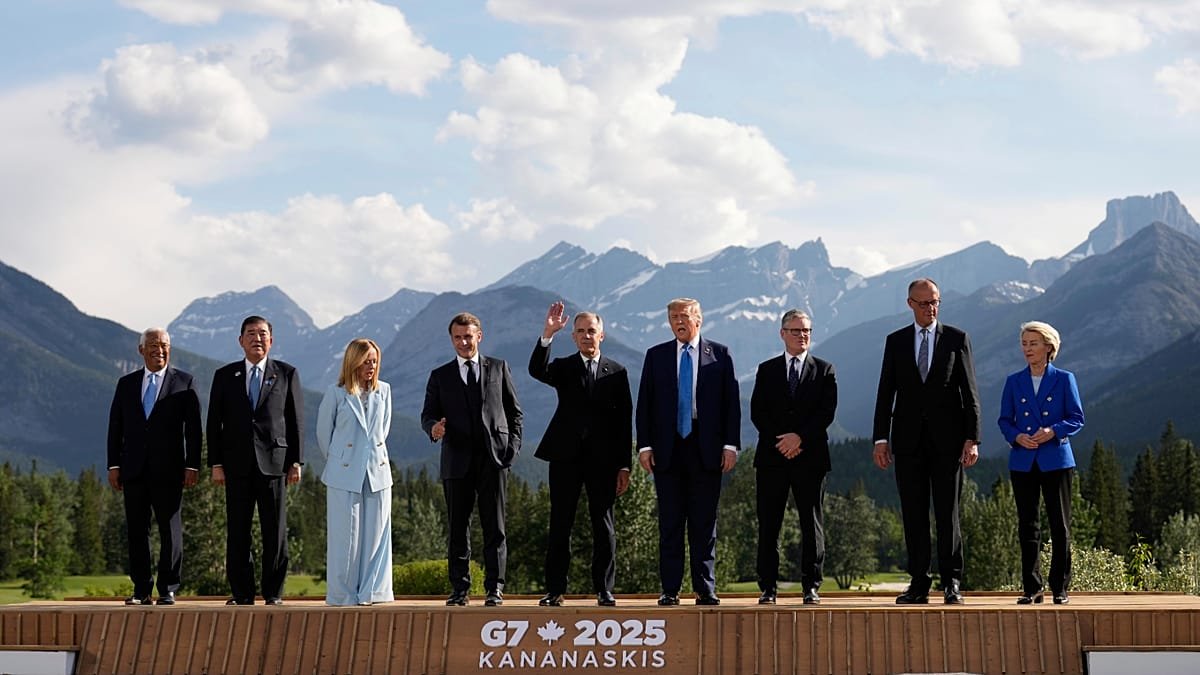
Technology and geopolitics will dominate the G7 summit in Évian, where host Emmanuel Macron will seek to paper over divisions between the group and the United States.
Leaders will gather for a three-day summit in Évian-les-Bains, a resort town on the shores of Lake Geneva, aiming to forge common positions on how to end the war in Ukraine, the conflict in the Middle East and the development of safer technologies.
Many on the sidelines of the summit had hoped the three-day gathering would help pave the way for an end to the Iran war, but those expectations were upended late Sunday when US President Donald Trump announced that a deal had been brokered to end the 15-week conflict.
“Ships of the World, start your engines,” Trump said in a social media post celebrating the deal, which he said would pave the way for the US ending its blockade of the Strait of Hormuz, a major energy corridor that previously catered to 20% of the world’s oil.
Germany, France, the UK and Italy released a statement welcoming the memorandum of understanding between the US and Iran, and the clear “diplomatic breakthrough”.
“The resumption of maritime traffic, without restriction or toll, is an indispensable condition for regional stability and the global economy,” Macron wrote on social media platform X.
“This agreement also paves the way for comprehensive negotiations in service of peace and security for all in the Middle East. These must address concerns related to Iran’s nuclear and ballistic programs, as well as its policy of regional destabilisation.”
Geopolitics at the G7
Before the summit, one senior EU official speaking on condition of anonymity said that the G7 leaders expected an update from Trump on the conflict in the Middle East and Russia’s invasion of Ukraine.
The American president has played a central role in both crises, first pledging and failing to end Russia’s invasion of Ukraine within 24-hours of taking office at the beginning of his second mandate — and starting another war in Iran thereafter.
Trump’s first face-to-face meeting will be with Macron on Monday night, hours after landing in Europe, with the pair expected to discuss both issues.
A French official said Europe’s position has been clear, and was centred on the reopening of the Strait of Hormuz. “This war must end, and this includes the whole region, including Lebanon,” another EU official said.
US and Israeli attacks on Iran and Lebanon since February have battered energy infrastructure and blocked the strait, sending the price of crude skyrocketing while leaving Europe lurching for other energy sources.
But divisions could flare again, with NATO allies also criticised by Trump for their limited involvement in the conflict.
One senior EU official said that the G7 format is conducive for free-flowing conversation, and the focus will be on what “unites” leaders from the world’s largest industrial economies — rather than what divides them.
A voice from the region is expected to be Syrian President Ahmed al-Sharaa, who—if he accepts Macron’s invitation—would become the first Syrian leader ever to attend a G7 summit.
Zelenskyy to make an appearance
Various officials have said Ukrainian President Volodymyr Zelenskyy’s presence is intended to examine whether fruitful negotiations with Russian President Vladimir Putin could be possible to end the bloodshed, as the invasion enters its fifth year.
It comes after weeks of chatter within Brussels about whether there is appetite to appoint a European envoy to represent the continent during potential peace talks.
This conversation has been routinely shut down by the EU’s foreign policy chief Kaja Kallas, arguing it is up to Europe to ensure that Ukraine is in the best possible position when and if the Kremlin wants to negotiate.
Another major question will be what it takes for Europe to help Ukraine find an end to the war, particularly about whether allied support can shift from something temporary to concrete security guarantees.
“Just, sustainable and lasting peace is required,” one EU official said.
AI in the crosshairs
French diplomats say artificial intelligence will feature high on the agenda, with leading Silicon Valley executives invited to a working lunch focused on what organisers have described as “the safe, rapid and effective deployment of artificial intelligence”.
Sam Altman of OpenAI, Dario Amodei of Anthropic and Arthur Mensch of Mistral will take part alongside eight other technology industry representatives.
The meeting comes after the US government issued a directive last week ordering Anthropic to restrict foreign nationals’ access to its most advanced AI models citing national security concerns. The restrictions apply to Fable 5 and Mythos 5.
Anthropic said it would have to “disable” the technology to comply with US regulations. Some commentators have described the move as a “kill switch” for the technology.
A European Commission spokesperson said US export controls should not be “discriminatory” towards partners, adding that the issue is likely to come up at the G7.
The China conundrum
Japanese Prime Minister Sanae Takaichi is expected to be consulted by the G7 for her expertise regarding how to counter Chinese trade pressure tactics. The assembly of leaders — which includes Germany, France, Italy, Canada, the US, the UK, and Japan — comprise 45% of global GDP at market prices.
EU officials stressed the need to discuss “microeconomics”, how to address the bloc’s ballooning trade deficit with Beijing, but also how Tokyo has managed to fend off similar trade spats.
The timing is opportune, as European heads of state will gather on Thursday in Brussels for high-level talks on how to speak to the Asian giant while addressing overcapacity issues and unfair subsidies.
However, the G7 summit will not be solely focused on the elephant in the room. “One important deliverable is to bring China into the dialogue,” one EU official said.
Chinese leader Xi Jinping is expected to attend the upcoming G20 format, where the matter will be revisited again.
PM office canada
Canada’s Carney charmed by Irish county filled with dozens of cousins
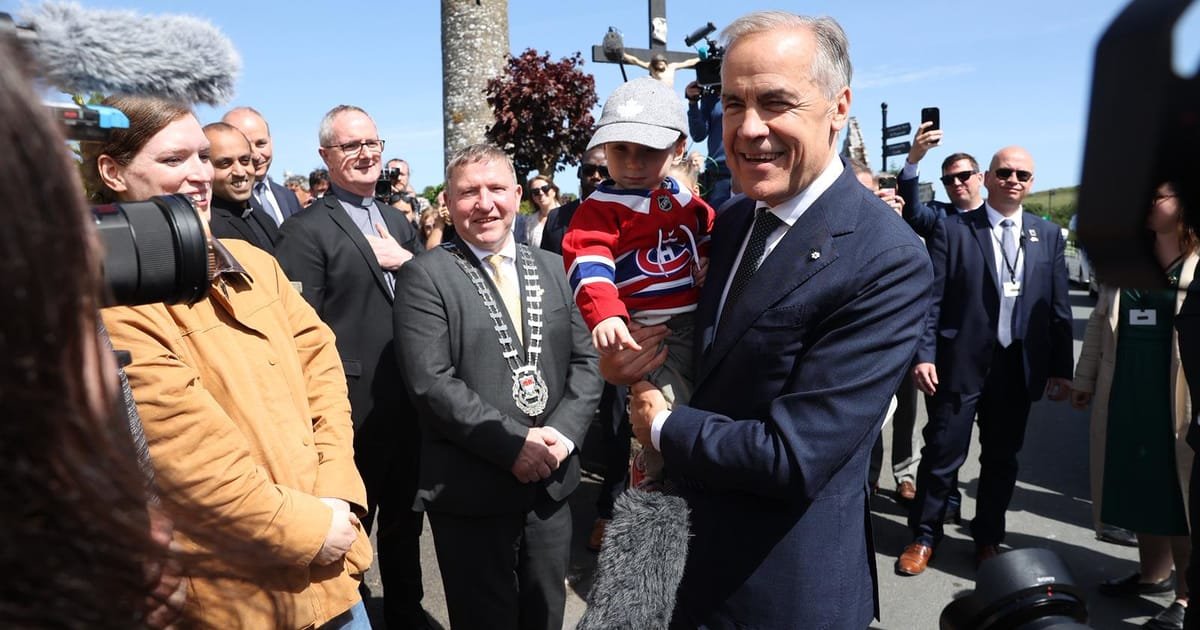
WESTPORT, Ireland — Canadian Prime Minister Mark Carney felt the embrace of an entire Irish county Sunday as he visited his ancestral homeland — and celebrated Catholic Mass and family ties alongside dozens of cousins he’d never met before.
His trip to County Mayo on the second day of his first official visit to Ireland included morning discussions behind closed doors with Ireland’s head of state, President Catherine Connolly, at Westport House, a stunning Georgian mansion on the edge of town.
But this exceptionally sunny day belonged to the Carney clan. They had spent weeks with their neighbors planting trees, sprucing up floral displays, whitewashing walls and decking shops and streets with Canadian flags and bunting in Westport, a town renowned both as one of Ireland’s tidiest and as the global home of Botox.
An emotional high point came in the nearby crossroads village of Aghagower, where Carney’s paternal grandparents, Robert Carney and Nora Moran, grew up on adjoining farms on the lands of Lord Sligo before emigrating together to Canada in 1925.
Waiting to meet Carney outside St. Patrick’s Church in Aghagower were dozens of cousins and hundreds of people from the surrounding community, including at least one impressively articulate local boy, as well as Ireland’s prime minister, Taoiseach Micheál Martin.
Carney tried to shake everyone’s hands, all the while noting that Mass was supposed to start at 11:30 a.m.
“I don’t want to hold up the service,” he said at one point before stopping to take a picture with 17-month-old Malachy Morgan, who had arrived with his Irish-Canadian mother donning a Montreal Canadiens jersey and nibbling on a toy hockey stick. Carney told them, in French, how pleased he was to see the jersey, “particularly in the west of Ireland.”
Inside the church where his grandparents were baptized, Carney sat in the front pew beside his nearest relatives living in Ireland, Pat Carney and Maureen O’Malley, who are first cousins of his late father, Robert Jr.
After Mass, Carney popped into Aghagower’s only shop, which does triple duty as the village’s post office and pub, and toured a cemetery beside the church bearing a 10th-century round tower and more than a few headstones with the Carney name.
Along the way, he heard how the village is on the pilgrim path taken by St. Patrick in the fifth century to Croagh Patrick, the mountain that towers over Westport. The parish priest, Father Tod Nolan, pointed out nearby sites where Ireland’s patron saint reputedly slept and baptized locals on the way to spending 40 days and nights atop the mountain.
As Carney negotiated a tide of well-wishers, many remarked that he looked from photographs to be the spitting image of “Gramps Carney” — a.k.a. his grandfather Robert.
“The genes are strong. They run deep,” he told them.
Later, Carney was due to be feted at a civic reception in Westport’s theater in a ceremony featuring the presentation of a 28-page booklet documenting his Aghagower roots — and the reading of a commemorative poem honoring Carney as a voice of sanity in a loony world.
“As democracies are subjected to coercion we look to Canada as we’ve done before, and with pride to our cherished native son,” the work by local poet Ger Reidy read, “to convene a coalition of the anti-war … to defend civilized values despite the struggle, so we can all resume living our sacred ordinary lives.”
PM office canada
Canada’s Carney sees ‘timely’ role for G7 in any Iran deal
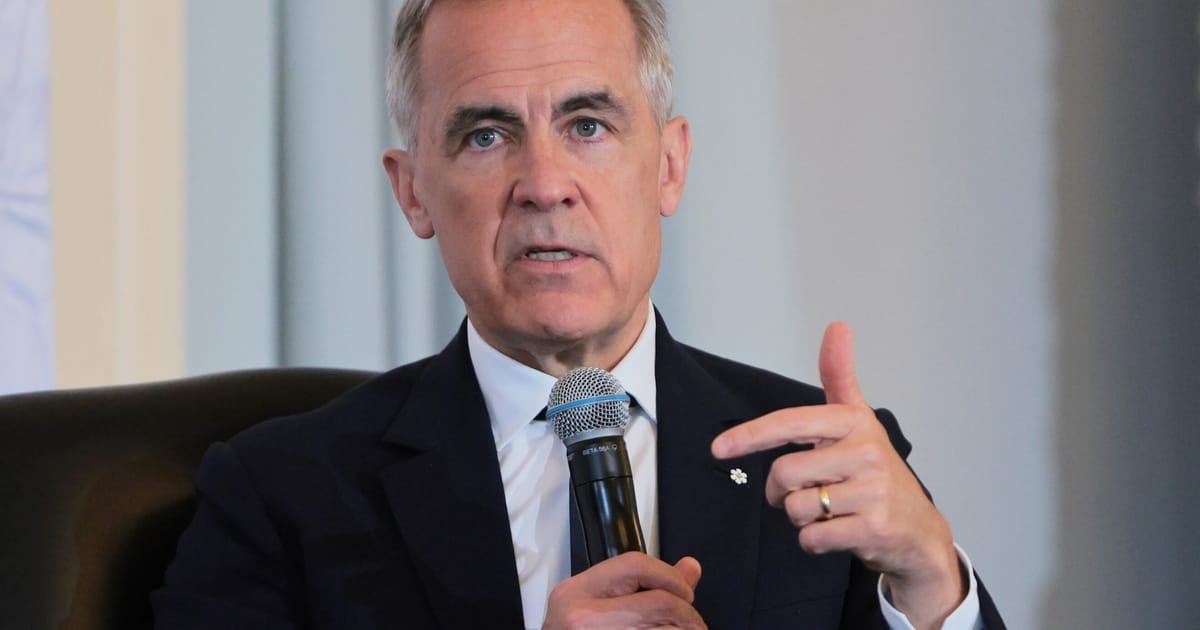
DUBLIN — The upcoming G7 summit could be well-timed to cement an emerging peace agreement on Iran — but only if the deal includes a ceasefire in Lebanon too, the leaders of Canada and Ireland stressed on Saturday.
Canadian Prime Minister Mark Carney, speaking at the start of a two-day visit to Ireland, looked ahead to his much more challenging next stop: the G7 summit in France alongside his frequent foil on the world stage, U.S. President Donald Trump.
Standing beside Irish Taoiseach Micheál Martin outside his central Dublin office, Carney said he was “encouraged by recent developments,” referring to the yo-yoing hopes of a potential U.S.-Iran agreement.
Carney touted “the possibility of a more durable ceasing of hostilities,” and he described G7 host France’s planned inclusion of the leaders of Egypt, Saudi Arabia, Qatar and the United Arab Emirates in an expanded summit format as “timely.”
But Carney emphasized any credible deal would require “a broader cessation of hostilities, including in Lebanon.”
Martin — whose government has been sharply critical of Israel, which shut its Irish embassy in protest — concurred, saying it would be “extremely important that Lebanon is included in the peace process. Lebanese sovereignty is absolutely essential.”
Lebanon is of particular importance to Ireland, a non-NATO member, because the Irish contribute troops to the United Nations peacekeeping force in south Lebanon — and have lost 48 soldiers on duty there since 1978.
Carney’s trip to Ireland seeks, in part, to promote his agenda of building Canadian cooperation with Europe as a counterbalance to the tension the country has experienced with its southern neighbor under the Trump administration. And Ireland is about to become a particularly influential ally, since it’s taking over the rotating presidency of the European Council on July 1 and will consequently be hosting scores of EU events over the coming six months.
But his swing through Ireland also looks like a bid to build the political brand of Carney, a policy wonk and former central banker who’s been an elected lawmaker for barely a year. His family story will come into focus Sunday when he visits his ancestral home in a County Mayo village from which his paternal grandparents emigrated to Canada in 1925.
For most of Saturday’s joint presser with Martin, a politician like Carney known for a demure disposition, both leaders seemed determined to avoid criticizing Trump — a global leader with a very different public persona — by not mentioning him.
Neither of their speeches mentioned the United States, never mind Trump. And when the reporters’ questions inevitably focused on Trump’s role in international conflicts and apparent unreliability as a trading partner, Carney and Martin stumbled over themselves avoiding a direct reply.
Carney even acknowledged the verbal gymnastics, capping one lengthy response that didn’t mention Trump by conceding: “That is a very oblique answer.”
Martin — whose own country is loath to draw Trump’s ire because it profits so handsomely from nearly 1,000 U.S. multinationals — softened his tacit criticism of the Trump administration with his only invocation of the T-word.
“President Trump is democratically elected as president of the United States and I’ll always respect that,” Martin began, before cautioning: “We must always understand the limits of power.”
Martin noted his own two most recent St. Patrick’s Day visits to the White House and observed that relations between any two countries can always improve — “once there’s mutual respect.”
PM office canada
As the AI economy booms in the U.S., Canada sees a blip

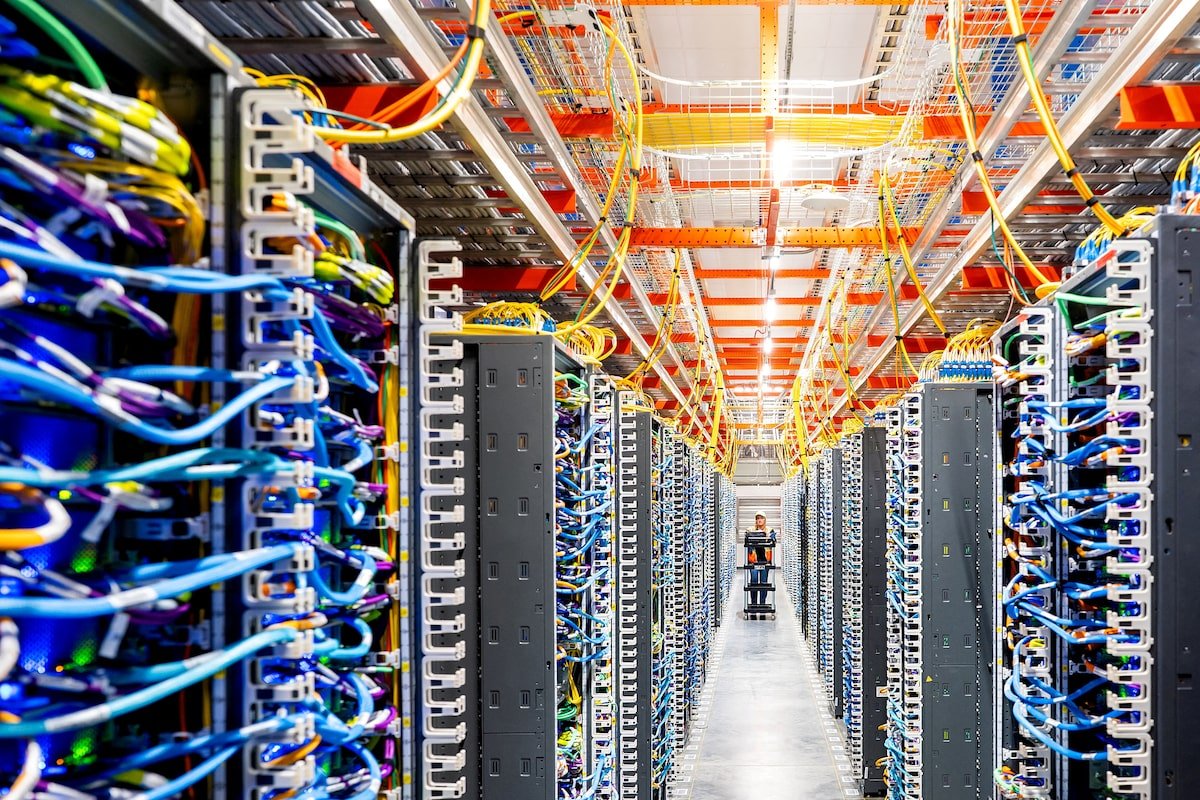
The frantic speed with which the artificial intelligence bonanza is rewiring the United States economy is staggering.
The U.S. now spends more to construct data centres than office buildings. Having roughly doubled imports of processors and servers from Mexico last year to US$90-billion, the U.S. is on track to double that number again this year.
Meanwhile, four tech giants alone plan to commit US$650-billion this year in capital spending. That’s almost as much as the U.S. private sector spent on all nonresidential structures last year, including factories, mines, railroads, warehouses and pipelines.
The manic rollout of AI-related infrastructure and systems is juicing economic growth south of the border in profound ways. In Canada, not so much.
While developers here have announced scores of new data centre projects – both standard facilities and large scale operations necessary to power AI – over the last two years, sparking a growing public backlash over water and energy-use fears, very few construction projects have gotten under way.
Konrad Yakabuski: AI data centres are becoming the wedge issue of our era
Likewise, workers and businesses in Canada have been much slower to adopt AI or invest in computing technology, continuing a decades-long pattern of underinvestment that has left Canada a productivity laggard. This is all reflected on the trade front, with Canada largely sitting out the rush to secure AI-related equipment from overseas.
Last year roughly 30 per cent of U.S. real GDP growth stemmed from private investment in IT equipment and software, according to a recent report by Desjardins’ deputy chief economist Randall Bartlett. By contrast, he estimated weaker spending on tech gear by businesses in Canada meant little more than 5 per cent of economic growth in 2025 could be attributed to AI-related capital spending.
“While tech-related investment did pick up in Canada toward the end of last year, there is a lot of ground to make up to close the gap with the U.S.,” he wrote.
In April, U.S. companies spent more than US$50-billion on an annualized basis on data centre construction, a 180-per-cent increase in three years, according to the U.S. Census Bureau.
Statistics Canada has no similar detailed measure, with investment in data centre construction mixed in with all spending on transportation and utilities. The closest the official stats get to measuring data centre construction activity is in the number and value of building permits for what Statscan calls “communications buildings,” a grab bag of bygone structures such as post offices, telephone exchanges and radio stations into which data centres get lumped.
The tally is sobering. During the last 12 months, as of March, municipalities issued just $188-million worth of permits for all types of communication buildings, and that was down 52 per cent from the previous 12-month period.
Xavier Lemyre, an analyst with Statscan’s building construction division, said there simply isn’t enough activity to warrant separate data centre building permit and construction investment releases yet. That could change if activity picks up, but he said there is no threshold for when that might occur.
“We keep a close eye on trends, and if the number of permits received increases steadily over the coming months, it’s something we would consider,” he said.
Alberta bill to prioritize AI data centres that generate their own power
Avik Dey has a front-row seat to Canada’s sluggish data centre rollout as the president and chief executive of Capital Power Corp., an Edmonton-based independent power producer. Since 2023, the company has been advocating for its Genesee Generating Station, a thermal power facility near Edmonton, to attract a large-scale AI data centre to the site.
Mr. Dey said Canada’s smaller size and the difficulty of securing semiconductors partly explains why the country is lagging, but the larger “bottleneck” for AI is access to power in Canada’s heavily regulated electricity market.
Since Alberta is the only fully deregulated power market, “Alberta has the advantage. The path to power is seamless, and there’s a path to power that actually benefits consumers and ratepayers here,” he said, pointing to the province’s ambitious goal of attracting $100-billion of data centre investment by 2030. “I believe the process will be successful, it’s just taking a longer time to get there.”
Still, even in Alberta, developers face mounting opposition to their data centre plans. Meanwhile, last week, two planned projects were thwarted shortly after the Prime Minister Mark Carney released his government’s AI strategy aimed at boosting its adoption.
On June 4, Manitoba Premier Wab Kinew nixed a large-scale data centre planned for Île-des Chênes, southeast of Winnipeg, saying, “There’s a big threat to the environment and not much benefit to the economy.” Then in Ontario, Hamilton’s committee of adjustment rejected a plan to partition land on the city’s waterfront for an AI data centre.
Canada isn’t sitting out the data centre building boom entirely. But for all the hype and attention the myriad of new construction announcements receive, that’s not yet translated into many shovels in the ground, according to Vancouver-based Aterio, which tracks the growth of the data centre industry.
Canada needs to be realistic about what its data centre goals are, said Viet Vu, manager of economic research at the Dais, a public policy think-tank at Toronto Metropolitan University, who cautioned against “using the U.S. as a yardstick to compare us against on AI.”
That’s because the frothy rollout south of the border is banking entirely on future gains from AI that may not unfold as hoped, which could leave local governments and electricity rate payers exposed if projects fail.
A bigger concern, he said, is the growing antipathy toward AI in Canada, with global surveys finding Canadians’ trust in the technology is significantly below the global average.
“Data centres are the physical embodiment of the visceral fear employees and people have about automating their jobs away in the long run,” he said. “For Canadians to embrace AI, that fear needs to be tackled.”
For Sal Guatieri, a senior economist at Bank of Montreal, the concerning AI gap between Canada and the U.S. isn’t so much data centre construction, which he said makes a relatively small contribution to GDP growth. It’s the yawning disconnect between business investment in innovative technologies between the two countries.
“We’re not investing as heavily in AI systems as U.S. companies are and that underinvestment in information technologies has been a longstanding issue for Canada all the way back to the tech boom of the late 1990s and beyond,” said Mr. Guatieri.
The investment gap has widened dramatically since 2023, with spending on computer equipment surging as a share of GDP in the U.S., while nudging only modestly higher in Canada.
It’s likely too soon to tell whether higher U.S. investment levels related to AI are behind that country’s productivity boom. Growth in U.S. productivity has been rising at its fastest pace in two decades, but that’s been the case for five years, well before AI hysteria began.
Still, given Canada’s poor track record, the widening gulf in business investment doesn’t bode well.
The first quarter of the year did hint at improvement for Canada, said Mr. Guatieri. Business spending on computers and software combined climbed by nearly 8 per cent from the year before, the fastest pace since 2022, despite the uncertainty from tariffs that is leading chief financial officers to keep a tight grip on spending.
“Investment in high-tech equipment would likely be even stronger if not for the trade war,” he said. “The AI boom is adding some resilience to the U.S. expansion but providing only a very mild tailwind here in Canada, though certainly any tailwind is welcome.”
Opinion: In the age of AI, power generation is Canada’s hard power against the U.S.
As much as intense AI capital spending is pushing U.S. economic activity higher, the country heavily relies on others to supply most of the computer processors and servers for all those data centres, and that is creating trade distortions that complicate the U.S. growth picture.
But powering up an AI data centre and keeping it running requires more than chips. And it’s here where another stark economic gap between the U.S. and Canada lies.
In a recent study, Michael Waugh, an economist and monetary adviser at the Federal Reserve Bank of Minneapolis, used AI to analyze the true scale of the computer equipment, batteries, electrical switchgear, copper wiring and hundreds of other products required for the U.S.’s AI rollout.
Taken together, those products amounted to 23 per cent of all U.S. imports last year, he found. Absent the AI boom, he estimated, the U.S. goods trade deficit would have been roughly smaller by US$200-billion, or 16 per cent.
When The Globe and Mail applied the same screen to Canadian imports, using a list of the 20 largest AI imports published by Mr. Waugh, the result was dramatically different. While Canadian and U.S. imports of AI-related equipment grew at roughly the same pace for most of the last decade, in early 2024, U.S. imports exploded, while Canadian import growth stayed the same. (Mr. Waugh reviewed and supported The Globe’s analysis.)
It’s another reminder that when it comes to AI’s effect on the economy, the U.S. is in a world all its own.


8 dead in B-52 crash: Air Force presser gives early details
Eight crew members are dead in a B-52 bomber crash shortly after takeoff from Edwards Air Force Base, northeast of...


‘Spider-Man of Yemen’ dies after fall into volcanic crater
A Yemeni climber known on social media as the “Spider-Man of Yemen” died after falling into a volcanic crater, according...


Iran v New Zealand: World Cup 2026 – live
Key events New Zealand’s national anthem rings out next and we aren’t too far away from kick-off at Los Angeles...


8 crew members dead after B-52 bomber crashes in California
Eight crew members are dead in a B-52 bomber crash shortly after takeoff from Edwards Air Force Base, northeast of...


Fans react to Cape Verde’s shocking draw against Spain in World Cup debut
The island nation of Cape Verde shocked fans in their first-ever World Cup match by earning a draw against reigning...


Live: B-52 crash site at Andrews Air Force base, CA
Eight crew members are dead in a B-52 bomber crash shortly after takeoff from Edwards Air Force Base, northeast of...


Why did 1.9M people leave California? | Fareed’s Take
CNN's Fareed Zakaria looks at why California's economy has stayed strong while its system of governance has become strained …


BBC tests out England and Argentina's World Cup training grounds in Kansas City | BBC News
The BBC's Will Grant has been taking a look around the base camps that England and defending champions Argentina will...


Marine jet crashes into mountain, erupts in fireball
A Marine pilot ejected from an F/A-18 Hornet shortly before it crashed into a mountainside during a routine training exercise...


US and Iran agree to strike a deal to end their conflict. #US #Iran #BBCNews
-
 Business2 days ago
How much of Musk’s wealth comes from government help? Virtually all of it
-

 LifestyleNews2 weeks ago
120 minutes of strength training per week may help extend lifespan
-
 Politics4 days ago
What to know about the stabbing that set off fiery riots in Northern Ireland
-

 Video3 days ago
Download fans say what they love about the festival. #DownloadFestival #BBCNews
-

 Video3 days ago
Why SpaceX IPO isn't about space. #SpaceX #ElonMusk #BBCNews
-
 HealthNews4 days ago
The people of Okinawa, Japan only eat until they are about 80 percent full, then stop — and the practice has been linked in multiple peer-reviewed studies to lower rates of cardiovascular disease, slo
-

 TravelNews3 days ago
My Paternal Instinct Should’ve Warned Me About Netflix’s Maternal Instinct
-
 Food3 days ago
Pope Leo’s plane was grounded. Then the King of Spain stepped in to help