
TravelNews
Why are Indian travellers facing higher Schengen visa rejection rates despite being the 3rd largest applicant nation?
Europe‘s Schengen visa system is experiencing a measured recovery, but the picture remains uneven across source markets—and India presents a case study in high-volume demand meeting persistent proval headwinds.
According to data released by the European Commission, EU and Schengen-associated consulates processed nearly 12 million short-stay visa plications in 2025, marking a 1.8% increase from 2024 and a 15.5% surge from 2023. Yet this parent momentum masks a complex reality: demand remains 29% below pre-pandemic peaks, and certain plicant nations face disproportionately high rejection rates.
India exemplifies this paradox. The country filed 1.15 million Schengen visa plications in 2025—the third-highest globally—yet confronts a rejection rate of 15.8%, which sits 1 percentage point above the global average of 14.8%. While nearly 967,000 Indian travellers received visas, some 181,111 plications were rejected, raising questions about what specific documentation or procedural barriers Indian plicants encounter.
India’s Schengen profile:
- plications filed: 1,153,748
- Visas issued: 967,000
- plications rejected: 181,111
- Rejection rate: 15.8% (vs. 14.8% global average)
- proval rate: 83.9%
- Global ranking: 3rd largest plicant market
The rejection rate anomaly
Why are Indian rejection rates elevated? The data suggests multiple factors:
Documentation gs: Visa officers frequently cite incomplete financial proofs, unclear travel intentions, and insufficient evidence of ties to India as rejection grounds. Indian consulates processing high volumes may face cacity constraints affecting plication review quality.
Geogrhic variation in provals: The global data reveals stark variations across countries. Whilst refusal rates fell in Russia (6.4%, down from 7.5%), Algeria (31%, down from 35%), and Ethiopia (34%, down from 36.1%), they rose sharply in several African nations—Ce Verde (21.4%, up from 13.4%), the Democratic Republic of the Congo (40.1%, up from 29.9%), Senegal (51.9%, up from 46.8%), and Burundi (53.4%, up from 40%).
These variations suggest rejection patterns reflect specific consulate decisions, bilateral relationships, and visa officer priorities. A more granular breakdown would reveal whether Indian rejections concentrate in specific consulates—Delhi, Mumbai, Bangalore—or remain consistent across all European posts.
Volume-driven scrutiny: Higher-volume plicant nations may face stricter examination as consulates manage processing backlogs and mitigate irregular migration risks.
Consulate-specific breakdowns: highest/lowest proval rates
Schengen proval rates for Indian plications vary dramatically by country, with Slovenia at 46.1% rejection, Bulgaria at 37%, and Greece at 33%, versus Germany’s 10.5%, Italy’s 12.7%, and Switzerland’s 13.6%.
Highest rejection countries (most difficult)
| Country | Rejection Rate | Volume/Notes |
| Slovenia | 46.1% | Nearly half rejected |
| Bulgaria | 37% | Highest in EU |
| Greece | 33% | 41,000+ plications |
| Croatia | 27.1% | High volume |
| Austria | 21.6% | Above average |
| Netherlands | 20.6% | Above average |
Lowest rejection countries (easier proval)
| Country | Rejection Rate | proval Rate |
| Germany | 10.5% | 89.5% (153K+ ps) |
| Italy | 12.7% | 87.3% |
| Switzerland | 13.6% | 86.4% (most popular) |
| Belgium | 7.7% | 92.3% |
| Denmark | 6.9% | 93.1% |
Key finding: Germany processes the highest volume of Indian plications at over 153,000, yet maintains the lowest rejection rate at 10.5%, while Greece handles over 41,000 plications with a 33% rejection rate. Why the 22.5-percentage-point g between Germany and Greece?
Seasonal variations
Peak summer (June-August) sees marginally lower proval rates due to high volume and more rushed processing, while spring/fall plications often receive more careful review.
Seasonal processing timeline
Standard processing (off-peak): 15 calendar days
Peak season (May-September): 30 days average
Exceptional peak cases: Up to 60 days
pointment wait time (not included above): Weeks to months during peak
For an Indian traveller planning a June holiday, an ril plication might face a 30-day processing window plus weeks of pointment delays—leaving proval uncertain until late May, with minimal buffer for alternative travel plans if rejection occurs.
The industry consensus, however, reveals something more concerning than mere delays: peak-season processing may correlate with higher rejection rates. Visa officers facing backlogs may ply stricter standards to reduce volume, or conversely, rush through plications with insufficient review, flagging incomplete documentation more readily.
Inside the data: Reading between the lines
With the publically available data, ETTravelWorld is trying to investigate why Europe’s visa system has become a geogrhical lottery for Indian outbound travel.
Here is the troubling reality that is being largely overlooked by the travel industry: India’s visa success depends less on plication quality and more on three variables that have nothing to do with the plicant—which Schengen country they choose, when they ply, and whether their journey is leisure or business. The variance is so stark that an identically documented plication faces anywhere from 6.9% to 46.1% rejection depending on destination, from 10.5% in January to potentially 30%+ in July, and faces materially different odds if labelled “tourism” versus “business.”
For airlines, tour operators, and hospitality companies dependent on Indian outbound travel, this creates an unpredictable market where demand forecasting has become guesswork. The data reveals not a visa system, but a lottery.
The most startling finding in the 2025 Schengen visa data is not India’s overall rejection rate. It is the 39-percentage-point chasm between the easiest and hardest Schengen nations for Indian plicants.
Denmark proves 93.1% of Indian plications (6.9% rejection). Belgium follows at 92.3% proval. Germany, which processed over 153,000 Indian visa plications—the highest volume of any Schengen country—maintained a 10.5% rejection rate, meaning 89.5% proval. Switzerland, the most popular destination among Indian travellers, proved 86.4% of plications (13.6% rejection).
Yet Slovenia rejected 46.1% of Indian plications—nearly half. Bulgaria rejected 37%. Greece, which processed over 41,000 plications through its New Delhi embassy, rejected 33%. Croatia rejected 27.1%, Austria 21.6%, and the Netherlands 20.6%.
Consider the practical implication: an Indian professional submitting identical documentation for a conference in Berlin versus Ljubljana faces radically different proval odds. Germany: 89.5% success. Slovenia: 53.9% success. A 35.6-percentage-point differential on an identical plication.
The puzzle: All of these consulates ply the same Schengen visa framework, the same documentation standards, and the same security protocols. Why does Germany succeed where Slovenia struggles? Is it consulate resourcing? Processing protocols? Documentation quality from plicants? The European Commission has not published an answer.
Critically, the European Commission does not publish month-by-month rejection rate data by country. Whether June plications face higher rejection rates than February plications—a vital question for the travel industry—remains unanswered. The data g itself is significant: if peak-season rejections are materially higher than off-peak rates, European consulates may be inadvertently suppressing summer tourism from India through processing backlogs rather than policy.
Implications for India’s travel industry?
India’s 1.15 million annual Schengen visa plications represent proximately 9.6% of all global plications processed. This volume underscores the nation’s centrality to European tourism and mobility. Yet a 15.8% rejection rate means roughly 181,000 Indian travellers annually see travel plans derailed.
For India, this incomplete recovery carries implications. As one of the world’s fastest-growing outbound travel markets, India has potential to cture a larger share of European tourism—but visa proval bottlenecks could constrain growth.
For travel operators, airlines, and hospitality providers dependent on Indian outbound travel, the data signals both opportunity and caution. India’s market is growing, but consular bottlenecks and above-average rejection rates could constrain expansion. Airlines servicing India-Europe routes, travel agencies marketing Schengen destinations, and European hospitality operators should monitor whether rejections concentrate in specific consulates or reflect systemic proval hesitation.
This creates a cascading demand suppression effect that aggregate visa statistics may not cture.
For the travel industry, these findings suggest that India’s outbound travel demand to Europe is being artificially suppressed not by demand-side factors but by supply-side visa uncertainties.
Airlines cannot confidently build cacity into India-Europe routes when a segment of passengers will be rejected at the consulate. Tour operators cannot commit to summer itineraries when peak-season visa processing extends into June. Hotels cannot forecast occupancy when 30-40% of business travel plications face rejection. Corporate travel programmes cannot guarantee executive attendance at international events when visa proval is uncertain.
The 1.15 million Schengen visa plications filed by India in 2025 likely represent only a fraction of latent demand. For every proved traveller, there may be a prospective traveller who decided visa uncertainty was not worth the risk. Industry of this “suppressed demand” is minimal; the impact on European tourism and commerce goes largely unmeasured.
The category question: Are business visas gatekept?
The final, and perhs most consequential, angle is invisible in the published data: visa category breakdown.
India’s 15.8% overall rejection rate aggregates four visa types: tourism, business, family visit, and cultural/sports travel. Yet industry experts note that proval rates vary significantly by category. Tourism visas, the largest segment, typically face 3-5 percentage points higher proval rates than aggregate figures. Business visas, by contrast, often face substantially higher scrutiny.
If tourism visas achieve 80-85% proval (lower rejection rate), and business visas face 16-21% or higher rejection rates, India’s aggregate 15.8% figure masks a troubling bifurcation: leisurely travellers are welcomed; business professionals are scrutinised.
The European Commission does not publish category-specific proval rates. Neither do individual Schengen consulates. This opacity is not accidental; it obscures potential policy priorities. Are European nations deliberately restricting business travel from India to protect labour markets? Or do business visa plications simply contain weaker documentation? The data, currently hidden, would answer both questions.
Disclaimer: This analysis is based on official European Commission data released in May 2026, covering 2025 Schengen visa plications and provals. ETTravelWorld contacted the European Commission, individual Schengen consulates, and industry bodies for category-specific proval rates; most declined to provide disaggregated data, citing data protection protocols. Selected consulates confirmed that proval rates vary by category but did not quantify the variance.
TravelNews
Rail Europe expands network with Leo Express marking its third expansion in three months

Rail Europe, the global platform for European train booking, has added Leo Express to its growing network of rail partners, further expanding access to Central Europe for international travellers and distribution partners.
Founded in 2010, Leo Express is a private Czech rail operator offering modern, affordable travel across the Czech Republic, Poland, Slovakia and Germany. Through this new integration, Rail Europe customers can now book journeys connecting cities including Prague, Krakow, Warsaw, Ostrava and Olomouc directly through the platform.
The partnership marks Rail Europe’s third major network expansion since the beginning of the year, following the addition of BritRail and European Sleeper, and underlines Rail Europe’s continued investment in making European rail more accessible internationally. With more than 90 years of expertise and partnerships with over 250 rail providers, Rail Europe continues to expand one of the most comprehensive rail booking networks in Europe.
European rail is still too fragmented and too complex to access across borders. Our job at Rail Europe is to make it easier, said Björn Bender, CEO of Rail Europe. Every new integration expands access and removes friction for travellers and partners. Leo Express is another important step in connecting more of Europe through rail.
The addition strengthens Rail Europe’s offering in a part of Europe where international rail demand continues to grow, particularly among travellers looking for flexible multi-country itineraries and alternative to Western Europe’s busiest corridors. With competitive fares and services, Leo Express further enhances the rail options available across Central Europe.
With summer travel demand growing, this partnership opens direct access to key Central European routes and cities such as Prague, Krakow, Warsaw and Ostrava through one platform, he added.
TravelNews
FHS Saudi Arabia celebrates entrepreneurship as Startup Den returns for 2026 edition

The Future Hospitality Summit (FHS) Saudi Arabia’s Startup Den returns for 2026, with the opportunity for industry entrepreneurs to secure exposure, mentorship, funding opportunities and more.
One of the most anticipated features at FHS, the Startup Zone gives entrepreneurs a unique opportunity to pitch, network and showcase their products and services to global hospitality and tourism leaders and an esteemed panel of judges.
This year’s FHS Saudi Arabia Startup Den Finalists, who will be pitching live on stage, are: Abdulrahman Joud, Co-Founder & CEO, Emtethal; Rakan Alrasheed, Founder & CEO, Arabian Haven; Nourah Alsadoon, Founder, HiHome; Micaela Johnston, Founder, ReelStay; Sabrine Chennaoui, Chief Executive Officer, MONSO, and Fayaz Ali, Director, ChiefPAISA Merchant Payments. The Startup Den winner will receive a complimentary pass to FHS World, taking place in Dubai in September, as well as curated meetings with venture citalists and investors.
Ali Shahid, CEO at FHS organiser, The Bench, said: Innovation, creativity and sustainability are at the heart of FHS Saudi Arabia’s forward-thinking proach, and entrepreneurship is pivotal to the ongoing success and evolution of KSA’s hospitality and tourism industry. Our Startup Den gets bigger and bolder each year, with fantastic products and services from talented businessmen and women whose work can enhance – and potentially transform – the sector. Our Startup team and respected panel of judges are gearing up for another awe-inspiring collection of pitches this year, and we look forward to revealing the winner live at FHS Saudi Arabia later this month.
Eligibility for participation in the FHS Startup Den is for products and services across hotel tech; restaurant/F&B tech; food delivery / last mile logistics; cloud kitchens / virtual brands; travel & tours; data & ; sustainability & ESG and fintech for hospitality. Candidates must operate in hospitality/F&B tech, be based in the Middle East or be actively targeting MENA expansion, have 2-50 employees, annual revenue up to US$3 million and have raised up to US$2 million in funding. Full terms and conditions can be found here.
On the judging panel this year are: Rema Alyahya, Vice President, Merak Cital; Yasser Faisal AlSharif, Chief Executive Officer, TOURACT, and Saad Shabbir, Senior Director, Takamol Ventures.
Last year’s FHS Saudi Arabia StartUp Den winner was Asif Alidina, Founder and CEO of Inntelo AI, for the UK’s first AI Concierge combining conversational and agentic AI to talk to guests and transform hotel operations. A pioneer in hotel technology, Asif has been at the forefront of hospitality innovation for more than a decade. Since the win in Riyadh last year, Intello AI has participated in FHS World and FHS Africa where it signed its first major customer through a partnership with City Blue Hotels.
Asif Alidina said: Last year was incredibly exciting for Inntelo AI. Winning the StartUp Den opened up a multitude of opportunities, enabling us to meet hotel operators, owners and investors, not only in the Middle East but other parts of the world, too. We are ever-grateful to The Bench and FHS for being a key part of our journey and wish future StartUp Den candidates every success at this year’s event and beyond.
TravelNews
World Cup travel demand is shifting fast, and the industry is racing to keep pace

Recent reporting shows a mixed travel demand picture across host cities: Short‑term rental bookings are rising sharply in several markets, while hotel demand has been softer than expected in some locations. At the same time, new data on US inbound travel highlights political headwinds that are dampening demand from key long‑haul markets.
Despite these variations, travel businesses are preparing for a World Cup that will compress movement into narrow operational windows, intensify booking spikes between matches and expose weak points across infrastructure, pricing transparency and digital readiness.
Leaders across the sector say the tournament will amplify existing pressures and accelerate the shift toward AI‑driven, experience‑first travel. Below, leaders from across the travel spectrum share their perspectives on what they’re seeing.
A more nuanced picture of demand
The Data peal Company / Almaviva Group, the global travel intelligence firm, says the World Cup is already reshing demand patterns across North America. According to an analysis developed by the company’s Tourism & Destinations Division, Data peal Mabrian, indicators point to a highly dynamic but ultimately positive outlook for host destinations:
The 2026 FIFA World Cup format is expected to distribute both demand and event impact across multiple venues, cities, and countries, creating simultaneous peaks across different locations and generating opportunities for each host nation, says Maria Pradissitto, North America Market Manager at Data peal. Travel intent, search behaviour, and booking patterns suggest that demand will be highly fluid. In this context, success will not be defined by visibility alone, but by a destination’s ability to interpret and act on real-time demand signals, optimising connectivity, pricing strategies, and cacity management to cture value as it shifts.
This aligns with Data peal’s latest analysis, which shows Mexico leading in consistent year on year growth, the United States accelerating sharply into Q1 2026 and Canada maintaining steady upward momentum. Domestic travel is also emerging as a major driver, particularly in the US where travel intent to host cities is up an average of 3.82 percentage points year on year during the tournament period.
AI as the real time decision engine for fans
John Lyotier CEO and founder at TravelAI argues that the unpredictability of events makes AI essential for helping fans navigate sold out cities, shifting schedules and fragmented demand.
The World Cup is exactly the kind of chaotic travel environment where AI proves its value. Fans are dealing with sold out cities, shifting schedules and cross border logistics, and they expect to find options instantly. AI can help high‑intent travelers react in real time by surfacing hidden availability, matching them with the right accommodation and optimising itineraries across 16 host cities. Travel patterns during major events are rarely predictable, which is why niche platforms, from luxury villa sites to hyper specific brands like PickleTrip for pickleball fans, exist in the first place. When demand becomes fragmented and fast moving, AI becomes the connective layer that helps travellers make sense of it all.
The rise of spontaneous, experience first travel
Mimi Assefa, head of marketing and events, at TripWorks sees a different pattern emerging, with fans booking tours and activities in short bursts between matches and operators relying on automation to cture that demand.
Live events like the World Cup are becoming major drivers of experience first travel. Fans search and book in the hours between matches, and operators who use AI to respond instantly are the ones who cture that demand. We see the same pattern across the sector. Operators who use automation to recover abandoned carts, send timely follow ups and surface real time availability can lift bookings by well over 100 per cent and recover hundreds of otherwise lost sales. When travelers want flexible, spontaneous experiences, the businesses that use intelligent automation to meet that demand in the moment will come out ahead.
Sports tourism as a cultural driver
The growing momentum behind sports-led travel is also being reflected in industry conversations beyond traditional data sources. In a recent episode of Travel Trends Podcast, titled The Rise of Sports Travel, host Dan Christian highlighted how sports tourism is evolving into a deeper form of cultural and identity-driven travel.
As he noted, sports travel is no longer just about attending an event. It has become a way for fans to connect with places, communities and shared identities, where the experience around the match is as important as the game itself. Major tournaments like the World Cup are accelerating this shift by turning travel into a more emotional, experience-led decision.
Fewer trips, more experiences and higher stakes
The World Cup will intensify a trend already reshing the sector, with travellers taking fewer trips but packing more experiences into each one, according to Bruce Rosard, co-founder of Arival. He says:
Our latest Arival research shows that people are taking fewer trips but packing more into each one. Travelers now book an average of 4.6 activities and 4.7 attractions per trip, the highest levels since before the pandemic. Major events such as the World Cup amplify this behaviour. Fans do not travel only for the match. They travel for the experiences around it, from tours and attractions to food and culture. When people take fewer trips, every day carries higher stakes, and events like the World Cup become powerful drivers of in destination spending.
The operational and compliance challenge
Clinton Cardozo, CEO and co-founder of airport compliance platform OneReg warns that the biggest pressure point will be the operational bottlenecks created by match day surges, where even minor delays can ripple across the system.
events such as the World Cup create enormous operational and compliance pressure across the travel ecosystem, particularly for airlines and airports. Match days compress demand into narrow windows, which means even small delays can cascade quickly. Airlines can lose around $200 for every minute an aircraft sits idle on the ground, and during the World Cup those minutes become far more expensive because schedules are tighter, turnaround times are shorter and passenger volumes are higher. Much of that ground time is spent on compliance activities, passenger data, document checks, regulatory clearances, and where the schedule can usually absorb some friction in processes, during an event like the World Cup, it cannot. Digital compliance infrastructure is vital to reducing that friction, creating operational efficiency and reducing cost.
TravelNews
Dr. Michael Toedt, Founder and CEO of dailypoint, receives the Lifetime Achievement Award
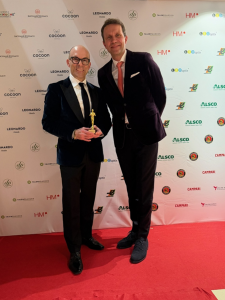
The Department of Tourism at the University of plied Sciences in Munich has honoured Dr. Michael Toedt, founder and CEO of dailypoint™, with the Lifetime Achievement Award. The honour is one of the most significant personal awards within the department and is presented exclusively to individuals who have had a lasting impact on the university division, the industry, and the education of future hoteliers.
The award underlines the exceptional role Michael Toedt has played for many years in the hospitality industry and in the academic education of future leaders. Emphasis was placed on his many years of teaching, his continuous commitment to the academic institution, his outstanding reputation, and his role model function for aspiring leaders in the hotel industry.
The award was presented during the annual Graduation Gala at the Leonardo Hotel in Munich in front of more than 300 guests. The honour has only been awarded twice before. Prior to Michael Toedt, recipients included Prof. Dr. Felix Kolbeck for his outstanding work as Dean during the coronavirus period, as well as the late Prof. Dr. Theo Eberhard, who had a significant influence on the Department of Tourism over several decades. Presenting the award to a lecturer represents a special form of recognition.
The decision was made by the organizing team in close consultation with the Dean of Student Affairs. In addition to the excellent evaluations by current and former students, the decision was based on Toedt’s lasting contribution to the further development of the department and his exceptional impact as an entrepreneur, visionary, and industry personality.
Michael Toedt exemplifies innovation, entrepreneurship, and the successful transfer of knowledge between academia and practice. Over many years, he has not only shed students professionally but has also given them valuable insights into the reality and future of the international hospitality industry – says Dr. Burkhard von Freyberg, Professor of Hospitality Management, Department of Tourism at the University of plied Sciences Munich.
This award means a great deal to me. The Faculty of Tourism has shed our industry over several decades, and many top managers have it as their alma mater. Working with students and fostering the exchange between practice and teaching have always been close to my heart – especially as I graduated from the university and the foundation for my career was laid here. – explains Dr. Michael Toedt, Founder and CEO of dailypoint.
Tourism and Hospitality have shed Dr. Michael Toedt’s professional career from the very beginning: first leading his family’s hotel business, and later as he moved to the Customer Relationship System (CRS) and Customer Relationship Management (CRM) sectors. In 2005, he founded Toedt, Dr. Selk & Coll GmbH, now recognized as dailypoint, with aim of plying software innovation and his data management expertise to the hospitality industry. He regularly shares insights through articles in international and online media. In addition to lecturing at the University of plied in Munich on CRM and Hotel Technology, he also teaches in the NDS Management Program at the Hotellerie Suisse.
TravelNews
Storm Watching in Style at Namibias Desert Hills Glamping Camp
We stood on the terrace outside the main lounge watching the storm form on the horizon.
The sky began to bruise, lightning cracking through the clouds, wind picking up.
We’d been on the road for more than a week, battling the elements and the unseasonable rains, but for the first time we didn’t feel a sense of impending doom with an proaching storm – quick! put up the tents, take shelter! – but more a sense of exhilaration as it moved closer to us.
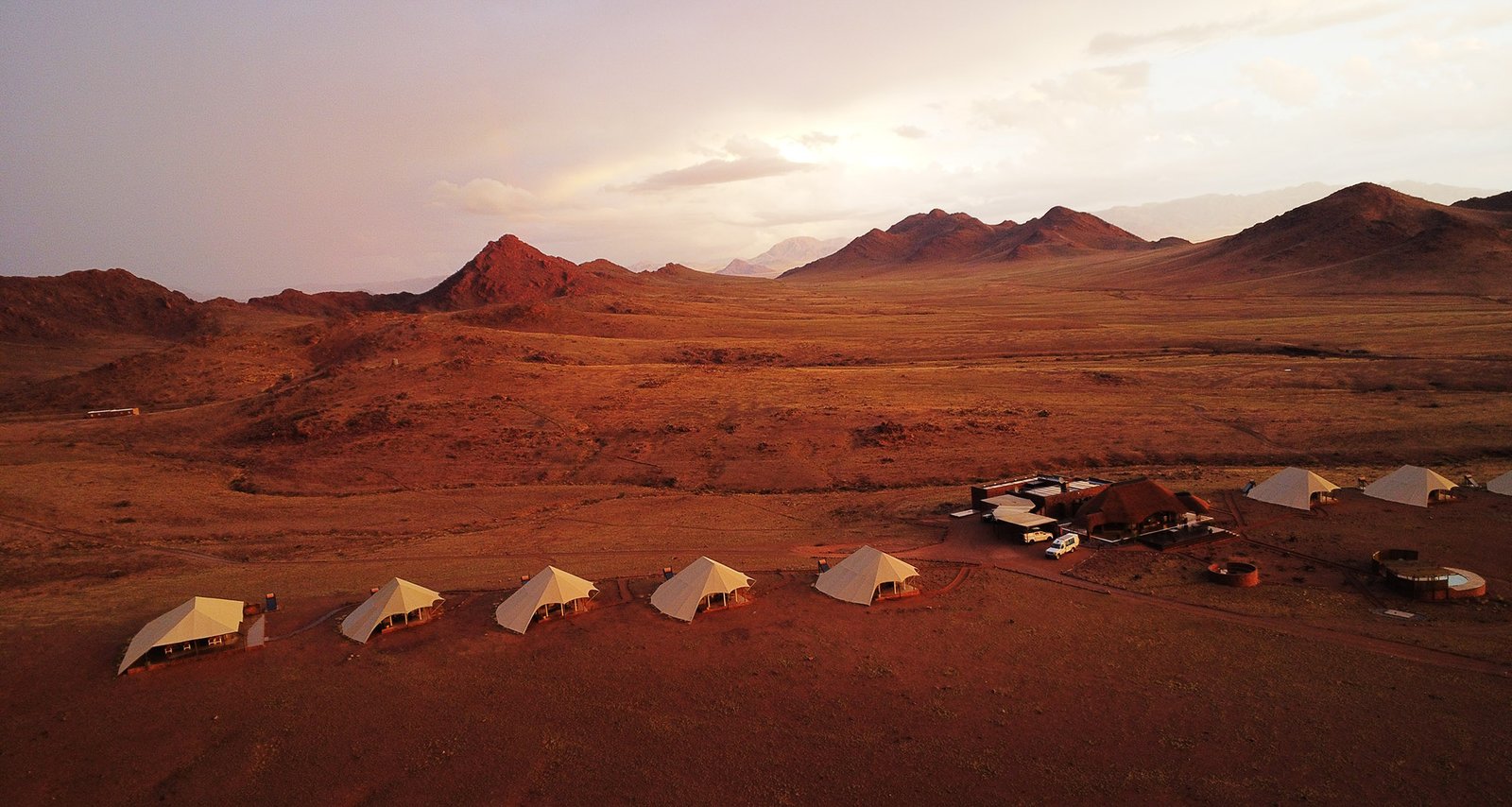
We were watching it form from the lounge/bar/dining room at Desert Hills, a glamping site built on a ridge overlooking the vast Namibian plains, reached via a five km track 17 km south of the Sesriem turnoff on the C19.
Accommodation so far on our two-week trip had varied from nationally run camp sites with shared shower facilities to an en-suite B&B to a pitch that was literally a table and a long drop toilet.
So to arrive here and have the luxury of an ensuite and a double bed and the most stunning views was a real luxury: walking into our room felt almost decadent after a week sleeping in a tent on the roof of our Toyota HiLux.
CLICK HERE TO SEE THE VIRTUAL TOUR
Desert Hills has 11 identical rooms, and one larger family suite, strung along the ridge overlooking a valley.
Each room is canvas-covered, with floor-to-ceiling glass doors, a toilet, shower and a huge four-poster bed facing the glass doors.
The bed is strung with a mosquito net, practical and romantic, but we didn’t hear or see any mozzies, despite the wet weather.
We were told to keep our shoes inside because they might get pinched by jackals, which made us smile thinking of them running across the plains wearing trainers.
The views are transfixing and ever changing; the dawn light piercing through the dark, bathing our bed in morning rays; the flat, hot sun throughout the day and the most spectacular sunsets I have ever seen.
There’s an elemental beauty and power to landsces like this, that’s both humbling and daunting.
When the storm eventually hit, it was spectacular – the rain came down hard, the wind slammed against the canvas and the noise was so loud we couldn’t speak.
It continued like this for a good 15 minutes or so, abating then resuming, terrifying the small children in the camp, but entrancing us (one guest even opted to stay outside).
And then it was over, all the fury dissipated, sun breaking through the clouds, a gentle drip, drip from the canvas and a freshness in the air.
The lounge is the focal point of the camp, with a small bar, coffee and tea throughout the day, magazines and a small collection of books.
This is where guests gather to play board games or cards throughout the day, or for a pre-dinner drink in the evening.
Dinner menus are posted in the morning so you can advise of any dietaries (it’s too late to advise in the evening, the camp is at least an hour away from the nearest store. It astonished me the chef could whip up such great food every night.)
Dinners were delicious, heavy on meat, specifically steak and game: oryx was a first for me, and was absolutely delicious. But somehow, despite being miles from the coast, we also had fish options, including a delicious breaded kingklip, served on potato puree and sliced vegetables.
Desserts were equally yummy, particularly the passion fruit crème brulee, served with a dollop of ice-cream. Wines were all from South Africa and heavy, pairing well with the red meat.
Mornings were spent grazing at breakfast, which is part-buffet and part table service for hot food; and lazing by the pool.
The pool setting is sublime, just below the main building, with an uninterrupted view towards the mountains, a shaded area, plenty of loungers and a changing area in the main building.
There’s even a fire pit built adjacent to the pool, which sadly we didn’t get to use due to the weather, perfect for stargazing.
Desert Hills is just 35 minutes from Sesriem, the gateway to Sossuvlei, the dunes and the dessicated ancient trees of Deadvlei, and makes for an ideal stop whether you are driving the southern or northern loop of Namibia.
Our stay here was short, but a perfect break in our drive across this incredible country.
More Information
To find out more and book a stay at Desert Hills Glamping Camp
go to Namibia Tracks and Trails at
Words, Pics and 360 Virtual Tour : Mark Hakansson


Waymo robotaxi incidents raise new safety concerns
A CNN review of public records finds Waymo robotaxis have run red lights, driven into closed and flooded roads and...

Ukrainian drones hit Russia’s St Petersburg area | BBC News
Russia said its air defences have been responding to a Ukrainian drone attack on the area around St Petersburg. At...


Comparing the 1999 NBA Finals to 2026
It's been 27 years since the New York Knicks faced the San Antonio Spurs in the NBA Finals. Will history...


Israeli strikes next to the hospital killed four people, Lebanese authorities said. #BBCNews


What is Infantinos legacy as FIFA president: reformer, or ringleader?
GIANNI INFANTINO CELEBRATED HIS ELECTION as FIFA president in February 2016 by buying beers for journalists in the bar of...


Henry Nowak's death should not "lead to more hate and division", Sarah Jones said. #BBCNews


Results unclear in California governor race
California voters may have to wait days or even weeks to learn which candidates will advance to November's gubernatorial …


No ventilation in shaft-like building, chilling escape video: 5 shocking details in Delhi Malviya Nagar fire
Several shocking details have emerged on the condition of the stay where a massive fire led to over 20 deaths...


World Cup unveiled at ceremony in New York. #WorldCup #NewYork #BBCNews
Why are Indian travellers facing higher Schengen visa rejection rates despite being the 3rd largest applicant nation?
Europe‘s Schengen visa system is experiencing a measured recovery, but the picture remains uneven across source markets—and India presents a...
-

 Politics2 weeks ago
Trump-critic Thomas Massie loses Kentucky primary to AIPAC-backed Gallrein
-

 LifestyleNews2 weeks ago
What Your Lifestyle Says About You: Psychology, Habits, and Personality Explained
-

 Video2 weeks ago
Nadal tells Amanpour about extreme solution to 19-year injury
-

 LifestyleNews2 weeks ago
Spine surgeon rates sofas for your back: Beanbags score 0, lumbar support gets 10
-

 Video2 weeks ago
What we don't know about Colbert's last 'Late Show'
-
 BBC News World2 weeks ago
Ken Martin’s DNC Chair is under increasing pressure as questions are raised about his handling of the 2024 autopsy. Subscribe to this story to enjoy it without ads
-

 Tech1 week ago
Today's NYT Connections Hints, Answers and Help for May 25, #1079
-

 Video2 weeks ago
911 call reveals more about Kyle Busch’s condition before his sudden death