
Tech
Until Dawn 2 looks like Cabin in the Woods, but in a jungle – Engadget

A sequel to Until Dawn is in development at Liverpool studio Firesprite, and it’s heading to PlayStation 5 in 2027. Until Dawn 2 pears to have all the trpings of the original choose-your-own adventure serial killer survival sim, but this time instead of being set on a snowy mountain, everything’s going down on a tropical island.
Until Dawn 2stars a cast of young-adult ghost hunters, all friends except for the random buff guy that no one seems to know. They operate a fledgling paranormal investigation channel and have just signed a deal with a TV network, so they’re sent to a remote island to collect (or create) footage. There’s your general gallivanting andcavorting amidst the waterfalls and greenery, and then suddenly a masked murderer with a machete slices open someone’s torso. The sequel features the series’ trademark quick-time events, complete with lethal consequences and plenty of gore, should you choose poorly.
Here’s how Firesprite describes its proach to the sequel’s mechanics:
“Will you risk injury to save a cute baby boar from a gnarly bear tr? Keep a scandalous affair going, even if it could blow up the group? Push someone to their breaking point, all for the sake of content that your intimidating boss says you need to get? This time, how you manage relationships within the crew matters more than ever, with some branches based on where things stand between characters. It’s not just the huge moments, even small character moments can set off a Butterfly Effect, sending your story spinning off towards unforeseen consequences.”
Until Dawn 2 is a standalone storyand it seems to have a laser focus on the teenage slasher aesthetic, which is certainly a welcome angle of attack. In the trailer, the scene with the couple being interrupted mid-kiss in the forest could’ve been pulled directly out of Cabin in the Woods, a classic of the genre. Until Dawn came out in 2015 with a similar b-horror vibe, so these are all fine signs.
Until Dawn was a product of Supermassive Games and published by Sony, and it was a cult hit that spawned a few spinoffs, including the VR games Rush of Blood and The Inpatient. Supermassive’s spiritual successor to Until Dawn, The Quarry, was published by 2K in 2022, and while it had fun moments, it lagged behind its progenitor in terms of overall flow and tension. The studio also released The Dark Pictures Anthology between 2019 and 2022. In early 2024, Supermassive’s co-founders left the studio and a majority of its employees were laid off.
Firesprite, the team in charge of Until Dawn 2, was built by the former members of Wipeout house Studio Liverpool and fully purchased by Sony in 2021. Sony has owned the Until Dawn license from the beginning, hence the “spiritual successor” title on Supermassive’s follow-ups, and it produced a 2025 film and remake based on the original game.
Tech
Meta will reportedly let employees take 30-minute breaks from its tracking program – Engadget
Workers can pause the all-seeing eye when they need to “check something personal.”
Meta is making some minor concessions in its extremely dystopian plan to track employees’ mouse clicks and keystrokes in the name of AI training. The company has reportedly made some changes to the controversial project known internally as the Model Cability Initiative (MCI), according to a report in The Information.
Meta now plans to allow employees to “pause” the for up to 30 minutes in the event they need to “check something personal,” the company told workers in a memo. A subset of employees will also be able to request to opt out of the program altogether, though this will be limited to remote workers with bandwidth concerns, people who deal with “sensitive” material and those who often work in spaces where they can’t easily keep ltops connected to a power source.
In other words, it sounds like the vast majority of Meta employees will still be required to allow their (nearly) every move to be tracked and recorded in the name of improving Meta’s AI models. However, the company did say that it had improved the software’s battery usage to address some employee complaints, reports.The company has faced protests from employees over MCI, which was announced last month just before the company laid off 8,000 workers and reshuffled thousands of others into AI-focused roles.
CEO Mark Zuckerberg recently defended the program to employees, telling them that “watching really smart people do things” is the best way for AI models to improve quickly. “The average intelligence of the people who are at this company is significantly higher than the average set of people that you can get to do tasks,” he said in leaked audio from a company-wide meeting last month.
“None of the data is being used for, like, looking at what people are doing, or surveillance, or performance track[ing], or anything like that. It’s purely just, like, we are using this to feed a very large amount of content into the AI model, so that way it can learn how smart people use computers to accomplish tasks. I think that this is going to be a very big advantage if we can do it.” He also added that if it works, “we’ll probably do more things like it” in the future.
Tech
Live from Microsoft Build 2026: Every Piece of AI, PC and Copilot News Dropped Today
Project Solara, a new AI cloud platform, was announced at Microsoft Build.
Nadella announced Project Solara, billed as a “new chip-to-cloud platform” for AI agent devices.
Steven Bathiche, who leads Microsoft’s plied Sciences Group, demonstrated onstage a new portable device built with Qualcomm silicon.
“It’s a turnkey solution for building unique agent-first devices,” Bathiche said, as he showed off an early prototype.
Steven Bathiche demonstrated a new AI agent access badge built using Qualcomm silicon.
“The Access Badge, built using Qualcomm silicon for wearables — this digital badge is a lightweight form factor designed for agent interactions on the go,” he said. You can unlock the badge with your fingerprint and use verbal commands to control the AI agent.
During the demo, he asked the badge to take photos for a social media post, using it to scan the crowd at the Build keynote. He asked Copilot to find some good shots from the audience scan, clean them up and send them to him and his team for review.
Microsoft is already working with AccuWeather, Best Buy, CVS Health, Levi Strauss and Target on the badge.
The other device Microsoft unveiled was a stationery-agentic AI MediaTek device, powered by Microsoft’s new Work IQ. Microsoft Work IQ provides workplace context for AI agents working in organizations, including access across Microsoft 365 — like emails, documents and meetings — and will be generally available on June 16.
Microsoft did not have a prototype of the MediaTek device on hand (which looks like those table-side payment terminals used in restaurants), and no news on when it could launch, but said it’s designed to be kept on your desk at work.
“Just walking up to the device securely signs you in, giving you direct access to your matrix … this means frictionless yet protected access to Microsoft 365 Copilot grounded in Work IQ, and with a simple glance at surfaces what matters next in your workday, helping you think, plan and even act by delegating tasks to your agents with a simple t or just using your voice,” Bathiche said.
The stationery agentic AI MediaTek device.
The screen behind Bathiche displayed images of wearables like smart glasses and smart watches, as well as tablets and screens.
“This is the moment to imagine where your agents should live, what form they should take and what new work they can unlock,” Bathiche said.
Tech
Best Mesh Wi-Fi Routers for 2026: Eliminate Wi-Fi Dead Zones for Good
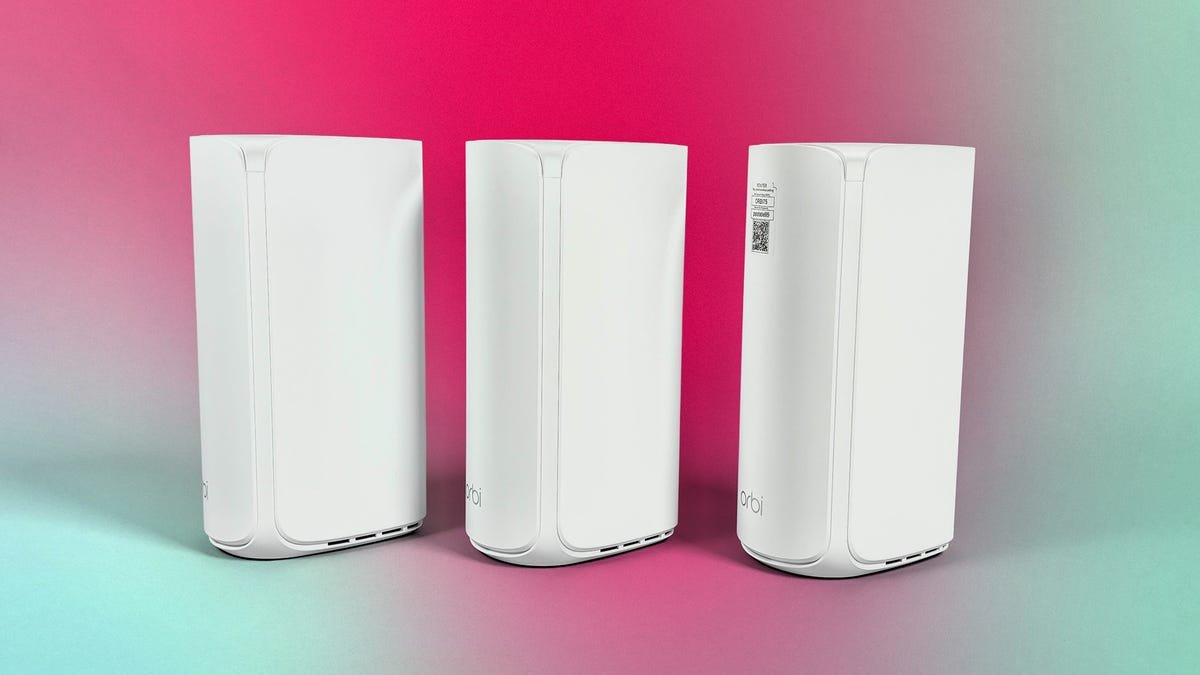
We test lots of routers at CNET HQ — mesh and otherwise — so we’re constantly updating our rundowns of the top systems on the market. I’ll note any new mesh systems we test here as we go, along with a quick summary of my takeaways. Please note that this list includes several systems that were tested at my home instead of our latest test setup.
Arris Surfboard Max AX6600: A high-powered Wi-Fi 6 system with an upright, cylindrical design, the Surfboard Max was able to deliver fast speeds to other Wi-Fi 6 devices in my tests, but the performance was inconsistent with earlier-gen Wi-Fi 5 devices. I also didn’t like the Ethernet jacks on the bottom of the device, which force you to bend your cables to the extreme in order to plug the router in.
Asus ZenWifi XD6: The middle child from the Asus family of Wi-Fi 6 mesh routers, the ZenWifi XD6 is a dual-band mesh system. It won’t give you the tri-band build of the ZenWifi XT8, nor will you get that system’s multi-gig Ethernet jack. Still, the system performed as well as any dual-band mesh router I had ever tested when I first reviewed it, so it isn’t a bad pick by any stretch. Available for around $140, it’s a reasonable price for a high-performance system.
Asus ZenWifi XT8: One of the most powerful ZenWifi systems, the tri-band XT8 performed well in our speed tests and was among the first mesh routers to include multi-gig Ethernet WAN ports on each device. Available in a two-pack for $330, the former CNET Innovation Award winner is a reasonable alternative, but it isn’t quite as good a value as the Netgear Orbi 870 or Eero 7.
Eero 6: Amazon’s first Wi-Fi 6 mesh router, the Eero 6 hit the market back in 2020, but it didn’t blow us away during our tests. Eero systems that followed it did a lot better in my speed tests and they offer the same smart home perks, such as built-in radios for Zigbee and Thread.
The Eero Pro 6E is a great pick for gigabit networks, but most homes would be better off upgrading to the Eero 7.
Eero Pro 6E: The Eero Pro 6E did an excellent job in our speed tests, finishing toward the top in just about every category while also delivering a noticeable speed bump to Wi-Fi 6E devices that can connect over the 6GHz band. The Eero 7 is the better value for most households, but if you’re a Wi-Fi 6E power user with gigabit speeds at home, then upgrading to the Eero Pro 6E merits strong consideration.
Eero Max 7: It’s Amazon’s newest, largest and priciest Eero mesh system, and it adds in support for Wi-Fi 7, the new Wi-Fi standard that promises to build upon Wi-Fi 6E’s foray into the 6GHz band. In our speed tests, the Max 7 was cable of hitting blazing-fast speeds, but at more than $1,000 for a two-pack, you’re better off spending less for the Orbi 870.
Linksys Velop MX2000: Available in a two-pack for $150, the Linksys Velop MX2000, also known as the Velop Atlas 6, is decent enough as baseline Wi-Fi 6 mesh routers go, but you’ll find better value and faster speeds if you shop around.
Nest Wifi Pro: The Nest Wifi Pro mesh router reworks the original Nest Wifi pitch by ditching the built-in Google Assistant smart speakers and adding in access to the 6GHz band via Wi-Fi 6E support. With a built-in Thread radio and robust smart home controls via the Google Home p, it’s a decent pick for smart home enthusiasts, and it was as stable a performer as I’ve seen in my speed tests. Still, those speeds were a bit lackluster, and the system also lacked backward compatibility with previous Nest Wifi and Google Wifi hardware. At $400 for a three-pack, it’s a bit expensive for such middle-of-the-road performance.
Netgear Orbi AX6000: Originally released as the Netgear Orbi 850 series, and recently updated to the 860 Series, both generations of Netgear’s flagship AX6000 mesh router offer strong performance, but I wasn’t as impressed with the system’s speeds on a gigabit network, where several systems that cost less have managed to outperform it in my tests. Even so, this is one of the most consistent mesh routers I’ve tested, with reliable speeds from test to test. If that type of steady performance is what you’re after, then it belongs high on your list.
TP-Link Deco X4300 Pro: The Deco X4300 Pro is an impressive system that features some of the best Wi-Fi 6 speeds we’ve seen, plus multi-gig Ethernet jacks on each device. The Deco W7200 still seems like the better value for most homes, but if you’re looking for a step up from that system, put the X4300 Pro on your radar.
TP-Link Deco X55 Pro: The X55 Pro earned CNET’s lab award for the fastest Wi-Fi 6 router, and it’s worth considering as a mesh system, too. It shares a lot of similarities with the Eero 6 Plus — support for Wi-Fi 6, far-reaching range, gigabit Ethernet jacks — and at $170, the X55 Pro is a solid value for a three-piece mesh system.
TP-Link XE75: TP-Link’s first Wi-Fi 6E mesh router, the XE75 did a decent job in our initial tests, though the system’s average upload speeds were lower than I’d expected. It’s a clear value pick and currently available in a two-pack for $150, so give it a look if you’re curious about Wi-Fi 6E but fearful about overspending. I’ll update this page once we’ve retested it in our lab, so stay tuned for that.
TP-Link Deco X90: With a multi-gig WAN port and a faster speed rating, the Deco X90 is a midrange upgrade pick over the Deco W7200, and it costs $259 for a two-pack. It performed well in my tests, but not enough that I’d recommend it over the Eero 7
Tech
Amazon Prime Day 2026 will run earlier this year from June 23 to 26 – Engadget
The four day shopping bonanza takes place earlier this year.
If you like to hold off on major purchases until big sales, listen up. Amazon has announced that its Prime Day event will take place this year from June 23 to June 26, a couple of weeks earlier thanlast year. As usual, the sale is for Prime members only and will feature deals across 35 categories ranging from clothing to electronics.
The event is one of multiple Prime Day sales Amazon usually holds throughout the year, along with its October and spring sales. However, it’s the biggest of the bunch with some of the steepest discounts, particularly on big-ticket items. It’s also, of course, a way for Amazon to convince people to sign up for its $139-per-year service, as most of the deals are only available to Prime subscribers.
Last year, Prime Day ran for four days compared to only 48 hours in 2024. The company is sticking to that four-day period this year as well, so you’ll have more time to find deals. Keep in mind, though, that some things are only discounted on certain days and stock can run out fast, so you’ll want to keep an eye on any products you’re interested in.
Amazon is also offering Prime members early theater screenings for Spider-Man: Brand New Day as a way to encourage signups. As usual, it already has early deals on products, particularly its own like Echo, Ring, Kindle and Fire TV devices, plus up to 50 percent off select movie purchases.
Tech
Audiophile-Oriented Noble Audio Debuts More Affordable Osprey Earbuds
You may not have heard of UK-based Noble Audio, but it makes some excellent-sounding earbuds and headphones and has gradually been producing more affordable true-wireless models. A couple of years ago, I added its FoKus Amadeus buds ($320) to CNET’s list of best-sounding wireless earbuds as my “top audiophile” pick. Now we get the Osprey, which are available for preorder on Thursday for $199 and ship in Late June.
I haven’t tried the new buds yet, but like other Noble Audio earbuds, the Osprey have a faceplate with an eye-catching marbled finish and an aluminum charging case. The company’s earbuds are on the larger side and feature dual-drivers — the Osprey pairs a 10mm dynamic driver paired with a custom balanced armature driver.
Noble says, “This carefully considered design provides confident, controlled bass, a natural and expressive midrange, and clean, extended highs with excellent separation.” Multiple ear tip options are included to support an optimal seal, which I certainly preciate.
The aluminum charging case does not pear to offer wireless charging.
While the earbuds feature active noise canceling, don’t expect it to be top-tier ANC, as audiophile wireless earbuds like the Fokus Amadeus don’t have the strongest noise canceling since it tends to impact sound quality. Also, the rated battery life is adequate but not great — up to 5 hours with noise canceling on and 7 hours with it off at moderate volume levels.
Noble Osprey key specs
- Hybrid dual-driver configuration: 10mm dynamic driver + custom balanced armature
- Frequency Response: 20Hz – 40kHz
- Bluetooth 5.4
- Chipset: Airoha 1571 (Airoha is a subsidiary of MediaTek)
- Supported Codecs: SBC, AAC and LDAC
- Bluetooth multipoint
- Active noise cancellation and transparency mode
- Dual microphones with cVc noise reduction
- Battery life: Up to 5 hours of playback with ANC on and 7 hours of playback with ANC off
- 10-minute quick charge gets you about 2 hours of playback
- USB-C charging
- Noble Audio p support with equalizer settings and firmware updates
- Price: $199


Waymo robotaxi incidents raise new safety concerns
A CNN review of public records finds Waymo robotaxis have run red lights, driven into closed and flooded roads and...


Ukrainian drones hit Russia’s St Petersburg area | BBC News
Russia said its air defences have been responding to a Ukrainian drone attack on the area around St Petersburg. At...


Comparing the 1999 NBA Finals to 2026
It's been 27 years since the New York Knicks faced the San Antonio Spurs in the NBA Finals. Will history...


Israeli strikes next to the hospital killed four people, Lebanese authorities said. #BBCNews


What is Infantinos legacy as FIFA president: reformer, or ringleader?
GIANNI INFANTINO CELEBRATED HIS ELECTION as FIFA president in February 2016 by buying beers for journalists in the bar of...


Henry Nowak's death should not "lead to more hate and division", Sarah Jones said. #BBCNews


Results unclear in California governor race
California voters may have to wait days or even weeks to learn which candidates will advance to November's gubernatorial …


No ventilation in shaft-like building, chilling escape video: 5 shocking details in Delhi Malviya Nagar fire
Several shocking details have emerged on the condition of the stay where a massive fire led to over 20 deaths...


World Cup unveiled at ceremony in New York. #WorldCup #NewYork #BBCNews
Why are Indian travellers facing higher Schengen visa rejection rates despite being the 3rd largest applicant nation?
Europe‘s Schengen visa system is experiencing a measured recovery, but the picture remains uneven across source markets—and India presents a...
-

 Politics2 weeks ago
Trump-critic Thomas Massie loses Kentucky primary to AIPAC-backed Gallrein
-

 LifestyleNews2 weeks ago
What Your Lifestyle Says About You: Psychology, Habits, and Personality Explained
-

 Video2 weeks ago
Nadal tells Amanpour about extreme solution to 19-year injury
-

 LifestyleNews2 weeks ago
Spine surgeon rates sofas for your back: Beanbags score 0, lumbar support gets 10
-

 Video2 weeks ago
What we don't know about Colbert's last 'Late Show'
-
 BBC News World2 weeks ago
Ken Martin’s DNC Chair is under increasing pressure as questions are raised about his handling of the 2024 autopsy. Subscribe to this story to enjoy it without ads
-

 Tech1 week ago
Today's NYT Connections Hints, Answers and Help for May 25, #1079
-

 Video2 weeks ago
911 call reveals more about Kyle Busch’s condition before his sudden death