
Business
Alphabet kicks off €6 billion bond sale, tests appetite for tech debt

Alphabet is offering the new bonds in seven tranches, with total demand just over €17 billion, the memo from one of the banks arranging the sale seen by Reuters showed.
Sign up here.
The bonds, expected to be priced later on Monday, have maturities ranging from 2 to 19 years. They include one floating-rate tranche and six fixed-rate tranches, according to an SEC filing.
The offer marks Alphabet’s second euro-denominated sale this year. In May, it sold €9 billion of bonds across six tranches, following a rare 100-year sterling bond sale in February.
Alphabet said it intended to use the net proceeds for general corporate purposes, which may include repaying outstanding debt.
Barclays, BNP Paribas and Deutsche Bank are the joint book-running managers for the offering, according to the SEC filing.
Alphabet’s shares fell more than 12% last Thursday, their worst day ever, wiping out roughly $500 billion in market value after its quarterly results showed slower-than-expected growth in Google Search and cash burn that rattled investors.
For the whole year, the company expects capital spending of as much as $205 billion.
As of September 30, Alphabet had also signed leases, mainly for data centres, that have not yet commenced, with future payments of $130.5 billion that are not yet recorded on its balance sheet, the SEC filing showed.
Microsoft, by contrast, was the only Big Tech company generating cash in the quarter.
Still, analysts expect major tech companies to step up bond sales in Europe to fund infrastructure investment, tapping the region’s deep and liquid debt markets.
Alphabet shares were up about 1% in premarket trading. The company’s US-listed shares fell nearly 19% in October, their worst monthly performance on record.
Its dollar-denominated 4.1% bond due in 2031 was little changed on Monday at about 95.43 cents on the dollar.
($1 = 0.8948 euros)
Reporting by Dhara Ranasinghe, Anzar Mehraj and Yoruk Bahceli; Editing by Amanda Cooper, Mark Potter and Tomasz Janowski
Our Standards: The Thomson Reuters Trust Principles., opens new tab
Dhara Ranasinghe is the Financial Markets Editor EMEA . She has more than two decades of experience covering global financial markets, including almost a decade in Asia covering emerging markets. Based in London, Dhara plays a key role in Reuters’ European markets coverage and making sure the Reuters file is ahead of the game in capturing the major themes of the day.
Yoruk Bahceli is a correspondent covering European financial markets from London.
Business
Oil prices slide as hopes rise for potential US-Iran diplomatic breakthrough
Oil prices took a leg down on Monday as the outlook for potential diplomatic breakthroughs in the Middle East strengthened just a day before midterm elections that could represent a pivotal moment for the Iran war.
Futures on Brent crude (BZ=F), the international benchmark, shed around 7.9% to trade below $105 per barrel, while those on US WTI crude (CL=F) lost 7.5% to hold near $96.
Oil futures initially began to move downward on Monday after Axios reported that, while Israeli Prime Minister Benjamin Netanyahu has pressed the White House for a forceful round of strikes on Iran, President Trump has said he wants to give diplomacy with Tehran another shot.
The reporting from Axios aligns with public statements in recent days from President Trump, where he has said the US won’t strike Iran after the midterms. However, reporting by national outlets in recent weeks has indicated that the US military has briefed Trump on options for a major reescalation after the midterms, when the risk of political backlash against the president will be lessened.
Read more: How oil price shocks ripple through your wallet, from gas to groceries
Adding to the downward pressure on oil prices Monday, leaders in Tehran said contact with the US over negotiations to end the war is continuing, Reuters reported, as talks between Iran and Qatari mediators have produced proposal language but no breakthrough agreement.
“Consultations through mediators are very intensive,” Iranian Foreign Minister Abbas Araghchi said in comments to the state-run media outlet IRNA. “We have presented our conditions and proposals and everything depends on the political rationality of Washington.”
Leaders in China and Russia both spoke out against a full-fledged resumption of hostilities on Monday, in comments from their foreign ministries. China is a major buyer of energy from the Gulf region, and after largely staying out of the conflict through its first several months, it has engaged more directly in recent weeks.
In Russia, the war in Iran has added to the nation’s domestic fuel shortage, caused largely by strikes on oil refineries by the Ukrainian military and international sanctions levied against Moscow. President Vladimir Putin reportedly spoke with Iranian security lead official Mohsen Rezaei on Monday , per Reuters.
Even so, the diplomatic headlines haven’t yet tempered predictions on Wall Street that oil prices will remain higher for longer. Goldman Sachs analysts led by Daan Struyven said on Monday that they now expect Brent prices to average $105 per barrel in December, up from a previous forecast of $90. They see Brent contracts averaging $88 per barrel in 2027, up from a prior $80 forecast.
Business
Marvell Could Be Making a $115 Billion Mistake With Lumentum Purchase
You are now leaving Barron’s website
By clicking on the “Proceed” button below, you will be redirected to a third-party website owned and operated by Hong Kong Tiimoot Information Technology Co., Limited. (“HKT”), which is located in Hong Kong. That website operates independently from Barron’s and Barron’s does not control the website. The privacy practices of HKT are subject to its Privacy Statement, so please read it closely. We are not responsible for HKT’s privacy or other data-related practices.
Business
Virgin Galactic unveils new spaceship Apeiron, targets commercial spaceflight return in 2027

Virgin Galactic unveiled its next-generation spaceship, Apeiron, bringing the company closer to its planned return to commercial spaceflight in 2027 after a multiyear pause in operations.
The spacecraft arrived at Spaceport America in New Mexico, where it will undergo final preparations and flight testing before entering commercial service.
Virgin Galactic expects to begin commercial spaceflights aboard Apeiron early in the second quarter of 2027, provided the test program is completed successfully. A second next-generation spaceship is expected to begin commercial operations late in the second quarter or early in the third quarter of 2027.
LOCKHEED MARTIN UNVEILS 10-YEAR FRAMEWORK TO PRODUCE 850 F-35 FIGHTER JETS FOR THE US MILITARY
The new spacecraft is designed to fly as often as twice per week and complete more than 500 missions over its operational life, potentially allowing Virgin Galactic to operate commercial flights more frequently.
Virgin Galactic last conducted a commercial spaceflight in 2024 before pausing operations to focus on developing its next-generation spacecraft.
Apeiron, an ancient Greek word meaning “boundless,” was chosen through a public vote that drew responses from thousands of people in more than 80 countries across six continents.
After being revealed at Virgin Galactic’s spaceship factory in Mesa, Arizona, Apeiron was flown beneath the company’s carrier aircraft, Eve, to Spaceport America, which will serve as the spacecraft’s permanent home and operations base. The spacecraft departed Phoenix-Mesa Gateway Airport at 10:29 a.m. MST and arrived in New Mexico at 12:59 p.m. MDT.
Virgin Galactic said its engineering team will now complete avionics software integration and validation while preparing Apeiron for flight testing.
Meanwhile, production of the company’s broader fleet is underway, with assembly of a second spaceship and a static test article progressing at its Arizona facility.
The timeline remains contingent on successfully completing flight testing and other development work.
CLICK HERE TO GET FOX BUSINESS ON THE GO
Business
Wall St rises as oil falls heading into US midterm elections
Summary
Companies
Indexes up: Dow 1.06%, S&P 500 0.58%, Nasdaq 0.65%
Oracle down on plans of raising $20 billion through debt, share sale
Apple falls ahead of earnings due after markets close
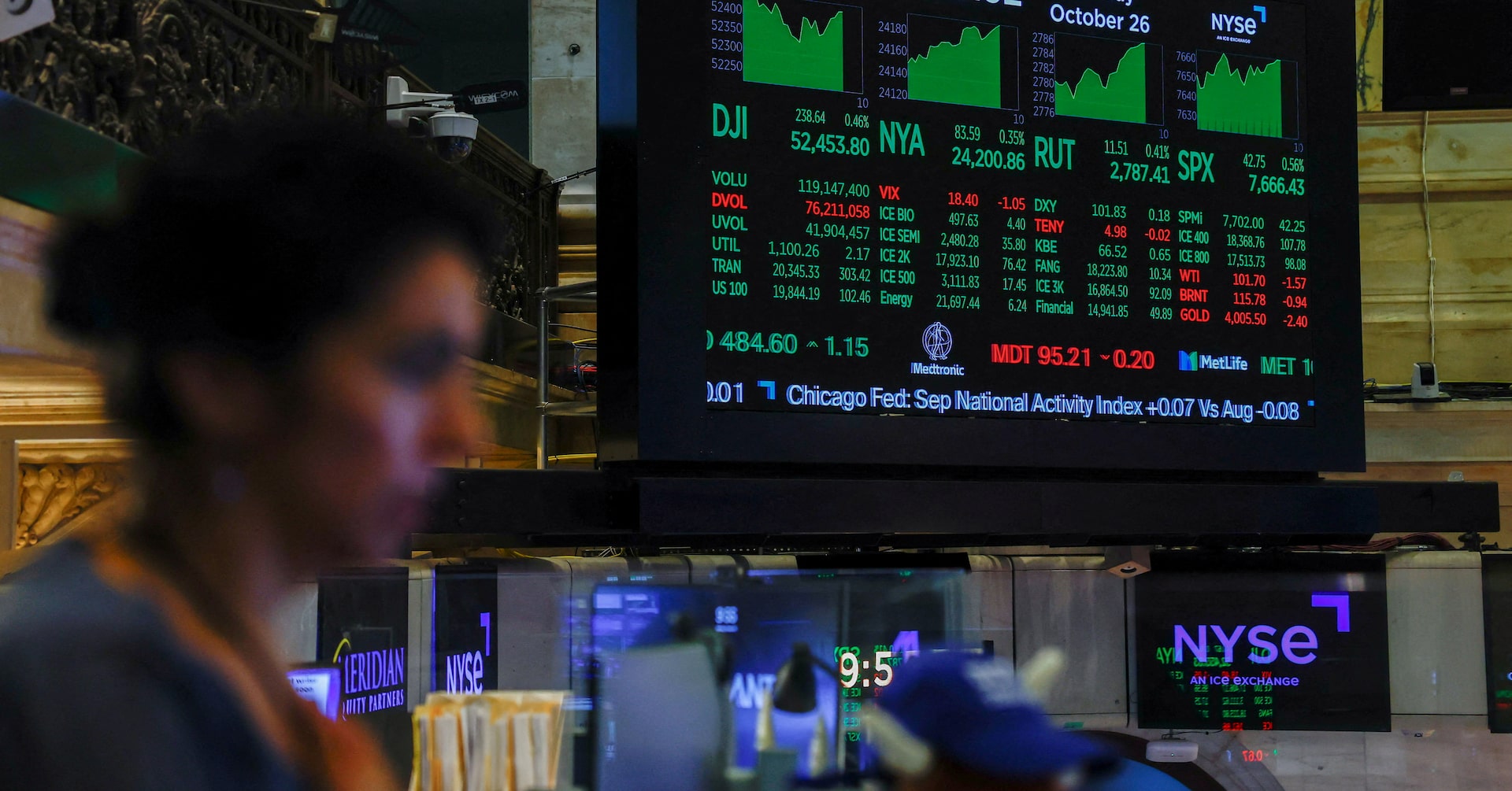
Nov 2 (Reuters) – Wall Street’s main indexes climbed on Monday as oil prices tumbled more than 7% on hopes of a US-Iran peace deal, with investors also bracing for Tuesday’s midterm elections and another busy week of earnings.
Brent crude prices fell to an over two-week low as Iran’s talks with Qatari officials to end the eight-month-long conflict with the US raised hopes that Middle East supply disruptions could ease.
Sign up here.
Iranian President Masoud Pezeshkian said the country’s supreme leader has granted “certain authorities” to the government with regard to peace talks, state media reported.
Most megacap and growth stocks gained, with Nvidia (NVDA.O), opens new tab and Amazon.com (AMZN.O), opens new tab rising 1% and 4.5%, respectively.
At 11:49 a.m. ET, the Dow Jones Industrial Average (.DJI), opens new tab rose 549.85 points, or 1.06%, to 52,320.16, the S&P 500 (.SPX), opens new tab gained 43.80 points, or 0.58%, to 7,623.75 and the Nasdaq Composite (.IXIC), opens new tab gained 164.91 points, or 0.65%, to 25,601.91.
Eight of the 11 major S&P 500 sectors were in positive territory, with consumer discretionary (.SPLRCD), opens new tab leading gains, while energy (.SPNY), opens new tab fell over 2.8%.
The gains offered some respite to the AI trade after a bruising October, which left the tech-heavy Nasdaq-100 (.NDX), opens new tab close to entering correction territory, as investors grew wary of Big Tech’s soaring AI spending while awaiting evidence of stronger returns.
Concerns, however, lingered as Oracle (ORCL.N), opens new tab dropped 5.5%, after regulatory filings showed that the cloud infrastructure provider plans to raise $20 billion through a debt and share sale, highlighting investor concerns that debt-funded spending could become harder to justify as borrowing costs rise.
Sentiment towards AI remains shaky, as an amended IPO filing showed Anthropic’s net loss narrowed sharply in the third quarter, while revenue jumped ahead of a potential listing.
“(AI) Demand still looks strong, but this earnings season has increasingly been about what companies are spending to capture it and when those investments start showing up in returns,” said Jake Behan, head of capital markets at Direxion.
Marvell Technology (MRVL.O), opens new tab fell 7.6% after the custom chipmaker said that it is buying optical components maker Lumentum (LITE.O), opens new tab in a $115 billion all-stock deal, including debt. Shares of Lumentum were down 12.9%.
Intel (INTC.O), opens new tab extended its losses, down 4.8%, after clocking the stock’s worst one-day fall since the 1980s on Friday. The company forecast quarterly revenue below market estimates and said it does not expect positive cash flow this year.
Rival chipmaker AMD (AMD.O), opens new tab is set to report its earnings later this week, while tech giant Apple (AAPL.O), opens new tab fell 1.6% ahead of its quarterly earnings due after the bell.
This week’s key catalysts include the US midterm elections on Tuesday, which will determine whether Democrats can wrest control of Congress away from President Donald Trump’s Republican Party.
Democrats are widely predicted to win the House of Representatives, but the Senate is more in doubt. Republicans controlled both chambers of Congress during the first two years of the Trump administration.
Meanwhile, data showed that US manufacturing activity picked up in October amid solid domestic demand.
Advancing issues outnumbered decliners by a 2.97-to-1 ratio on the NYSE and by a 1.78-to-1 ratio on the Nasdaq.
The S&P 500 posted 30 new 52-week highs and no new lows, while the Nasdaq Composite recorded 88 new highs and 182 new lows.
Reporting by Shashwat Chauhan and Utkarsh Hathi in Bengaluru; Editing by Maju Samuel
Business
Elon Musk throttles Grok Bot limits due to ‘unsustainably high’ costs
Over Halloween weekend, some Grok Bot users awoke to something especially spooky: their weekly usage limits were unexpectedly maxed out, even if they hadn’t been using SpaceX’s agentic AI overnight. Some users reported on X that their usage jumped from as low as 50% to 100%.
SpaceX CEO Elon Musk confirmed in an X post on Sunday that this was not a glitch.
“The cost of serving Grok Bot was unsustainably high relative to revenue,” he wrote in a reply to a question from a user. He has not addressed the issue on his main feed, but has continued boasting that Grok Bot can help you buy gifts for your family.
Grok Bot has been positioned as a success story for the newly public SpaceX, which said in a filing last month that AI now makes up 52% of company income. Its renamed “Super Intelligence” division actually turned a profit of $431 million, which is a rarity in the AI industry. Its profit would’ve been higher if not for $1.2 billion of one-time costs related to its acquisition of Cursor. Musk recently referred to Grok Bot as having “the fastest growth of a product that I’ve ever seen in my life.”
Musk has not yet shared how subscribers’ usage limits will be impacted moving forward.
Oil prices slide as hopes rise for potential US-Iran diplomatic breakthrough
Oil prices took a leg down on Monday as the outlook for potential diplomatic breakthroughs in the Middle East strengthened...
Marvell Could Be Making a $115 Billion Mistake With Lumentum Purchase
You are now leaving Barron’s website By clicking on the “Proceed” button below, you will be redirected to a third-party...


Virgin Galactic unveils new spaceship Apeiron, targets commercial spaceflight return in 2027
Virgin Galactic unveiled its next-generation spaceship, Apeiron, bringing the company closer to its planned return to commercial spaceflight in 2027...


Sectors bracing for a pivot as US midterm elections loom
Nov 2 (Reuters) – As the US midterm elections approach, Corporate America is bracing for a potential shift in the...


Alphabet kicks off €6 billion bond sale, tests appetite for tech debt
Alphabet is offering the new bonds in seven tranches, with total demand just over €17 billion, the memo from one...


Wall St rises as oil falls heading into US midterm elections
Summary Companies Indexes up: Dow 1.06%, S&P 500 0.58%, Nasdaq 0.65% Oracle down on plans of raising $20 billion through...


Angelina Jolie and Brad Pitt’s daughter Vivienne delivers final blow to estranged dad
Brad Pitt and Angelina Jolie’s daughter Vivienne has officially dropped her father’s famous last name. A Los Angeles judge granted...


Netflix Acquires Joel Coen’s ‘Jack of Spades’ Starring Josh O’Connor
Netflix is back in business with the Coen Brothers with its global acquisition of the sinister gothic mystery film Jack...

Elon Musk throttles Grok Bot limits due to ‘unsustainably high’ costs
Over Halloween weekend, some Grok Bot users awoke to something especially spooky: their weekly usage limits were unexpectedly maxed out,...
SpaceX weighs Boost Mobile deal in push for Starlink phone service: Report
SpaceX (SPCX) may be attempting an end run to circumvent obstacles it’s facing in getting a mobile network off the...
-

 HealthNews1 week ago
E. coli cases possibly linked to Bengtson’s Pumpkin Farm, Will County health officials say
-
Business2 weeks ago
GLP-1 injections recalled nationwide. See affected products
-

 Entertainment2 weeks ago
R.J. Mitte’s Mother Opens Up on His Life, Rumors and Legacy
-

 Entertainment2 weeks ago
Noah Adams, longtime host of NPR’s All Things Considered, has died
-
 Business2 weeks ago
Datacenters 2027: The Year of Acceleration, +50GW in a Single Year
-

 Business2 weeks ago
Tesla (TSLA) Q3 2026 earnings preview: flat revenue, falling profits
-

 Entertainment2 weeks ago
J Mascis has nothing better to do
-

 HealthNews2 weeks ago
My In-Laws Offered to Watch My Baby, Then Didn’t Give Her Back for Six Weeks. That Was Just the Beginning.