
Politics
King describes slave trade as ‘shameful chapter’ that ‘fills my heart with horror’ in Commonwealth speech
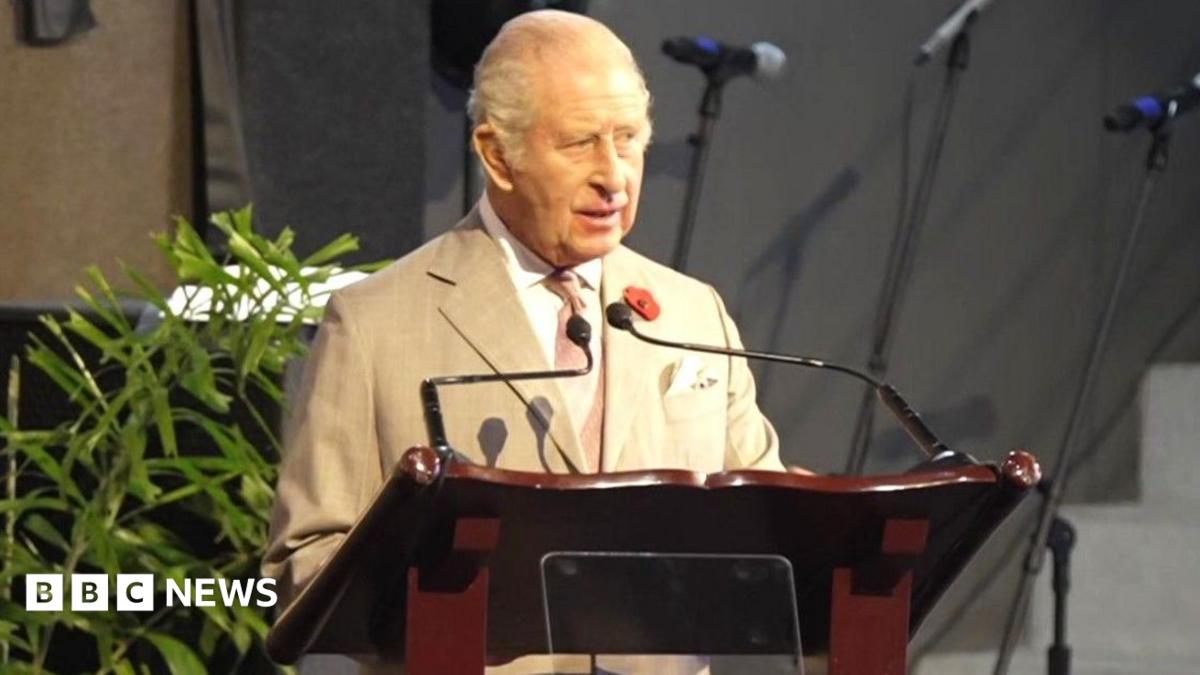
King’s candid Commonwealth speech fell short of an apology for slave trade
Daniela Relph
Senior royal correspondent, in Antigua
The King knew he couldn’t give the audience exactly what they wanted today – which for many leaders would have been a straight apology for the transatlantic slave trade.
That will have disappointed many in the room but the King did speak with personal conviction and genuine sorrow.
These were the most extensive comments he has made on the UK’s role in the slave trade.
He was as candid as he could be in a role that a senior royal aide has described as “transcending politics” on this diplomatically delicate trip to the Caribbean
He is a constitutional monarch who is guided by the position of his government. That position may be shifting but for now it remains as no apology and no reparations.
The King was heard respectfully and warmly in the room by Commonwealth leaders and in the hours ahead we are likely to get reaction from them to the King’s words.
We’re now bringing our live coverage to a close, you can read more in our news story.
King speaks of sorrow for the slave trade and ‘unique advantage’ of Commonwealth
Joe Coughlan
Live reporter
King Charles III today addressed Commonwealth leaders at a summit in which he called the slave trade the “most monstrous injustice” and a “shameful chapter” of history.
Speaking at the Commonwealth Heads of Government Meeting (Chogm) in Antigua and Barbuda, the monarch said the period “fills my heart with horror and my soul with the most profound personal sorrow” – but he did not offer a direct apology.
Britain’s involvement in the transatlantic slave trade began in 1562, and by the 1730s it had become the world’s biggest slave-trading nation., external
The King spoke of the character and courage to overcome “monstrous injustice” to bring about an end to the international slave trade, in which he said the “the Royal Navy played such a leading role”.
Prime Minister Andy Burnham is also attending the Chogm, which is held every two years, and is expected to set out plans for a “debt reset” to support Commonwealth countries. The summit continues tomorrow.
Before our coverage comes to a close, we will bring you some analysis of the King’s speech from our senior royal correspondent Daniela Relph.
What has Burnham said on plans for a Commonwealth debt reset?
Successive prime ministers have ruled out making reparations for the UK’s part in the transatlantic trade of enslaved people.
Last week Prime Minister Andy Burnham said he was open “to calls for an apology” but called reparations “not the right answer”.
He is expected to set out plans for a “debt reset”.
This would aim to support Commonwealth countries dealing with the growing cost of interest on their debts. The Aids Health Foundation charity warned that one in three Commonwealth countries are in debt distress.
Alongside plans for a debt reset for these countries, Prime Minister Andy Burnham is also expected to allocate £40 million for infrastructure improvements in the Caribbean.
“Britain is bringing a new approach to this meeting,” the prime minister has said.
Bond, a network for organisations working in international development, welcomed the plan and said: “Too many Commonwealth countries are losing vital public revenue to unsustainable debt repayments and tax abuse, while struggling to fund their own public services including healthcare, education and climate resilience.”
Britain’s involvement in the transatlantic slave trade
King Charles referred to the slave trade as a “shameful chapter of history” during his Commonwealth speech.
Buckingham Palace has been clear that it is not the King’s role to decide whether the UK makes reparations for its part in the transatlantic trade of enslaved people.
Britain’s involvement in the transatlantic slave trade began in 1562, and by the 1730s it had become the world’s biggest slave-trading nation., external
Between 1500 and 1800, around 12-15 million people were captured in Africa and taken to the Americas where they were forced to work as slaves. It is estimated that over two million people died on the journey.
The British Parliament passed more than one hundred acts supporting and protecting the slave trade and, with royal support and backing, had assisted the development of growing the enslaved African population in the British colonies.
British enslavers profited from the buying and selling of enslaved Africans to work on plantations and that trade became bound to Britain’s economy and society.
Eventually, Parliament abolished the transatlantic slave trade in 1807, before banning enslaved labour colonies in 1833.
King offers no direct apology
Daniela Relph
Senior royal correspondent, in Antigua
The words, as ever from the King, were careful and considered. But he spoke personally and that will have landed in a room full of leaders – many of whom want more from the UK.
There was no direct apology or offer of reparations but there was a sense of sorrow and contrition from the King in his own words.
There was an acknowledgement that he had personally learnt more about the brutality of the slave trade.
But there was also a sense from the King that the most powerful way forward is to look to the future and ensure the next generation of young people in the Commonwealth have the best opportunities made available to them.
“Evil need not have the last word,” the King said.
Charles concludes with message of hope for tangible change
Concluding his speech, the King says he has only had time in this speech to mention “some of the ways” in which the Commonwealth is able to use its “unique advantage” to deliver tangible change.
Addressing the gathered leaders, he says the leadership of the Commonwealth is “in your hands”.
“Each of you has the opportunity to make the greatest possible difference, I pray that over the coming days you will embrace this opportunity and commit yourselves to action,” he says.
Above all, he says he trusts that each of the gathered leaders will commit to a Commonwealth in which “our young people can look to the future with greater confidence and purpose”.
He ends by saying that he hopes people can draw inspiration from “this remarkable family of nations” as he himself has “always done”.
King outlines ‘crisis of our time’ at Commonwealth summit
The King mentions “brutal conflicts” the world is facing, and calls climate change a “catastrophic reality”, which is leaving nature under constant attack.
He also says technology is transforming societies and economies “at dizzying speed”, with little certainty about where it will lead us.
Together, these challenges “comprise the crisis of our time,” the King continues.
The King then says that while the Commonwealth can’t provide all of the solutions required, it does provide the opportunity to work together.
The monarch says the theme of this Chogm, accelerating partnerships and investment for a prosperous Commonwealth, represents a “vital opportunity” for us all.
On climate change, he adds that large ocean states have contributed little to the effects of climate change but are among those carrying the “greatest cost”.
He says he is looking forward to hearing how Commonwealth leaders work with others such as the private sector on innovative proposals to tackle climate change.
‘Vocation of Commonwealth is more compelling than ever’ – King Charles III
The King continues, saying that the more he has furthered his “understanding of the issues” the more committed he has become to “address the wrongs of the past with action for the future”.
This includes, he says, improving access to education, investing in jobs and opportunities, encouraging “inter-Commonwealth trade” and tackling climate change.
“I have always felt there is so much that can be done to help lift up those who struggle against hardship,” he says, adding that he has “always tried to play my part in doing just that”.
He says the Commonwealth today is not just a product of the past, but a “response of the world of today”, adding that “its vocation is more compelling than ever… in a desperately troubled world”.
King says transatlantic slave trade a ‘shameful chapter’ that ‘fills my heart with horror’
The King continues by saying the prism of time can be “both clarifying and distorting”, but its consequences “resonate with contemporary force”.
He says: “Our history inspires us, can appal us yet it can always teach us.”
The monarch says the transatlantic trade in enslaved persons “still cast a shadow” over the Caribbean islands and other members of the Commonwealth.
“As I’ve said before, that shameful chapter of history is one that fills my heart with horror and my soul with the most profound personal sorrow,” the King says.
He adds that character and courage can combine to overcome the “most monstrous injustice” as it did with the determination to end the international slave trade.
We must carry commitment forward to discuss reparatory justice, Antigua and Barbuda PM says
The prime minister of host nation Antigua and Barbuda is first to speak on stage at the Commonwealth Heads of Government Meeting (Chogm).
Gaston Browne says hosting the meeting is “more than a privilege” and tells the King: “We are deeply honoured by your presence as Head of the Commonwealth, together with her Majesty the Queen.”
He adds at the last Chogm, in Samoa in 2024, nations agreed the time had come for a “truthful respectful conversation on reparatory justice”.
“We must now carry that commitment forward through structured inclusive dialogue on the enduring consequences of slavery and colonialism,” he says.
Commonwealth gatherings have a habit of playing out noisily
Chris Mason
Political editor, in Antigua
Fifty-six Commonwealth countries are represented here.
This once-every-two-year gathering has a habit of playing out noisily, as this club with a long and often awkward history now thrashes around for purpose and a future.
British diplomats see a value in a collection of countries, including many small ones, scattered around the world with a combined population of 2.7 billion – and not involving America, China or Russia.
But after the summit in Samoa two years ago was dominated by reparations, this time the UK has sought to attempt to neutralise or at least cool the issue in advance.
A formal apology is in the offing in the next year and there’s talk of trying to ease the burden of spiralling debt interest payments.
Buckingham Palace makes clear King’s role in Commonwealth is not political
Daniela Relph
Senior royal correspondent, in Antigua
Queen Elizabeth II was always a strong supporter of the Commonwealth. The King has picked up that baton – seeing it as a force for good.
More than 60% of the population of the Commonwealth is under the age of 29 according to official figures and the King is especially interested in the opportunities the Commonwealth offers young people as well as its work on the environment.
Buckingham Palace has issued an official statement on the King’s role as head of the Commonwealth and made it clear his role is not political.
An official spokesperson for the King has also spoken of the monarch’s “longstanding belief that lasting solutions come from collaboration between governments, business, investors, philanthropy and civil society”.
Politics
Iran, Gaza, Ukraine: What will US midterm results mean for these conflicts?

As Democrats swept to victory in a blue wave across the United States in this week’s midterm elections, the world’s eyes turned to Congress and how it is likely to address conflicts in Iran, Gaza and Ukraine from January.
The midterms have largely been viewed as a referendum on President Donald Trump’s policies, particularly his decision to start a war with Iran in February.
Recommended Stories
list of 4 items
list 1 of 4Zelenskyy hopes Democratic Congress will bring more US help for Ukraine
list 2 of 4Election deniers lose races for governor in key US swing states
list 3 of 4What’s delaying the US Senate election results in Mississippi and Alaska?
list 4 of 4Israel’s opposition slams ‘toxic Netanyahu’ after Democrats win US Congress
end of list
The war has proved deeply unpopular in the US, as the closure of the Strait of Hormuz caused fuel prices to soar, and as it has cost US taxpayers an estimated $47bn so far. Several prominent Republicans, including Vice President JD Vance, have already made moves to distance themselves from the conflict.
European leaders cautiously welcomed the results on Wednesday, voicing hopes that the Democrat-led lawmakers taking office in January would help mend fractured transatlantic ties and boost Washington’s waning support for Ukraine amid Russia’s invasion. Trump has withdrawn support for Ukraine, blaming strikes on Russian oil facilities for the fuel crisis, calling for the resignation of Ukrainian President Volodymyr Zelenskyy and suspending sanctions on Russian oil.
As well as largely supporting Ukraine, Democrats have also been strongly opposed to the US war on Iran since it began, unlike the Trump administration. While the previous Biden administration did little to deter Israel in its genocidal war on Gaza, a new wave of progressive Democrats elected to office in the midterms has loudly opposed it, as well as the pogroms against Palestinian communities by Israeli settlers in the occupied West Bank.
On Tuesday, as defeats to Republican candidates flooded in, Trump promised to use his presidential veto power to push back against any “insane” policies from Democrats in Congress. Presidential vetoes can only be overturned by a two-thirds majority in both houses of Congress.
So what’s likely to change and what does this mean for conflicts in Iran, Gaza and Ukraine? Here’s what we know:
What were the election results?
Republicans suffered a crushing defeat on Tuesday, losing control of both the House of Representatives and the Senate to the Democrats, including in some traditionally conservative states like Texas, Ohio, Iowa, Kansas and others which backed Trump in the 2024 presidential election.
In the 100-seat Senate, Democrats now have 54 seats while Republicans have 44, with two more to be declared. In the House of Representatives, Democrats have won 242 seats, well above the 218 threshold needed to control the chamber, while Republicans have won 151 seats.
Democrats have governors in 28 states, compared with the Republicans’ 20, with two yet to be declared.
There were many firsts for the Democrats: Abdul El-Sayed of Michigan became the first Muslim senator; Georgia voted in Keisha Lance Bottoms as the first Black female governor; Gina Hinojosa became the first Latina governor in Texas, and in New Mexico, Deb Haaland became the first female Native American governor.
What does this mean for the Iran war?
The US-Israel war on Iran was top of voters’ minds in this election. On Wednesday, President Donald Trump admitted it had contributed largely to the Republicans’ spectacular losses but maintained it was worth it.
It “drove the price of gasoline up a little bit short term … but at the same time if I had to do it again I’d have to do it again because long term it’s the only answer – you can’t let Iran have a nuclear weapon,” he told reporters.
Trump had campaigned for the presidency on promises to end US involvement in foreign wars and to lower the cost of living.
Since he took office in January 2025, Trump has dragged the US into two wars on Iran without seeking Congress’s approval. Democrats attempted to push back with little success, as Trump relied heavily on executive orders to bypass them. Popular anger at his administration is clear in his plunging ratings. On the eve of the election, only 32 percent of respondents said they approved of Trump’s policies, a Reuters/Ipsos poll suggested.
Still, Trump has kept the option of further strikes on Iran, as well as diplomatic talks, open. He has also threatened to use his veto powers to frustrate Democrats.
Democrat Senator Chuck Schumer told reporters on Wednesday that lawmakers have the financial upper hand.
“We are going to end the war … the founding fathers had the power of the purse as one of the ways of deterring a president who does war without the consent of the American people.”
However, although a Democrat-led Congress may well control the purse strings, restricting funding for the war may not be straightforward.
James Boys, research fellow at the Centre on US Politics at University College London, told Al Jazeera on Wednesday: “With troops in theatre, this would prove to be highly problematic and be seen to be placing American lives at risk.”
Analysts also said the War Powers Resolution is unlikely to succeed in reining Trump in. Previous attempts to use the 1973 federal law have been defeated or rendered ineffective.
The War Powers Resolution states that a president can repel an imminent attack, but military actions must end within 60 days unless Congress declares war. The president can then issue a veto, which can only be overturned by a two-thirds supermajority in both the House and Senate, something the Democrats do not have.
Iran may now press harder for the US to agree to its conditions for ending the war, given the weakening of the Republican Party in this election.
Will the Republicans’ losses affect Gaza?
Democrats have long been known for their pro-Israel stance. Former President Joe Biden’s administration continued military support for Israel after it launched its war on Gaza in October 2023, even as thousands of Palestinians were being slaughtered in Gaza.
But several so-called “progressive” Democratic candidates elected on Tuesday stood out for their criticism of Israel’s genocidal war on Gaza, the illegal Israeli settler pogroms in the occupied West Bank, and the US’s longstanding unwavering financial and military support for Israel.
Abdul El-Sayed, who won a seat in the Senate for Michigan on Tuesday despite a vicious campaign against him by Republicans and the pro-Israel AIPAC super PAC, railed against the Trump administration and pledged to press for the withdrawal of US aid to Israel.
In an apparent attempt to appease voters on election day, Trump announced on Fox News that Israeli Prime Minister Benjamin Netanyahu had suggested the US should cease its $4bn annual aid to the country.
“We’ve already agreed that by the end of this year we won’t be paying Israel,” he said, adding that “we’ll help Israel if they need it.”
Netanyahu’s office did not comment.
Will the US support Ukraine again?
Trump came to power promising to end the Russia-Ukraine war in “days”. He has failed to do this, however, and has increasingly turned his ire on Ukraine and its European allies, who he says should be bearing the brunt of financial and military support. Earlier this year, Trump appeared to suggest that Ukraine should give up territory already seized by Russia in order to end the war and get a peace deal in place.
Last February, when Volodymyr Zelenskyy visited the White House, Trump called the Ukrainian president “ungrateful” in a heated exchange.
Most recently, Trump has blamed Zelenskyy for causing the rise in global diesel prices, which have badly affected farmers and truckers in the US, by striking Russian oil facilities. He also suspended sanctions on Russian oil, which were passed in September following bipartisan support in Congress, causing anger from within his own Republican Party.
During recent strikes by Russia on Kyiv, Ukraine accused the US of withholding intelligence about incoming missiles and restricting Ukraine’s access to the Starlink satellite network owned by Elon Musk, which it uses to guide its missiles.
Trump’s administration has also delayed the transfer of weapons Ukraine says it desperately needs, while Trump has called for Zelenskyy to step down as president, claiming Ukraine “does not want to end this war”. Washington, in October, waived sanctions on Russia and began buying Russian oil, alarming European leaders and drawing rebuke from Ukraine.
All of this is a complete change since the previous Biden administration, which promised Washington “will not walk away” from Ukraine.
Now, Ukraine hopes it will be back on the agenda in January when the new Congress convenes.
“The Democrats speak very clearly about supporting Ukraine and providing assistance to Ukraine,” Zelenskyy told German broadcaster ZDF. “They speak about renewing the connection between the United States and Europe … Therefore, there is hope that a balance of power will emerge, and that we will receive more support.”
Politics
5 Black governors make US history with record wins
A record five Black governors will serve at the same time beginning in January, a historic milestone after the Nov. 3 midterm elections nearly doubled the number of Black Americans ever elected governor in the United States.
Before this election, only three Black Americans had ever been elected governor: Wes Moore in Maryland, Deval Patrick in Massachusetts and Doug Wilder in Virginia. Never had two served simultaneously. On Election Day, four Black gubernatorial candidates broke barriers in their states, joining Moore, who won reelection.
The victories were among a series of historic firsts dominated by Democrats, who flipped seven Senate and 25 House seats to take control of Congress. Voters also elected the nation’s first Native American woman governor, first openly gay member of the U.S. Senate and first Muslim U.S. senator.
“The story of this election is not just about who won,” Dominik Whitehead, chief of field for the NAACP, said in a Nov. 4 statement. “It’s about the Black wave of voters who understood what was at stake and made their voices heard.”
Here’s a look at the historic five Black U.S. governors who will take office.
Keisha Lance Bottoms, Georgia
Democrat and former Atlanta mayor Keisha Lance Bottoms made history as Georgia’s first Black and first woman governor, defeating GOP pick Rick Jackson to end Republicans’ 24-year gubernatorial reign in the state. The win also secured her the title of the nation’s first Black female governor.
Lance Bottoms, 56, is an attorney who served as an Atlanta City Council member, magistrate judge and prosecutor before serving as Atlanta’s mayor from 2018 to 2022 and later as a senior adviser in the Biden administration. Her midterm campaign focused on affordability, housing, healthcare access and Medicaid expansion.
“If we want a better Georgia, we have to fight for it,” she said during an Oct. 13 debate, as reported by USA TODAY. “We can make Georgia more affordable, restore women’s right to choose, protect our voting rights, protect our communities from data center growth, ensure every child has the opportunity to succeed and fight against the dangerous policies of Donald Trump.”
Lance Bottoms is a mother to four adopted children with her husband, Derek W. Bottoms.
Byron Donalds, Florida
U.S. Rep. Byron Donalds, the only GOP candidate on the list, dodged Election Day’s blue wave to become Florida’s first Black governor. His victory extends the state’s nearly three-decade run of Republican leadership.
Also the nation’s first Black Republican governor, the 48-year-old topped Democratic challenger David Jolly with promises of continuing Gov. Ron DeSantis’s policies on education, deregulation and immigration.
A prominent conservative and House Freedom Caucus member, Donalds began his elected political career in the Florida House, where he served from 2016 to 2020. He was elected to the U.S. House in 2020 and has represented Florida’s 19th Congressional District since 2021.
“The truth is, in our state, we have people who are struggling,” Donalds said in his victory speech, USA TODAY reported. “We have people who are looking at their insurance bills. We have people who are looking at their bank accounts, not month in, month out, but day in, day out, trying to make how they are going to make ends meet.”
His professional career before politics was in finance, during which time he worked for institutions such as TIB Bank and Wells Fargo Advisors. He is the father of three sons with wife Erika Lees.
David Crowley, Wisconsin
Democrat David Crowley defeated Republican Tom Tiffany to become Wisconsin’s first Black governor, months after briefly suspending his campaign. At 40, the Milwaukee County executive will also become the state’s youngest governor in nearly a century.
Crowley represented Milwaukee’s 17th District in the Wisconsin State Assembly from 2017 to 2020 before becoming the first Black candidate and the youngest to be elected Milwaukee County executive in 2020. His earlier political career included working on U.S. Sen. Russ Feingold’s 2010 reelection campaign and serving as a legislative aide to Milwaukee County supervisor Nikiya Harris Dodd.
His campaign focused on affordability, opportunity and economic growth.
“Wisconsin, this is a very good day. This is a very good day. Because of you, a boy who grew up facing evictions will now live in the governor’s residence,” Crowley said at his campaign event in Milwaukee, USA TODAY reported. “Thank you for placing your faith in me. That’s ultimately what voting is. A tremendous act of faith. Not faith in one person or party, but faith in the ideas and the lessons learned − that the right leadership can make a difference in people’s lives.”
Crowley has two daughters with wife Ericka Crowley and a stepdaughter from a previous marriage.
Aaron Ford, Nevada
Democrat, state attorney general and former state senator Aaron Ford rounded out a list of “firsts” by defeating incumbent Republican Joe Lombardo to become Nevada’s first Black governor, the Reno Gazette Journal, part of the USA TODAY network, reported.
Ford, 54, is a lawyer who was first elected to office in the Nevada Senate, where he represented the 11th District from 2013 to 2018 and served as both minority and majority leader. He was elected Nevada attorney general in 2018 and became the state’s first Black statewide constitutional officer when he took office in 2019; he won reelection in 2022.
Before his political career, Ford worked as a public school teacher and clerked for federal judges on the Ninth Circuit Court of Appeals before joining several law firms. He holds a master’s degree in international education from George Washington University and an M.A., J.D., and Ph.D. from Ohio State University.
Ford ran on a platform focused on affordable housing, lower health care costs, job creation and cost-of-living relief.
“Tonight’s victory belongs to the housekeepers, nurses, teachers, rideshare drivers, electricians, and all working Nevadans who will no longer have to settle for working harder than ever yet struggling more and more to afford to live,” he said in a statement following his victory.
Ford has three sons with wife and fellow attorney Berna Rhodes.
Wes Moore, Maryland
Incumbent Democrat Wes Moore initially made history in 2022 when he became Maryland’s first Black governor. Tuesday marked his second win against Republican challenger Dan Cox, who also ran in 2022.
Moore, 48, had never held elected office before winning the gubernatorial race. A U.S. Army veteran, bestselling author and former CEO of the Robin Hood Foundation, Moore became chair of the National Governors Association in August, making him a prominent figure among the nation’s governors.
His platform focuses on economic opportunity, education, poverty reduction and public safety.
“When our time is done, I want a Maryland where everyone has a shot to succeed, no matter where their story begins,” he said in his victory speech.
Moore has two children with wife Dawn Flythe.
Contributing: Terry Collins, USA TODAY; John Pacenti and Alicia Devine, USA TODAY NETWORK – Florida; Molly Beck, Mary Spicuzza and Laura Schulte, USA TODAY NETWORK; Mark Robison, Reno Gazette Journal
Politics
Democrats’ historic rout was fueled by massive voter swing to the left

Democrats heralded a new era in American politics Wednesday after voters broke Republicans’ control of government and delivered a pivotal rebuke of President Trump.
Victories that handed Democrats control of the House and Senate on Tuesday night came in historic form, with margins outstripping expectations and double-digit shifts to the left by nearly every voting bloc. In some of the reddest states in the union, even Republican redistricting efforts designed to shield districts from competition were not enough to prevent Democratic inroads.
The sweeping wins were driven by a rare coalition of voters across nearly all walks of American life, in cities and countryside, from the rural Midwest and Deep South to a traditionally conservative mid-Atlantic. Not since voters were repulsed by President Nixon after the Watergate scandal half a century ago has the popular vote swung so decisively in a single election cycle.
The wave was so comprehensive that it handed Democrats wins that for decades have been unthinkable — flipping Senate seats in Kansas, South Carolina and Texas — and a majority of governors’ seats for the first time since 2010. The party also flipped statehouse chambers in nine states, including Texas, Arizona and Georgia.
The size of the House majority remained to be seen as states continued counting votes, but Democrats had reached 237 seats, representing a decisive wave, by Wednesday afternoon, according to Associated Press projections.
“It wasn’t simply a blue wave, it was an American tsunami,” House Minority Leader Hakeem Jeffries said, pledging to deliver “a dramatic change in direction” after the new legislative session begins in January. “The American people have chosen the economy over extremism. The American people have chosen hope over hatred.”
The routing of the GOP appeared to validate the populist messages Democrats — in many cases, both progressives and moderates — ran on, from lowering costs to addressing healthcare and housing issues to confronting the power of corporations in American society.
And Democrats moved quickly to acknowledge that their big wins come with demands from voters — and the next two years will be a test of how they deliver on them.
“Last night we saw how quickly a political party can go from a big victory to crushing defeat if they sell out and fail to deliver,” Rep. Greg Casar of Texas, chair of the Congressional Progressive Caucus, told reporters on a call. “So now it’s up to Democrats to show that we will actually deliver what is being asked of us.”
As the electoral map came into clearer focus, members of both parties predicted the results would reshape politics for years.
Speaking to reporters Wednesday, Senate Minority Leader Chuck Schumer (D-N.Y.) called it “a generational remake of the Senate map that is going to change America not only now but on into the future.”
He pledged Democratic senators would be intent on working for their constituents and delivering on promises to relieve Americans’ economic “anguish” and clean up government corruption. He also nodded to the responsibility the party now shoulders.
“With this majority, Americans have given we Democrats the opportunity to prove ourselves worthy of their trust, and that’s our most important job,” Schumer said.
Democrats had won 54 Senate seats with two left to be called, Alaska and Mississippi. The race in Mississippi, a seat that was considered likely safe for Republicans, was too close to call, a sign of how deep the Democrats’ reach had gone.
In every demographic, whether cut by gender, race, age, education or region, voters shifted to the left compared to 2024, in most cases by double digits, according to New York Times data. Men 18 to 44 moved to the left by 31 percentage points, Latinos by 28 points, voters under 30 by 32 points.
The nation also elected several historic firsts, including the first Muslim senator, the first openly gay male senator and the first Black female governor, in spite of Republican campaign attacks around identity. And Democrats defied Republican redistricting efforts in at least 11 districts, including four in Florida, four in Texas, one each in Ohio, Alabama and North Carolina.
Democrats had been cautiously optimistic heading into the evening, with good polling and the American tradition of midterm backlash against a sitting president behind them. But few had expected gains of this magnitude.
“The only thing unusual here is scale,” said Andrew Sinclair, an assistant professor of government at Claremont McKenna College. “It is not at all unusual in American political history to see a poorly led party lose badly in the next election.”
“To build anything enduring out of this election,” he added, “Democrats are going to have to do the hard work of having honest conversations with each other about how such a diverse group of people can cooperate and deliver results.”
The results showed the success of economic populist messages, said Alex Jacquez, a Democratic consultant and former policy advisor to Sen. Bernie Sanders (I-Vt.).
“The throughline for all the Democrats [who won] is the corporate-friendliness era of moderation is over and we are much more squarely in the prairie populism of the ’80s and ’90s,” Jacquez said. “You saw a real resurgence of that.”
The unambiguous nature of the victory helped repel the notion that Republicans might attempt to challenge election results, as Trump had telegraphed as a possibility before the election. Instead, the president spoke at length about construction on his ballroom on Wednesday.
Trump blamed the fact that he was not on the ballot for the losses, as Republicans swiftly began trading blame — at times directing it toward Trump and the war in Iran.
Florida Gov. Ron DeSantis, a likely 2028 presidential contender, predicted the results could “reverberate for the next decade or more,” saying the routing was worse than anticipated.
It was “close to an extinction-level event for Republicans across the country,” DeSantis told reporters.
Republicans will now face questions about the party’s future direction, and how they prevent a repeat of Tuesday’s wave in 2028. President Trump signaled his willingness to accept the election results.
“For Republicans, it is clear that President Trump has led the party to disaster — again,” Sinclair said. “Looking to the future, Republicans should reconsider following his style of governance and his policy agenda.”
Democrats will now have to deliver on the affordability and accountability agenda. With full control of Congress, they will be able to send legislation to Trump’s desk, and could force him to sign bills or make unpopular vetoes. Schumer told reporters Wednesday that the party would work to lower costs “with the president or without him, period.”
“It is critically important now that Democrats, now that we’ve been given the keys to the car here, we’re able to drive it,” Pennsylvania Gov. Josh Shapiro, who won reelection, said on MS NOW’s “Morning Joe.”
Shapiro, also a likely presidential contender, projected confidence in the new majorities and said Democrats would need to show that they “can legislate, bring down costs, end these wars.”
On the call with progressive House Democrats, Casar suggested that the party should send a bill to Trump’s desk every week on something “overwhelmingly popular” with Americans and should surmount administrative hurdles that can keep Congress from moving quickly.
The mood among Democrats was quickly turning to “resolute” amid the jubilation, said consultant Andrew DeStefano. Party operatives want to build lasting power, he said, not become just another swing in the electoral pendulum.
“Folks don’t want this to be the latest ping-pong volley,” DeStefano said. Democrats are “laser-focused on how we can deliver on some achievable concrete policy.”
Politics
Voters rebuff data centers in every ballot measure except one

The artificial intelligence data center boom hit a roadblock on election night, further complicating the tech industry’s historic expansion plans.
There were 41 local ballot measures in 10 states up for a vote on Tuesday that would place restrictions on the construction of data centers in different ways, according to Ballotpedia.
Voters sided against data centers in each measure except one in Harwood, North Dakota, according to an analysis by Ballotpedia and additional results gathered by CNBC on Wednesday.
The City of Harwood voted against a charter rule amendment that would have required additional review before city approval of industrial developments, including data centers.
In Ohio, where Democrat Sherrod Brown ousted Republican Sen. Jon Husted after casting the incumbent as “the face of data centers,” 21 local measures were up for a vote, according to Ballotpedia.
The Buckeye State, which was named America’s Top State for Business in 2026 by CNBC, has become a key battleground for the issue.
OpenAI announced in August that it secured 8 gigawatts of computing capacity at the PORTS-Pike Technology Campus in Ohio, the largest planned AI data center campus in the world. The first phase of construction is slated to begin this year, and capacity is expected to come online in phases starting in 2028, according to the project’s website.
SoftBank and SB Energy are developing the Ohio data center campus in partnership with the U.S. Department of Energy. SoftBank is a major investor in OpenAI, and the two companies announced plans to invest $1 billion in SB Energy earlier this year.
Nvidia is also backstopping the project, which could cost more than $500 billion in total.
The Ohio governor’s mansion also turned blue, as Democrat Amy Acton, a physician, defeated Republican businessman Vivek Ramaswamy. Acton supports a “conditional moratorium” on data centers to ensure they cover 100% of utility costs and “exclusively build with union labor.”
Heading into the election, the AI trade was already faltering on Wall Street, with chipmakers, neoclouds and other data center-related companies selling off in October on concerns about rising interest rates and overspending. The hyperscalers — Alphabet , Amazon , Microsoft and Meta — are each spending hundreds of billions of dollars a year on AI infrastructure to meet what they say is insatiable demand. All of those companies except Microsoft have turned cash flow negative in the process.
Getting data center projects off the ground may have just gotten a lot harder.
Communities in California, Florida, Illinois, Kansas, Maine, New Jersey, Nevada and Wisconsin also went to the polls to weigh in on the issue, according to Ballotpedia, and data centers were a key motivating factor for voters in matters up and down the ballot.
In a CNBC Voter Poll, 56% of voters said data centers were a crucial or major factor in their decision, with Democrats ranking the issue higher than Republicans.
Democrats who campaigned on pausing or regulating new projects won key races in Ohio, Wisconsin, Georgia and Texas, which is on track to become the world’s largest data center market by 2030.
In one of the biggest results of the night for Democrats, Gina Hinojosa unseated Gov. Greg Abbott after blaming the Republican incumbent for the rapid buildout of data centers across Texas, saying he put the tech industry’s interests ahead of local communities.
Silicon Valley spent record sums trying to shape the 2026 midterms, with the GOP boasting a commanding advantage among the election’s biggest donors. According to a CNBC analysis of Federal Election Commission records, 14 of the 20 largest donor groups backed Republicans almost exclusively. Crypto, AI and online gambling interests poured in more than $377 million.
Elon Musk, who spent hundreds of millions of dollars this election cycle, largely came up empty.
“Data centers in space looking pretty appealing right now,” Musk wrote in a post on X.
The Texas results appear to be a warning sign for the AI industry as a whole.
Within hours of the polls closing, Democrats were already calling for AI executives to testify under oath.
Among the first to seize on the results was Rep. Greg Casar, the Texas Democrat who chairs the Congressional Progressive Caucus.
“The House Democratic majority must make it a top priority to protect Americans’ jobs, freedom, and lives from AI billionaires,” Casar said in a statement after Democrats were projected to win the House. “AI company CEOs should be called to testify under oath.”
Casar also accused Republicans of being “bought and paid for by AI billionaires,” arguing that voters had rejected that influence and warning Democrats to “hold them accountable instead of cashing their checks.”
He said the data center fight is only the beginning.
“The revolt against data centers was one of the top issues of the 2026 election,” he said. “And in a few years we will look back on it as just the early tremor of a much bigger AI earthquake upending American politics.”
— CNBC’s Ashley Capoot contributed to this article.
WATCH: Data center backlash raises questions over U.S. AI capex growth
Politics
Mike Johnson will step aside as top House Republican : NPR

Midterms coverage: Live results | Takeaways | Stories around the country
Stay connected: NPR Politics Podcast | NPR Politics newsletter | NPR app
After a bruising defeat for Republicans, House Speaker Mike Johnson does not plan to stay on as Republican leader in the new Congress, according to a source familiar with his plans who was not authorized to discuss them publicly.
The Louisiana Republican served two terms as speaker, elected after his predecessor, California Rep. Kevin McCarthy, was ousted in 2023.
Johnson’s decision will open a role for the top House leadership position in the minority. Republicans are scheduled to hold their leadership elections on Nov. 10.
Historically, the president’s party loses seats in midterm elections. The blue wave soared past the expectations of many in Washington, flipping seats in traditionally red states that the president has won previously.
Johnson nodded to that history in remarks Tuesday night.
“From the first day of this election, we knew that to keep the House and sustain our majority, we would have to defy more than a century of midterm history. It’s only happened twice in 90 years that a sitting president has picked up or held seats for his party in that first two-year cycle. There’s a lot of reasons for it. It’s very, very difficult to overcome, and it looks like history will be kept tonight,” he said.
Johnson worked closely with the Trump administration throughout his tenure as speaker, and endured the balancing act of trying to keep his conference united with the narrowest of majorities. His razor thin majority meant even one Republican defection meant GOP priorities were at risk.
That dynamic will not be replicated for the presumptive next House Speaker, Rep. Hakeem Jeffries of New York. While there are a handful of lawmakers elected with support of the Democratic Socialists of America, eager to push the party further to the left, the comfortable margin for Jeffries means he will likely be able to achieve his priorities, even with defections.
His speakership would be history making — he would be the first Black lawmaker elected to the position.


GOP diagnoses what went wrong; CNN unpacks 2028 GOP prospects
The Inside Politics panel breaks down President Trump's response to his party's once-in-a-generation midterm losses, what …


Fake bomb threats disrupt flights across Europe | BBC News
At least 21 aircraft and several airports across Europe have been targeted by bomb threats in the second such incident...


Russia and Ukraine representatives honor Melania Trump’s ceasefire efforts
First lady Melania Trump held an event with representatives from Russia and Ukraine and described her efforts to broker a...


How Liev Schreiber is making a difference in Ukraine
Award-winning actor and filmmaker Liev Schreiber joins CNN for an in-depth conversation discussing his ongoing humanitarian …


Thousands of tarantulas found stuffed in suitcases at Peruvian airport
Peruvian authorities say they found more than 3000 tarantulas hidden in the bags of three foreign nationals preparing for a...

Scott Colom's lead stretches in tight Mississippi Senate race
Mississippi Democratic Senate nominee Scott Colom told reporters that he is "very confident" about his chance of winning the tight...


How El Niño is making the Pacific 'burn with fever' | BBC News
A wave of intense and, at times, unpredictable storms exacerbated by the El Niño weather pattern has killed dozens, shuttered...


Propane tank explodes amid Georgia flood
A propane tank burst into flames after historic flooding inundated McCaysville, Georgia, Thursday morning.


Baby koala saved from python
A woman walking her dog came across a python wrapped around a baby koala in Australia and told CNN she...

How big is the Dems' mandate? And what comes next? Enten & CNN unpack
CNN chief data analyst Harry Enten answers the question of just how big the Democrats' mandate is after the 2026...
-

 HealthNews2 weeks ago
E. coli cases possibly linked to Bengtson’s Pumpkin Farm, Will County health officials say
-

 Tech2 weeks ago
Trump issues AI, data center position; Anthropic CEO defends safety record, sales to China
-

 Business2 weeks ago
United Airlines set to open its biggest airport lounge in Houston
-
UsaLocalNews2 weeks ago
Toledo toxic chemical release prompts evacuations, smell: Updates
-
Business2 weeks ago
Anthropic to publicly file for IPO as early as Friday, sources say
-

 Entertainment2 weeks ago
Sean ‘Diddy’ Combs Faces New Prison Reality After Solitary Confinement Drama
-
Sports2 weeks ago
He paid $5,000 for Clavicular’s ‘Camp Looksmax.’ Now he wants surgery
-

 HealthNews2 weeks ago
Norovirus outbreak confirmed at metro area elementary school with around 85 cases reported