
Business
Eli Lilly (LLY) earnings Q2 2026

Eli Lilly reported earnings and revenues that exceeded estimates, and raised its outlook for the full year. Demand surged once again for Zepbound (a blockbuster diabetes drug) and Mounjaro (a weight-loss drug).
From an earlier guidance range of $82 to $85 Billion, the pharmaceutical giant expects revenue in 2026 to be between $85 and $87 Billion.
Lilly expects its adjusted full-year profit per share to range between $35.50-36.50, compared to a prior outlook that was $35.50-$37 per share. The company raised its underlying profit forecast by $2.78 at midpoint but said that this was offset by charges of $3.03 for deals during the third quarter.
In premarket trading on Wednesday, shares of Lilly rose by more than 5 percent.
Lilly, fueled by the massive windfall of money from obesity and diabetes medications, is on a spending spree unprecedented in M&A history. In July the company announced its intention to purchase three vaccine manufacturers and in May it struck a deal with a drug manufacturer of psychedelics.
Lilly has enjoyed several quarters of strong growth despite the lower price for Zepbound and Mounjaro in the U.S.
Mounjaro’s global revenue grew 91%, to $9.94billion for the third quarter. This included U.S. revenues of $4.8billion. According to StreetAccount, this exceeded the analysts’ expectations of $8.99 billion worldwide and $4.44 in U.S. sales for the third quarter.
Mounjaro’s sales outside of the U.S. jumped 172%.
Zepbound has been on the market for about three years and generated $4.93 billion dollars in revenue during the second quarter. This is a 44% increase from the previous year’s period as the demand for Zepbound also increased while real prices fell, partly due to previously-announced cash-pay discounts. StreetAccount estimates that analysts were anticipating $4.69 billion of sales in the U.S. for Zepbound.
Foundayo by Lilly, a newly approved obesity drug that was launched in April and received U.S. FDA approval, generated $98 millions in sales in the second quarter. FactSet’s analyst estimates as of Wednesday predicted nearly $103 millions in sales.
This is the first quarterly report to include revenue generated by the GLP-1 tablet, which competes head-to-head against a competitor oral drug launched a few weeks earlier.
Based on a survey by LSEG, here’s how Eli Lilly did in the second quarter compared to what Wall Street expected:
Earnings Per Share: $8.38 Adjusted vs. expected $6.01
Revenue: $22,97 billion, compared to the $20.73 billion anticipated
The U.S. revenue grew 33%, to $14.4 Billion. Lilly reported a 37% rise in the volume of its products (numbers of prescriptions and units) mainly for Mounjaro & Zepbound. This was partly offset by lower prices realized for the same drugs.
The revenue outside of the U.S. increased by 80 percent to $8.6 Billion, largely due to a volume increase by 113%, partially offset by an actual price drop by 36 %. The lower prices were mainly due to Mounjaro being added to China’s government-run healthcare insurance for Type 2 Diabetes.
For the second quarter of 2018, the pharmaceutical giant reported a net profit of $7.10billion, or $7.94 a share. This includes $3.03 in deal-related charges per share. This compares to net income of $6.29 or $5.66 per share a year ago.
Eli Lilly reported earnings per share of $8.38 for the second half of the year, excluding one-time adjustments related to the intangible asset value and other items.
In an interview conducted in April, Eli Lilly’s CEO Dave Ricks stated that he expected lower prescription prices in the U.S. to increase demand. In an interview in late April, Eli Lilly CEO Dave Ricks said that he expects lower prices to accelerate prescription volumes in the U.S.
Lilly and Novo will both benefit from the new Medicare coverage for obesity drugs that was launched early in July. This is expected to happen in the second half of this year.
Business
Court filings: Dutch Bros to buy Salad And Go locations in Arizona, Nevada
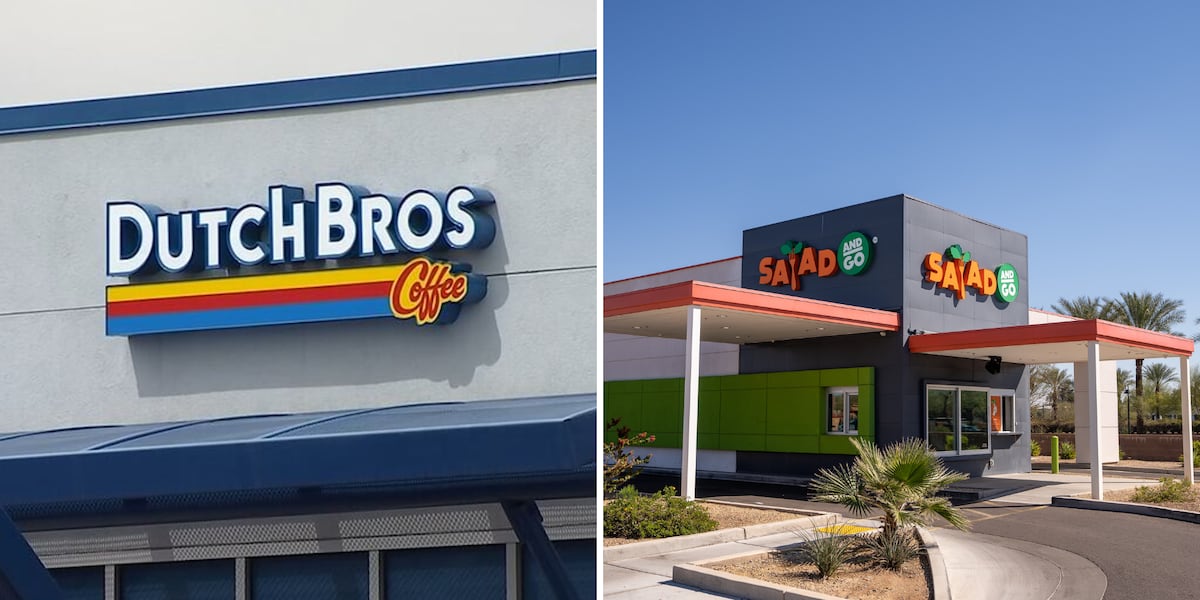
Customers will be able to get a coffee at a drive through in the near future instead of a salad.
Court documents filed with the U.S. Bankruptcy Court of Texas reveal that Boersma Bros, LLC, an Oregon-based company linked to Dutch Bros Coffee’s founders, has agreed to buy Salad And Go assets for $105 million. This week, the popular Arizona salad chain announced that they would close their doors for good.
Dutch Bros has agreed to take over the leases of Salad And Go and its equipment in Arizona and Nevada, where they will convert them into coffee shops, beverage outlets, and restaurants. In the documents, it is noted that these locations do not require any maintenance or alterations because they are only drive-thru formats.
The deposit has been made of 10 million dollars, and the balance is due on closing.
Dutch Bros has been contacted by Arizona’s Family for a comment.
Salad and Go has announced the closure of 70 drive-thrus in Arizona, Nevada by Wednesday evening. CBS News reported that the company had closed its locations in Texas and Oklahoma in January. In September 2025 it announced the closure of more than forty stores in the United States.
Dutch Bros, founded by Dane Boersma and Travis Boersma at Grants Pass in Oregon in 1992. In June 2025, the company will move its headquarters from Grants Pass to Tempe. It has more than 100 stores in Arizona.
You find a grammatical or spelling error? Click here to let us know.
Business
After jacking up prices, Disney+ and Netflix consider offering free alternatives

Disney “explores a free-of-charge product” for its streaming subscribers, confirmed CEO Josh D’Amaro in an investor call today.
D’Amaro succeeded Bob Iger in March as Disney’s CEO. He said that the free Disney streaming service will help Disney to reach “price sensitive” customers. This is “a strategic priority” for Disney.
Free streaming would generate a lot more revenue in the form of advertising, something that is becoming increasingly important to streaming services who are facing challenges such as stagnant subscriber numbers and subscriber turnover, not to mention competition from free and cheaper rivals.
D’Amaro stated that “we’re pretty well-sold compared to a number of our AVOD (advertising on demand) competitors. This means more inventory could actually accelerate our ad revenues growth.”
The executive said that a free streaming service could also increase interest in Disney+ subscriptions.
D’Amaro, referring to the first stage of the funnel where customers are acquired, said that a free offer could be a way for Disney+ subscribers to grow. We have nothing to announce, but we are definitely considering it.
Disney executives did not provide any details on what the free streaming service would be like. Business Insider reported last month that Disney was discussing making certain content available on Disney+ for free, according to people who were familiar with the issue.
Disney+ could benefit from a free-tier to help it stand out among other video-on demand platforms like Netflix or HBO Max. Prices are constantly increasing and many people have become frustrated.
Netflix has also been hesitantly considering the possibility of a streaming service that is free.
Netflix’s co-CEO Greg Peters told investors in a recent call that a free offer could be logical for some markets. However, we must not cannibalize paid levels. We have to make sure that the offering is the best one, and that it’s differentiated. In order to achieve these economics, it’s also important that the candidate countries have a scaled ads industry. We’ll continue to think about free, but there are no immediate plans to release something.
Price increases in the past
Disney+ (131,6 million subscribers in November) and Netflix (325 million as of January), are the two largest streaming services based on subscriber numbers. This large base of customers has had to deal with price increases over the years.
Disney+ raised the US price twice since 2024. In October 2018, the price of ad-free and paid plans both increased by $3. Netflix increased its prices two times during that period. The most recent increase was in March, when prices were raised by either $1 or $2 for ad plans.
The increasing cost of streaming services has led to a growing number of free alternatives. These include FAST (free advertising supported streaming television), The Roku Channel, and Pluto TV. According to Parks Associates’ Q3 2025 study of 8,009 US homes, 46 percent of US Internet householders regularly watch long-form videos using FAST. A Q4 2025 study of 4,493 adults aged 18 and over in the US or Canada found that 54 percent use subscriptions with ads, and 70 percent are using AVOD/FAST. This is a five-point increase year-over year.
Many people find subscription streaming services like Netflix and Disney+ too costly. These companies, ironically, are now considering a pivot to free content.
Business
SpaceX is barely Space and mostly X

Once I asked myself why SpaceX, Elon Musk’s most healthy company, bought xAI, Elon Musk’s sickest. Now, I’m wondering why the company is called SpaceX.
According to SpaceX’s first quarter earnings report as a publicly traded company, we are primarily dealing with a telecom and computing company. SpaceX’s business did not break the billion dollar mark this quarter, and only contributed a little over 10% of revenue. SpaceX is still its biggest customer. Just not enough people want SpaceX’s rockets. SpaceX might not be at risk of creating a new lunar crater if its rockets had been the primary focus.
What is being called “AI” is still the focus of most spending and hype.
Starlink is the telecom component, or “connectivity,” which SpaceX refers to. It had a $4.2 billion revenue and was the one part of SpaceX without a loss. Gwynne shotwell described plans to launch a new phone service to rival AT&T and Verizon. However, most of the money (and hype) was spent on what’s being called “AI”, to include Grok. Bloomberg reports that analyst Alexander Potter believes the spending for the neocloud, which rents out data centers to AI firms, will reach $65 billion in 2019. This is $17 billion higher than his previous estimate.
SpaceX’s data centers are a huge part of their business. It not only made more money than SpaceX rockets but also drove up spending, with $15.8 Billion on AI in just the second quarter. Comparatively, the spending in both space and connectivity was just over one billion dollars each. This makes CoreWeave, Nebius and other neocloud firms a direct competitor.
It wasn’t the original plan.
Musk constructed SpaceX’s Colossus 1 Data Center in Memphis, Tennessee for Grok. Grok is Musk’s AI who also refers to himself as MechaHitler. It has a tendency to undress women and children with no consent. xAI, however, had difficulty running the facility and decided instead to lease it. The center was plagued by latency, which made it difficult to train models in-house. It also used a mixture of older and newer chips that caused bottlenecks. Musk stated on the earnings call that Grok will only receive 10 percent of all the computing SpaceX produces.
Building data centers can be expensive and revenue is not profit.
SpaceX has now signed deals with Google Anthropic Reflection AI and Cursor – an AI firm Musk chose to buy. Bret Johnsen, SpaceX’s chief financial officer, said that the deals would put SpaceX “on a path, with Cursor contributing, to achieve $100 billion in ARR (annualized revenue run-rate),” a financial measure used to predict how much money an organization will earn over a period of time. Musk went even further, saying “the $100 Billion ARR is not in doubt” and that it’s possible that actual ARR could be much higher.
It’s very good. Revenue isn’t the same as profit and data centers are expensive to build.
Renting out compute as a commodity has its own set of problems. These include inevitable obsolescence and construction vagaries. More data centers are built and the more computing power is available. Companies can charge less for chips if there is more computing power available.
Musk claims that he made SpaceX public so he could build data centres in space. If I was having trouble managing a datacenter on Earth, then I would think I should get better before trying something even more difficult — like something never done before. Musk, however, does not think that way.
It all seems expensive to you, don’t you think?
SpaceX even suggested to the Federal Communications Commission an orbital satellite data center that could contain up to 1,000,000 satellites. We don’t know the size of satellites or when they will be deployed, so I think it is more PR-oriented than anything. Musk also revealed a few more details, or at least some sketches, about the satellites. According to this vision, Terafab (a chip manufacturer owned by Musk) will be able to produce 1 terawatt per year. Musk will use a billion Optimus robots to do the job, once he figures out how to make hands.
All of this sounds very expensive doesn’t it. Musk says that the ultimate goal is to construct a massive accelerator on Moon.
Musk said in the earnings conference that Starlink would deliver “a majority of the internet in the world.” I do not put much weight in such claims. This is part of Musk’s habit to talk about sci-fi futurities as imagined by mid-20th century writers. Musk’s space data center proposal is criticized by a number of scientists. If you like, you can debate the feasibility of building space data centres. Remember, was the Hyperloop built ever? Speak it now with me: This is all vaporware until it ships.
After we remove the pseudoscientific jargon, what we have is a company which launches rockets mainly for its own use, runs a successful satellite business and is running the capital-intensive and risky bare-metal businesses we have seen in a number of neoclouds as a consequence of the failures of their AI. It’s not as exciting as going to Mars within six years.
SpaceX’s Insider Lockups expire on the 6th of August, tomorrow.
It does, however, provide Tesla with a significant customer who purchases $295,000,000 in Tesla Megapack batteries. SpaceX is also buying Cybertrucks – Musk’s historic failure of an automobile. Tesla’s stock has fallen 25 percent in the last year.
Musk could charge more for his computer because of his connections in politics — I doubt he will spend $100 million to win the midterm elections. Those political connections may make it easier to Musk build terrestrial data centres, even though they are unpopular with politicians across the board. Maybe the plan is to say, “That’s an AI company you run.” It would be terrible if it was damaged. You could buy my computer so that nothing bad happens.
Maybe I am just looking too far ahead. SpaceX insiders’ lockups expire on the 6th of August, tomorrow. Short-sellers are expecting these insiders to sell, which will make the stock even more volatile. It’s possible that the reminder of the Moon mass accelerator is meant to motivate the troops. Nasdaq has changed their rules to allow SpaceX losses, which will affect everyone who owns an index fund.
In fact, I’ve got a sci-fi idea about it. Hey Elon! Why not take a flying fist at a donut that is rolling? Why don’t take a flying fuck to the Mooooooon?
Business
Tanger CEO says World Cup drove up traffic, sales this summer

Tanger’s CEO Stephen Yalof stated that the retailer saw an increase in traffic during June and July as a result of international and domestic tourists tied to World Cup.
Yalof said on CNBC that “we knew we had one chance to introduce these visitors who come to the World Cup to our brand. If they enjoy their experience, they will hopefully become great ambassadors for it.”
In addition to the increased sales, the company’s athletic brands performed well amid the excitement surrounding the World Cup.
Traffic drives sales. Yalof stated that traffic and sales are always linked. For the entire year, sales are up about 5%, which is a pretty significant increase.
Yalof stated that the company has seen World Cup visitors looking for “real American experiences” like dining at Chick-Fil-A, or listening to American Music. He noted that most of these options can be found within or near a Tanger Center.
He added, “We add value to this mix by offering our customers shopping opportunities in outlet centers where they can shop American brands such as Polo, Michael Kors, Kate Spade, Coach, Nike and Kate Spade at the lowest possible prices.”
Yalof stated that the company is prepared to make the most of the summer traffic generated by the World Cup in order to create “long-term loyalty” among its customers.
The company has also seen an increase in domestic travel this year, due to the rising price of oil and current macro-political environment.
Yalof, the CEO of Tanger Centers, said that customers visit its centers for one thing and then stay to experience other things.
Yalof explained that “that’s the thing that will keep us in their minds and help them remember us when they come back, or go to tell others about how wonderful it was when they visited.”
Tanger reported strong results for the second quarter on Tuesday, with “strong marketing and driving traffic initiatives throughout our portfolio” cited as a key factor.
Yalof said that on a conference call with analysts the recent strength of the movie industry and box office also contributed.
Yalof stated that people are arriving early for shopping and staying late to dine. Yalof said, “The flywheel we created along with the new merchandise mix have been great for attracting customers.”
Business
Disney parks buck travel slowdown

Disney’s parks have defied a decline in foreign travel to the U.S. by posting record revenue on Wednesday for its experiences division.
In the third fiscal quarter of 2018, the experiences segment, including Disney theme parks, Disney Cruise Line, Disney resorts, and consumer goods, generated nearly $10 billion, an increase of 10% from the previous quarter and a record quarterly. Six consecutive quarters have seen the division record revenues.
This division reported operating income in excess of $3 billion. That’s a 20% increase from the previous year. Disney shares were up 2% on Wednesday.
Disney CEO Josh D’Amaro stated during the earnings call on Wednesday that it was important to emphasize how much better we perform than our competitors. In doing so, we’re delivering solid volume and [per capita] spending results. To remind you, we are able to achieve this despite a time of considerable macro-uncertainty.
Comcast, the rival cable company, reported last month that theme parks in Orlando and elsewhere in Florida were not as popular as they used to be.
According to the World Travel & Tourism Council, tourism grew around the world last year. However, only the United States saw a decline in the number of foreign tourists. The organization reported that international travel in the U.S. dropped by 6% overall.
According to the WTTC, travel bans, fees for visas and intrusive searches at entry ports are factors that international travelers use when deciding whether or not they want to visit the United States. Travel experts have told CNBC that trade frictions, geopolitical uncertainty and safety fears are also factors in the decline of demand for stateside travel.
Hugh Johnston, CFO at Disney, told CNBC that domestic park attendance rose by 3%, and spending by guests rose by 4%. Johnston also praised the “very high attendance” of Walt Disney World, Orlando.
He added, “These numbers differ from what our competitors down there would have reported as well as the traffic that has been reported through Orlando [International] Airport.”
It attributed the high attendance rate to its Cool Kids Summer Promotion, which includes kid-friendly character meet-and greets, air-conditioned hangout areas, and dance parties, as well as complimentary water park entry for hotel guests.
Disney has also renovated and reimagined recent park attractions such as Buzz Lightyear’s Space Ranger Spin and Big Thunder Mountain Railroad, and Muppets’ Rock ‘n’ Roller Coaster.
Gavin Doyle of MickeyVisit.com said that Disney used a combination of discounting and marketing campaigns to encourage their fans, especially young families, to visit theme parks in the first quarter. Disney created urgency to encourage guests to come to the parks right away, despite a large number of rides coming up.
Doyle stated that these efforts are “designed to strengthen [Disney]’s connection with modern audiences.”
Disneyland Anaheim, located in California’s West Coast had an identical promotion.
Doyle stated that Disneyland’s discounts targeted at Californians and children ensured families didn’t miss visiting the park this year.
Disney’s experiences division also benefited from the addition of the Disney Destiny, and Disney Adventure to the cruise fleet. These cruise ships increased the stateroom capacities by 50%, and the revenue generated from resorts and holidays grew 17% in the third fiscal quarter to $2.77billion.

Court filings: Dutch Bros to buy Salad And Go locations in Arizona, Nevada
Customers will be able to get a coffee at a drive through in the near future instead of a salad....


After jacking up prices, Disney+ and Netflix consider offering free alternatives
Disney “explores a free-of-charge product” for its streaming subscribers, confirmed CEO Josh D’Amaro in an investor call today. D’Amaro succeeded...
Riverhead woman gets ‘rabbit fever’ from cat bite
An infectious diseases doctor at Peconic bay Medical Center confirmed Wednesday that a Riverhead woman was being treated by tularemia...


SpaceX is barely Space and mostly X
Once I asked myself why SpaceX, Elon Musk’s most healthy company, bought xAI, Elon Musk’s sickest. Now, I’m wondering why...


‘Jeopardy!’ Fans Notice This Change Has Happened Since Ken Jennings Became Host
Newer Jeopardy Fans may not be aware that rounds have a time limit, but they do know that they must...


The sex Purge sends itself to horny jail
For much of Will Gluck’s One Night Only, you can accept the goofy rules of this romantic-comedy-meets-political-satire. The movie makes...


Animatronic Tiki Room Bird, Fuzzball from Captain EO, and Pirates of the Caribbean Redd Doll Announced
New collectible figurines and plush bring to life the characters of Disney Parks. They will be first available at D23,...
Do NYC restaurant workers have their knives out for the Anthony Bourdain movie?
Shucking oysters is a difficult task that requires patience and precision. The new movie “Tony” is set in a 1970s...


Disney Iconics Introduces Plush Versions of Favorite Disney Parks Rides & Treats
You can now bring a Disney Parks or Disney Ride plush to your home. Disney Iconics will be launching a...


Tanger CEO says World Cup drove up traffic, sales this summer
Tanger’s CEO Stephen Yalof stated that the retailer saw an increase in traffic during June and July as a result...
-
 Business4 days ago
Minnesota bans crypto ATMs after elderly population was targeted
-

 Business2 weeks ago
OpenAI president shares concerns about how powerful AI is becoming
-

 Tech2 weeks ago
Trump jokes about tariffs on lettuce and smoke
-

 Business1 week ago
Elon Musk drops wild 5-year prediction about AI and humanity
-
 Food2 weeks ago
A grandfather struggled with treatment for late-stage pancreatic cancer – until a clinical trial helped him beat the odds
-

 BBC News World1 week ago
Seattle shooting: Two killed and five injured in shooting at food festival near Space Needle
-
 BBC News World2 weeks ago
First person gets new experimental vaccine for Bundibugyo species of Ebola
-

 Entertainment2 weeks ago
D4vd Allegedly Texted Teen About Abortion, Detective Reveals