

Business
McDonald’s brings back fried apple pie for America’s 250th birthday
McDonald’s is frying up some apple pies to honor America’s 250th birthday.
The company said Tuesday it’s bringing back fried apple pies for the first time in more than three decades. They’ll be available at most U.S. restaurants for a limited time starting June 23.
McDonald’s is one of several fast food companies offering semiquincentennial treats. Burger King recently debuted its Firecracker Cookie Pie, which has a sugar cookie crust and red, white and blue star-shaped sprinkles. Sonic is offering a red, white and blue slush float for $2.50. Hardee’s has an iced Star-Spangled Biscuit with red and blue sprinkles.
Here’s a look at McDonald’s fried apple pies by the numbers:
— 1968: The year McDonald’s introduced both its fried apple pie and the Big Mac hamburger. Litton Cochran, a McDonald’s franchisee in Tennessee, developed the rectangle-shaped pie, whch was served in a cardboard sleeve. 1968 was a momentous year that included the assassinations of Martin Luther King Jr. in Memphis and Robert F. Kennedy in Los Angeles, protests against the Vietnam War, and the signing of a federal law prohibiting housing discrimination.
— 1992: The year McDonald’s replaced the fried apple pie with a baked version in most of the U.S., responding to growing consumer awareness of fat and cholesterol consumption. The U.S. Department of Agriculture first published its food guide pyramid the same year. Fried apple pie remains on McDonald’s menus in some other countries, including Mexico, Australia and China.
— 230: Number of calories in McDonald’s baked apple pie. That’s 10 more calories than the fried version, according to the company’s website. A cup of boiled lentils, a single almond Snickers bar and a grande coffee Frappucino from Starbucks have the same calorie count, according to publicly available nutrition information.
— 130: Number of members of the Facebook group “Bring Back the Original McDonald’s Fried Apple Pie”
— 170 million: Number of American-grown apples that McDonald’s says it serves every year at its U.S. stores.
— 35: Height, in feet, of a giant fried apple pie that McDonald’s is installing on Route 66 in Joliet, Illinois, near McDonald’s Chicago headquarters. That’s about the height of a three-story house and some species of palm trees. The giant apple pie will stay in place until July 4, the company said.
Business
AI may be messing with home prices


A version of this article first appeared in the CNBC Property Play newsletter with Diana Olick. Property Play covers new and evolving opportunities for the real estate investor, from individuals to venture capitalists, private equity funds, family offices, institutional investors and large public companies. Sign up to receive future editions, straight to your inbox. A home is only worth what someone is willing to pay for it. That is probably the only dependable truth when it comes to putting a price tag on a property. Enter artificial intelligence. As with everything on the planet, AI is disrupting real estate. In March, celebrity real estate CEO Ryan Serhant, of his namesake company, posted a video on Instagram titled, “ChatGPT just blew up my $50M deal.” In the post, he explained how he had brokered a deal on the property, but, “at the last minute the seller uses ChatGPT, asks it, ‘Should I sell at this price?’ And maybe because of how he asked, whatnot, ChatGPT basically told him no, you should not sell at that price, it’s worth more.” Then, he said, the buyer did the same thing, asking the AI tool from OpenAI if he was overpaying, and ChatGPT told him that, yes, he was paying too much. “It gave him comparables that showed why, without context and without actually understanding the property,” Serhant said. Serhant’s post has more than 3 million views. He was able to salvage the deal, he said in a subsequent post, by explaining to both the buyer and seller the following about AI: “It doesn’t know the future, it can’t predict the future. It doesn’t know intentions, doesn’t know emotions, doesn’t know what buyers are circling, doesn’t know off-market comparables, doesn’t understand, fully, replacement costs, and doesn’t actually optimize for the deal,” he said. “AI can model a market. It can’t model a deal.” Serhant has said he does believe AI is a critical tool for real estate agents and even launched his own AI-powered workflow automation platform and operating system, called S.MPLE, which he talked about recently on the Property Play podcast. And he’s not alone. For most real estate professionals, the data aggregation capabilities of AI can certainly enhance their expertise, according to Kamini Lane, CEO of Coldwell Banker Realty. “Market analysis, comparative analysis, those are key tools in a real estate agent’s toolbox. But the important thing is that those are starting points for an agent to then apply their judgment, their expertise, their nuanced understanding of the real estate market, to either validate or enhance the recommendation that any data tool would provide,” she said. Lane said her agents are seeing more and more clients — both buyers and sellers — look to sources like Anthropic’s Claude and OpenAI’s ChatGPT to price their homes or calculate offers. Like Serhant, she warned of how these generalized large language models miss the nuances of a home, a neighborhood and a client. “One of the most important things that agents can see, that ChatGPT, or any other AI tool is not going to know, is [what’s] up and coming. So neighborhoods that are up and coming, design features that are up and coming,” she said. “Anecdotal data that agents are aggregating through their conversations, that is something that no AI tool is ever going to be able to aggregate in the same way that a real estate professional can.” Zillow, one could argue, was the original AI price model for residential real estate. It launched its so-called Zestimate feature back in 2006, alongside the launch of its website. It recently launched “AI mode,” designed to guide homebuyers through their search by learning their specific needs. It then enables homebuyers to have a more personalized conversation with the Zestimate. “AI guidance for consumers needs to be connected to real context, real data, real ability to take action,” said Nicholas Stevens, vice president of product and AI at Zillow. “Then that AI guidance needs to be deeply connected to what a real estate agent is attempting to do. That’s the difference between what we’re doing at Zillow versus like a third-party, generic experience.” Agents have to upload in-depth floor plans and 3D visual captures of the entire home and surrounding lot with every possible piece of information. Then, in AI mode, Zillow gives advice to the buyer on what might be a good offer. “It actually sees a remodeled kitchen. It actually sees upgrades in the house, and that’s useful, both for buyers but also homeowners thinking about selling or remodeling as well,” said Stevens. Zillow’s AI feature is now primarily for buyers, but Stevens said the company will roll out a tool for sellers as well. It still raises accuracy questions, however, about the AI itself as it tries to understand its human users. Coldwell Banker’s Lane said she worries that for both buyers and sellers, AI will not be able to pick up on what they might need compared with what they say they want. It might also not be inclined to offer the often hard-to-hear advice that a human agent has to. “Artificial intelligence is trained to be sycophantic, it’s trained to give you the answers that you want, so that you will continue to engage, and so AI is more likely to give you the price that you want versus the price at which a home is going to sell for,” said Lane.
Business
New Verizon plans and loyalty program with Austin Powers ad campaign


A common complaint about mobile carriers is that they launch attractive new plans and other deals that are limited to new subscribers, leaving existing customers feeling short-changed.
Verizon is aiming to avoid this by combining the launch of new plans targeting switchers with a loyalty program for existing customers. Both are being promoted with an Austin Powers ad campaign …
Verizon says that simplicity was a key goal with the new initiatives.
The company is putting its customers first – existing and new – by redefining loyalty and eliminating activation and upgrade fees. As part of the customer-centered reboot, Verizon is also launching “Verizon Simplicity,” the industry’s most simple and cost-effective plan. With Simplicity, there are no network tiers; everyone gets Verizon’s best 5G network.
Verizon Loyalty
For the Verizon Loyalty program, a 3% reward is the headline news.
Hello Verizon Dollars: A first-of-its-kind program that rewards customers with 3% back in Verizon Dollars every single month, just for being a customer. Starting in July, Verizon Dollars can be redeemed for devices, accessories or up to 5x for each Verizon Dollar from top brands including Sephora, Hilton, Marriott, Starbucks and more. “Customers reward us with their loyalty every month. Verizon Dollars lets us reward them back, on their terms,” said Villanueva. “Not just some customers, on some plans, but for all. Customers earn Dollars every single month just for being with us, and we let them choose how to spend it.”
Additionally, the company is abolishing activation and upgrade fees, as well as providing free entry to weekly prize draws.
Verizon Simplicity
A new Verizon Simplicity plan is aimed at encouraging customers of competing carriers to make the switch.
A breakthrough offering at $45, with an initial promotional offer of $30 per line for mobile customers that switch to Verizon […] Simplicity moves beyond tiered network confusion and complicated phone subsidies and provides a simple choice for mobile service. With the best networks for everyone at an affordable price, including unlimited 5G Ultra Wideband data, 10GB of premium mobile hotspot, roaming in Canada and Mexico and satellite texting all standard. And the option to add home internet starting at $35 a month.
Whether the simplicity label is justified may depend on your point of view: there are a range of potential add-on bundles for customers to choose, including upgrades for streaming video services and travel passes.
Verizon One
The company is also launching a plan combining home and mobile services.
A streamlined plan that combines Mobility and Home designed specifically for customers new to Verizon. Built for affordability and ease, and powered by *Verizon’s best and fastest 5G network and its award-winning 100% fiber network, the plan is the easiest way to connect services. With one truly combined plan for mobile and home, one price and one bill, it’s the most affordable and connected experience for customers. With a single, transparent monthly bill for just $70 (taxes and fees included).
You can watch the Austin Powers ad below.
What are your thoughts on these latest initiatives? Please share in the comments.
Business
Yum Brands sells Pizza Hut to LongRange Capital and Yum China
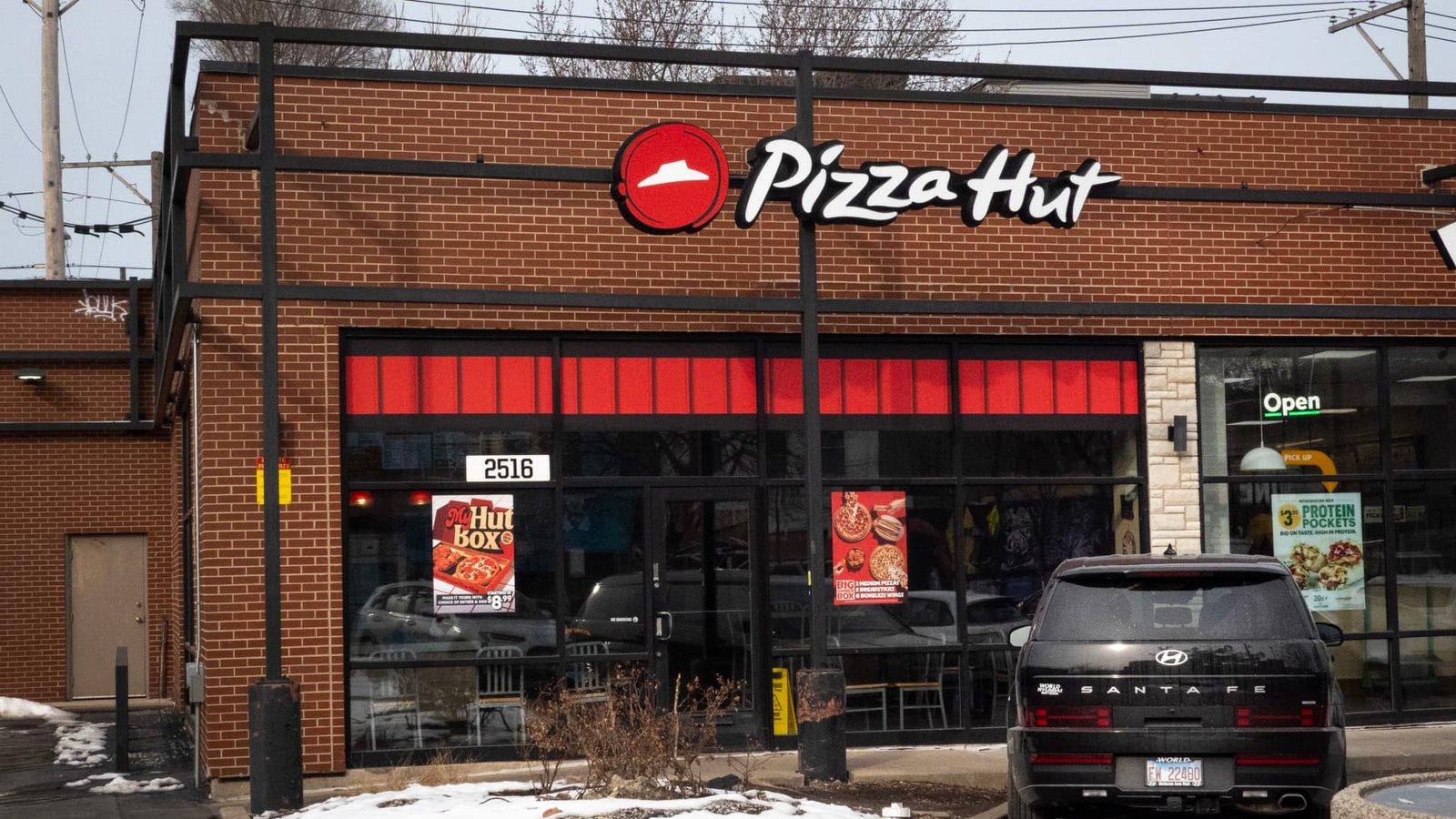
Yum Brands on Tuesday announced it is selling Pizza Hut to private equity firm LongRange Capital for roughly $1.5 billion.
The deal excludes the pizza chain’s locations in mainland China; Yum China will acquire those in a separate transaction for about $1.2 billion.
The deals cap off years of struggles for Pizza Hut, which has weighed on Yum’s overall financial performance. In the U.S., the pizza chain has transitioned from the sit-down format and salad bars of yore to focus on delivery and carryout — far behind the curve. Rival Domino’s Pizza has gobbled up market share from Pizza Hut for years; third-party delivery apps like DoorDash have further stolen sales from the chain.
In November, Yum said it was exploring strategic options for Pizza Hut. On Tuesday, the company said its leadership team and board determined that selling Pizza Hut would provide “the strongest path” to maximize shareholder value and give the pizza chain an ownership structure “tailored to its distinct markets, competitive strengths and long-term priorities.”
Across both deals, Yum expects to receive about $2.3 billion in net proceeds after taxes, closing adjustments and fees, excluding a possible earn-out of $75 million by 2030 from LongRange. Yum also anticipates one-time expenses of about $85 million during the rest of 2026 tied to the transactions.
The company’s management will provide more details about the financial impact of the transactions during Yum’s second-quarter conference call on July 30. Yum expects the sales to close in the third quarter, subject to regulatory approval.
Brothers Dan and Frank Carney founded Pizza Hut in 1958 in Wichita, Kansas. A year later, they were franchising the concept.
In 1969, Pizza Hut went public. Just two years later, it was the biggest pizza chain in the world, although it lost that title in 2017 to Domino’s.
The deal severs Pizza Hut’s decades-long ties to Taco Bell and KFC, its sister brands in Yum’s portfolio.
PepsiCo bought Pizza Hut in 1977, marking the beverage giant’s entry into the restaurant business. By 1986, it also owned Taco Bell and KFC. When Pepsi spun off its restaurant unit in 1997, the holding company was dubbed Tricon Global Restaurants — later renamed to Yum.
At the end of 2025, Pizza Hut had nearly 20,000 locations across 108 countries and territories and reported $12.8 billion in annual system sales, according to regulatory filings from Yum. The U.S. is its biggest market, representing about 40% of its system sales, followed by China with roughly 20% of its system sales.
Correction: The headline was updated to reflect that the $2.7 billion sale value includes deals with both LongRange Capital and Yum China.
Business
US student debt repayment system is being overhauled – here’s what to know


The American student loan repayment system is set to undergo a significant overhaul next month, changing the way millions of borrowers pay off their debt.
The series of changes, which take effect 1 July, are a result of the Trump administration’s One Big Beautiful Bill Act that was signed last summer and a recent court ruling that ordered the end of the Biden-era Save repayment plan. Borrowers will be facing stricter payment timelines and less forgiveness, what will be the latest in a series of massive changes to the student loan system in just a few years.
“This is impacting, in my opinion, every single student loan borrower in one way or another – even if you don’t have to make a change in your loans, just the confusion alone,” said Natalia Abrams, the president of the Student Debt Crisis Center.
“I’ve worked in this space for more than 15 years, and I’ve never seen it this bad, and I’ve never seen it change this much, this frequently.”
Here’s a rundown of how the repayment system is changing and how it is affecting students.
What’s changing?
More than 7 million Americans are enrolled in the Save plan, an income-based repayment plan launched in 2023 by the Biden administration. The program was created with the goal of drastically reducing undergraduate loans, eliminating monthly payments for some, and offering early forgiveness for borrowers with low-balances.
After a federal appeals court ruling in March, the Save plan will be official dismantled 1 July. The ruling came after Republican attorneys general across the country challenged the plan, putting monthly repayments on hold for years.
On 1 July, monthly repayments will start again and Save borrowers will soon have to apply for a different payment plan.
What repayment options will borrowers have?
Once the Save plan officially ends, borrowers will have 90 days tochoose a different repayment plan.
Borrowers with loans issued before 1 July 2026 – and who do not plan to take out more loans – will retain access to several existing income-driven payment and fixed-income plans.
Compared to plans offered under the Biden administration, these plans push borrowers to pay back their loans more quickly and include less forgiveness options.
Borrowers will have access to existing income-driven payment plans – which are based on a borrower’s discretionary income – including the income-based repayment (IBR), pay as you earn (Paye) and income contingent repayment (ICR) plans, which offer loan forgiveness between 20 to 25 years after payments. The latter two options, however, will also be dismantled by the summer of 2028.
Meanwhile, anyone enrolled in the Save plan who does not apply for another payment program will automatically be enrolled into a fixed-income plan, which are typically not eligible for loan forgiveness. The monthly payments under a standard fixed-payment plan are generally higher than the income-based plans because the fixed amounts are set to ensure loans are paid off within 10 years.
Two other fixed payment plans offer lower or gradually increasing monthly payments made over a longer period of time.
Why is this happening now?
The Department of Education has said the upcoming overhaul simplifies the student debt system. In a statement earlier this year, Nicholas Kent, the under-secretary of education, said: “For years, borrowers have been caught in a confusing cycle of uncertainty, but the Trump administration’s policy is simple: if you take out a loan, you must pay it back.”
It’s a U-turn from how the Biden administration approached student loans including, at one point, attempting to cancel $430bn worth of student debt before it was blocked by the supreme court in 2023.
Experts say the new plans offered by the Trump administration are less forgiving than previous programs, what they say will make college more prohibitive for future generations.
“We have an affordability crisis in our country, and having more expensive repayment plans is just going to affect the money that people have in their pockets,” said Abrams of the Student Debt Crisis Center. It feels like this has been designed by people that do not understand the student loan system,” she said.
William Elliott, the founding director of the University of Michigan’s Center on Assets Education and Inclusion, said student debt has shaped a generation, changing how Americans view the value of an education.
“I ended up with debt for over 20 years. And every day you get up, you think about that debt. I mean, it’s just an albatross around your neck,” he said. “It affects your ability to begin to build wealth like you want. It is just something that is constantly there, destroying the sense of a return on degree for you.”
Are there any new options for borrowers?
Any borrower who plans to take out new loans after 1 July – even if they have existing loans – will have access to two new repayment plans: the repayment assistance plan, or RAP, and the tiered standard plan.
Under RAP, monthly payments are calculated based on a borrower’s adjusted gross income (AGI), rather than their discretionary income. If a borrower has an AGI above $10,000, monthly payments range from 1% to 10% of that amount. For those below that threshold, the monthly payment is $10. Loans are forgiven after 30 years.
The tiered standard plan is a fixed-payment plan where payments last between 10 to 25 years depending on the initial balance and are at least $50 a month. Some borrowers may be automatically enrolled in this program if they are entering repayment and haven’t chosen another eligible plan.
How are students reacting?
Recent college graduates are bracing for the overhaul, with many unsure if they will be able to take out loans in the future under the new payment system.
Ryan Coryea, a 21-year-old senior at the University of California, San Diego, said she is planning to move back home to Texas after graduation because she can’t afford to make her student debt payments on top of rising housing and food costs. Though she is considering getting a law or master’s degree in public policy, the new payment plans may make it prohibitive.
“For me as well as for a lot of my friends, it’s really making us reconsider how we’re going to pay for grad school, and also if we’re going to go at all,” said Coryea, who is also an intern at the Student Debt Crisis Center.
Cassie Urbenz, who graduated this spring with a masters degree from the University of Florida, is about to start paying off the $20,000 she took out in loans she took out for her undergraduate degree. She recently landed a job as a union organizer for the Florida Education Association and will soon start making monthly payments just over $200.
“It’s really disappointing that I’m going to be having a lot of extra pressure to pay it off early” under the new repayment plan, she said. “It’s going to delay my own accumulation of wealth and set me back in that sense.”
Business
Is it a renter’s market? It depends on where you live


Stay up to date with our Up First newsletter, sent every weekday morning.
In Nashville, Tenn., the landlords come to you.
At least, it looked that way from the texts showing up on Mason Comans’ phone a few months ago when he was apartment hunting. One property manager wrote that they were offering one month of free rent. Another offered two.
“I even saw some places doing three months, three and a half months free,” Comans said.
This is what a renter’s market looks like, said Zillow senior economist Kara Ng: “Renters, this is your year.”
The typical asking price for rent nationally is now rising slower than wages and inflation — 1.9% year over year in April, according to Zillow. By contrast, the latest inflation report, in May, showed that consumer prices more broadly were up 4.2% compared with a year ago.
Figures from Realtor.com say rent has actually gone down 1.5% year over year. And Ng added that a record 39.8% of rentals on Zillow offered move-in incentives in April, from waived fees to a month or more of free rent.
An extra few thousand dollars from move-in concessions is a sizable cushion for American families that are being squeezed on other expenses, such as power bills and gasoline. “Rent is the place giving you that breathing room,” Ng said.
But as with all things real estate, there’s one really big caveat when it comes to rent prices: location. Just how good renters have it depends on where they live.
An apartment construction boom
The reason rent increases have fallen behind inflation comes down to Economics 101: supply and demand. Specifically, the supply of apartments has been boosted by a construction boom. In 2024, the U.S. built some 600,000 apartment units, the most in 38 years.
All that extra supply has outpaced demand. The rental vacancy rate was at 7.3% at the start of the year, the highest it has been in a dozen years.
But that supply of new housing isn’t evenly distributed throughout the nation. Sun Belt cities, in particular, caught the construction bug. That’s why many apartment managers in cities like Nashville, Phoenix and Austin, Texas, are more likely to offer perks for new renters.
“There’s a lot of apartment buildings hitting the market all at once,” Ng said. “And property managers are trying to fill it, and they’re doing it with freebies.”
But ask a Chicago native whether it’s a renter’s market there, and you’ll get a simple answer. “Hell, no,” said Chloe Troub. “I find that to be really insulting, just given the cost, the sheer cost, of putting a roof over your head right now.”
Troub rents in the Windy City, which has seen some of the largest rent increases in the nation, with rents rising 5.4% year over year in April, according to Zillow. This can also be explained by supply and demand: Too many renters are chasing not-enough apartments.
Troub and her boyfriend currently rent a one-bedroom apartment, which she said is a steal at $1,600. But on a recent hunt to see whether she could find a bigger space, the best deal was a sublet for $2,000 — and an increase of that size would eat up her boyfriend’s last raise.
When she told the guy subletting the place that the price was too much for her, he said he wasn’t worried — he had 12 other showings lined up behind her. “It’s a rat race out there,” he told her.
The renter’s market fine print
And there are a couple of other caveats for renters to consider. First, move-in incentives don’t last forever. “As soon as they get you locked in, you’re still getting rent increases every year,” said Michelle Becker, a broker with Adaro Realty in Nashville.
Comans, the Nashville apartment hunter, has been willing to keep moving to score new deals — this is his fourth move in five years. His newly constructed one-bedroom apartment came with access to a pool, a private market and two and a half months of free rent.
But if he wants more free rent next year, he said, “then I would have to move to do that.”
And second, rent is still more expensive than it used to be. The average rent has shot up 36.9% since the beginning of the COVID-19 pandemic, according to Zillow.
Even Comans is paying more than he used to: $1,800 a month. “It is a lot of money,” he said. “It’s not cheap at all.”




German Chancellor Merz gifts Trump soccer jersey at G7
President Donald Trump was presented a soccer jersey with the number 47 printed on the back by German Chancellor Friedrich...


What the tentative Iran deal means for the Middle East
Displaced families are beginning to return to southern Lebanon after the US and Iran signed a memorandum of understanding …


Trump says he may read Iran agreement on camera
President Donald Trump vowed to publicly release the text of the agreement with Iran "in a couple of days" and...


White House attack thwarted: Arrests made for drone plot at UFC fight
Federal officials have arrested multiple people who they claim discussed plots to attack the UFC fight night event at the...


Kamala Harris: ‘This is a war the American people did not want’
Former U.S. Vice President Kamala Harris talks with CNN's Elex Michaelson and Arnold Schwarzenegger at the Austrian World …


Ebola outbreak in DR of Congo could take year to end, Red Cross says | BBC News
The Red Cross said it could take a year to end the Ebola outbreak in the Democratic Republic of Congo....


Wildfires light up Southern California night
Evacuations are underway as the "Shore Fire" blazes through Riverside County in Southern California.


Trump says Netanyahu needs to be 'more responsible' with Lebanon
President Donald Trump criticized Israeli Prime Minister Benjamin Netanyahu during bilateral meetings at the G7 summit, saying …


Which social media platforms will be banned for under-16s in the UK? | BBC News
Millions of children in the UK will be forced off social media after the government announced it would ban under-16s...


Meet the World Cup tourists going viral
Tourists visiting the United States for the FIFA World Cup are gaining the attention of thousands online after posting their...
-

 Business3 days ago
How much of Musk’s wealth comes from government help? Virtually all of it
-

 LifestyleNews2 weeks ago
120 minutes of strength training per week may help extend lifespan
-

 Politics5 days ago
What to know about the stabbing that set off fiery riots in Northern Ireland
-

 Video4 days ago
Download fans say what they love about the festival. #DownloadFestival #BBCNews
-

 Video4 days ago
Why SpaceX IPO isn't about space. #SpaceX #ElonMusk #BBCNews
-

 HealthNews4 days ago
The people of Okinawa, Japan only eat until they are about 80 percent full, then stop — and the practice has been linked in multiple peer-reviewed studies to lower rates of cardiovascular disease, slo
-

 Food4 days ago
Pope Leo’s plane was grounded. Then the King of Spain stepped in to help
-

 TravelNews4 days ago
My Paternal Instinct Should’ve Warned Me About Netflix’s Maternal Instinct