
Business
Rivian (RIVN) earnings Q3 2026

Rivian Automotive beat Wall Street’s third-quarter earnings expectations as it ramped up production of its new R2 entry-level SUV that the company has promised investors will lead the company to profitability.
Here’s how Rivian performed in the period ended Sept. 30, compared with average estimates compiled by LSEG:
Loss per share: 48 cents adjusted vs. loss of 62 cents expected
Revenue: $2.16 billion vs. $1.99 billion expected
Shares of Rivian were up roughly 5% during afterhours trading Thursday, after hitting a new 52-week low of $11.38 earlier in the day. The stock closed at $11.45 a share, down 1.9%
The electric vehicle maker also revised its 2026 guidance to mark expected improvements in its vehicle deliveries, pre-tax adjusted earnings and capital expenditures.
The new guidance calls for a pre-tax adjusted loss of between $1.75 billion and $1.85 billion — a $100 million improvement at the midpoint from its prior guidance — vehicle deliveries of between 67,000 and 70,000 units, up from at least 65,000; and capital expenditures of between $1.4 billion and $1.5 billion, $300 million less at the midpoint.
Rivian attributed the improvement in its pre-tax adjusted earnings guidance to better-than-expected revenue related to its sales of regulatory credits, an IEEPA tariff refund receivable in the third quarter and its expected increase in vehicle deliveries.
The R2 — the first deliveries of which arrived to customers in June — has become Rivian’s best-selling model and was responsible for “much of the gain quarter-over-quarter,” the company said.
Rivian delivered a record 19,248 units from July through September.
The EV maker remains unprofitable overall but continued to narrow its losses during the quarter. The company reported a net loss attributable to common stockholders of $913 million, compared with a loss of $1.17 billion during the third quarter of 2025.
Rivian’s gross profit, which is closely monitored by investors, was $176 million during the third quarter, up from $24 million a year earlier. Its adjusted earnings before interest, taxes, depreciation and amortization was a loss of $435 million, a $167 million improvement from the same period last year.
The company reported that its software and services segment continues to grow, generating $605 million in revenue and a gross profit of $256 million, a 42% margin. That compares to its automotive operations, which recorded nearly $1.55 billion in revenue and a gross loss of $80 million.
Rivian CEO RJ Scaringe has said the company will reach profitability this year on a per-unit production basis with the R2, a smaller and less expensive sibling to its current luxury R1S SUV. But he said the company needs to scale beyond current R2 production plans of 160,000 units in order to achieve profitability.
Scaringe said Thursday that the R2 will continue to assist with the company’s gross profit.
“That ramp-up is critical for us getting to positive gross margin on R2 and that ultimately will contribute to positive gross margin for the business,” he told CNBC’s Phil LeBeau during an interview.
Rivian on Thursday reconfirmed its cash, cash equivalents and short-term investments balance was $5.5 billion, up from $5.3 billion to end the second quarter.
Business
McDonald’s McRib lawsuit moves forward after federal judge’s ruling
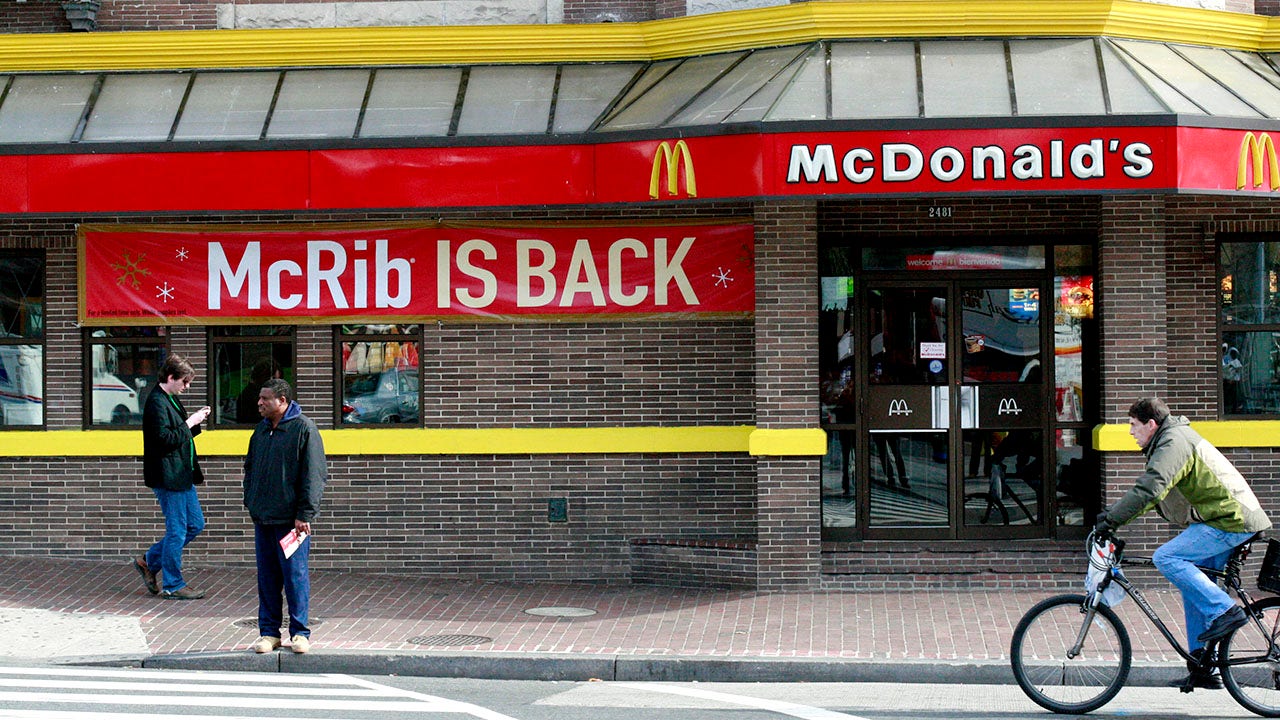
A federal judge ruled Friday that McDonald’s must face a proposed class action lawsuit accusing the fast-food giant of misleading customers about the meat used in its popular McRib sandwich.
U.S. District Judge April Perry in Chicago rejected the company’s bid to dismiss the lawsuit in its entirety, allowing consumer deception, fraud and unjust enrichment claims to proceed while dismissing five other claims without prejudice.
The lawsuit, filed by four consumers in December, alleges that McDonald’s designed the McRib patty to resemble a rack of pork ribs despite containing no actual rib meat.
The plaintiffs argue that the sandwich’s name, appearance and marketing mislead customers into believing they are purchasing a more expensive cut of pork.
MCDONALD’S HIT WITH LAWSUIT CLAIMING MCRIB CONTAINS NO REAL RIB MEAT
Perry determined that it was too early to conclude that consumers could not reasonably expect the sandwich to contain rib meat, citing allegations about its marketing and consumer surveys submitted by the plaintiffs.
One survey found that 72% of respondents expected the McRib to contain rib meat, while another found that 67% considered rib meat important or very important to their purchasing decision, according to the court filing.
The ruling allows portions of the case to proceed but does not establish that McDonald’s engaged in deceptive advertising.
NELSON PELTZ-LED GROUP OFFERS TO BUY WENDY’S FOR $1.4B
As FOX Business previously reported, the lawsuit alleges that the McRib contains lower-grade pork products, including pork shoulder, heart, tripe and stomach, rather than rib meat.
McDonald’s has denied the allegations, maintaining that the sandwich contains 100% pork sourced from U.S. farmers and suppliers. The company previously told FOX Business that it does not use heart, tripe or scalded stomach in the McRib patty.
McDonald’s argued that the sandwich’s name does not mislead reasonable consumers and that its publicly available ingredient list identifies pork as the primary ingredient.
Ticker Security Last Change Change % MCD NO DATA AVAILABLE – – –
Perry rejected the argument that the McRib’s trademarked name shields the company from deceptive marketing claims, noting that other McDonald’s products, including the McChicken and Egg McMuffin, have names that describe their ingredients.
GET FOX BUSINESS ON THE GO BY CLICKING HERE
A representative for McDonald’s did not immediately respond to FOX Business’ request for comment.
Introduced in 1981, the McRib has developed a loyal following through its periodic limited-time returns to McDonald’s menus. The sandwich features a boneless pork patty covered in barbecue sauce and topped with onions and pickles.
There are nearly 14,000 McDonald’s restaurants in the U.S. and more than 45,000 worldwide.
Business
McDonald’s must face lawsuit over McRib, US judge rules
The plaintiffs accused McDonald’s of intentionally shaping McRib patties with ridges to resemble pork ribs and make diners believe the sandwich contains rib meat, an expensive cut known for its higher fat content and rich flavor.
Sign up here.
Consumers said McDonald’s actual use of lower-grade pork products including shoulder, heart, tripe or stomach caused them to overpay for the McRib, one of its most expensive menu items.
While dismissing some claims, US District Judge April Perry in McDonald’s hometown of Chicago called it premature to accept the company’s argument that no reasonable consumer could expect the McRib to contain rib meat.
She said McDonald’s website describes the sandwich only as containing pork, and reasonable consumers need not do research before buying a $7 fast-food sandwich.
The judge also said ads highlighting the meat’s rib-like shape could support a claim of intent to defraud, though further proof was needed.
“Plaintiffs’ proffered understanding of ‘McRib’ is not unreasonable or fanciful,” Perry wrote.
McDonald’s has sold the McRib periodically since 1981.
It contended that distinctive product names do not fool reasonable consumers, and the plaintiffs’ preference for a certain cut of pork “doesn’t turn McDonald’s truthful marketing into consumer fraud.”
In a statement, McDonald’s maintained that it does not use hearts, tripe or stomach in the McRib, and has always been transparent about its ingredients. “This lawsuit distorts the facts and the claims are meritless,” it added.
Thiago Coelho, a lawyer for the plaintiffs, said his clients will continue seeking accountability for deceptive marketing.
Fast-food chains have faced other lawsuits over product depictions in ads and on menu boards.
Reporting by Jonathan Stempel in New York; editing by David Gaffen and David Gregorio
Business
Binance pledges to cover billions in stolen assets after hack

A record-setting cyberattack targeting the world’s largest cryptocurrency exchange rocked the digital assets industry Friday, delivering another blow to a sector already struggling to achieve mainstream adoption.
The exchange, Binance, announced late Thursday that more than $6 billion appeared to have moved through wallets connected to a security breach, the highest dollar amount ever associated with a crypto cyber attack. Around $3 billion of that had potentially been located and frozen across several exchanges, though it was not immediately clear if those funds were recoverable.
It was not immediately clear whether hackers were able to access individual customer accounts or holdings. Binance co-CEO Richard Teng released a video statement Friday morning that sought to reassure platform users that only Binance’s corporate holdings were targeted.
“Your assets are safe,” he said, adding the platform had preexisting reserves totaling more than $1 billion designed to cover customer losses, and that it was setting aside an additional $6 billion from its $167 billion balance sheet to shore up further losses.
“Binance will absorb the financial impact of these stolen funds, not our users,” Teng said in an X post late Friday.
U.S. officials said they are working with Binance to investigate the hack.
President Donald Trump said his administration was “looking at” the incident, telling reporters Friday he was reassured by Binance’s pledge to reimburse any losses.
The Secret Service said it was working with private-sector partners to identify, freeze, trace and recover funds stolen from Binance, but that the investigation remained in early stages.
The hack is the latest setback for crypto, which continues to reckon with a reputation for being too volatile — and too vulnerable to criminal activity — for widespread use. The scale of the hack echoes collapse of crypto exchange FTX, which, though not the result of a cyberattack, led to billions in losses.
The renewed doubts were reflected in the value of Bitcoin, which dropped as much as 5% to below $76,000, accelerating a month-long downturn. Other affected cryptocurrencies fell as much as 9%.
The crypto industry was already recovering from the failure in Congress of the Clarity Act, a bill that would have granted comprehensive legal protections for crypto assets in the U.S.
Despite bipartisan support for the core elements of the legislation, its passage was torpedoed by a battle over conflict-of-interest rules for elected officials, notably President Donald Trump.
The president has disclosed in filings that he earned more than $1 billion from crypto last year.
The Binance hack stands to prolong this reckoning, experts said.
“There will be an imperative for Binance to cover losses not only for its own reputation and value, but I expect there will be a level of co-operation within the space as they look at the collective reputational harm this may, rightly or wrongly, cause to the sector,” Laura Clatworthy, head of digital assets at the law firm Edwin Coe, said in a statement.
That cooperation was evident in the immediate responses of other mainstream crypto players. Tether and Circle, which operate the world’s two largest stablecoins, both worked quickly to freeze assets implicated in the hack.
The Trump-backed crypto platform World Liberty Financial also worked to freeze USD1 and WLFI holdings tracked to the attackers, a spokesperson told NBC News.
Most USD1 and WLFI transactions occur on Binance, according to blockchain data.
More than $27 million-worth of USD1 was implicated in the attack, the analysis group TRM Labs reported. The group also assessed that $2.4 billion in Bitcoin and Ethereum will never be recovered.
The hack’s origins remain murky. The entire heist unfolded in just 20 minutes starting at approximately 4 p.m. ET Thursday.
Binance initially said the attack involved a compromised laptop, but that a subsequent investigation uncovered “additional points of breach.”
Multiple blockchain analysis firms said the hack had attributes associated with previous operations believed to have been carried out by North Korean actors.
Teng, the Binance co-CEO, said Binance’s investigation had not yet identified the attackers.
At least one prominent tech CEO could not resist making light of the situation. Elon Musk left a “yikes” emoji in response to an X user who noted that the collapsed crypto exchange FTX had initially also told users their funds were safe amid a wave of losses.
Binance co-founder CZ Zhao responded:“Elon, have a lot of respect for you, but bad time to troll. Please stop.”
Zhao noted that his SpaceX shares — the product of a Binance-related $500 million investment in Twitter, were now worth more than $1 billion.
“Would appreciate if you show a little support. Thanks!”
Business
Alphabet’s October wipeout hits $758 billion, its worst month ever
Big Tech’s brutal week had one clear epicenter. Alphabet (GOOGL) lost $468 billion in market value this week, more than SpaceX, Intel and Nvidia combined.
That was the Google parent’s worst week ever and the second-biggest weekly wipeout for any US-listed stock, by Yahoo Finance calculations. Only Nvidia (NVDA) has lost more, about $552 billion in the week of Jan. 27, 2025, when China’s DeepSeek rattled AI investors. Alphabet’s previous worst was about $386 billion in the week ended June 26.
Most of the damage came Thursday, when Alphabet lost $475 billion in a single session after its third quarter results. Friday’s slide wiped out the gains the stock had made earlier in the week.
October was even worse. Alphabet shed about $758 billion in market value this month, the second-biggest monthly loss ever for a US-listed company. Only SpaceX (SPCX) has lost more, about $822 billion in July. Alphabet’s October loss is nearly double its previous worst month, about $420 billion in February 2025.
In percentage terms, the stock fell nearly 19% in October, its worst month since it went public in 2004. Its previous worst was an 18.5% drop in November 2008. For the week, it fell nearly 13%, its worst since August 2011.
The selloff has left Alphabet’s price-to-earnings ratio at its lowest in more than a decade.
Alphabet wasn’t alone
SpaceX, Intel (INTC) and Nvidia each lost more than $100 billion in market value this week. Intel fell as much as 30% Friday after a weak outlook,its steepest drop in decades. Amazon (AMZN) shed about $80 billion for the week after reporting results Thursday. Some software names fell harder in percentage terms, with ServiceNow (NOW) and Fortinet (FTNT) down roughly 25% to 34%.
Not all of that money left the market. Eli Lilly (LLY), Tesla (TSLA) and SK Hynix (SKHY) added more than $300 billion in combined value, even as theMagnificent 7 stumbled.
UBS’s chief investment office argued against heading for the exits. “Further volatility does not make retreating from markets an effective way to protect portfolios from potential drawdowns, in our view,” Ulrike Hoffmann-Burchardi, CIO Americas and global head of equities, wrote Friday. “We continue to see scope for equity gains overall and believe investors should focus on building a resilient portfolio that includes exposure beyond tech.”
The close settled it. October goes down as Alphabet’s worst month since its IPO, in dollars and in percentage terms. The stock finished the week about $7 above the roughly $273 level it would have needed to take Nvidia’s weekly record.
Business
Wall Street abandons ship after gold sinks below $3,900/oz, Main Street maintains bullish majority bias as midterms, payrolls loom

(Kitco News) – Gold prices suffered another sharp weekly decline, as an early recovery gave way to heavy selling after the Federal Reserve maintained its hawkish stance, stronger U.S. economic data reinforced expectations for further tightening, and Friday’s technology-led equity rout triggered widespread liquidation across precious metals.
Spot gold kicked off the week trading at $3,994.95 per ounce on Sunday evening, and the yellow metal initially pushed higher as bargain-hunting emerged following the previous week’s selloff below $4,000. The recovery gathered momentum Tuesday as Treasury yields eased and the U.S. dollar softened, carrying gold back above $4,050 ahead of Wednesday’s Federal Reserve policy decision. After the Fed voted 10-2 to hold interest rates steady at 3.75% to 4.00%, with two policymakers dissenting in favor of another 25-basis-point hike, spot prices ultimately set their weekly high at $4,082.50 per ounce just before the equity close on Wednesday, before sellers regained control.
Gold came under renewed pressure Thursday after stronger-than-expected third-quarter GDP growth and elevated core PCE inflation reinforced expectations that further monetary tightening could be necessary. The metal slipped back toward $4,000 as the dollar remained supported, despite some relief from easing Treasury yields and lower oil prices.
Selling accelerated dramatically on Friday as a sharp decline in technology stocks, driven by growing concerns over returns on artificial intelligence investment, triggered broader market liquidations. Gold broke decisively below $4,000 and continued falling alongside silver and other precious metals, as forced selling and expectations for another Fed rate hike overwhelmed safe-haven demand. Spot gold ultimately set its weekly low of $3,870.25 per ounce late Friday afternoon – its weakest level in more than a year – and was trading only a few dollars above that level heading into the close.
The latest Kitco News Weekly Gold Survey showed Wall Street bulls abandoning ship after gold sank below $3,900, while Main Street maintained a narrow bullish majority bias despite the yellow metal’s price rout.
“Gold’s shine has dulled,” said Marc Chandler, managing director at Bannockburn Global Forex. “The yellow metal was near $4700 as recently as late August. The one caveat is that the once-more precious metal is below the lower Bollinger Band (two standard deviations below the 20-day moving average. Still, there does not appear to have been a capitulation trade, and assuming a push to new lows for the year, I suspect gold can fall into the $3750-$3850 range.”
“Lower,” said Adam Button, head of currency strategy at investingLive. “It’s a big week with the midterms and the potential resumption of the Iran war, but I fear that Trump could lash out and escalate, leading to a severe risk-off trade.”
“I am bearish on Gold for the coming week,” said Colin Cieszynski, chief market strategist at SIA Wealth Management. “Technically, the breakdown below $4,000 is significant.”
“Unchanged,” said Rich Checkan, president and COO of Asset Strategies International. “I see competing influences this coming week. Renewed strikes on oil tankers in the Strait of Hormuz may bring retaliation soon after U.S. mid-term elections. That should push oil prices higher and stoke inflation concerns… putting downward pressure on gold. But if Democrats make gains in the mid-term elections, it may very well drive uneasy Republicans to the safety and protection of gold.”
“I would treat every drop in gold prices as an opportunity to buy well,” Checkan added.
Daniel Pavilonis, senior commodities broker at StoneX Group, told Kitco News that now that gold and silver have broken near-term critical support, the precious metals may be in for a longer and deeper correction, and gold will need some indication of easing monetary policy to resume the upward trajectory of the last couple of years.
“We’re still seeing some inflation,” he said. “We’re seeing equities sell off. We’re seeing commodities have come off, except for some of the energy sector.
Pavilonis said the market is in the midst of an unwind. “If you’re looking at the charts, they don’t look so hot… If you’re just looking at this from a technical standpoint, not any fundamentals, it looks like we could go lower.”
As for how low the precious metals could slide, Pavilonis said the metals could be in for a deep pullback before sustained buying resumes.
“I could see silver getting as low as the high $30s,” he said. “I could see gold getting as low as somewhere around $3,000. I think it’s very likely to happen into the first quarter of next year, and then maybe just base out for a little while, and then possibly move higher.”
Pavilonis said he’s seen this time and time again. “What happened the last few times when silver hit $50, when gold spikes up? We sell off afterward,” he said. “The party is over. The themes that we [saw at the early 2026 highs], the same headlines, the same stories… because of inflation, because of this or that. People need to rationalize why it went up so much. But if you go back into the archives and look at news around 1980 – before people realized it was the Hunt brothers, which was part of the story – but it was the same thing: ‘We’re running out of silver, we’re running out of gold, the exchanges are low, warehouses are low, inventories… And people are buying, and so you’ve got to go out and buy some gold, go out and buy some silver!’ There were almost identical New York Times articles being written about silver and gold in the run-up to 1980.”
“Now I think that anybody from the move to the upside that hasn’t been stopped out, or is holding on the physical side, It’s time to hedge,” he said. “You want to start collaring around positions. You want to start collaring and capitalizing on it. Because if it does go lower, then there’s ways to mitigate that, put yourself in the right position where you can accumulate more. That’s what I would be thinking about right now.”
Pavilonis said that if we see further liquidations across financial markets, he expects to see more selling of gold as well.
“We have this rationale to buy and hold onto the metals,” he said. “I think in the long term you’re going to be right. But in the short term, the thesis can be wrong, so it’s time to maybe even hedge a little bit further if you haven’t already.”
This week, 16 analysts participated in the Kitco News Gold Survey, with Wall Street’s bullish belief all but evaporating after gold couldn’t hold $3,900. Only one expert, or 6%, expected to see gold prices gain ground during the week ahead, while 10, representing 63%, saw the yellow metal declining further. The remaining five analysts, 31% of the total, said they couldn’t predict gold’s direction, or expected sideways trading next week.
Meanwhile, 184 votes were cast in Kitco’s online poll, with Main Street investors once again more bullish than their professional counterparts despite gold’s steep selloff. 98 retail traders, or 53%, looked for gold prices to rise next week, while 56 others, or 30%, predicted the yellow metal would lose further ground. The remaining 30 investors, representing 16% of the total, expected to see price consolidation during the week ahead.
Next week will feature top-tier economic data and geopolitical risk events for investors to navigate, with the U.S. midterm elections and October’s nonfarm payrolls report the most significant of a raft of market-movers.
The week begins with the Monday morning release of ISM Manufacturing PMI for October. Then on Tuesday markets will receive JOLTS job openings as ongoing mid-term election voting dominates the news.
Wednesday will offer the second reading of U.S. employment with ADP’s private nonfarm payrolls, followed by the ISM Services PMI. Then on Thursday, traders will watch for the Bank of England’s monetary policy decision, along with weekly jobless claims data.
The week wraps up Friday morning with the publication of October nonfarm payrolls, followed by the University of Michigan’s preliminary Consumer Sentiment survey.
Jesse Colombo, independent precious metals analyst and founder of the BubbleBubble Report, told Kitco News that gold and silver are testing key support zones which, if definitively breached, could result in a broad capitulation in precious metals.
Colombo said Friday’s price action is somewhat unusual, because it’s not driven by a clear surge in the dollar.
“You also have Treasury yields falling, and bond yields overall falling,” he said. “Oil is up, so that could certainly be a factor, but it’s not really up in such an extreme way, about 2% to 2.5%. It doesn’t seem like the sell-off in gold is commensurate with the rise in oil.”
“There’s definitely a technical element,” he said. “I suspect there’s risk aversion heading into the midterms, and also there’s liquidations in tech stocks.”
Colombo said there’s also trepidation that the U.S. administration may escalate the Iran conflict.
“I’ve even seen some speculation that there could be some action this weekend,” he said. “A lot of times President Trump likes to kick things off on the weekend, have a quick skirmish, and then wrap it up by Sunday evening before the futures open. It’s possible that there’s risk aversion ahead of this weekend, like ‘sell first, ask questions later.’”
Colombo warned that negative sentiment has resulted in a snowballing of downside momentum which could soon lead to a capitulation.
“It’s taking out these key support levels,” he said. “For example, on COMEX gold futures, $3,900 to $4,000 was that floor of support that I’ve been watching, and that was formed exactly one year ago, in October and November, that support zone. It’s testing that zone, but it has not broken below it yet.”
Colombo said he’ll also be watching Friday’s close and how the new week begins.
“Does it continue to hold this zone? We’re really at a critical level,” he said. “If it does indeed close below on strong volume – possibly next week – then the next support I’m looking at is around $3,500.”
“I’m not saying it will go there. I’m just saying if this current support indeed fails, the next level to watch is $3,500.”
For silver, Colombo is keeping his eye on the 45-55 support zone in COMEX futures, which was also formed during the October-November highs and lows exactly one year ago.
“That was the last area where it was consolidating and bouncing around before that big parabolic run-up into late 2025, early 2026, so I want to see how it acts there,” he said. “Plus $50, which has played such a key role going back to 1980, roughly the peak of the 1970s secular bull market in silver and precious metals, and then 2011 as well.”
“In November 2025, silver shot above that, and I viewed that as a sign of a major multi-year breakout,” Colombo said. “Now we’re approaching $50 from the upside, and now it’s a new support – not literally $50, but a zone around there, because you know there’s going to be all sorts of shenanigans at that level. I want to see if it’s going to hold; It can go a little bit below there, a quick flush. If it holds it, good. If it breaks below, we look to the next support. But for now, it’s still holding that support, so that’s what I’m banking on at the moment.”
Alex Kuptsikevich, senior market analyst at FxPro, expects gold prices to fall further next week.
“Gold has now been in a downtrend for almost two and a half months, continuing to form an almost perfect line of resistance through a series of progressively lower local highs,” he noted. “On Friday, the spot price of a troy ounce plummeted to $3,940, rewriting the lows seen since last November and breaking through the support zone (just below $4,000) that had halted the sell-off in June and July. Of the entire recent uptrend, starting from the lows four years ago to the highs in January and February, the price has now corrected by 61.8% of that rise, meaning it has reached the lower boundary of a classic correction.”
“However, we view the immediate short-term outlook with some concern,” Kuptsikevich warned. “The decline in gold is accompanied by substantial sell-offs in the stock markets; in other words, this is a typical flight from risk amid potential margin calls, with few paying attention to prices and merely rebalancing their positions to normal levels. Although gold is generally regarded as a safe-haven asset, it tends to move in tandem with equity markets during such sell-offs and only turns upwards after signals from central banks that monetary policy is shifting towards easing.”
Kuptsikevich said that while the Fed, the ECB and the Bank of Japan did not raise interest rates this week, they reinforced expectations of a December hike. “At the same time, oil, a leading indicator of inflation in the current economic climate, is approaching the upper limit of this year’s trading range, promising increased pressure on prices,” he noted. “It is clear that the inverse correlation between oil and gold seen four years ago has returned: the higher oil prices, the lower the gold prices. And we find ourselves having to dust off our original scenario for gold, which we have maintained since the start of the year, which predicted a fall in the price of a troy ounce to $3,300.”
Neil Welsh, head of metals at Britannia Global Markets, said gold prices have declined against the backdrop of technology-sector losses, higher energy prices and changing interest rate expectations. “These are overlapping influences rather than evidence of a single driver,” he said. “Gold’s safe-haven reputation does not make it immune to the market’s demand for cash.”
“The clearest catalyst for a change would be a material deterioration in US economic activity, particularly in the labour market, that leads markets to price out further rate hikes and pushes real yields lower,” Welsh said. “A central-bank pause alone is unlikely to be enough. Both the Fed and the ECB have maintained a conditional bias towards further tightening, so gold needs evidence of a genuine shift in the policy outlook, rather than simply a wait for more data.”
Welsh said next Friday’s nonfarm payrolls report will be an important test for markets. “A weak reading, particularly if accompanied by slower wage growth, higher unemployment or downward revisions to previous figures, could substantially reduce expectations of a December rate hike and create a more supportive macroeconomic backdrop for gold,” he said. “However, a single release may not be enough if inflation stays elevated and the broader economy remains resilient. In that case, any recovery could prove to be a tactical rebound within an ongoing period of consolidation.”
At the time of writing, spot gold last traded at $3,875.05 per ounce for a loss of 3.74% on the week and 3.62% on the day.


McDonald’s McRib lawsuit moves forward after federal judge’s ruling
A federal judge ruled Friday that McDonald’s must face a proposed class action lawsuit accusing the fast-food giant of misleading...


Selma Blair apologizes to the ‘people that I disappointed’ after plane incident arrest
Selma Blair has spoken out publicly for the first time since her arrest on assault charges after an incident on...


14 spooky movies and shows to stream this Halloween weekend
From “The ‘Burbs,” to “The Blackening,” “A Haunted House,” and more we round up 14 movies and shows to stream...


A human subject has been injected with an AI-designed virus aiming to kill antibiotic-resistant bacteria, so let’s see how that turns out
When you buy through links on our articles, Future and its syndication partners may earn a commission. San Francisco lab...


McDonald’s must face lawsuit over McRib, US judge rules
The plaintiffs accused McDonald’s of intentionally shaping McRib patties with ridges to resemble pork ribs and make diners believe the...


Selma Blair apologizes in video weeks after arrest: ‘I take this very seriously’
Selma Blair is speaking out weeks after her arrest following an alleged altercation aboard a flight from Los Angeles to...


Martin Scorsese On How Seth Rogen “Ruined” His ‘Cleopatra’ Film
More than a decade after the Sony hack shook Hollywood, Martin Scorsese is still reeling from the fallout of the...


Selma Blair apologizes for mid-flight meltdown that led to arrest
Selma Blair broke her social media silence Friday following her arrest over an in-flight meltdown earlier this month. “Hi, it’s...


College football picks: Predictions, odds for key top 25 games in Week 9
It’s dangerous being ranked near the top of the polls. Three top-two teams have lost to unranked opponents over the...


Inside Crystal Hefner’s final break from late husband Hugh as she accuses ex of rape and incest
Crystal Hefner made a final break from her late husband, Hugh Hefner, by dropping her infamous last name. “I am...
-

 Business2 weeks ago
‘Black Monday’ fears intensify as prediction markets shrug off 2026 crash
-

 HealthNews1 week ago
E. coli cases possibly linked to Bengtson’s Pumpkin Farm, Will County health officials say
-
Entertainment2 weeks ago
Parents are embracing ‘whimsymaxxing.’ The results might surprise you
-

 Business2 weeks ago
Southwest announces major loyalty shake
-

 Sports2 weeks ago
Tesla’s flying car is here. Here’s all you need to know about the Roadster
-

 HealthNews2 weeks ago
Mom of 6 Sues Doctors, Hospital After Hysterectomy Allegedly Leads to Paralysis, Quadruple Amputations
-

 Entertainment2 weeks ago
Crystal Lake’s Jason Voorhees Origin Twist Will Leave Friday The 13th Fans Furious
-

 Entertainment2 weeks ago
Songwriter Sues, Says Chorus Copied Demo