
Business
Rivian (RIVN) earnings Q3 2026

Rivian Automotive beat Wall Street’s third-quarter earnings expectations as it ramped up production of its new R2 entry-level SUV that the company has promised investors will lead the company to profitability.
Here’s how Rivian performed in the period ended Sept. 30, compared with average estimates compiled by LSEG:
Loss per share: 48 cents adjusted vs. loss of 62 cents expected
Revenue: $2.16 billion vs. $1.99 billion expected
Shares of Rivian were up roughly 5% during afterhours trading Thursday, after hitting a new 52-week low of $11.38 earlier in the day. The stock closed at $11.45 a share, down 1.9%
The electric vehicle maker also revised its 2026 guidance to mark expected improvements in its vehicle deliveries, pre-tax adjusted earnings and capital expenditures.
The new guidance calls for a pre-tax adjusted loss of between $1.75 billion and $1.85 billion — a $100 million improvement at the midpoint from its prior guidance — vehicle deliveries of between 67,000 and 70,000 units, up from at least 65,000; and capital expenditures of between $1.4 billion and $1.5 billion, $300 million less at the midpoint.
Rivian attributed the improvement in its pre-tax adjusted earnings guidance to better-than-expected revenue related to its sales of regulatory credits, an IEEPA tariff refund receivable in the third quarter and its expected increase in vehicle deliveries.
The R2 — the first deliveries of which arrived to customers in June — has become Rivian’s best-selling model and was responsible for “much of the gain quarter-over-quarter,” the company said.
Rivian delivered a record 19,248 units from July through September.
The EV maker remains unprofitable overall but continued to narrow its losses during the quarter. The company reported a net loss attributable to common stockholders of $913 million, compared with a loss of $1.17 billion during the third quarter of 2025.
Rivian’s gross profit, which is closely monitored by investors, was $176 million during the third quarter, up from $24 million a year earlier. Its adjusted earnings before interest, taxes, depreciation and amortization was a loss of $435 million, a $167 million improvement from the same period last year.
The company reported that its software and services segment continues to grow, generating $605 million in revenue and a gross profit of $256 million, a 42% margin. That compares to its automotive operations, which recorded nearly $1.55 billion in revenue and a gross loss of $80 million.
Rivian CEO RJ Scaringe has said the company will reach profitability this year on a per-unit production basis with the R2, a smaller and less expensive sibling to its current luxury R1S SUV. But he said the company needs to scale beyond current R2 production plans of 160,000 units in order to achieve profitability.
Scaringe said Thursday that the R2 will continue to assist with the company’s gross profit.
“That ramp-up is critical for us getting to positive gross margin on R2 and that ultimately will contribute to positive gross margin for the business,” he told CNBC’s Phil LeBeau during an interview.
Rivian on Thursday reconfirmed its cash, cash equivalents and short-term investments balance was $5.5 billion, up from $5.3 billion to end the second quarter.
Business
SpaceX loses bid to toss NAACP suit over data center pollution
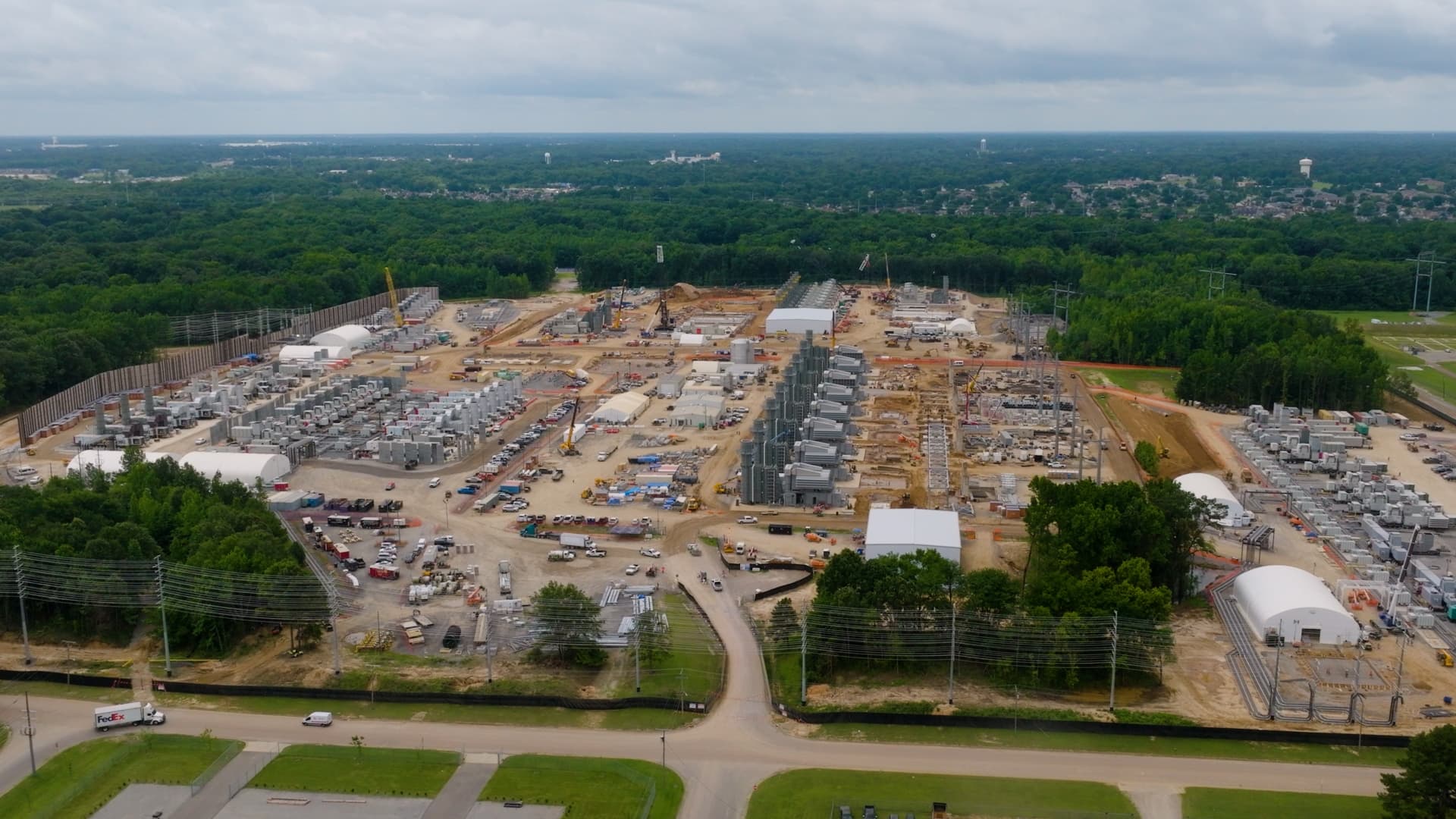
SpaceX’s AI division, SpaceXAI, lost its bid to dismiss an NAACP lawsuit, which is proceeding in federal court in Mississippi, according to a judge’s opinion released late Friday.
The lawsuit claims that the AI division of CEO Elon Musk’s aerospace and defense tech conglomerate violated the Clean Air Act with its use of gas-fired combustion turbines to power its massive AI data centers in Greater Memphis.
The Colossus data centers and a power plant that SpaceXAI is also building in Southaven, Mississippi, have faced community backlash for years.
The Southern Environmental Law Center and Earthjustice filed the suit on behalf of the NAACP in the U.S. District Court for the Northern District of Mississippi in April 2026.
The suit alleges that between August and December 2025, xAI and its subsidiary MZX Tech, installed and operated 27 gas turbines in Southaven, Mississippi, “without an air permit or regard for the health and safety of people living nearby.”
(SpaceXAI is owned and operated by SpaceX, which has rebranded it as SpaceXAI or SpaceXSI.)
The turbines emit smog-forming pollutants and particulate matter that can increase health risks and cause an unpleasant odor, among other unwanted impacts, according to the suit.
Lawyers for SpaceXAI argued in their motion to dismiss, filed in June, that the NAACP suit should be tossed because the company’s use of the turbines, which it characterized as “mobile,” was exempt from permitting requirements. They also argued that NAACP didn’t have a right to sue under the federal Clean Air Act, and suits by such community groups were unconstitutional.
The judge presiding over the case rejected those arguments, writing: “Because the plaintiffs have statutory standing under the Clean Air Act, because the combustion turbines are not ‘mobile sources’ under Mississippi’s SIP, and because the citizen suit provision does not violate Article II of the Constitution or the private nondelegation doctrine, the plaintiffs’ claims will proceed.”
The decision comes about two weeks after the same court rejected a Department of Justice’s request to end the case against Musk’s company.
SpaceX did not immediately respond to a request for comment.
Business
Popular supplement sold at Whole Foods recalled for salmonella concerns

It’s a tough pill to swallow.
A popular supplement touted to help reduce stress and improve sleep is being recalled for concerns over salmonella contamination.
An infection from this bacteria is especially dangerous for young children, older adults, pregnant women and those with weakened immune systems. It can cause dangerous levels of dehydration, or enter the bloodstream and infect tissues around the body.
The supplement being recalled are ashwagandha pills, sold at Whole Foods and on Amazon.
The manufacturer, Vitality Works Inc. of Albuquerque, New Mexico, is recalling one lot (# 2025-26227) of their 365 Whole Foods Market Standardized + Full Spectrum Blend Ashwagandha Capsules.
The bottles are 120 count and sold in white plastic bottles. You can check the lot number and expiration date of 10/13/2028, both printed on the bottom of the bottle.
They were available for purchase from November 24, 2025 through October 20, 2026 around the country.
If you have it, don’t take it — throw it out and don’t return it to the store. Refunds are available at any Whole Foods Market store, the FDA said. Those with questions can contact Vitality Works Inc. at (505) 268-9950.
No illnesses have been reported to date. The potential contamination was identified through routine sampling of a single retail unit, the FDA said. They didn’t explicitly say they found a positive Salmonella sample.
Salmonella and ashwagandha
Ashwagandha is a plant found in parts of Asia, Africa and the Middle East. Its roots are dried and ground into powder for a number of traditional practices, including Ayurvedic medicine.
Some research shows that it can help lower stress, anxiety, and help with sleep quality and total sleep time.
Salmonella can contaminate plants like Ashwagandha before harvesting or during processing, and can lay dormant for months or even years in a dormant state and causing infection when swallowed.
This is a huge issue for food manufacturers, as salmonella has been showed to survive drying in spices and herbs like ginger.
After a person consumes something contaminated with salmonella, it multiplies in the small intestine, triggering an immune response that can cause cramping, nausea, vomiting and diarrhea.
With a lot of vomiting and diarrhea, dehydration can become serious. The infection can also tear or cause bleeding in the digestive tract. If the bacteria gets into the blood stream, it can become life threatening — infecting the brain and spinal cord, heart, bones, and urinary tract.
Treatment will often address dehydration dangers with IV fluids, anti-diarrheal medications like Imodium, and antibiotics — though most recover without them.
Salmonella infects about 1.35 million in the US every year and is a leading cause of foodborne illness. This ashwagandha recall is just one of several that happened this year related to salmonella.
In August, jalapeños and fresh produce from Sinaloa prompted a recall of salsas, pico de gallo and other products from Target, Trader Joe’s, Whole Foods, and H-E-B.
Business
AI outlook: OpenAI cuts fundraising goal while Meta gets a credit warning on cash flow and spending

Following a brutal selloff in tech stocks over the past week, OpenAI slashed the target on its latest fundraising round to $20 billion from $30 billion, sources told the Financial Times. That also cut its expected valuation to $1.25 trillion from $1.4 trillion.
The funding round was also upstaged by Anthropic, according to the report, as OpenAI’s arch-rival prepares to go public next month. Ahead of its IPO, Anthropic filed an S-1 on Monday that showed revenue has soared and its cash flow turned positive in the first half of this year.
OpenAI didn’t immediately respond to a request for comment.
The timing couldn’t have been worse. Quarterly earnings reports from hyperscalers this week spooked investors. Alphabet saw its cash flow sink deeper into negative territory in the third quarter, with the Google parent also joining Meta and Amazon in charging ahead with massive spending plans. On Thursday, Alphabet fell about 12%, its worst day on record.
To be sure, there were other positive signs as well, in addition to Anthropic’s bullish S-1. Microsoft reported strong cloud growth and stayed cash flow positive, though it said its capital spending will accelerate, while AI chip maker SK Hynix blew away earnings forecasts.
But the narrative had already turned bearish, especially after AI debt fears sent shares and bonds of “neocloud” companies tumbling earlier this month.
At the same time, OpenAI was seeking more capital just as other AI giants tapped financial markets heavily. This past week alone, Elon Musk said SpaceX closed $40 billion in debt financing, Meta announced plans to raise $95 billion in equity, and Microsoft raised $25 billion in a bond sale.
The prospect of hyperscalers continuing to hemorrhage funds was too much for S&P Global, which cut its outlook on Meta to “negative” from “stable” late Friday, citing negative cash flow and uncertainty around capital expenditure plans.
The credit ratings agency maintained Meta at AA- but warned the social media leader’s leverage could top 1.0x as soon as 2027, which is the downgrade threshold for the current rating. That’s up from about 0.1x in 2025 and primarily reflects its strategy of leasing data center capacity rather than from its debt issuance.
Meanwhile, S&P sees Meta’s capex reaching $140 billion this year, topping $225 billion in 2027, hitting $252 billion in 2028, and then flattening out from there. As a result, it expects free operating cash flow to remain negative: -$22 billion this year, -$71 billion in 2027, and -$39 billion in 2028.
Of course, other hyperscalers are spending heavily and running cash deficits, but S&P also said Meta’s ability to monetize its AI investments is more limited than that of its peers.
“While we believe the company intends to monetize these investments via improved advertising tools that support faster ad revenue growth, as well as from the development of new revenue streams stemming from its introduction of agentic apps such as Muse, it is unclear when these revenue streams will generate material contributions that exceed their rising costs over the next few years,” S&P said.
Meta’s rivals, however, are monetizing their data centers by leasing compute capacity, including to frontier model labs and enterprise customers, it added.
In a statement to Fortune, a Meta spokesperson said the company disagrees with S&P’s assessment of its AI monetization capabilities, pointing to “significant product and business opportunities” ahead.
“Meta is already delivering stronger engagement, better recommendations, and greater returns for businesses as a result of AI investments,” the spokesperson continued. “We believe the technology and infrastructure we’re building now will open new revenue streams, create long-term shareholder value, and bring us closer to delivering personal superintelligence to everyone.”
The bearish environment on Wall Street also comes as rising bond yields have sent borrowing costs sharply higher, the political backlash against data centers is expected to help Democrats retake Congress, and the Iran war could re-escalate after midterm elections.
Still, some bullish voices aren’t convinced the AI boom is about to go bust, and even think some retrenchment is a good thing.
According to market veteran Ed Yardeni, the AI investment boom faces financial, physical, and political constraints. If any of these constraints worsen, stocks could dive further, especially considering that AI is now a major driver of corporate earnings and GDP growth, he said in a note this week.
“However, we view these constraints as healthy for the durability of the AI boom!” he added.
For example, if the supply of capital doesn’t flow as easily, it could lead to more efficient allocation, lowering the risk of overinvestment. Yardeni expects hyperscalers to retain access to financing—thanks to their strong balance sheets—and keep spending.
In his view, it all comes down to the U.S. economy, which he said has performed remarkably well over the past few decades. Even the midterm elections are unlikely to derail it, regardless of which party controls Congress.
“Further AI jitters therefore could set up buying opportunities rather than signal the end of the boom,” he said.
Business
McDonald’s must face lawsuit over McRib, judge rules

A federal judge on Friday rejected McDonald’s request to dismiss a proposed class action accusing it of defrauding consumers about the content of its McRib sandwich.
The plaintiffs accused McDonald’s of intentionally shaping McRib patties with ridges to resemble pork ribs and make diners believe the sandwich contains rib meat, an expensive cut known for its higher fat content and rich flavor.
Consumers said McDonald’s actual use of lower-grade pork products including shoulder, heart, tripe or stomach caused them to overpay for the McRib, one of its most expensive menu items.
While dismissing some claims, U.S. District Judge April Perry in McDonald’s hometown of Chicago called it premature to accept the company’s argument that no reasonable consumer could expect the McRib to contain rib meat.
She said McDonald’s website describes the sandwich only as containing pork, and reasonable consumers need not do research before buying a $7 fast-food sandwich.
The judge also said ads highlighting the meat’s rib-like shape could support a claim of intent to defraud, though further proof was needed.
“Plaintiffs’ proffered understanding of ‘McRib’ is not unreasonable or fanciful,” Perry wrote.
McDonald’s has sold the McRib periodically since 1981.
It contended that distinctive product names do not fool reasonable consumers, and the plaintiffs’ preference for a certain cut of pork “doesn’t turn McDonald’s truthful marketing into consumer fraud.”
In a statement, McDonald’s maintained that it does not use hearts, tripe or stomach in the McRib, and has always been transparent about its ingredients. “This lawsuit distorts the facts and the claims are meritless,” it added.
Thiago Coelho, a lawyer for the plaintiffs, said his clients will continue seeking accountability for deceptive marketing.
Fast-food chains have faced other lawsuits over product depictions in ads and on menu boards.
Business
Sandisk Is Splitting Its Stock 8-for-1. History Says What Usually Happens to Stocks After a Split Announcement.
Sandisk (SNDK -13.47%) gave investors two pieces of news on Thursday, Oct. 29. The flash memory company’s fiscal first-quarter revenue grew 23% over the previous quarter to $11.0 billion. And the board approved an eight-for-one stock split, with split-adjusted trading expected to start Friday, Nov. 20.
Does a split announcement tell investors anything about where a stock heads next? I checked what happened over the year after eight big-name split announcements, measured from every stock’s close on announcement day.
Five of the eight were up one year later, and the median stock rose around 26%. Five also beat the S&P 500. But the results ran from a 43% drop to a 79% gain.
Eight splits, five gains
Apple announced its split on July 30, 2020. Nvidia announced one on May 21, 2021, and another on May 22, 2024. Alphabet followed on Feb. 1, 2022, and Amazon on March 9, 2022.
Walmart announced its split on Jan. 30, 2024, Broadcom on June 12, 2024, and Netflix on Oct. 30, 2025.
Walmart did best, with its stock up around 79% in the next year. Broadcom climbed about 71%, and Apple gained 52%. Nvidia rose 40% after its 2024 announcement and a smaller 11% after its 2021 one, but that smaller gain still beat an S&P 500 that dropped in the same 12 months. Alphabet lost around 27% and Amazon about 34%. Netflix is down about 43% as I write, a day shy of its full year.
These are price-only numbers, adjusted for the splits, with dividends left out.
Put another way, a split announcement has come with better-than-even odds of a higher stock a year later. But it hasn’t said much about how big the gain would be.
What separated the winners?
Still, where every stock stood when its board acted looks to have mattered. Six of the eight closed within about 8% of their 52-week closing high on announcement day, and five of those six were up a year later.
The exception, Alphabet, ran into the 2022 bear market, when the S&P 500 slid about 9% in the same span.
The two that announced from well below their highs did worst. Amazon closed around 25% under its 52-week closing high on announcement day, then dropped another 34% in the next year. Netflix announced from about 19% below its high and has since fallen about 43%.
Two examples is a thin record, so I wouldn’t take it as a rule. But it does suggest the split itself mattered less than where every stock began and where the market headed next.
Sandisk’s setup looks different
Sandisk is splitting from much further down than any stock in the group. At around $1,330, its Oct. 29 close was 43% below the $2,335 record close it set on June 25, even though the stock’s still up about 551% since its close a year ago.
And its growth is slowing. The 23% sequential rise Sandisk posted for fiscal Q1 of 2027 (the three months ended Oct. 2, 2026) followed sequential leaps of 51% and 97% in the two quarters before it. Management’s guidance for fiscal Q2 revenue of $12.2 billion to $12.6 billion implies about 12% sequential growth at the midpoint.
SNDK – Sandisk
$1,150.89-$179.16 (-13.47%)
NASDAQ · As of 4:00 PM ET 10/30/26
Premium Feature
Key data points
Market capMarket cap calculated using publicly traded shares outstanding only. Does not include unlisted, private, or dual-class non-traded shares. Implied market cap may vary.$166.34B
Day’s range$1,115.16 – $1,239.00
52wk range$183.00 – $2,354.39
Volume17.5M
Avg volume10.9M
Gross margin71.47%
Margins might not have much higher to go, either. Gross margin reached 85% in fiscal Q1, up from about 30% a year before. And management’s fiscal Q2 guidance calls for about the same level.
Of course, investors already look skeptical. The stock sells for about 11 times earnings, based on its non-GAAP (adjusted) earnings per share in the last four quarters. If Sandisk earned the midpoint of its fiscal Q2 adjusted earnings guidance every quarter for a year, the stock’s price would be only about 6 times those earnings. Investors usually pay a price-to-earnings ratio that low for a growing company only when they expect its earnings to drop.
Yes, the business is much stronger than it was a year ago. Data center revenue rose 61% sequentially to $4.8 billion in fiscal Q1, up from $269 million a year before. But on where its stock sits, Sandisk arguably looks more like Amazon in 2022 and Netflix in 2025, which also announced from well below their highs, than the stocks that split near their records and kept climbing.
Flash prices might stay high longer than investors seem to think, and that may matter far more than the split. I just wouldn’t count on the split’s track record to help much here.


Heidi Klum Reveals 2026 Halloween Costume: Severed Hand
It wouldn’t be Halloween without Heidi Klum, as the star revealed yet another jaw-dropping costume at her signature party on...
McDonald’s move to dismiss McRib lawsuit denied
A federal judge has rejected McDonald’s request to dismiss a proposed class-action lawsuit alleging the fast-food giant has defrauded customers...
Player stats, box score
7:17 pm ET October 31, 2026 Charlie Becker scores quickly in overtime Scott Horner On the first play of overtime,...


Residents evacuated from Russia-occupied Oleshky arrive back in Ukraine amid temporary U.S.-brokered ceasefire
Residents who were evacuated from the Russian-occupied city of Oleshky as part of a U.S.-brokered temporary ceasefire crossed into Ukrainian-held...


31 new measles cases in Indiana reported over three days
Measles continues to spread throughout Indiana. The Indiana Department of Health has reported 31 new cases across the state in...


Ricki Lake claims Rosie O’Donnell judged her facelift, then got one
NEWYou can now listen to Fox News articles! Ricki Lake admitted to feeling a little judged by her friend Rosie...


Doors Guitarist Robby Krieger’s Wife Lynn Dead at 79
Lynn Krieger — the wife of the legendary guitarist of The Doors, Robby Krieger — is dead … TMZ has...


‘Nobody Wants This’ star Tovah Feldshuh addresses ‘tensions’ around Palestine
“Nobody Wants This” star Tovah Feldshuh swears there is no squabbling amongst the cast over the ongoing Israeli-Palestinian conflict. “Tensions...


Atlanta Dream v Golden State Valkyries: WNBA finals 2026 Game 7 – live updates
Key events Dream 37-34 Valkyries, 4.17, 3rd quarter Just when Atlanta appeared poised to take control, the Valkyries have come...


Savannah Chrisley shares pointed message after fraudster husband Jason Galanis reveal
Savannah Chrisley has a pointed message for those who are critical of her recently revealed engagement, secret marriage and pregnancy....
-

 HealthNews1 week ago
E. coli cases possibly linked to Bengtson’s Pumpkin Farm, Will County health officials say
-

 Business2 weeks ago
‘Black Monday’ fears intensify as prediction markets shrug off 2026 crash
-

 Entertainment2 weeks ago
Songwriter Sues, Says Chorus Copied Demo
-

 Business2 weeks ago
Bending Spoons wants to revive software castoffs. Berkshire investing
-
Business2 weeks ago
After Muse Launch, U.S. Banks Are Saying Hell No to AI Agents Moving Money
-

 Entertainment2 weeks ago
Jennifer Meyer speaks out on ex-husband Tobey Maguire officiating her wedding to Geoffrey Ogunlesi
-

 HealthNews2 weeks ago
Is the brain actually 2 nervous systems smooshed together? A new study claims it is.
-
Business2 weeks ago
GLP-1 injections recalled nationwide. See affected products