
PM office canada
You can see You Can See Everything everywhere
Some movies leave you with a memorable line. You Can See Everything leaves you with a face inches from yours and plenty of parodies.
Nathan Fielder and Lance Oppenheim’s movie about Elizabeth Holmes, Theranos founder and convicted fraudster , has become a meme machine, powered by the film’s most unnerving visual signature: close talking. Online, the answer has been to turn the pauses, the proximity, the dead-serious eye contact and that discomfort into a format.
The latest take came on The Tonight Show Starring Jimmy Fallon, where Jamie Lee Curtis played Holmes and Fallon took on Fielder. They delivered a shot-for-shot remake of of one of the film’s most intense exchanges.
With tense music underneath, Fallon mirrored Fielder’s measured questions and subtle expressions while Curtis held Holmes’s wide-eyed stare and repeated her lines, including, “I’m engaging with you as a human being.” The pair stayed in character until Fallon walked away and Curtis broke the tension.
The spoof quickly won over viewers online, with fans calling it Emmy-worthy and some saying Fallon looked so much like Fielder they briefly thought it was him.
This Hour Has 22 Minutes borrows the film’s close-talking tension for a parody negotiation between U.S. President Donald Trump and Prime Minister Mark Carney.
As Trump insists he isn’t lying, Carney asks, “So you won’t try to make Canada the 51st state?”
Trump promises he won’t, then admits, “I lied.”
Their face-to-face exchange spirals into an absurd argument about truth and trust, with Carney struggling to follow Trump’s shifting story.
The joke made its way to Washington Square Park in New York City, where dozens gathered for a Holmes and Fielder lookalike contest. Organized by comedian Maddy West and a friend, the event drew more than 200 registration responses.
The winners were Nicole Travolta, an actor and comedian who has been impersonating Holmes since 2022, and Joe Sivick, whose resemblance to Fielder was convincing enough to briefly fool one of the organizers.
Fans react online
On platforms including X, Instagram, TikTok and Reddit, users have also been reacting to Holmes and Fielder’s real-life exchanges, even making parodies of their own. One Reddit user reimagined the film as You Can Eat Anything.
Other memes transplant the film’s dead-serious dialogue into everyday situations. One X user posted, “It’s finally fall, we’re going apple picking with my college friends next Sunday at 1 pm.”
A user on Reddit re-shared this one, which said, “My cat telling me she hasn’t been fed yet. Why would I deceive you? There’s no reason for me to do that.”
Box office success
The film’s reach extends beyond social media. It took in more than $15 million US during its opening weekend, the second-largest opening weekend for a non-musical documentary in domestic box office history, behind only 2004’s Fahrenheit 9/11.
PM office canada
‘Associate’ EU membership for Canada not a ‘short-term’ project: expert
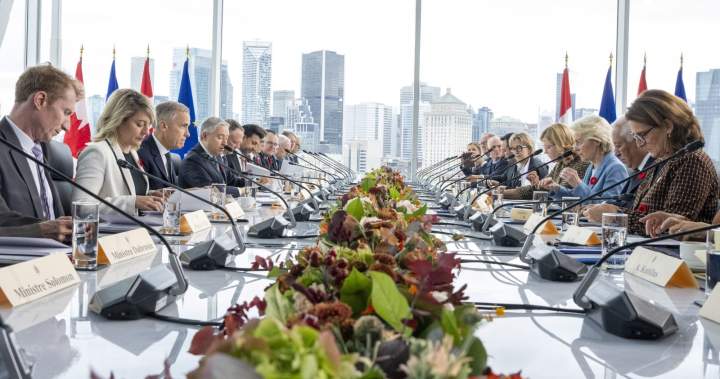
Prime Minister Mark Carney has laid out a timeline that would see Canada sign an agreement on a new partnership with the European Union in the next seven months, if all goes well.
Carney said Friday that Ottawa and Brussels are working toward the “deepest possible partnership short of accession” that would see Canada become “the European Union’s first associate member.”
He said in the coming months, the two sides will meet to “determine the full substance, scale and scope of this new form of membership.”
Ursula von der Leyen, president of the European Commission, championed the idea of associate membership in Strasbourg, France, last month. On Friday, she said she believes in building a partnership with Canada that “comes closer to membership than anything we’ve done before.”
Even though top EU officials are enthusiastic about closer ties with Canada, the talks won’t necessarily be a walk in the park. The European Union is far from politically united on the idea.
Achim Hurrelmann, co-director of the Centre for European Studies at Carleton University, said it could prove difficult to negotiate that status, especially in the short term.
“I’m not sure if a status with that name can be established for Canada any time soon,” he said.
“It seems that von der Leyen and Carney have decided to just press ahead with the use of this term and use the momentum that’s there on both sides for Canada-EU relations to make this a reality. But in the EU, that often can be quite difficult because once all of the member states get involved — we saw that in negotiating the summit declaration — then the entity is able to move only very slowly.”
Carney and EU officials met for a summit in Montreal on Thursday and Friday, where they agreed on a joint statement promoting what they called a “Canada-EU Alliance for the Future.”
The joint statement commits the two sides to working to “define by the 2027 EU-Canada Summit the concept of an ever-closer association of Canada to the EU, short of full membership itself.”
The 27-member bloc ultimately opted against including the term “associate member” in the joint statement. The phrase has seen some pushback from countries like Germany, which see it as a stepping-stone to permanent membership for countries like Ukraine.
EU debates are always complicated matters. In the coming months, major European countries will go to the polls for elections that could shake up the nature of those talks.
Spain’s general election is set for Nov. 29 and the French presidential elections go ahead in April. Poland will also go to the polls next year for parliamentary elections on Nov. 11.
Hurrelmann said the main challenge remains a lack of clarity on the term “associate membership” in Europe. He noted the language used by Canadian officials this week has been the “strongest embrace of associate membership” he’s seen by the Canadian side.
“It’s very clear that even if it’s associate membership … that it’s not just some kind of occasional political agreement, but something quite fundamental,” he said. “So I think the member states definitely will insist on their right to be heard on that.”
Carney said Friday he will meet with the EU presidents periodically to track progress, and Canada’s federal cabinet will meet in March with European cabinets in Canada.
The prime minister will then attend the European Council meetings in June, where the aim is to conclude negotiations. EU members would have to approve the resulting agreement, which would be put to a vote in the House of Commons as well.
Carney has said he’s not married to the term “associate member” and is more concerned about the outcomes from closer economic and defence ties.
“There is a case for an enhanced partnership status,” said Hurrelmann. “Maybe finding a different label will eventually do the trick, but that remains to be seen.”
The joint statement signed Friday calls for more industrial collaboration and supply chain integration and cites various joint projects. There are plans to create a new Canada-EU business council.
The Prime Minister’s Office said Canada and the European Union will in the coming months take their first steps toward a new transatlantic data cable and study how to increase liquefied natural gas exports to the European market.
— With files from Dylan Robertson
PM office canada
Here’s how Carney’s promises stack up as he prepares to deliver his second budget

With Prime Minister Mark Carney releasing his second budget next week after a year of announcements on major projects, foreign trade deals and new defence spending – and on the heels of a summit that drew foreign investors from around the globe – we check in on how his progress stacks up against his promises in nine areas.
The progress: At a September investment summit in Toronto, Mr. Carney announced that his government will balance the operating budget one year ahead of schedule.
However, in a series of recent reports, Parliamentary Budget Officer Annette Ryan has struck a cautionary note about the direction of Ottawa’s finances. Specifically, Ms. Ryan said the government’s definitions of what counts as operating versus capital spending is based on unclear and sometimes contradictory definitions.
The government’s approach to measuring its operating budget allows it to still run a traditional deficit and pile on more debt, leading economists to question the usefulness of the target, which Ottawa describes as a fiscal anchor.
However, while the size of the deficit is often the focus of the budget in the public’s eyes, that metric doesn’t tell the whole story. In a recent report, Ms. Ryan pointed out that the cost of interest on the federal debt is the fastest-growing federal expense. While each year’s federal deficit is added to the federal debt, the PBO points out that other less-understood factors – including the way defence spending and loans to Crown corporations are accounted for – also contribute to Ottawa’s debt, which is growing twice as fast as the deficit.
The PBO says the size of the federal debt will rise to $1.67-trillion in 2030-31, up from $1.3-trillion in 2025-26.
The debt as a percentage of GDP will reach 42.6 per cent, up from 41.1 per cent over the same time frame. For context, the debt-to-GDP ratio was around 31 per cent in 2018-19, before the pandemic, which led the government to add billions in new debt to fund emergency support measures.
The deficit-to-GDP ratio is projected to increase slightly from 1.8 per cent in the current fiscal year to 2 per cent in 2027-28, before declining to 1.7 per cent in 2030-31.
Should the November federal budget confirm increases in the debt and deficit-to-GDP ratios, that would run counter to Liberal Party’s campaign pledges.
– Bill Curry, Ottawa
The progress: Put simply, Mr. Carney has struggled to reset Canada’s economic relationship with its largest trading partner. Whether anyone else could have made lasting progress in talks with a president as capricious as Mr. Trump is another matter entirely.
The Canada-United States-Mexico Agreement has been living under a shadow since July, when the Trump administration chose not to grant a 16-year extension to the deal, triggering a decade-long process of annual reviews and uncertainty. Meanwhile, Mr. Carney suspended trade talks in August after accusing the U.S. of introducing last-minute measures that made it “unfair” and “uneconomic.”
Yet as difficult as this uncertain trade environment has been, Canada’s total exports to the U.S. are higher than before Mr. Trump was elected.
Mr. Carney has framed Canada’s stance as holding out for a broad, durable deal and he has repeatedly expressed the sentiment that no deal is better than a bad deal. If and when his negotiating team does reach a deal with the Americans, he’ll have to convince Canadians it is a good deal that was worth the wait.
– Jason Kirby, Toronto
The progress: Ottawa has landed broad commitments and promises with big dollar figures attached, but firm investment deals are in short supply.
In the run-up to September’s Canada Investment Summit, big banks made major financing commitments – TD Bank alone promised to undertake $150-billion of lending, underwriting and financing work for Canadian companies over five years. Brookfield Asset Management and the Canada Pension Plan Investment Board launched a $50-billion “Maple Fund” to make big-ticket domestic investments. Other pension funds followed suit with multi-year, multi-billion-dollar pledges.
The government of the United Arab Emirates has pledged to invest $70-billion in Canada. Dubai-based ports giant DP World Ltd. has signed a memorandum of understanding to explore an expansion of the Port of Churchill, while other entities have signed agreements to facilitate energy co-operation and business connections, but with no financial commitments spelled out.
But none of that has yet translated into significant amounts of capital flowing into Canadian projects or companies, and investors have cautioned that deals of this size take time to come together.
– James Bradshaw, Toronto
The progress: Ottawa has backed a new oil pipeline from Alberta to the West Coast, called Pacific Link, with the aim of expanding exports to more global markets. The first proposal to gain the Project of National Interest stamp, the pipeline, if built, would transport one million barrels of crude to southern B.C. each day. The federal government has also committed $100-million toward development of a Nova Scotia offshore wind energy project and said it will cover up to $1-billion in international UN fees for the Bay du Nord oil project off the coast of St. John’s, NL, which would stem from the fact that it would fall outside of Canada’s exclusive economic zone.
Joint venture company LNG Canada announced in September it would go ahead with the second phase of its liquefied natural gas export facility on the B.C. coast, following an agreement between the province and federal government that aims to accelerate the construction of major energy and trade corridors.
On the environmental front, the B.C. agreement included a pledge to uphold the oil tanker ban for the province’s northern coast. In addition, in September, Mr. Carney announced a $1.2-billion federal ocean protection package. Electrification has been hit and miss: Mr. Carney has shelved clean electricity regulations in Alberta and relaxed a previous mandate on EV sales, but has committed to $2-billion over eight years for heat pump rebates.
Mr. Carney’s government has seen some pushback from environmental groups and some First Nations over potential negative effects caused by the accelerated approval processes for pipelines, ports and mines under the Building Canada Strong Act.
– Emma Graney, Calgary
The progress: The Major Projects Office now has a staff complement of 200 assisting development proponents with regulatory and Indigenous consultation direction as well as providing options for sources for funding. Many of those staff members are seconded from the private sector.
The MPO is evaluating 18 projects, including mines, ports, power transmission lines, roads, LNG projects and pipelines. The agency is also studying 10 so-called transformative strategies that involve multiple proposals within regions. It all represents $194-billion in potential spending, the MPO says.
The MPO’s listing of the Pacific Link oil pipeline and the Roberts Bank Terminal 2 in British Columbia as projects of national interest under the Building Canada Act gives them a fast-track approval process to be complete by Sept. 1, 2027. There are three other proposals in the queue for potential listing: the Mackenzie Valley Highway Project in the Northwest Territories, Grays Bay Road and Port Project in Nunavut and a deep nuclear waste storage project in Northwestern Ontario.
In September, at Mr. Carney’s investment summit in Toronto, institutional investors from around the world met with backers of more than 160 projects in various stages of development to drum up interest in providing capital. No developers or investors have yet announced any investments that stemmed directly from the high-profile gathering.
The government has tabled Bill C-39, the Building Canada Strong Act, sweeping legislation aimed at getting major projects built faster. The Liberals assert that the push for speed in approval decisions will not lower environmental and social standards. But some Indigenous groups, green activists and unions voice concerns that it could weaken consultation requirements, protections for nature and workers’ rights.
– Jeffrey Jones, Calgary
The progress: The number of international students and temporary workers has dropped significantly, as have asylum claims. In March, a law received royal assent restricting the right for an asylum hearing at Canada’s independent tribunal only to people who have been in Canada for less than a year. This led to many asylum seekers being put on a fast track to deportation, and has sparked many court challenges.
In its November, 2025 immigration plan, the government slashed the number of temporary residents – particularly international students – that it plans to admit in the next three years. It froze the number of permanent residents to 380,000 a year for three years, down from 395,000 in 2025.
Also, Ottawa’s 2025 budget outlined an International Talent Attraction Strategy led by Immigration, Refugees, Citizenship Canada, which included efforts to attract health care workers from abroad.
Within days, Immigration Minister Lena Metlege Diab is due to announce immigration targets for the next three years, including provincial nominee numbers.
The government is now coming under pressure from industry to create more places for skilled workers to settle in Canada to fill job gaps, including in construction. Representatives of the construction industry warn that a shortage of workers, including digger drivers, brick layers and carpenters, could hamper Mr. Carney’s ability to fulfill his ambition to build “major projects.”
Universities and colleges are also hoping that international student numbers will be increased. The drop has reduced a much-needed revenue stream for Canada’s higher education sector. Meanwhile, some provinces, including Alberta, Saskatchewan, Ontario and Newfoundland, have recently renewed calls for more control over immigration. Provinces, including Alberta and Saskatchewan, have also told Ottawa they want the power to nominate more immigrants for permanent residence in their provinces.
Ms. Metlege Diab recently announced changes to Canada’s Express Entry system, giving highly paid foreign nationals working in Canada – including doctors, engineers and programmers – an advantage when applying for permanent residence. Applicants to the Express Entry system will now receive additional points if they have worked for at least a year in a high-wage job in Canada or have a high-paid job offer.
Announcing the changes earlier this month, Ms. Metlege Diab said they would help the federal government identify, attract and retain skilled newcomers best positioned to succeed in Canada, while making the Express Entry system “more targeted and responsive to our labour-market needs.”
– Marie Woolf, Ottawa
The Progress: In order to expand the capabilities of the Navy’s submarine fleet, in July the federal government selected TKMS of Germany to be the preferred supplier for up to 12 submarines, although the government is now hedging on whether it will acquire 12 and it hasn’t booked the spending in the fiscal framework yet.
NATO’s 2025 commitments call for increasing core defence spending to 3.5 per cent of Gross Domestic Product from 2 per cent by 2035 and additionally demonstrating it’s spending another 1.5 per cent annually on security- and defence-related infrastructure. The government has not provided a plan for reaching 3.5 per cent nor has it showed its math on how it will be spending 1.5 per cent on strategic infrastructure with a dual civilian and military purpose, such as bridges, ports and roads, as well as cybersecurity and measures to protect energy pipelines.
In August, 2026, Mr. Carney announced Ottawa will spend $11.3-billion to build six new icebreakers for the Canadian Coast Guard in Quebec.
In an effort to improve procurement legislation to ensure Forces can “buy the equipment that they need, when they need it – which is now,” in October, the Liberals introduced Bill C-40. The bill turns the Defence Investment Agency into a Crown corporation and makes it nimbler and more autonomous, allowing it to move faster to procure military goods.
The government has a stated aim to create a “first-in-class drone capability that will build and deploy aquatic and airborne uncrewed vehicles to defend our arctic, our undersea infrastructure, our borders, and our allies.” It also would match this new capability with an industrial strategy that builds and perfects these technologies so that Canadian companies benefit from Canadian procurements.
Mr. Carney’s pledge is still a work in progress. The government set up the framework with its Feb. 17, 2026, Defence Industrial Strategy, which names drones and other uncrewed systems as one of ten sovereign capability priorities. Ottawa then launched the Defence Drone Initiative in July – a program run by National Defence and the Defence Investment Agency to speed up the development, testing and production of Canadian-made uncrewed and autonomous systems for the Armed Forces and the Coast Guard. It works as a pre-approved supplier list covering six areas: low-cost surveillance drones, ground robots, maritime and underwater systems, counter-drone interceptors, standardized drone munitions and long-range precision strike. On Sept. 10, the PMO announced a national drone marketplace and said it has awarded initial contracts worth up to $50-million that it says will increase the number of drones the Armed Forces have deployed tenfold, though no starting number was given.
– Steven Chase, Ottawa
The progress: A commitment to the free flow of goods across provinces marked the biggest leap in dismantling internal trade barriers over the past year. Ottawa brought provinces to the table and urged implementation of the Canadian Mutual Recognition Agreement, which took effect in January and which allows goods sold lawfully in one province to be sold in another.
But the services sector is where trade liberalization would offer the biggest economic gains, according to interprovincial trade researcher Trevor Tombe, and it’s where the biggest gaps remain. The most meaningful blockers, including occupational licensing, product standards and rules around alcohol and food, are in provincial hands.
Pledges on paper also haven’t matched facts on the ground when it came to direct-to-consumer alcohol sales. Commitments to remove red tape on interprovincial shipments of wine, beer and spirits led to a series of bilateral and trilateral agreements between provinces instead, often involving eye-watering markups.
– Mariya Postelnyak
The progress: Employee reductions appear to be on pace to meet the budget target. When the Treasury Board released its annual head count statistics for the public service in June, which are based on figures as of March 31, it showed there were 345,282 federal public servants, down from 357,965 the year before.
Last year’s budget announced funding for an early retirement incentive, which is meant to encourage voluntary departures and reduce the need for layoffs as departments meet their reduction targets.
The government received 10,006 early retirement applications as of the July 24 deadline, of which 9,694 have been confirmed to meet the program’s criteria, according to the Treasury Board.
PM office canada
Carney grants new $5.9-billion Metro Vancouver superport national interest status
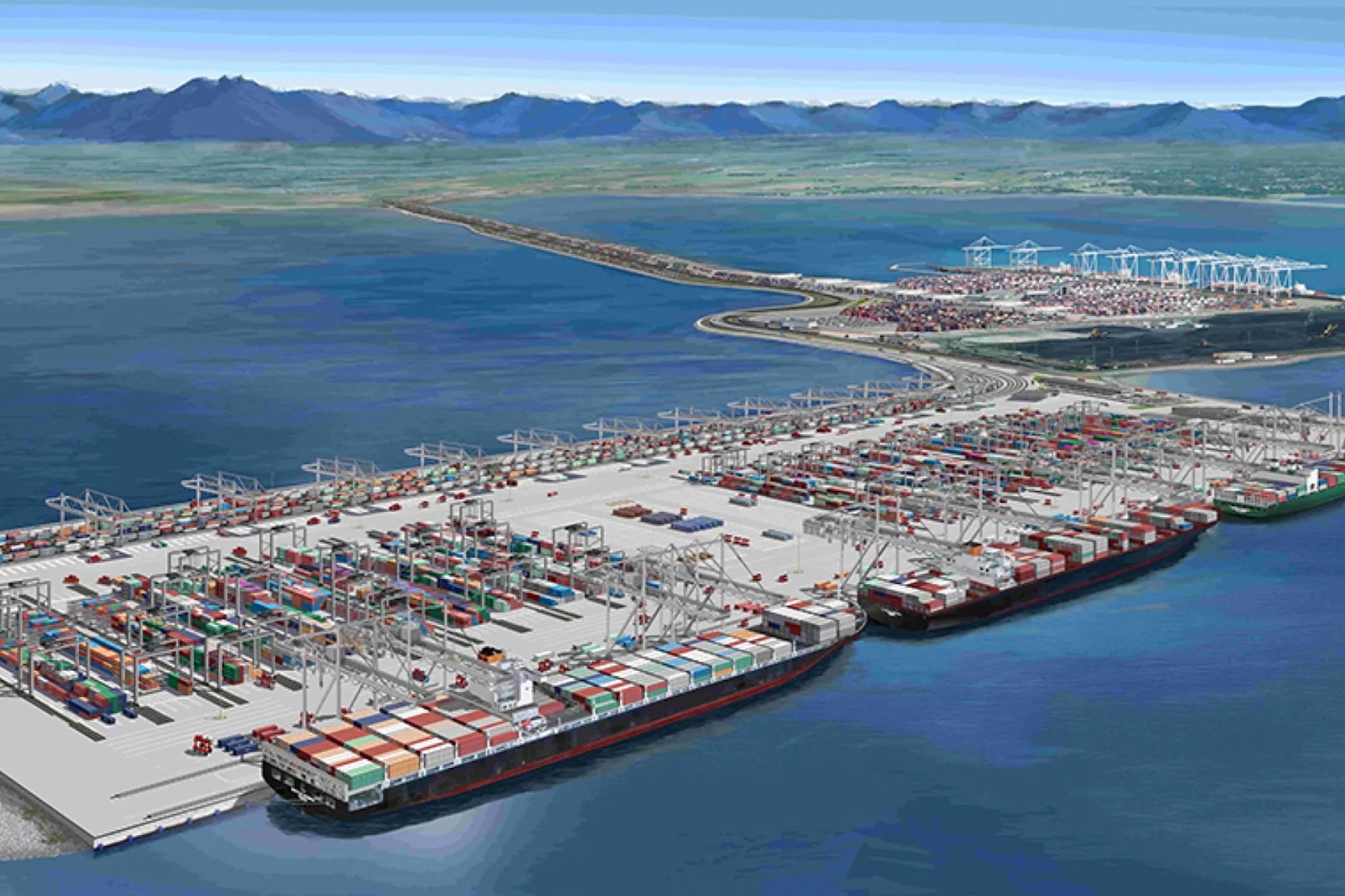
The new Roberts Bank Terminal 2 container port in Metro Vancouver could open four years earlier after Prime Minister Mark Carney formally designated it a project of national interest.
The Government of Canada announced the formal designation today, noting that it could bring the superport into operation in 2035 instead of 2039 by speeding up the remaining federal approvals.
It would be built by significantly extending the existing port causeway in Tsawwassen, which is already home to the GCT Deltaport superport container terminal and the Westshore coal export terminal.
You might also like:
New Pacific Link oil pipeline to B.C.’s coast officially declared a national priority
Massive Metro Vancouver oil terminal proposed as endpoint for new Alberta pipeline
B.C. government agrees to talks on new Alberta oil pipeline to coast, with revenue share and tanker ban
Contractor selected to create 320 acres of land for Metro Vancouver’s new superport
Battle over Metro Vancouver superport expansion concepts ends in surprise alliance
How air cargo is driving Vancouver International Airport’s evolution and growth beyond passenger travel
Lorne Doerkson’s B.C. Conservatives promise 10-lane George Massey Bridge instead of $8.5-billion, eight-lane immersed tunnel
Orca population face ‘possible extinction’ as feds push for a new B.C. port
The Vancouver Fraser Port Authority, which is leading the project, is working toward a final investment decision by the middle of 2027. Excluding the interest costs from borrowing, the terminal’s estimated construction cost now stands at $5.9 billion — up from $3.5 billion about five years ago.
“Canada is working. By listing Roberts Bank Terminal 2 as a project of national interest, we are better connecting our economy with the world and diversifying our trade. As the world competes for capital, Canada will not wait. We are building a stronger, more independent, and more competitive Canadian economy,” said Carney.
B.C. Premier-elect Lorne Doerkson added, “Our incoming government is committed to making British Columbia a place to build. That means working collaboratively with our federal, industry, and First Nations partners, removing unnecessary barriers, and ensuring the infrastructure and connections needed to support economic growth are in place.”
“We recognize the importance of moving major projects like Roberts Bank Terminal 2 forward as quickly and efficiently as possible. Our teams stand ready to work closely with the federal government and project proponents to help move this project forward. British Columbia has enormous economic potential, and investments like this will help us build a stronger, more competitive and prosperous province,” continued Doerkson.
The decision follows the Prime Minister’s similar project of national interest designation on Oct. 1, 2026 for the new Pacific Link oil pipeline, which is intended to carry one million barrels of Alberta oil a day from the Edmonton area to a major new marine export terminal and storage facility in Tsawwassen. This could involve building a third causeway in the area west of Delta — in addition to the existing southern causeway for BC Ferries’ Tsawwassen ferry terminal and the existing northern causeway for GCT Deltaport, the Westshore coal export terminal, and the new Roberts Bank Terminal 2 superport.
Roberts Bank Terminal 2 is a completely separate project for shipping containers, but there is now the possibility of overlapping major construction timelines in the area for both the new superport and the Pacific Link oil pipeline’s marine export terminal and storage facility. The federal government is aiming for a construction start on Pacific Link in September 2027.
Existing condition:
Future condition:
In Summer 2026, the port authority announced that, through a bidding process, it had selected a private consortium called TerraMarine to extend the existing port causeway by 320 acres through land reclamation. Early construction and site preparation work by TerraMarine is expected to begin in late 2027, followed by the start of major construction and land reclamation activities in 2028.
At a later date, the port authority will conduct separate bidding processes for additional contractors that will be responsible for building other components of Roberts Bank Terminal 2, including building the container terminal’s equipment and facilities and the supporting ground transportation infrastructure on the newly-created land mass.
In April 2026, the port authority announced it had reached a truce with GCT Global Container Terminals, the private company that operates GCT Deltaport, to work together on a joint strategy to advance Roberts Bank Terminal 2, with the company potentially becoming the superport’s builder and operator. They have provided their organizations with one year to reach an agreement. For years, both the port authority and GCT were engaged in a battle over competing concepts on how to expand the container terminal facilities in Tsawwassen.
As spearheaded by the port authority, the new Roberts Bank Terminal 2 will have three ship berths, a wider access causeway for roads and freight railway tracks, and a large basin for tugboats.
It would add annual capacity equivalent to 2.4 million standard 20-ft-long containers (TEUs), increasing the Port of Vancouver’s overall container capacity by about 50 per cent and the overall container capacity of Canada’s West Coast by about 30 per cent.
Moreover, this would double the immediate Tsawwassen area’s existing container terminal capacity, as GCT Deltaport can currently similarly handle about 2.4 million TEUs annually.
The federal government estimates that the added capacity could accommodate roughly $100 billion in goods each year.
Carney’s designation under the federal Building Canada Act follows the project’s referral to the Major Projects Office in July 2026. This federal office will help coordinate the outstanding federal approvals and bring them together in a single document setting out the requirements the project must meet.
Roberts Bank Terminal 2 already received federal environmental approval in April 2023, subject to 370 legally binding conditions. The existing environmental requirements will remain in place as the project advances.
Marine protection measures outlined alongside the designation include nearly $2 billion in investments aimed at protecting fish habitat, salmon, whales, and other species at risk, but some environmental groups remain unconvinced that the mitigation measures will be sufficient.
An agreement with BC Ferries includes a goal of reducing underwater noise from its vessels in southern resident killer whale habitat by 50 per cent by 2036. The federal government is also setting an interim objective to keep underwater noise in the whales’ critical habitat at 2023 levels while pursuing further reductions.
The federal government is presenting the new superport as a way to help Canadian companies reach more overseas customers and reduce the country’s reliance on the United States. Its broader goal is to double exports to markets outside the U.S. by 2035.
Once operating, the superport is projected to support approximately 17,000 jobs across the supply chain, contribute about $3 billion a year to Canada’s economy, and generate roughly $631 million annually in tax revenue. Those employment figures extend beyond people working directly at the terminal.
According to the federal government, a shortage of port capacity on Canada’s West Coast could otherwise add $800 million to $900 million a year to shipping costs, beginning as early as 2031.
The terminal is part of the wider Port of Vancouver Gateway Strategy, which also covers rail improvements, bulk cargo terminals, industrial land, and environmental protection. The federal government estimates that the new superport, combined with investments in railways and distribution centres, could help cut container import costs by up to 25 per cent and Vancouver-to-Toronto delivery times by about 17 per cent, with approximately $1 billion in annual shipping savings.
“British Columbia is Canada’s gateway to the Asia-Pacific, and this project represents a significant opportunity to supercharge our province’s economy, attract investment, and create good-paying jobs for British Columbians,” said Doerkson.
The region’s port facilities, including the new superport, would also benefit from the new crossing to replace the aging and highly constrained four-lane George Massey Tunnel, which cannot handle oversized freight trucks and vehicles carrying hazardous goods. For factors that include a lower construction cost and project risk, the incoming provincial government led by Doerkson’s Conservative party is looking to abandon the outgoing BC NDP administration’s eight-lane immersed tunnel project to restore the original project of building a 10-lane bridge.
A new bridge — cancelling the new immersed tunnel project, and removing the existing tunnel — could also potentially allow larger ships to head up the Fraser River to reach Fraser Surrey Docks.
PM office canada
Budget 2026 title and theme focus on Canada’s sovereignty, minister reveals
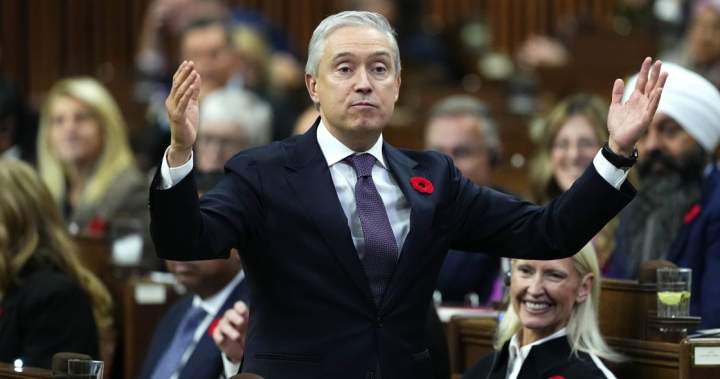
The federal government has released the title and theme for its upcoming budget set to be tabled on Nov. 5, which the finance minister’s office says reflects a period of “profound change and uncertainty.”
Finance Minister François-Philippe Champagne posted on social media Thursday morning revealing the title “MASTERS OF OUR DESTINY: BUDGET 2026,” with the cover of the budget document, showing power lines suspended over a forested valley landscape.
Story continues below advertisement
Champagne’s office also released a statement explaining the significance of the chosen theme and title.
It was inspired by the 1962 Quebec electoral campaign of then-premier Jean Lesage, where the slogan was “Maîtres chez Nous,” loosely translated to “Masters of Our Own House.”
The note from Champagne’s office says the slogan at the time was “a defining expression during a moment of profound change and uncertainty,” as the Lesage government was planning to build up hydroelectric resources and institutions that would support the economy.
“Today, Canada faces a moment of profound change. Trade relationships are redefined. Old alliances are being tested. The forces reshaping the world are challenging our economy, our sovereignty and our sense of who we are,” the note said.
“Through Budget 2026, we reinforce that we are masters of our destiny. That we build our economic strength. That we are there for Canadians. That we defend what makes us Canadians.”
It added: “That is the ambition at the heart of Budget 2026: Maîtres chez nous. Masters of our destiny.”
Ottawa’s latest budget comes as Prime Minister Mark Carney‘s government has been focused for over a year on rewiring Canada’s economy and trade relationships in order to reduce reliance on a more volatile United States.
U.S. tariffs and trade tensions continue to impact Canada’s economy and job market, while geopolitical conflicts lead to rising oil and gas prices and pose a risk that inflation could continue to rise as a result.
PM office canada
Ottawa vows to prepare for all contingencies, ‘including war,’ in national security plan

The federal government will beef up Canada’s intelligence-gathering capabilities and “prepare for all contingencies up to and including war” under a new national security strategy that says protecting sovereignty now requires building “strategic capabilities” in eight sectors from critical minerals to defence and emerging technologies.
The Plan for a Stronger Canada, released Thursday, is the first national security strategy from Ottawa in more than two decades. Only 13 pages long, it’s a framework guiding the development of five new detailed national policies for defence, foreign affairs, economic security, public safety and intelligence. A new foreign policy will be released in about one month with others to follow, the government says.
Senior officials at a briefing Thursday said threats facing Canada are increasingly complex, ranging from climate change, terrorism, pandemics to cyberattacks, cutting-edge artificial intelligence and the increasing possibility of a major war. The Globe and Mail is not identifying the officials, who were not authorized to speak publicly on the matter.
Officials did not say where specifically war might break out but some European leaders and military commanders have said that by 2029, Russia will have the capacity to attack another North Atlantic Treaty Organization country.
Prime Minister Mark Carney’s office in a statement said he plans to convene a first ministers’ meeting on national security to strengthen co-ordination with provincial and territorial governments. Ottawa will also introduce legislative proposals to modernize national security legislation within a year, it said.
A major theme of this new strategy is “strategic autonomy,” an expansive view of security that Mr. Carney has previously defined as a country’s ability to act independently for its own national and economic interests rather than being vulnerable to coercion from superpowers.
The strategy does not name any countries as risks but the Prime Minister’s Office, in an accompanying statement, said threats now include the “weaponization of trade deals,” an indirect reference to how the United States has used protectionist tariffs and hindered access to its massive market to extract concessions from allies such as Canada.
Canada making progress on defence strategy, but key aspects remain a challenge, industry members say
The strategy is the first overarching national security policy since 2004, when former prime minister Paul Martin’s Liberals released Securing an Open Society.
Mr. Carney, speaking in Montreal, said the last national security strategy was written for a different world.
“Today’s reflects profound new realities,” he said. “It is not enough to feed, fuel and defend ourselves. Sovereignty now requires secure access to semiconductors, critical minerals, payment systems, clean energy technologies, vaccines, space-based communications and artificial intelligence,” he said.
These capabilities will ensure Canada can be sovereign, and, finally, “maîtres chez nous,” – able to “live our lives as we choose,” the Prime Minister said, invoking the historic Quebec political slogan “masters in our own house.”
The strategy says Canada aims for a “cooperative, clear-eyed relationship with the United States” and will work to “maintain a relationship with the United States based on mutual respect, national sovereignty, and shared responsibility for the security of North America.”
It says Ottawa will “strengthen sovereign intelligence capabilities, collection and analysis,” meaning Canada will build up its ability to gather secret information rather than relying on others. It will bolster the capacities of the Communications Security Establishment, the country’s electronic eavesdropping agency, as well as the Canadian Security Intelligence Service and defence intelligence operations.
Canada will also diversify intelligence partnerships around the world – beyond the Five Eyes intelligence sharing alliance – the plan says.
Officials at Thursday’s briefing said they’re not on the verge of announcing a new foreign human-intelligence gathering agency such as Britain’s MI6 or the U.S. Central Intelligence Agency but are looking at how to expand capabilities among existing intelligence-collection operations.
The solution to reducing vulnerabilities and risks, according to the strategy, is building up Canada’s capacity in eight areas: emerging technologies such as AI and quantum computing, critical minerals, defence, energy, transportation, pharmaceuticals and biotech, food security and financial payments, transaction settlement and investment.
The language fits a theme Mr. Carney has embraced over the past year. In Davos, Switzerland, he described a “rupture in the world order” and argued that middle powers such as Canada are not powerless. In February, launching the country’s first Defence Industrial Strategy, he said Canada should never be hostage to the decisions of others on its own security.
Mr. Carney recently said that he plans to “diversify away from” billionaire Elon Musk’s Starlink satellite-internet network, citing instances in which Ukraine’s access to Starlink services was “turned on and off in a way that was not sovereign to the actors in the conflict.”
He said Canada cannot be reliant on critical technology such as Starlink.
“Once you realize that, as we have, this government has, it leads to a series of decisions and partnerships that are necessary in order to diversify and to build up sovereign capabilities within Canada or with partners,” the Prime Minister told reporters in Istanbul last week.
This will take time, he said, “because we’re starting from a position where we’re highly, highly reliant on certain systems in certain countries.”
The strategy also says the Canadian military will draw on Ukraine’s defence against a Russian invasion and will be given one clear central mission: the defence of Canada and Canadian interests. It says the Canadian Armed Forces will develop special capacities and training that enable Canada to defend against threats from space to cyberspace.
Ottawa said it wants to make Canada “a defence partner of choice,” meeting “our commitments to NORAD and NATO, strengthening partnerships in the Arctic, and demonstrating our ability to contribute to security and stability in the Indo-Pacific, Middle East and elsewhere.”


Heidi Klum Reveals 2026 Halloween Costume: Severed Hand
It wouldn’t be Halloween without Heidi Klum, as the star revealed yet another jaw-dropping costume at her signature party on...
McDonald’s move to dismiss McRib lawsuit denied
A federal judge has rejected McDonald’s request to dismiss a proposed class-action lawsuit alleging the fast-food giant has defrauded customers...
Player stats, box score
7:17 pm ET October 31, 2026 Charlie Becker scores quickly in overtime Scott Horner On the first play of overtime,...


Residents evacuated from Russia-occupied Oleshky arrive back in Ukraine amid temporary U.S.-brokered ceasefire
Residents who were evacuated from the Russian-occupied city of Oleshky as part of a U.S.-brokered temporary ceasefire crossed into Ukrainian-held...


31 new measles cases in Indiana reported over three days
Measles continues to spread throughout Indiana. The Indiana Department of Health has reported 31 new cases across the state in...


Ricki Lake claims Rosie O’Donnell judged her facelift, then got one
NEWYou can now listen to Fox News articles! Ricki Lake admitted to feeling a little judged by her friend Rosie...


Doors Guitarist Robby Krieger’s Wife Lynn Dead at 79
Lynn Krieger — the wife of the legendary guitarist of The Doors, Robby Krieger — is dead … TMZ has...


‘Nobody Wants This’ star Tovah Feldshuh addresses ‘tensions’ around Palestine
“Nobody Wants This” star Tovah Feldshuh swears there is no squabbling amongst the cast over the ongoing Israeli-Palestinian conflict. “Tensions...


Atlanta Dream v Golden State Valkyries: WNBA finals 2026 Game 7 – live updates
Key events Dream 37-34 Valkyries, 4.17, 3rd quarter Just when Atlanta appeared poised to take control, the Valkyries have come...


Savannah Chrisley shares pointed message after fraudster husband Jason Galanis reveal
Savannah Chrisley has a pointed message for those who are critical of her recently revealed engagement, secret marriage and pregnancy....
-

 HealthNews1 week ago
E. coli cases possibly linked to Bengtson’s Pumpkin Farm, Will County health officials say
-

 Business2 weeks ago
‘Black Monday’ fears intensify as prediction markets shrug off 2026 crash
-

 Entertainment2 weeks ago
Songwriter Sues, Says Chorus Copied Demo
-

 Business2 weeks ago
Bending Spoons wants to revive software castoffs. Berkshire investing
-
Business2 weeks ago
After Muse Launch, U.S. Banks Are Saying Hell No to AI Agents Moving Money
-

 Entertainment2 weeks ago
Jennifer Meyer speaks out on ex-husband Tobey Maguire officiating her wedding to Geoffrey Ogunlesi
-

 HealthNews2 weeks ago
Is the brain actually 2 nervous systems smooshed together? A new study claims it is.
-
Business2 weeks ago
GLP-1 injections recalled nationwide. See affected products