
test
Sunday’s ‘Wear Orange’ event a reminder to lock up your damn guns
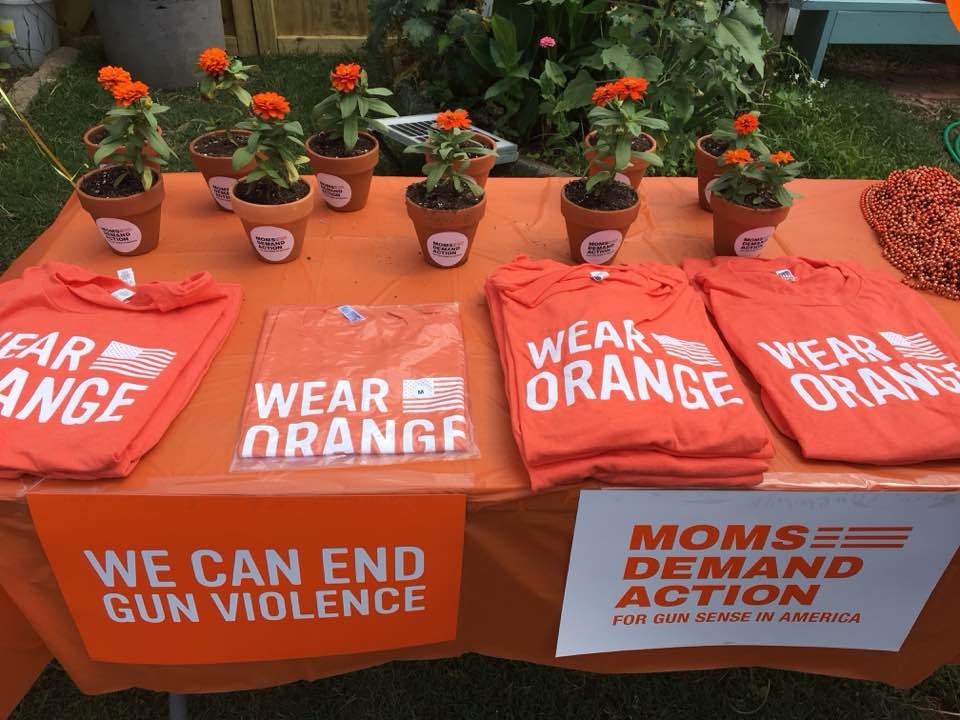
In Arkansas, 669 people die each year in homicides and suicides by gun. This inglorious stat, the product of lax gun safety laws and rabid gun culture, puts Arkansas in the top 10 most dangerous states when it comes to firearms.
On Sunday, June 7, the tireless members of Moms Demand Action will circle up the food trucks and convene conversations from 1-3 p.m. at Station 801, 801 South Chester Street, Little Rock.
A roundtable discussion starting at 1:30 p.m. will include Scott Hamilton, CEO & president of the Arkansas Urban League; Eric Brown, executive director of Seis Puentes Hispanic Outreach; Susie Reynolds Reece, a national leader in suicide prevention; and Dr. Whit Hall and Mariah Hatta, volunteers with Moms Demand Action for Gun Sense in America. Representatives from Parents of Murdered Children and the Center for Healing Hearts and Spirits will also join in.
The Sunday afternoon event, which will include snacks, drinks and kids’ activities, is part of Wear Orange Weekend and National Gun Violence Prevention Month, observed to honor lives lost to gun violence and elevate gun violence prevention efforts.
All are welcome.
test
Abbott: ‘No Food Safety Issue’ From Screwworm
Gov. Greg Abbott told Texans on Friday there is “no food safety issue” tied to the first U.S. detection of the New World screwworm in decades, signing an expanded statewide disaster declaration that pulls every arm of state government into the fight against a parasite threatening the country’s largest cattle industry.
As of Friday evening, the only confirmed case remains a three-week-old calf in Zavala County, near the Mexican border.
At a news conference in Austin, Abbott drew a clean line between contamination and supply.
“What we’re dealing with is an infestation of animals; however, there is no food safety issue,” he said.
“There’s a food production issue, but not a food safety issue.”
The screwworm fly does not infect meat, and federal inspectors keep affected animals out of the food chain, but a sustained outbreak would cut into herds and push beef prices higher.
The U.S. Department of Agriculture’s Animal and Plant Health Inspection Service confirmed the detection June 3 after testing a sample from La Pryor at the agency’s National Veterinary Services Laboratories in Ames, Iowa.
Larvae were found in the calf’s umbilical area.
USDA has drawn a 20-kilometer quarantine zone around the site, barring movement of warm-blooded animals without inspection, while the Texas Animal Health Commission set an infested zone covering parts of Zavala and Uvalde counties.
Abbott’s Friday order expands a January declaration that had covered only the two affected counties, reassigning resources statewide and making university personnel available to accelerate sterile fly shipments and speed construction of a federal production plant in Edinburg, Texas.
Funded by a $750 million USDA investment and built with the Army Corps of Engineers at Moore Air Force Base, the facility is designed to release up to 300 million sterile flies per week, but is not scheduled to open until fall 2027.
Abbott said he had offered Texas A&M and state agencies to run construction “24 hours a day, seven days a week” to move that timeline up.
The governor told ranchers the parasite is manageable if caught early.
“This is a highly treatable condition if acted on quickly, whether it be for someone’s pets or someone’s cattle,” Abbott said.
“Constant contact with your veterinarian is very important.”
He urged pet owners with outdoor animals to watch for untreated wounds, and closed with a confidence note: “The bottom line is Texas is resilient, and our producers, veterinarians, and state officials are among the very best in the United States.”
During the public portion of his briefing, Abbott also called the broader response inadequate and said the pest can spread like wildfire, though he offered no specifics afterward.
The economic stakes are concentrated in South Texas but national in reach.
Texas anchors a $15 billion state cattle industry, and a USDA estimate cited by the Texas Tribune puts potential economic damage from a potential outbreak at $1.8 billion.
test
Fire damages Brother George’s food truck in Kankakee
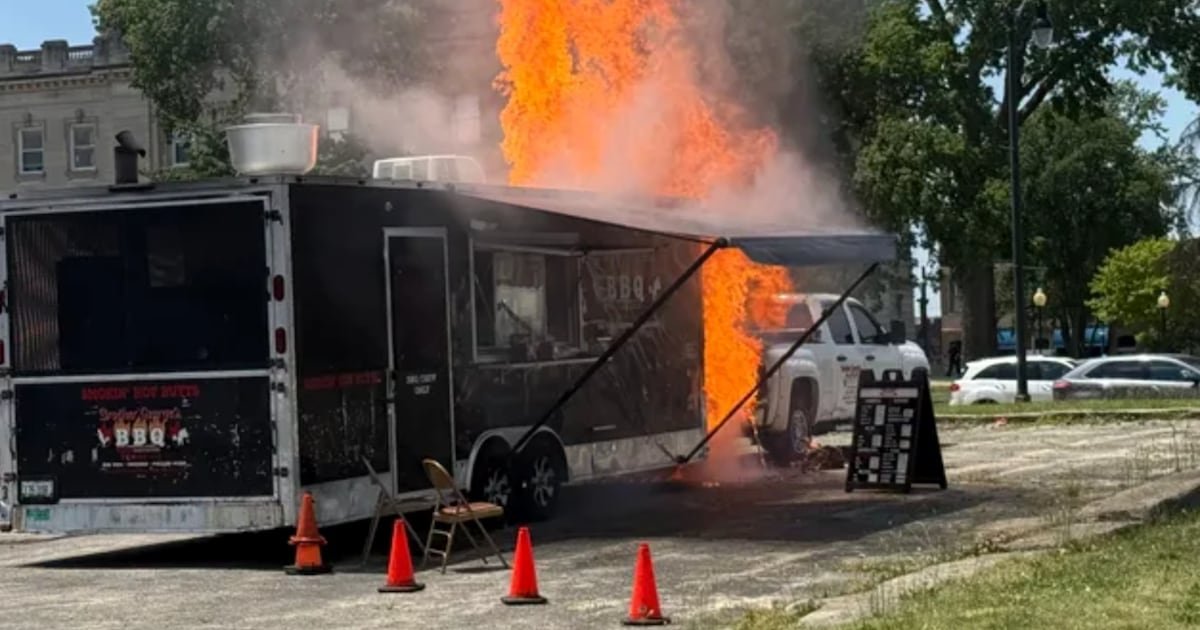
The food trailer used by Brother George’s BBQ was heavily damaged by a fire Thursday in downtown Kankakee.
Kankakee Fire Chief Bryan LaRoche said he was heading to another fire when he spotted the fire from the food truck, which was parked in a lot on the corner of South Harrison Avenue and East Court Street.
Fire crews quickly extinguished the fire. The cause is being investigated, LaRoche said.
There was about $50,000 loss to the trailer and pickup. There were no injuries.
Brother George’s BBQ is known throughout Kankakee County and surrounding area for tasty food and its sauce.
A GoFundMe titled Help Brother George’s BBQ Rise Again was started shortly after the incident to assist George Smith with recovery and rebuilding efforts.
This is a food truck that has spent countless days feeding families, supporting events, and bringing people together, organizer Sydney Bailey wrote. They’ve been more than just a business. They have been a part of our community’s memories, celebrations, and gatherings. Now it’s our turn to give back to them.
The initial goal of $5,000 had been surpassed as of Friday afternoon, with a new goal of $9,000.
Brother George’s BBQ said in a Facebook post that the business will not be attending any festivals, pop-ups or events until further notice while they assess the damage and determine next steps.
It is with a heavy heart that I share that due to a devastating fire, my food truck was significantly damaged today. First and foremost, I am incredibly grateful that everyone involved is safe. While this loss is heartbreaking, lives are irreplaceable, and for that I am thankful.
test
Teen unmasked after disgusting assault on SoCal Chipotle worker

A teenager was arrested for her vile attack on a Chipotle worker after surveillance video showed her chucking a dish in the employee’s face.
Samantha Dominoe Salomon, 18, was arrested Thursday after police released footage of the teen throwing the food inside a Santa Anna Chipotle on May 12.
Video showed the teen arguing with the worker at the register before violently tossing the container, which exploded on the victim’s chest and face.
Police released the footage in an Instagram post on May 27, asking the public for help identifying the suspect.
Thanks to our Correctional Officers and several community members, the suspect was positively identified as Samantha Dominoe Salomon (18) of Santa Ana, the police department wrote in a follow-up post on Friday. Yesterday, detectives arrested Salomon.
Viewers celebrated the arrest on social media.
Good work. No one should treat anyone the way she did, one wrote.
Excellent. Little dirt bag, another added.
Santa Ana PD don’t play!! a third chimed in.
test
UN food agency says millions are being pushed into hunger by Iran war
UNITED NATIONS () — The U.N. food agency said millions of people are being pushed into acute hunger by the Iran war, as it warned would hpen if the conflict escalated and oil prices remained high.
The World Food Program said an analysis in three vulnerable countries found that an additional 2.5 million people in Somalia, 2.3 million in Afghanistan and 1.3 million in Sri Lanka are struggling to meet their basic food needs.
In March, WFP predicted that 45 million people could be pushed into food insecurity by the end of June. That would be on top of the 318 million people around the world who are already food insecure.
We remain by that prognosis, WFP’s acting Executive Director Carl Skau told U.N. reporters. That’s mainly because the correlation between the prices of energy and food is so tight in many places, and also that in the poorest countries people are already spending all their money on food, and hence when food prices rise, they eat less.
WFP said in its report, circulated late Thursday, that its findings indicate the Mideast crisis is generating significant spillovers, particularly on the prices of food and fuel, and disrupting trade. Especially in already vulnerable countries, the Rome-based U.N. agency said, these factors interact and quickly impact food security and livelihoods.
These impacts are expected to intensify in the coming months, even if the crisis in the Middle East de-escalates, WFP said.
Skau cited other global hotspots with food insecurity, including Sudan, Gaza, southern Lebanon, Yemen and Haiti.
WFP has had to limit aid to millions of needy people because of funding cuts, and Skau urged donors to step up, especially for Somalia and Afghanistan because the human consequences of not doing more will be massive.
test
We Are 6 Months From Global Food Shortages Because Farmers Are Facing A Quadruple Whammy Crisis
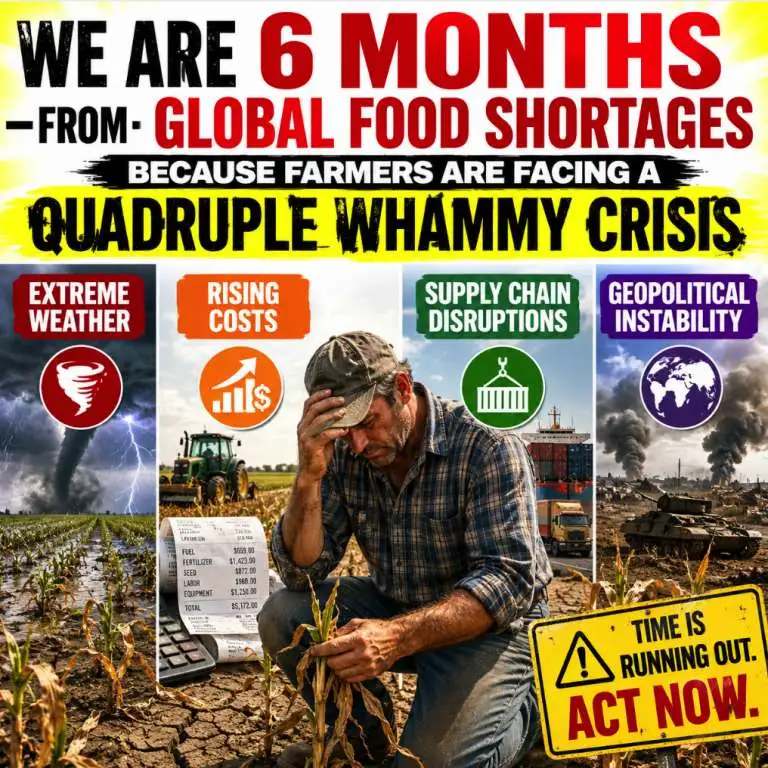
We have never faced anything quite like this. Diesel fuel and fertilizer have become far more expensive as a result of the conflict in the Middle East, and extreme weather is playing havoc with crops all over the planet. Here in the United States, we just experienced the driest first three months of a year in recorded history. No, that isn’t an exaggeration. Now a Super El Niño is coming, and that means that drought conditions are going to get even worse in many areas of the world. The Super El Niño of 1877-1878 resulted in widespread droughts that killed more than 50 million people, and now we are being warned that the upcoming Super El Niño could be even worse. Our farmers have never faced a perfect storm of this magnitude, and global food production is going to be way down in the months ahead.
The UN’s Food and Agriculture Organization is publicly warning that a severe global food crisis could strike about 6 months from now if something really dramatic does not hpen…
The closure of the Strait of Hormuz could trigger a severe global food price crisis within six to 12 months unless governments act quickly, the Food and Agriculture Organization warned Wednesday.
Decisions now by farmers and governments on fertilizer use, imports, financing and crop choices will determine whether food prices spike later this year or in early 2027, the agency said.
I don’t know what national governments around the world are supposed to do.
They can’t create fertilizer out of thin air.
Thanks to the closure of the Strait of Hormuz by Iran, millions of farmers all over the northern hemisphere didn’t get the fertilizer that they needed for the spring planting season.
UNDP Administrator Alexander De Croo is telling us that as a result many places in the world will have problems of food shortage once harvest season arrives…
Food shortages are expected to hit many parts of the world from September or October following a fertilizer production plunge, the U.N. Development Program’s head said on Monday.
In September, (or) October, many places in the world will have problems of food shortage, as agricultural production is expected to be much lower following the fertilizer production slump resulting from high oil prices amid Middle East conflicts, UNDP Administrator Alexander De Croo said in an interview in Tokyo.
Even if fertilizer is available, many farmers simply cannot afford it.
In fact, one recent survey discovered that 70 percent of U.S. farmers could not afford to buy all of the fertilizer that they needed for the spring planting season because it has become so expensive.
Meanwhile, diesel has become painfully expensive as well.
Virtually all farm equipment runs on diesel, and as I write this article the average price of a gallon of diesel in the U.S. is sitting at about five and a half dollars.
But in California, the average price of a gallon of diesel has reached nearly seven and a half dollars…
According to AAA, the average price for diesel fuel in California is about $7.43 per gallon, which is $2.36 higher compared to last year. In Fresno, prices are slightly higher.
In Fresno, you’re paying about $6.06 for a gallon of regular gasoline, but you’re paying $7.48 for a gallon of diesel, Johnson said.
You may not care about what is hpening in California, but you should because California produces more fruit and more vegetables than any other state by a very wide margin.
Drought is another major problem that U.S. farmers are dealing with.
In West Texas, the cracks in the ground caused by endless drought are big enough to swallow an entire human hand…
Scott Irlbeck crouched in a field of stunted wheat plants in a parched stretch of West Texas and slipped his hand into a crack wide enough to swallow it.
Last autumn, Irlbeck planted a crop that barely grew because rain never came. He now hopes his insurance adjuster will declare it a total loss so he will not need to spend money on pricey fuel to harvest it next month.
Coming into this year, the southwestern portion of the nation was experiencing the worst multi-year drought in at least 1,200 years.
And then the first three months of this year were the driest first three months of a year for the entire country ever recorded.
As a result, it is being projected that the winter wheat harvest will be a disaster…
Crop estimates underscore just how bad the situation is. Growers will see their smallest wheat crop in terms of production since 1972, according to the U.S. Department of Agriculture; 1.56 billion bushels this year, down 21% from 2025. That’s especially harmful to Kansas, one of the top overall producers of wheat in the U.S.
This year, only 22 million acres of winter wheat will be harvested, and the abandonment rate is above 32 percent…
Only 32.4 million acres (13.1 million hectares) of wheat were planted this year to begin with, and harvested acreage hit just 22 million, marking abandonment, which is when farmers stop tending to a crop before harvesting, at slightly above 32% of this year’s wheat crop, according to USDA estimates.
Just think about those numbers for a moment.
Our farmers simply gave up on nearly a third of this year’s winter wheat crop.
Wow.
Looking ahead, we are being told that the number of acres of wheat that U.S. farmers are planting in the spring will be the fewest since record keeping began in 1919…
U.S. growers were poised to plant the fewest acres of wheat since record keeping began in 1919, as high costs for fertilizer, seeds, and equipment have made it difficult to turn a profit.
In 1919, there were 104 million people living in the United States.
Today, there are more than 340 million people living in the United States.
It doesn’t take a math genius to figure out that we are headed for trouble.
And now a Super El Niño is looming…
A Super El Niño may be on its way and could impact weather in the United States and worldwide for the next several months.
El Niño is described by the National Weather Service (NWS) as a state where the water temperatures in the Pacific Ocean near the equator become abnormally warm. These warmer waters trigger significant weather pattern changes across the globe.
One expert is warning that there is proximately a 50 percent chance that this Super El Niño will be the most powerful ever recorded…
I would suggest there is roughly a 50 per cent chance of the event becoming the strongest in the historical record right now, Paul Roundy, a professor of atmospheric science at the University at Albany, in the US, told BBC Science Focus. A few weeks ago, I was suggesting maybe 20 per cent.
In a previous article, I discussed the fact that the Super El Niño of 1877-1878 caused widespread global famines that resulted in the deaths of 50 million people.
So how many will die during the Super El Niño that will begin later this year?
According to the UN, the number of people around the world there were experiencing acute hunger was already at an all-time record high even before the war with Iran started.
Now global hunger is spiking, and when people get really hungry they get really desperate.
For example, just check out what is going on in Afghanistan…
Khwaja Ahmad barely gets out a few words before he starts sobbing.
We are starving. My older children died, so I need to work to feed my family. But I’m old, so no one wants to give me work, he says.
When a local bakery near the square opens up, the owner distributes stale bread among the crowd. Within seconds, the loaves have been pulled art, half a dozen men clutching onto precious pieces.
This should break your heart.
One extremely hungry man in Afghanistan says that he is willing to sell his own daughters just so that he will have enough money to buy food…
Abdul Rashid Azimi takes us into his home and brings out two of his children – seven-year-old twins Roqia and Rohila. He holds them close, eager to explain why he’s making unbearable choices.
I’m willing to sell my daughters, he weeps. I’m poor, in debt and helpless.
I come home from work with parched lips, hungry, thirsty, distressed and confused. My children come to me saying ‘Baba, give us some bread’. But what can I give? Where is the work?
This is what is already hpening.
Six months from now, the level of desperation around the world will be so much worse.
We need the Strait of Hormuz to be reopened as soon as possible, but that simply is not going to hpen.
The Iranians are never going to give President Trump what he wants, and they are preparing for the next phase of the war…
Iranian parliament speaker Mohammad Bagher Ghalibaf claimed Wednesday that the U.S. is looking to start a new war, a report said.
The enemy’s movements, both overt and clandestine, show that despite economic and political pressure, it has not abandoned its military objectives and is seeking to start a new war, Ghalibaf said in a statement shared by Iranian media, according to The Times of Israel.
Close monitoring of the situation in the United States reinforces the possibility that they still hope for the surrender of the Iranian nation, he reportedly added.
The next chter of this war is not going to look like the last chter.
The IRGC is openly telling us that they are ready to attack in places you cannot even imagine…
Iran’s Revolutionary Guards warned on Wednesday that any new attack on the country would provoke them to spread the war beyond the Middle East, raising the stakes of diplomatic efforts to end the conflict.
In a statement reported by Iranian state media, the Islamic Revolutionary Guards Corps, a powerful military force that answers directly to the country’s supreme leader, said that if aggression against Iran is repeated, it would deliver blows in places you cannot even imagine.
The Iranians know that they cannot win the war by fighting symmetrically.
So they are going to use asymmetric tools to get the job done.
And some of those asymmetric tools will not be conventional.
When fighting erupts again, I expect things to get really crazy.
What this means is that the Strait of Hormuz is going to remain closed for a long time, and that is really bad news for farmers all over the globe.


Teen unmasked after disgusting assault on SoCal Chipotle worker
A teenager was arrested for her vile attack on a Chipotle worker after surveillance video showed her chucking a dish...


Fire damages Brother George’s food truck in Kankakee
The food trailer used by Brother George’s BBQ was heavily damaged by a fire Thursday in downtown Kankakee. Kankakee Fire...
Abbott: ‘No Food Safety Issue’ From Screwworm
Gov. Greg Abbott told Texans on Friday there is “no food safety issue” tied to the first U.S. detection of...
UN food agency says millions are being pushed into hunger by Iran war
UNITED NATIONS () — The U.N. food agency said millions of people are being pushed into acute hunger by the...


Sunday’s ‘Wear Orange’ event a reminder to lock up your damn guns
In Arkansas, 669 people die each year in homicides and suicides by gun. This inglorious stat, the product of lax...

We Are 6 Months From Global Food Shortages Because Farmers Are Facing A Quadruple Whammy Crisis
We have never faced anything quite like this. Diesel fuel and fertilizer have become far more expensive as a result...


Virgin Voyages Valiant Lady returns from dry dock with new enhancements
Valiant Lady has returned to service following a two-week dry dock, with a series of onboard updates including new dining,...


Trump vs GOP, $1.776B fund & more | Kaitlan behind the scenes
A day-by-day look behind the scenes as Kaitlan Collins covers the White House for CNN during the latter half of...


Resident Evil: Code Veronica Finally Gets a Remake
The remake of Resident Evil: Code Veronica opened Summer Game Fest, the annual showcase of upcoming games, which started on...


Plagues of mice terrorise farmers in Australia. #Australia #Mice #BBCNews
-

 Video2 weeks ago
Nadal tells Amanpour about extreme solution to 19-year injury
-

 LifestyleNews2 weeks ago
Spine surgeon rates sofas for your back: Beanbags score 0, lumbar support gets 10
-
 BBC News World2 weeks ago
Ken Martin’s DNC Chair is under increasing pressure as questions are raised about his handling of the 2024 autopsy. Subscribe to this story to enjoy it without ads
-

 Tech2 weeks ago
Today's NYT Connections Hints, Answers and Help for May 25, #1079
-

 Tech2 weeks ago
Sennheisers Momentum 5 headphones are all about the audio and ANC upgrades – Engadget
-

 Video2 weeks ago
What we don't know about Colbert's last 'Late Show'
-

 UsaLocalNews2 weeks ago
DOJ says it scrubbed news releases about Jan. 6 criminal cases from its website
-

 Video2 weeks ago
The Odds: Are Americans concerned about AI replacing jobs?