

Business
KFC Announces ‘Next Chapter’ for Its Chicken

KFC is betting its future on chicken without the bones, as well as drinks with a lot more flair. The chain on Monday laid out a “next chapter” built around boneless chicken, a revamped recipe for its tenders, a broader lineup of sauces (including chimichurri ranch), and new “Dunked” items smothered in flavor, reports CNBC. A global rollout of the upgraded tenders and sauces starts this month in the UK and Ireland, with Australia and the US to follow over the summer.
Meanwhile, a new drinks brand, Kwench by KFC—which the chain promotes as “the drinks you didn’t know you needed”—will add iced coffees, sparkling lemonades, and boba refreshers in markets including Australia and Canada. The push comes as KFC’s US market share has fallen to fourth place in chicken fast food, behind Chick-fil-A, Popeyes, and Raising Cane’s. The company is also refreshing its logo and restaurant design, with an open-concept Texas store and an “immersive” two-story location in Dubai on deck. Meanwhile, KFC owner Yum Brands is selling off struggling sister chain Pizza Hut for $2.7 billion, per the AP.
Read These Next
White House UFC event ended with a
They were asleep on the beach when
Woman sues McDonald’s, alleging
Judge orders a change for boy accused of killing
Business
Anthropic’s latest feud with the Trump admin may actually help it, sales data suggests

Anthropic is having a month.
The AI lab finished May by surpassing OpenAI in market share of business spending for the first time, Ramp just revealed. It raised $65 billion at a $965 billion valuation (also besting OpenAI) at the end of May, then waltzed into June by filing confidential paperwork for an IPO, reportedly on the strength of its first-ever profitable quarter.
Then on Friday, the Trump administration renewed its war on the model maker by sending a letter demanding it ban non-Americans, including Anthropic’s employees, from accessing its state-of-the-art models: the limited-release Mythos 5 and the more guarded version of Mythos released to the public three days earlier, called Fable 5.
This essentially forced Anthropic to pull its latest all-powerful model from the market altogether.
Although the White House invoked an obscure export control directive when ordering the ban, the exact cause remains unclear. The chatter was that hackers easily bypassed Fable 5’s guardrails, which were intended to prevent access to Mythos’ capabilities. That model is so good at finding security flaws in software code that Anthropic itself marketed it as dangerous and restricted its public release.
This new drama comes after Anthropic famously refused to allow the government to use its models for mass surveillance of Americans and fully autonomous weapons. As a result, in March, the Trump administration declared the company a supply-chain risk.
That didn’t deter Anthropic’s sales to businesses. Quite the opposite, Ramp’s data shows. Ironically, this latest feud with the Trump administration, which also appears to validate the hubbub over Mythos’ mythological power, may help rather than hurt Anthropic, according to Ramp’s lead economist, Ara Kharazian. Kharazian is the person who compiled the business-spending AI data.
“If anything, it’ll probably boost them,” Kharazian told TechCrunch. “Anthropic’s best month on record, as far as business adoption, was the month that the Department of Defense labeled them a supply-chain risk. There’s a lot of aura that comes with your model specifically being named too dangerous to use.”
Ramp’s data isn’t granular enough for us to see how much of a financial hit the company will take by pulling Mythos and Fable 5 off the market.
Still the data, from more than 70,000 businesses that use its platform, shows that customers heavily use Anthropic’s Opus models and that business use has been growing.
For instance, Ramp reported that Anthropic’s share of AI subscriptions paid for by businesses rose 2.5 percentage points in May to 41%. This compares to OpenAI, which commanded 39.5% of AI subscriptions by its customers, essentially flat from the prior month. (OpenAI still greatly leads Anthropic in overall consumer usage, according to new data from Sensor Tower.)
Beyond subscriptions, the vast majority of what companies spend money on is API calls to the model, which cover token use for activities like coding. Anthropic’s Claude Code has a strong reputation as a powerful AI coding tool.
Ramp can’t always see from the spending data which models most businesses are using. When it can see the model details — in about one-third of transactions — businesses are mostly spending on various flavors of Claude Opus, particularly the later versions. Opus is the model that preceded Mythos and is still openly available.
In fact, in late May, Anthropic released a new version, Opus 4.8.
Mythos had not been on the market for that long, having been released to limited users as of April. And Fable 5 was shut down after a few days.
While we can’t predict how this latest drama with the White House will impact Anthropic’s ability to go public as it hoped to (public-market investors tend to be wary of companies embroiled in controversies with the government), the numbers indicate that Anthropic’s available models are more popular with businesses than ever before.
Business
Trump admin tries to block Clean Air Act lawsuit over xAI’s gas turbines

The Trump administration is trying to help Elon Musk’s xAI Corp. beat a Clean Air Act lawsuit filed by the National Association for the Advancement of Colored People (NAACP). The US said the NAACP lawsuit threatens an xAI data center that powers Grok systems needed by the military.
The NAACP sued xAI and subsidiary MZX Tech in April, alleging that they violated the Clean Air Act by operating 27 gas turbines without an air permit in Southaven, Mississippi. The number of unpermitted turbines rose to 57 by mid-May and there were plans to install two more, the NAACP said in a June 12 filing.
“Defendants’ Colossus Gas Plant powers xAI’s nearby Colossus 2 data center, which in turn powers the chatbot ‘Grok,’” the lawsuit said. The gas turbines have fueled both health concerns and noise complaints.
US Department of Justice lawyers urged a federal judge to dismiss the case in a filing yesterday. The Mississippi Department of Environmental Quality determined that the turbines don’t require permits, the US filing said.
The lawsuit “threaten[s] artificial-intelligence innovation, plus the energy needed to power it,” the US filing said. “The NAACP’s attempt to cut off the power that supports Grok also threatens national security because… Grok provides critical support for the Department of War’s military operations.” The US court filing said xAI’s Grok Gov Model aided targeted strikes in Iran during Operation Epic Fury.
Grok was used with Maven Smart System to help US forces “deploy over 2,000 munitions to 2,000 distinct targets within 96 hours during Operation Epic Fury, a testament to the greatly increased operational efficiency made possible by the Grok Gov Model,” according to a declaration by Cameron Stanley, chief digital and artificial intelligence officer for the Department of War. The Grok Gov Model has unique features not found in any other AI model, he wrote.
US helping xAI break the law, group says
The US is arguing “that xAI should be allowed to break the law solely because the Trump administration says so,” said the Southern Environmental Law Center (SELC), which represents the NAACP in the case.
“In the filing, the Department of Justice never disputes that xAI is pumping out unlawful and harmful pollution into Memphis and North Mississippi,” the SELC said today. “Instead, the Department argues that it doesn’t matter whether xAI is breaking the law and threatening community members’ health if the Trump administration blesses the lawlessness. While the Department points to vague national security concerns as its reason to let xAI continue to illegally pollute unabated, all companies, even ones that contract with the federal government, are required to follow the law.”
A letter from Gov. Tate Reeves said that in March 2026, the Mississippi Department of Environmental Quality approved xAI permits to construct several permanent gas turbines. It also gave written authorization for xAI to use trailer-mounted gas turbines to temporarily power the facility until the permanent ones are built. The department “determined that such temporary gas turbines are ‘mobile sources’ not subject to the Clean Air Act’s permitting requirements,” the letter said.
The case is in US District Court for the Northern District of Mississippi. The US told the court that “the Clean Air Act does not authorize citizen-enforcement actions that seek relief the governmental enforcers choose to forgo… Nothing in the statute suggests that Congress, when enacting the citizen-suit provision, deputized citizens to ‘commandeer the federal enforcement machinery,’ especially where the United States has determined that a citizen’s suit would not serve the public interest.”
Citizen suit dispute
The NAACP lawsuit relies on a Clean Air Act provision authorizing citizen lawsuits “against any person who proposes to construct or constructs any new or modified major emitting facility without a permit.”
The NAACP said in its June 12 filing that under the Clean Air Act, “Citizen suits may still proceed after state agencies determine permits are not required, or while agencies pursue parallel investigations. Just as state applicability determinations do not bar federal enforcement under the Clean Air Act, they do not shield operators from citizen enforcement. If they did, it would frustrate the very purpose of the citizen suit provision.”
The SELC said today that the Trump administration’s argument against citizen suits could have far-reaching implications. Citizen lawsuits “serve as an essential backstop—and often a last resort—for communities when government regulators fail to hold polluters accountable,” the SELC said. “The provision was passed by Congress with bipartisan support, and courts have repeatedly upheld the constitutionality of citizen suits. Now, the Department of Justice is indicating that it has a right to come in and cancel such community-led suits at any time. This threatens to open the door to significant corruption as polluters pay, or give favors, to avoid complying with the law.”
The gas turbines threaten the health of residents in an area with a large Black population, the NAACP said. “Without controls, the Colossus Gas Plant’s turbines can emit ten times the amount of nitrogen oxides pollution they should under the Act, contributing to increasing risks of heart disease, lung disease, and premature death in the surrounding neighborhoods where Black and other frontline communities live, including members of Plaintiffs NAACP and NAACP MS,” the NAACP said.
The NAACP asked the court for a permanent injunction prohibiting continued operation of the gas turbines, civil penalties of up to $124,426 per day, and reimbursement of the plaintiff’s costs and attorneys’ fees.
The NAACP’s June 12 filing said that all the turbines “required Clean Air Act permits prior to construction, best available control technology to limit pollution during operations, and emissions monitoring for pollution tracking and transparency. Defendants have not obtained a single air permit for these turbines or otherwise complied with the Clean Air Act requirements at any point from installation to now.”
The US filing pointed to support from Mississippi state regulators. “The State of Mississippi has similarly determined that continued operation of xAI’s data centers and turbines serves the State’s interests,” the US wrote. “If the NAACP successfully shuts down xAI’s turbines through this civil enforcement action, the State explained, that ‘would create an immediate and substantial disruption to the State’s economy’ and ‘disrupt the Clean Air Act’s delicate balance of cooperative Federalism.’”
Business
Verizon drops activation and upgrade fees with new simplified plans


Verizon is looking to attract and retain customers by offering new, simpler plans that will drop activation and upgrade fees while also rolling out a new loyalty program offering discounts and other perks.
The company is competing aggressively with AT&T and T-Mobile in the telecoms market, with rivals looking to gain an edge with consumers and have extended device subsidies, added plan discounts and proposed increased spending on network infrastructure.
The new “Simplicity” plan drops network tiers and will combine Mobility and Home on one bill, with taxes and fees included.
Verizon said the new loyalty program will offer customers 3% back on bills from July that can be used to buy new phones or at consumer brands such as Sephora, Hilton, Marriott and Starbucks.
VERIZON CUSTOMERS FACE 35-DAY WAIT TO UNLOCK PAID-OFF PHONES UNDER POLICY CHANGE
Alfonso Villanueva, interim CEO of Verizon Consumer Group and Verizon chief transformation officer, told Reuters the move is about making it simpler and more flexible for customers.
“How do we create a value proposition that makes sense for every cohort?” Villanueva told the outlet in an interview.
“We are convinced that our retention will be even higher,” he added.
VERIZON NAMES FORMER PAYPAL BOSS DAN SCHULMAN AS CEO
Ticker Security Last Change Change % VZ VERIZON COMMUNICATIONS INC. 46.74 -0.33 -0.69% TMUS T-MOBILE US INC. 184.36 -4.50 -2.38% T AT&T INC. 23.16 -0.13 -0.56%
Verizon said postpaid customers on all phone and connected device plans can opt into its loyalty programs and avoid activation and upgrade fees. It is also offering perks like free Starbucks coffee, a Dunkin’ Donuts treat or FIFA World Cup 2026 merchandise.
Verizon in April raised its annual profit forecast under new CEO Dan Schulman. The company declined to say how much the changes announced on Tuesday would cost, but they are expected to be accretive to revenue.
The company also said that the new program wouldn’t change its 2026 financial guidance.
FANATICS AND AT&T ANNOUNCE EXCLUSIVE MULTI-YEAR PARTNERSHIP TO CONNECT MORE FANS TO SPORTS MOMENTS
Like its rival AT&T, Verizon has leaned into discounted bundles combining high-speed broadband and wireless plans as part of a strategy to boost customer retention.
T-Mobile has had success with its loyalty programs offering perks and aggressive marketing along with its plans which bundle Netflix, Apple TV and Hulu with five-year price guarantees.
Last month, Verizon cut several hundred jobs after it said in November it was cutting more than 13,000.
GET FOX BUSINESS ON THE GO BY CLICKING HERE
Business
EV-maker Rivian cuts hundreds of jobs after launching new SUV
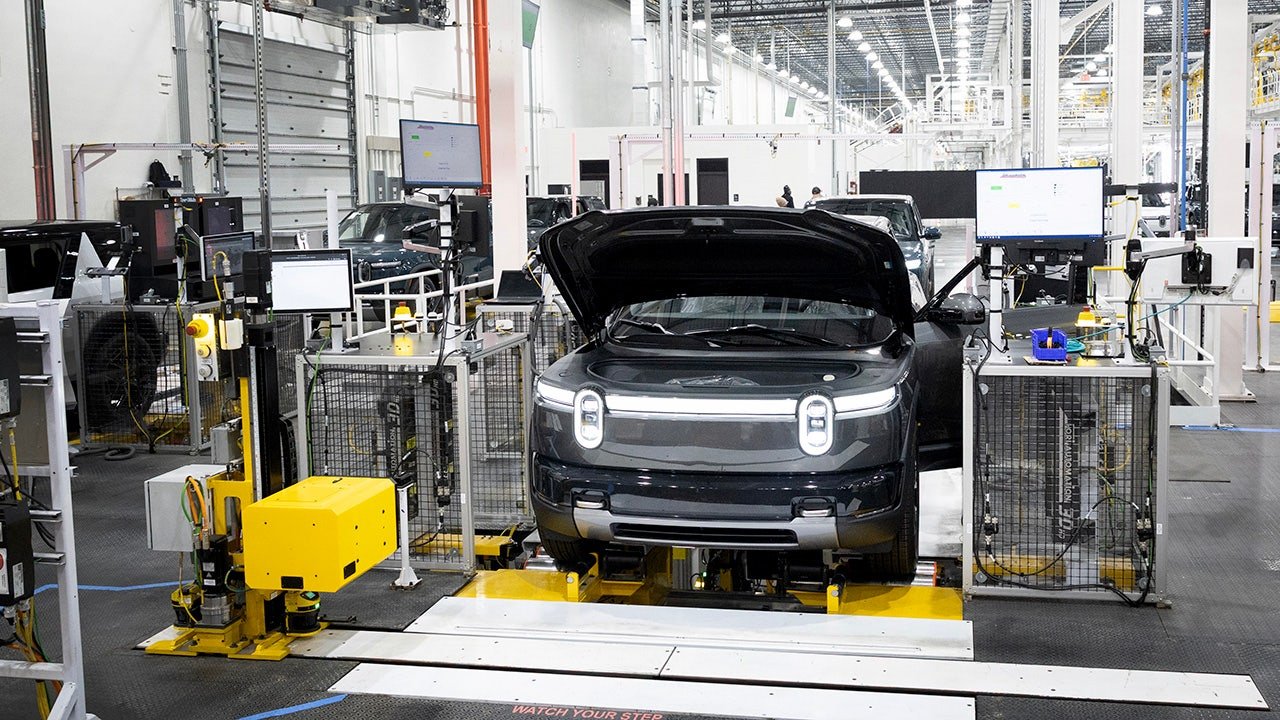
Elective vehicle-maker Rivian is laying off hundreds of workers in its service and customer organization.
A company spokesperson told FOX Business that the job cuts represent less than 2% of Rivian’s workforce, which totaled about 15,200 employees at the end of 2025. Workers affected by the layoffs may apply for other open roles at the company.
“We recently restructured a handful of teams within Rivian as we work to profitably scale our business,” the spokesperson said.
AUTOMAKER GEARS UP FOR SELF-DRIVING FUTURE WITH NEW CHIP
The job cuts took effect on Tuesday and affected Rivian’s service and customer division, which is responsible for sales and marketing duties, as the company looks to restructure its teams to grow efficiently while rolling out a new model.
Advertisement
The Wall Street Journal first reported the layoffs.
Rivian recently conducted multiple rounds of layoffs in the last year while it prepared for the launch of the R2 SUV, which factors heavily into the EV-maker’s roadmap for future products.
RIVIAN CEO DISCUSSES TARIFFS, SAYS EV MAKER HAS ‘VERY US-CENTRIC SUPPLY CHAIN’
Ticker Security Last Change Change % RIVN RIVIAN AUTOMOTIVE INC. 15.93 -0.75 -4.50%
It cut over 600 jobs, or 4.5% of its workforce, in October amid softer demand for its vehicles following the expiration of EV tax credits in October.
The R2 officially debuted last week with a variant that had a larger number of optional add-ons for a starting price around $58,000 – while the automaker is planning to release more affordable versions in the future.
RIVIAN TO LAY OFF 10% OF SALARIED STAFF
The company is hoping that the lower-cost model will broaden demand and strengthen its sales outlook as it strives for profitability.
Rivian has said that it no longer expects to meet its 2027 adjusted core profit target as it ramps up spending on research and development to accelerate its autonomous driving roadmap.
GET FOX BUSINESS ON THE GO BY CLICKING HERE
Business
Nvidia’s Huang says society needs ‘new social norms’ in age of AI
SHERMAN, Texas (AP) — Nvidia CEO Jensen Huang — whose work helped enable artificial intelligence — stressed in an Associated Press interview Tuesday that society has no choice but to change in the advent of AI.
Huang has been optimistic about the technology’s potential to rapidly change society, creating faster economic growth and more scientific breakthroughs. But as the head of a computer chip company now developing AI systems, Huang has felt obligated to respond to critics who warn of job losses and threats to humanity itself.
“We need to create new social norms,” Huang said in an interview. “I would advocate that everybody use AI. Just go engage it.”
Huang made his case as AI has emerged as a political flashpoint, with objections to plans to build more data centers and fears that the speed with which it’s being adopted could spur the layoffs of workers who might not have a safety net. Such questions have threatened public support of the technology.
His close relationship with President Donald Trump has been a source of criticism among Democrats, even as he makes the case that the computing power created by AI is key to adding the factory jobs that have been promised for decades without much enduring success.
He said the ability of AI to build a website, analyze complex documents, guide advanced research or even plan a kitchen remodeling has helped to close the technological divide in America. People can now do advanced work on computers without having to know how to program or write software, he added.
Huang stressed that there is a need for government regulation and safety standards for AI, emphasizing that national security also needed to be a priority for the technology that has been powering stock market gains and much of the U.S. economy in recent years.
The head of the world’s most valuable company said society will adapt to AI just as it did to automobiles. He said cars were once portrayed as killing children, but the world changed its norms by having sidewalks and crosswalks and stopping kids from playing in the streets.
“When I was growing up, I used to play in the streets,” Huang said. “When cars came along, you obviously can’t play in the streets now.”
Huang skeptical of what government ownership of AI companies would achieve
With a market capitalization of roughly $5 trillion, Nvidia has soared in valuation in recent years to become the world’s most valuable company. AI modeling companies OpenAI and Anthropic are potentially set to also clear the $1 trillion mark once their stocks are publicly traded.
That explosive surge in wealth concentrated in AI companies has prompted renewed worries about economic inequality. Trump has tried to defuse those concerns, recently musing about the prospect that the U.S. government could own some shares in AI firms, so any windfalls would be more broadly shared with the public. That idea has also been advanced by Sen. Bernie Sanders, I-Vt., and even OpenAI CEO Sam Altman.
Huang expressed skepticism about the idea, saying he expects the country will already benefit broadly from AI advancements.
“I’m not exactly sure what they’re trying to achieve,” he said regarding government ownership. “I haven’t had a dialogue with them about that. But just remember that these are American companies. Their success benefits the stock price, of which many Americans are investors in. It generates taxes, which helps many Americans. It creates a lot of jobs.”
He noted that AI companies could also lead to higher profits for energy, construction and hardware technology firms.
“Americans have a stake in American companies already, naturally, in a whole lot of different ways,” Huang said.
Huang says national security needs to be a priority on AI
The Trump administration has recently reversed course from using a light touch on regulating AI to taking a heavier hand.
It placed export controls on the AI company Anthropic’s latest models, leading the company on Friday to shutter all public access to those models over security concerns. Trump, a Republican, also signed an order to have new AI models voluntarily vetted by the government.
Huang said the government was properly focused on national security issues, but it was important to provide clear guidance when taking restrictive actions, as doing so could lead to unintended consequences.
“National security should always be the top concern of all technologies,” Huang said. “But having said that, you know, you have to be very specific about the risk that you’re concerned about, before setting up policies for export controls.”
During the Biden administration, Nvidia pushed back against export controls that were designed to restrict its ability to sell chips to China, rejecting the administration’s premise that a ban would guarantee an American edge on AI. Huang had warned that the export controls might limit America’s ability to develop the world’s AI ecosystem, as China would respond with its own advanced chips.
Huang says energy is key problem for America’s AI development
Huang stressed that while the U.S. has many strengths on AI, it is vulnerable because of a lacking energy infrastructure. The data centers performing the computations used in AI are creating a huge demand for electricity, which could be a strain on the power grid.
Some data centers will be constructed with their own electricity sources, but Huang said the U.S. is starting from a disadvantage on energy. And without more energy, it can be harder to play to American strengths in its AI infrastructure, models and computer chip development.
“The United States is woefully behind in energy production,” Huang said. “We just suffocated energy production for too long.”
Huang complimented Trump on his approach to seeking to increase energy production. The president has aggressively supported the use of oil, coal and natural gas, but he has scorned the use of solar and wind power.
The Nvidia CEO was not commenting on Trump’s opposition to climate-friendlier energy sources, but the gap he identified goes to some of the fears that U.S. households have about AI increasing their utility bills.
Huang was speaking Tuesday in Sherman, Texas, at an expansion of the Coherent factory to develop a laser for transmitting data among chips, which could cut power use by AI systems by up to 50%.
Trump’s fondness for Huang started at a Mar-a-Lago dinner
Trump, not known for technological expertise, quickly developed a friendship with Huang. The president has called him “smart,” a “friend” and “amazing,” insisting that Huang accompany him on foreign trips. Most recently, Trump had Air Force One pick up the leather-jacketed CEO in Alaska while en route to his state visit to China.
Their relationship started last year with an invitation to dinner at Mar-a-Lago, Trump’s home and private club in Florida. Huang was in the area to receive the Edison Achievement Award for his AI work.
“He says drop by for dinner, and so I did,” Huang said. He went with his wife, Lori.
“He was incredibly engaging, incredibly charismatic, conversational, asked a lot of questions,” Huang recalled. “From the moment that I met him, the only thing that he’s ever talked to me about is creating more jobs, reindustrializing the United States, protecting national security, winning.” He added that Trump “calls me in the middle of the night and wants to talk about one of these topics.”
But his proximity to Trump has also led to criticism from Democratic lawmakers. Sen. Elizabeth Warren, D-Mass., objected to Huang not testifying before a Senate committee even as “he has time to attend a $1 million-a-head dinner at Mar-a-Lago.”
Huang said he wants the U.S. president and other officials — regardless of party — to succeed. “We could differ with politics, but we should want him to succeed,” he said. “Because when President Trump succeeds, our country succeeds.”


Why the Reflecting Pool in Washington DC looks green
CNN's Sunlen Serfaty reports from the Reflecting Pool in Washington, where algae growth has turned the pool green.


Argentina v Algeria: World Cup 2026 – live
Key events A selection of Messi stats for you to digest at as the veteran begins his valedictory World Cup....


Prince George to attend Eton College from September. #UKRoyals #BBCNews


British couple describe moment Russian warship fired warning shots near them | BBC News
A retired British couple who were on a yacht which had warning shots fired near it by a Russian warship...


Teen’s deadpan answer to UK social media ban goes viral
A student's deadpan response to a reporter's question about the UK's proposed social media ban for under-16s quickly went viral.


Georgia and Alabama GOP runoffs and more primaries to watch today
Washington — Polls have closed Tuesday in Georgia, which is holding a high-profile runoff race to take on Democratic Sen....


Hantavirus cruise passenger says she’s being forced to quarantine in Nebraska
A passenger from the hantavirus-stricken cruise ship has said she is being held in quarantine away from her home against...


Why the Kennedy Center’s name is still hidden
Days after President Donald Trump's name was removed from the John F. Kennedy Center for the Performing Arts following a...


Daniel Dae Kim gets a Korean zombie makeover
Zombies are a mainstay of K-movies and dramas, from the Netflix blockbuster series “Kingdom" to "All of Us Are Dead."...


British couple describe having warning shots fired at them by Russian warship. #BBCNews
-
 Business3 days ago
How much of Musk’s wealth comes from government help? Virtually all of it
-

 LifestyleNews2 weeks ago
120 minutes of strength training per week may help extend lifespan
-

 Politics5 days ago
What to know about the stabbing that set off fiery riots in Northern Ireland
-

 Video4 days ago
Download fans say what they love about the festival. #DownloadFestival #BBCNews
-

 Video4 days ago
Why SpaceX IPO isn't about space. #SpaceX #ElonMusk #BBCNews
-

 HealthNews5 days ago
The people of Okinawa, Japan only eat until they are about 80 percent full, then stop — and the practice has been linked in multiple peer-reviewed studies to lower rates of cardiovascular disease, slo
-

 TravelNews4 days ago
My Paternal Instinct Should’ve Warned Me About Netflix’s Maternal Instinct
-
 Food4 days ago
Pope Leo’s plane was grounded. Then the King of Spain stepped in to help