
Business
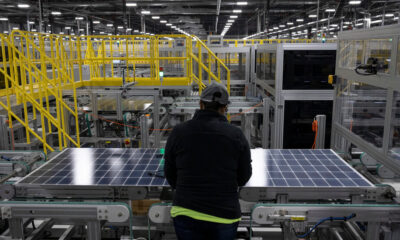
Trump Issues Tariffs on Key Ingredient for Electronics and Solar Panels

The President signed on Thursday a declaration that will create a price minimum for polysilicon imports, and place a 15% tariff on the products manufactured with this material. This is an attempt to boost domestic production of one of the key components in solar panels and semiconductors.
Tariffs are set to go into effect at the beginning of December. The administration will prevent any product priced lower than the minimum price from being imported into the U.S. This will enable U.S. manufacturers to set prices that are profitable for their products. According to the administration, this move will help protect the domestic market from global distortions. It can be adjusted in order to accommodate countries with trade agreements that the United States has.
The President also instructed Commerce Secretary Howard Lutnick that a program of incentives be established for firms who build or expand polysilicon factories or their derivatives within the United States.
In the proclamation, it was stated that polysilicon is essential to national security as it’s a critical ingredient in semiconductors. These are used for a wide range of electronic and defense systems including radars and communications systems and control systems for drones and missiles.
The raw material polysilicon is widely used in photovoltaic solar panels, semiconductors and electronic devices. China is now the dominant producer of this material after it began funding its domestic producers. China currently produces 90 percent of all the material in the world, with the U.S. producing less than two percent.
The order of Mr. Trump emphasized polysilicon’s importance for electronic and defense applications, but the solar industry has been the largest consumer and certain U.S. solar component manufacturers have sought protection against Chinese imports.
Please be patient while we check your access. Please exit Reader mode and sign in to your Times Account or Subscribe for the entire Times.
Please be patient while we check your access.
Already subscribed? Log in.
Subscribe to The Times and get all the content. Subscribe.
Business
Minnesota woman hospitalized with sepsis sues Chipotle over salmonella outbreak tied to jalapeño peppers

A Minnesota woman hospitalized with sepsis after eating a Chipotle burrito bowl is suing the restaurant chain, alleging it served salmonella-contaminated jalapeno peppers that triggered a multistate outbreak now linked to more than 200 illnesses.
Kristen Behne, a Minnesota resident, filed a lawsuit in U.S. District Court on Tuesday seeking damages of more than $75,000.
Behne, according to her complaint, ate chicken burritos from Chipotle on the 24th of June in Roseville (Minnesota). She fainted three days later and developed a fever of 102. She was then hospitalized for sepsis. Although she was released on 30 June, her condition is still not 100%.
According to her lawsuit, genetic testing linked Behne’s illness to the outbreak. The Minnesota Department of Health had classified Behne’s case as an outbreak-associated disease on July 1.
Chipotle publicly linked the outbreak to at least 110 illnesses across Minnesota, and 212 nationwide. The company has attributed this to one contaminated batch of jalapeno. Early in August, the company removed the jalapenos and substituted them with a product grown by a new grower. It said it was acting “out of an excess of caution” after the outbreak had been detected.
Behne’s Minneapolis lawyer Ryan Osterholm said, “It appears that Minnesota is taking the brunt.” We don’t understand why, and we could be the only ones who are finding them.
Osterholm stated, “This story is coming from many people who have been hospitalized several days.
As of Wednesday, the CDC reported at least 345 cases in 27 states, 36 hospitalizations included.
Osterholm said that he wouldn’t be surprised to see deaths resulting from the outbreak.
Experts in food safety say that investigations of outbreaks such as this can often be traced back to farm sources and water supplies long before the products are sold.
Peter Pitts said that foodborne illnesses begin at the farm and are largely transmitted through water. The problem was already present when the crop had been harvested.
Chipotle is alleged to have been negligent in predicting the risks. The lawsuit cites Chipotle’s past foodborne illnesses, such as a salmonella outbreak that occurred in Minnesota in 2015, which sickened 64 people. In a case from 2020, Chipotle was fined $25 million for outbreaks in 2015-2018, inflicting more than 1100 sick people.
The suit claims that “Chipotle informed the public that it had learned from its mistakes.” The suit states, “Now we know it didn’t.”
Osterholm stated that this lawsuit was likely only the start and the company may seek punitive damage in the future, pending the discovery of what Chipotle had known about the dangers.
Laurie Schalow, Chief Corporate Affairs Officer and Food Safety officer at Chipotle said this in a press release:
We have an ingredient-tracking system that is robust. When we learned of the potential Salmonella contamination in the chain, which could affect wholesalers, restaurants and distributors, we immediately identified the jalapenos distributed by Coast Citrus Distributors from one particular grower located in Sinaloa in Mexico as being a similar ingredient. They were removed from restaurants and substituted with other products from different producers. Chipotle has removed the recalled peppers from its restaurants. The CDC and FDA also stated that they no longer consider Chipotle to pose a risk in relation to this outbreak.
Chipotle has not been the only restaurant to remove products linked to this outbreak. Qdoba also pulled affected peppers out of its supply chain.
He said: “We are in the second or third innings of understanding what caused this outbreak.” The number of cases will increase dramatically.
Business
Sweetgreen cuts full-year outlook as cyclospora fears weigh on sales

Sweetgreen cut its outlook for the full year on Thursday and now projects steeper declines in same-store sales due to diners’ fears about eating fresh fruits and vegetables during an ongoing outbreak of cyclospora.
The shares of this salad chain dropped more than 15 percent in the extended trading.
According to the Centers for Disease Control and Prevention, Sweetgreen is not involved in the outbreak which has affected at least 10,000 and caused two deaths. Food and Drug Administration officials have identified iceberg salad from a Taylor Farms plant in central Mexico, as the most likely source of the outbreak. Contaminated products were recalled. Taco Bell is the only national restaurant chain that has been linked to this outbreak. Sales have already started to rebound.
Fear of this waterborne parasite is still a factor in many people’s desire to buy fresh food, especially salad.
Sweetgreen released a press release that said “the Company’s revised outlook reflects a reduced demand from consumers for prepared fresh foods as a result of the widespread outbreaks of cyclosporiasis in multiple states since mid-July.” The pace and timing remain uncertain.
The company now projects that its same-store sales for 2026 could decline by 7% to 8 %. In its previous projection, the company predicted a decline in same-store sales of only 2% to 4.
Sweetgreen also expects to report a loss adjusted before taxes, interest, depreciation, and amortization between $27mil to $23mil. It had previously predicted earnings before taxes, interest and depreciation between $1 million and $6 million.
Sales at other restaurant chains that are not connected to the contamination of iceberg lettuce also fell. Chipotle Mexican Grill reported in late July that the cyclospora outbreak had a negative impact of about 2 percentage points on their sales for the second half July. Salad and Go filed for bankruptcy on Tuesday. The chain was already in trouble, but the mistrust of consumers caused by this outbreak has exacerbated their current business problems.
Sweetgreen released its results for the second quarter after Thursday’s bell. The loss for the quarter was higher than anticipated, while its revenues fell below Wall Street expectations.
Correction: The story was revised so that it reflects the fact Sweetgreen announced its results for the second quarter after Thursday’s bell. The day was incorrect in an earlier version.
Business
Virginia Gov. Spanberger takes unprecedented step to intervene in $67B Dominion

The Virginia Mercury has given permission to reprint this article.
Gov. Abigail Spanberger has stepped directly into the regulatory battle over the proposed $67 Billion sale of Dominion Energy by Florida-based NextEra Energy. She is the first Virginia Governor to formally interject in a case brought before the State Corporation Commission.
Spanberger said Thursday she would seek to intervene in the case. This will allow her to ask questions of both companies, examine documents, and make arguments for the conditions that are related to the customer’s electric bill, Virginia jobs, and the future energy needs of the state.
“The act of formally intervening is unprecedented as a Governor, and I acknowledge that,” Spanberger said to reporters in a Zoom conference call on Thursday afternoon. But frankly, this application’s size and scope is unprecedented.
Spanberger announced that she had decided to intervene following a review of the application by the companies and after hearing concerns from Virginians about the potential impact the deal could have on the Commonwealth. The deal, if approved, would put Virginia’s biggest regulated utility in the hands of a company from out-of state.
This does not grant the Governor the power to accept, reject or change the merger. These decisions are left to the SCC. The independent regulator is responsible for determining if the merger serves the public interest.
The SCC still has the authority to decide whether to accept or reject a deal, put in place a new set or parameters, or to offer a new set or parameters to Dominion or NextEra.
She said that intervening would allow Dominion, NextEra, and her administration to raise questions that they must address as the commission examines the proposal. The process is now in motion, and regulators are expected to either approve or reject this deal within six months.
You can also apply for intervenor status if you are a group or an individual.
Spanberger’s expectations from the transaction
Spanberger revealed her first plans in an op/ed in The Washington Post published Thursday morning. She wrote that she was “deeply sceptical” about the benefits of selling Virginia’s main regulated utility to an outside company.
“I am concerned about the implications of this agreement for Virginia,” Spanberger said. As governor, I will get answers to these questions and represent Virginians’ interests in this process.
She said that she will judge the process based on three questions. These are: Does it reduce customers’ electricity bills? Does it protect Virginia jobs? And does the process keep the state moving towards reliable and locally produced clean power.
She said that any approval should be accompanied by a “substantial” financial benefit for the customers. She said that rising electricity prices are one of Virginians’ most frequent concerns.
Her review will also focus on protecting Dominion’s Virginia workforce, from the lineworkers in the entire state of Virginia to the employees at Dominion’s Richmond headquarters.
Spanberger also wants assurances from Dominion that the combined company will continue to invest in existing projects, such as Dominion’s offshore wind project off Virginia Beach’s coast.
She said, “Virginia has the biggest offshore wind project on the East Coast.” It’s something that many Virginians are proud of. Any company interested in buying Dominion Energy should also make sure to prioritize exceptional investments and projects such as that.
Dominion & NextEra submitted their merger request to the SCC, formally initiating the review by the commission.
According to the agreement, NextEra’s shareholders will own 74.5%, and Dominion shareholders the remaining 25%.
This merger will create America’s largest utility serving approximately 10 million customers across Virginia, Florida and North Carolina. The companies will control 110 gigawatts in generating power and 130 gigawatts total of large load interconnection capacity.
Companies have offered to provide bill credits funded by shareholders in the amount of $2.25 billion for Dominion customers throughout its three state service area. These credits were intended to cover merger costs over a two-year period, but it is unclear whether the customers will see any additional savings in the long term.
This transaction must also be approved by regulators from North Carolina and South Carolina as well as the Federal Energy Regulatory Commission, and Nuclear Regulatory Commission.
David Suetterlein, a Republican senator from Salem and Delaware. Joe McNamara, of Roanoke county, called for an extra legislative session in order to extend Virginia’s period of review. The state would lose its negotiating power if it’s regulators acted before other states completed their review.
After Spanberger announced her decision on Thursday, both lawmakers reiterated their calls. They argued that just her announcement would not allow regulators to have enough time for a thorough review of the deal.
In a statement issued jointly, they stated that adding another party into a hasty decision does not help Virginia’s families. They called the Governor’s plan “improvised” and “constitutionally uncertain”, while noting the SCC still had less than 180 days left to examine what they describe as the biggest proposed utility merger ever in U.S. History.
Suetterlein, McNamara, and a former Republican Governor, as well as Lt. Governor, all support the approach that Suetterlein, McNamara, and Spanberger believe is Spanberger’s “best and most plainly lawful choice” to bring lawmakers to Richmond for an extension of the review period. Ghazala Hahmi.
The merger and affordability
Spanberger, who signed more than a dozen laws related to energy this year, said that her merger review is part of her efforts to keep energy prices down.
One of them is the new tax on energy consumption, which was designed to make data centers pay more for their huge electricity demand.
Her announcement comes a day following the SCC’s directive to Dominion that they develop a rate structure which would place more cost of future transmission infrastructure on data centers and customers with large loads who require these upgrades.
Spanberger’s administration had urged that the commission avoid placing these costs on ratepayers.
Dominion is expanding Virginia’s grid by building more than 200 transmission lines to accommodate the demand of more than 600 data centres in Virginia.
Spanberger stated that she plans to formally interject in the next few days, before submitting any questions or other documents for consideration by the SCC.
She said, “For me the priority is being able to continue the work I’ve been doing in relation to the affordability of energy.”
Business
Michigan lifts lettuce warning as state’s cyclosporiasis cases fall

Michigan Health officials announced Thursday that the number of cyclosporiasis patients in Michigan continues to decline.
Michigan is the state with the highest number of cases. The parasitic disease, which can cause explosive diarrhea, has been on the rise in the U.S. Michigan reported 12,485 cyclosporiasis cases since June. This includes 279 hospitalizations, and two fatalities.
Officials said that case reports are on the decline, including a decrease in emergency department visits related to diarrhea.
Michigan’s Health Department said on Thursday that most of the people who became ill were exposed between late June and early July. “Most of the contaminated produce has likely been removed from shelves.”
Michigan residents can return to normal produce handling practices and no longer have to stay away from bagged salads.
It added that residents should continue to avoid the recalled lettuce.
According to the Centers for Disease Control and Prevention, 15 states are connected with an outbreak of cyclosporiasis. The outbreak has been traced to Taylor Farms de Mexico’s shredded iceberg salad served in Taco Bell restaurant.
Taylor Farms, a company that grows iceberg lettuce in Mexico’s central region, voluntarily recalled its entire supply of iceberg salad on 17 July. This lettuce was distributed to retailers and restaurants in 27 different states. Walmart stores sold lettuce with the Marketside label.
Michigan officials recommend that, in addition to not eating the lettuce that was recalled, people buy whole heads or greens of salad instead of pre-packaged salads. They also suggest that you remove the outer leaves and wash all the inner leaves thoroughly before eating.
Business
Here’s the income needed to afford the typical American home

The affordability of housing remains an issue for prospective homebuyers, as incomes required to buy a home in the U.S. remain near historical highs. This is well above most American household’s earnings. However, there have been signs of improvement since a year earlier.
Mortgage rates will also double due to the rise in interest rates to combat the inflation surge.
Redfin’s latest report shows that income required to buy the average home is $109,000 as of the end of June. This represents a 0.5% decrease from last year’s all-time record of $110 382.
Two years ago, incomes of the average American family were $28,834 below the amount needed to buy a home priced at median price. A year earlier, this gap was as high as $26,125. Redfin attributes the shrinking gap to the fact that income growth has outpaced the rise in housing prices in recent years.
The income required to buy a house has decreased since October 2025. However, these decreases are relatively minor and still leave the household average income at $87,599.
The Housing Markets: Luxury Demand Surges as Affordability Squeezes Starter-Home Buyers
The median house price in June was 2.2% higher than last year. Mortgage rates were slightly lower, between mid-6% and low-6%. Median household incomes increased by 4%.
“The income needed to purchase a home has stabilized, after years of deterioration. But that does not mean homes are accessible to average Americans,” explained Redfin’s senior economist Yingqi Xu.
There’s a gap of double digits between the average household income and the amount needed to buy a house comfortably. This leaves many first-time homebuyers on the fence. Even if it’s not becoming more affordable for buyers, the housing market has become more manageable,” Xu said.
Report: CASH-STRAPPED HOMES RAISE FORECLOSURES Against Delinquent Homeowners
Redfin defined affordable housing listings as those where a monthly mortgage payment does not exceed 30% of a purchaser’s income. This share rose from 31% in the previous year to 34% this June.
The report does note that there are still fewer listings of affordable homes than in the past. Prior to the rise in 2022 mortgage rates, nearly half the listings in the U.S. were within the reach of the average American almost every month, according to records going back to 2013.
Redfin’s analysis found that affordability improved in 24 out of 46 metropolitan areas. Seattle homeowners saw the largest decline, as the income required to buy the median-priced home dropped 7.4%, to $221.831.
These American cities are trending towards a buyer’s market
The top three West Coast metros in terms of the largest improvement were San Jose, which saw a 6.5% drop in income to $423.840, followed by Portland, in third place, who had a decline of 4.5% in income to $153,844 compared to a year earlier.
The median household income in San Jose is $176.401, which is about $250,000. This is less than what is needed to buy a typical house in this area.
St. Louis Indianapolis and Pittsburgh are the only three metros where the average household’s income is higher than the amount required to buy a median priced home.


Minnesota woman hospitalized with sepsis sues Chipotle over salmonella outbreak tied to jalapeño peppers
A Minnesota woman hospitalized with sepsis after eating a Chipotle burrito bowl is suing the restaurant chain, alleging it served...


Flesh-eating bacteria has killed 5 in Louisiana this year, officials say
State health officials announced Thursday that a flesh-eating bacterium found in warm coastal water is the cause of at least...

Trump Issues Tariffs on Key Ingredient for Electronics and Solar Panels
The President signed on Thursday a declaration that will create a price minimum for polysilicon imports, and place a 15%...


Miss North Carolina USA 2026 stripped of title as organization condemns ‘racism, homophobia’
The Miss USA organization has announced that Brittany Boltinhouse was stripped of the title Miss North Carolina USA 2020. The...


Sweetgreen cuts full-year outlook as cyclospora fears weigh on sales
Sweetgreen cut its outlook for the full year on Thursday and now projects steeper declines in same-store sales due to...


Jaylen Brown Says He, Jayson Tatum Haven’t Talked Since 76ers Trade, Talks Relationship
On Thursday, the Philadelphia 76ers introduced Jaylen brown after acquiring his services via a trade with Boston Celtics for Paul...


Virginia Gov. Spanberger takes unprecedented step to intervene in $67B Dominion
The Virginia Mercury has given permission to reprint this article. Gov. Abigail Spanberger has stepped directly into the regulatory battle...


Michigan lifts lettuce warning as state’s cyclosporiasis cases fall
Michigan Health officials announced Thursday that the number of cyclosporiasis patients in Michigan continues to decline. Michigan is the state...


Here’s the income needed to afford the typical American home
The affordability of housing remains an issue for prospective homebuyers, as incomes required to buy a home in the U.S....


‘Bachelor in Paradise’ Alum Joe Amabile Has Brain Tumor Removed
Joe Amabile, the popular “Bachelor in Paradise” alumnus has just announced some great news: his brain tumour was successfully removed....
-

 Business6 days ago
Minnesota bans crypto ATMs after elderly population was targeted
-

 Business2 weeks ago
Elon Musk drops wild 5-year prediction about AI and humanity
-

 Food2 weeks ago
A grandfather struggled with treatment for late-stage pancreatic cancer – until a clinical trial helped him beat the odds
-

 Entertainment2 weeks ago
D4vd Allegedly Texted Teen About Abortion, Detective Reveals
-

 BBC News World2 weeks ago
Seattle shooting: Two killed and five injured in shooting at food festival near Space Needle
-

 HealthNews2 weeks ago
6 Foodborne Illnesses an Infectious Disease Doctor Worries About More Than Cyclospora
-

 Entertainment6 days ago
Brand New Day’ Post Credits Scene, Explained
-

 Fashion1 week ago
‘Escape From Tarkov’ Seasons Update And Wipe Delayed Until August