

Tech
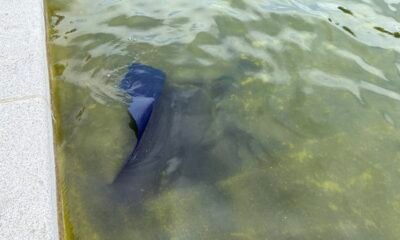
Blue paint on bottom of Reflecting Pool appears to be peeling away

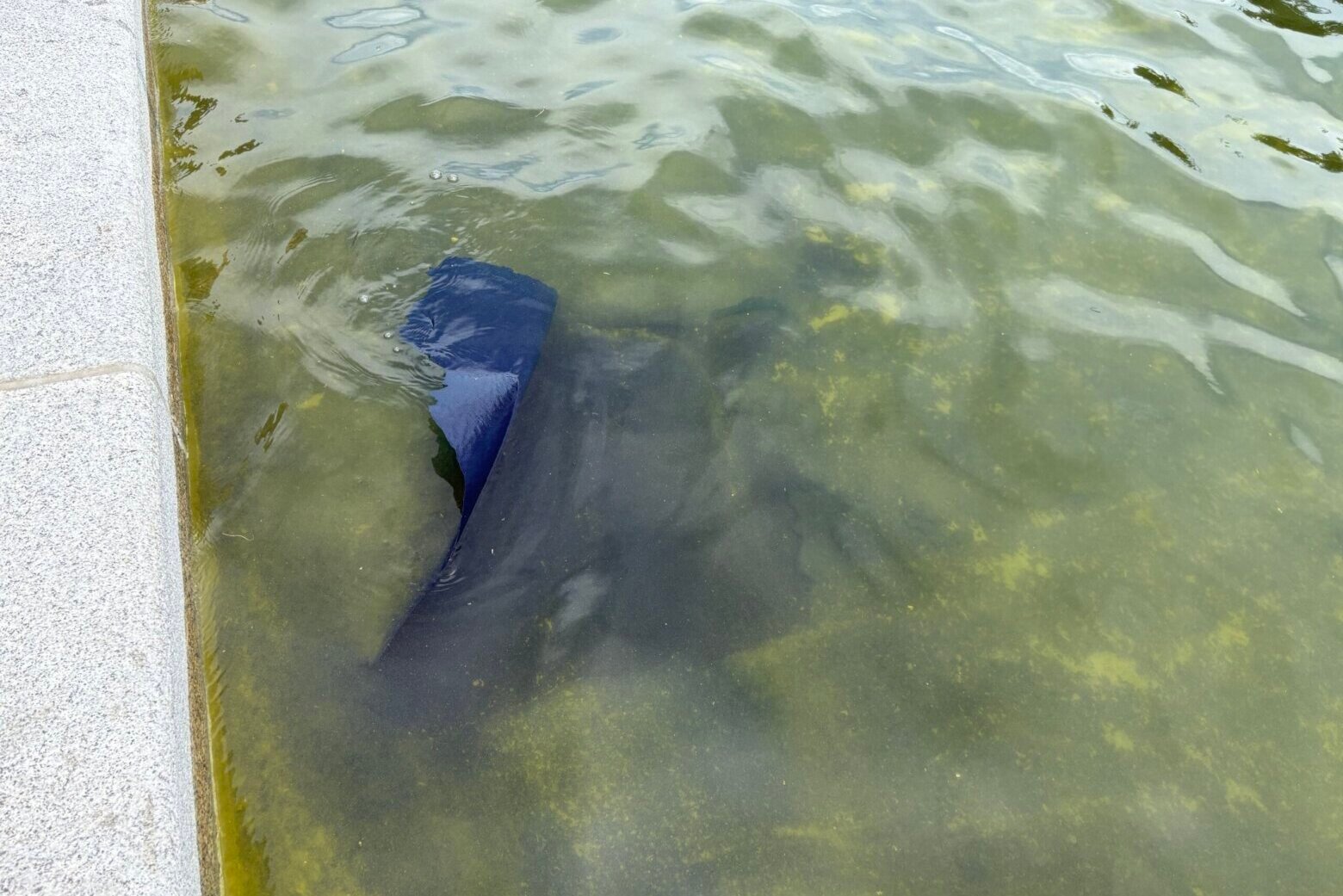
The bottom of the pool was painted at the direction of President Donald Trump and refilled with water about two weeks ago. Since then, algae that blooms in the Reflecting Pool every summer returned, making the pool green.
Crews have been scrubbing the algae out and using nanobubble ozone technology to try and clean the pool. Workers were recently seen dumping hydrogen peroxide in the water.
Thursday, some of the blue paint started lifting from the bottom. About half-way down the south side of the Reflecting Pool, a 2- to 3-foot section appeared to be peeling away near the pool’s edge. As the wind blew, the chunk rose above the water, ripping away from the bottom just a little bit more.
Derek Amspaugh visiting D.C. from Columbus, Ohio, stopped to take a look.
“It’s definitely concerning, yeah; you’re spending $11 million, you’d like to see quality work being done.”
The Trump administration has said the cost of the renovation is around $14 million.
John Ritter, who lives in Northern Virginia, suggested the issue could be emblematic of the Trump administration.
“It’s a bit of a metaphor, I think, for some of the other projects they are trying to do.”
It’s unclear whether the hydrogen peroxide, the scrubbing of the algae or the nanobubble technology being used has anything to do with the peeling.
As of Thursday afternoon, about a third of the pool looked clean and blue — the rest was the algae green color usually seen in the summer.
Get breaking news and daily headlines delivered to your email inbox by signing up here.
© 2026 WTOP. All Rights Reserved. This website is not intended for users located within the European Economic Area.
Tech
Trump administration compares reflecting pool algae battle to Iran war


US federal government workers continue to take on the green hue that has swept across Washington’s reflecting pool, an increasingly fiendish battle the Trump administration compared to its war with Iran.
After Donald Trump ordered a $14.2m refurbishment to turn the monument “American Flag blue” in time for the country’s 250th birthday celebrations, the administration encountered a formidable foe: algae.
For days, the pool has been fluctuating between various shades of green, frustrating efforts to ensure it adopts the US president’s preferred color. And by Thursday parts of the coating laid by Atlantic Industrial Coatings in an effort to turn the monument “American flag” blue had appeared to start peeling off.
Workers were seen on site in waders, attempting to fish out algae and eliminate patches of deep green across the pool.
Hours earlier, the US Department of the Interior – which oversees the National Park Service – had claimed the water was “crystal clear”, and blamed the “Fake News Media” for reports to the contrary.
In a statement on X, after eyewitnesses saw the pool looking distinctly murky, the department went so far as to liken the administration’s purported victory against algae to its purported victory against Iran.
“The Reflecting Pool water is crystal clear, and our National Park Service team is now vacuuming up the dead algae resting on the bottom of some parts of the Reflecting Pool – just like the destroyed Iranian Navy resting on the bottom of the Persian Gulf,” the department’s press office said.
Both campaigns have so far failed to match Trump’s stated intentions. At the outset of the US-Israel war on Iran, he vowed to eliminate Iran’s nuclear program and destroy its ballistic missile program.
A peace deal signed on Wednesday left the US president with Iran’s word not to build a bomb and no mention in writing of the ballistic missile program.
The reflecting pool – one of Washington DC’s most historically symbolic attractions, and the scene of Martin Luther King’s 1963 “I have a dream” speech – has been one element of Trump’s efforts to recondition Washington during his second term.
A no-bid contract to waterproof and repaint the site, which dates back over a century, raised eyebrows. It was awarded to a Virginia-based company, Atlantic Industrial Coatings, which had previously carried out work on a swimming pool at one of the president’s golf clubs.
The administration had initially claimed that “residual” algae would be cleared in the immediate aftermath of the renovation. But it has proliferated amid warm weather.
It later suggested the installation of a water treatment system, described as “nanobubbler technology”, would help address the issue. The technology had “very effectively killed the algae”, the interior department claimed.
Tech
Here’s how Russia’s nuclear-powered ‘Skyfall’ missile works : NPR

Loading…
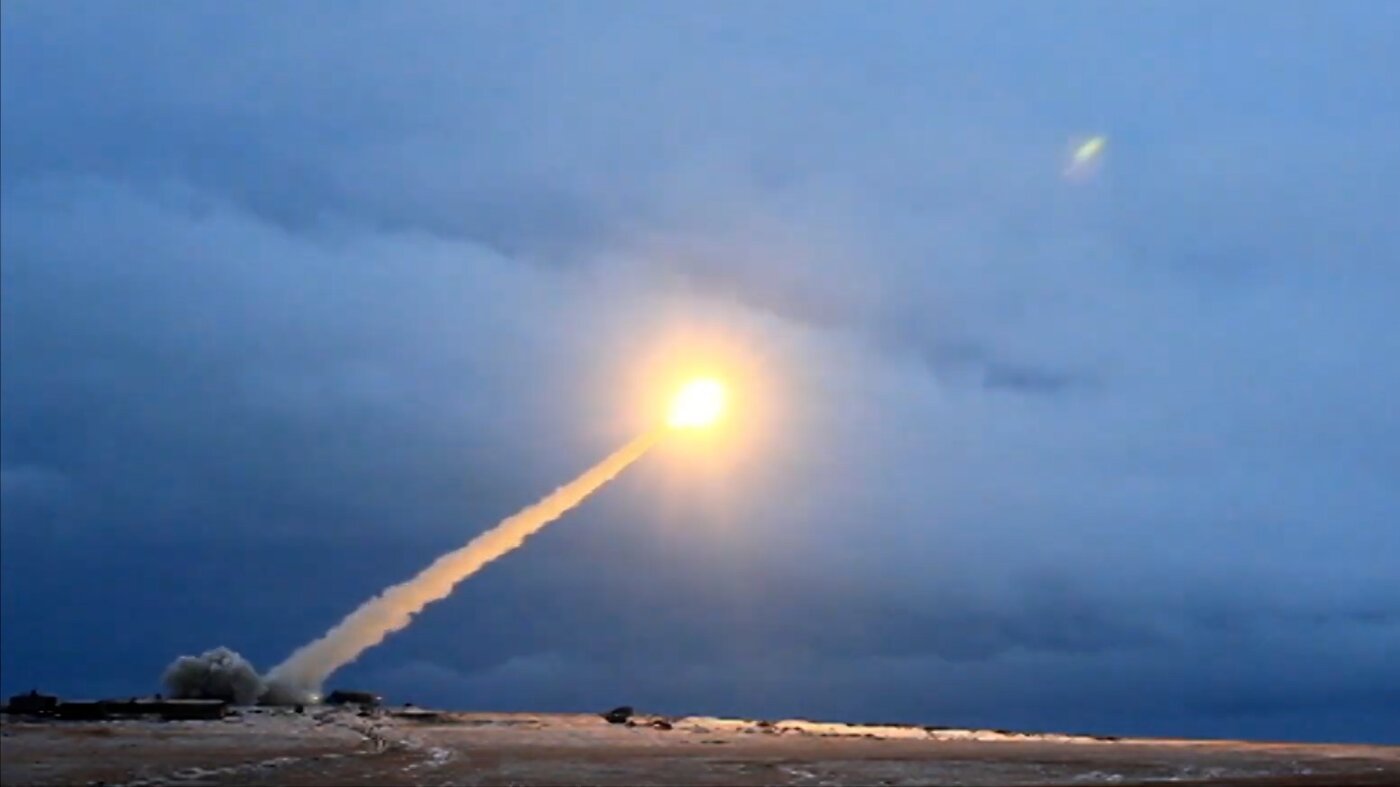
Sometime on Oct. 21 of last year, high above the Arctic Circle, a lone missile shot skyward from a Russian island.
The missile flew northeast and then banked and began flying in loops for hours over the barren, frozen landscape.
According to Russian and Western sources, the new weapon, known in Russian as Burevestnik and by NATO as Skyfall, was powered by a small nuclear reactor. Few other details were forthcoming.
Now, two MIT researchers have published an analysis that sheds fresh light on how the nuclear-powered missile actually worked. If they are correct, the October flight test marks the first time a nuclear-powered aircraft has ever flown. It would also suggest the opening of an extraordinarily dangerous new chapter in the 21st century’s simmering arms race.
“This is something that is possible, but wildly expensive and very dangerous,” said Jake Hecla, a professor at the Massachusetts Institute of Technology with a dual appointment in both aerospace and nuclear science and engineering, who led the new analysis along with co-author R. Scott Kemp.
Their modeling shows a reactor design that spews radiation as it flies, putting anyone living or working near the test site for the missile at “enormous risk, potentially.”
The dream of nuclear flight
Since the 1950s, both the U.S. and the then-Soviet Union contemplated building nuclear-powered aircraft. Such weapons had the potential to give both sides an advantage in the Cold War because they would have nearly unlimited range. That could allow them to loiter near a target awaiting an attack order almost indefinitely, or they could attack from an unpredictable direction, making it harder to defend against.
In 1955, the U.S. Air Force put a small nuclear reactor inside a Convair B-36 strategic bomber to test whether it would expose the crew to excessive amounts of radiation in flight. The reactor was never hooked up to the plane’s engines, but it did show that a nuclear reactor could fly. In 1961, the Soviet Union conducted similar experiments aboard a modified Tupolev TU-95 bomber.
Safety concerns left those concepts grounded, but the U.S. also worked on a series of nuclear reactors to power missiles. Known collectively as Project Pluto, the idea was to build a supersonic low-altitude cruise missile that could deliver a nuclear weapon to any point on Earth. The tests culminated in 1964, with the ground test of a reactor mounted on a railroad car in Nevada that could run for five minutes, producing 513 megawatts — equivalent to more than 35,000 pounds of thrust.
When news of the new Russian cruise missile first emerged, many onlookers assumed it would be a variant of the Project Pluto engine, but Hecla was skeptical. Project Pluto’s design, known as a ramjet, required air to move through it very quickly and could only operate at supersonic speeds.
“There are a number of reasons we have to suspect that a nuclear ramjet is infeasible for Burevestnik,” he said. In particular, the shape of the weapon looks much like a conventional subsonic cruise missile.
“You can see very obviously that it is a subsonic system, and ramjets are not very efficient at subsonic speeds,” he said.
A new kind of reactor
To try and figure out how the weapon was powered, Hecla first used a handful of videos posted by Russian media to determine its dimensions. He identified objects of known size in the factory where the videos were filmed — things like a utility desk or a fire extinguisher. Through many hours of repeated measurements, he was eventually able to build a three-dimensional model of the missile.
Loading…
Based on the measurements, he concluded that Burevestnik is larger than even the largest Russian cruise missiles, but it is by no means enormous. Aerodynamic modeling showed it would need to travel around Mach .75 or about 575 miles per hour to stay airborne. That speed is similar to a commercial aircraft, like the Airbus A320.
Hecla now knew roughly how big the reactor could be and how much thrust it needed to produce to make Burevestnik fly. Based on that data, and his knowledge of nuclear engineering, he was then able to model the type of reactor that might be powering the missile.
His conclusion: “It’s almost certain that the system uses a direct-cycle air-breathing nuclear propulsion system, most likely driving a turbojet,” he told NPR.
A direct-cycle system means that the reactor runs by pushing air from the atmosphere directly through the nuclear fuel. A compressor forces the air through tiny straw-like channels in the reactor core, where nuclear reactions cause the air to heat and expand out the back of the engine. Such a system is radically different from most nuclear reactors, which use an “indirect” closed loop. Those sealed systems are filled with water or another coolant and transfer heat out of the reactor while limiting radiation exposure.
Hecla said he can’t completely rule out that some sort of indirect loop is used in the missile, but given the complexity and extra weight involved with building such an indirect system, he finds it far more likely that Burevestnik is heating air by sucking it right through the reactor core.
Loading…
And that’s a big problem. “The direct cycle is very likely to result in a large quantity of radioactive material in the exhaust,” Hecla said. Air itself is irradiated as it passes through the engine, and fission decay products from the nuclear fuel also diffuse into the straw-like cavities and are shot out the back.
Hecla said his calculations show that a direct-cycle system would produce large quantities of radioactive isotopes of argon, krypton and carbon. He admits the reactor could release still more radioactivity if the core starts to corrode during hours of flight.
“Heated, compressed atmospheric air is very good at eroding engine components,” Hecla noted. There’s no reason to think this new nuclear reactor would be different.
“A terrible idea”
If Hecla is correct, then Burevestnik is the first aircraft ever built and flown using nuclear power. It’s also incredibly problematic, said Jeffrey Lewis, a scholar at Middlebury College who specializes in studying rockets and missiles and was not affiliated with the MIT study.
“This thing is an environmental nightmare,” Lewis said. In addition, the reactor poses a huge risk to members of the military who might be required to handle it. “Just the question of how you safely load one of these things is, I think, really pretty challenging,” he said.
In 2019, an accident off the Russian coast killed several Russian nuclear personnel. Shortly thereafter, a spike in radioactivity was detected nearby. It’s now widely believed the accident was the result of a Russian team attempting to recover a prototype Burevestnik reactor. Hecla said it’s possible that the reactor restarted as it was being hauled from the bottom of the sea, sparking an explosion.
Given all the problems, both real and potential, associated with Burevestnik, Hecla questions why the Russians developed it at all. He notes that although its range is likely significantly longer than that of a conventional cruise missile, that doesn’t mean it’s particularly hard to intercept.
“It’s not a game-changing idea by any stretch of the imagination,” he said. “We are able to routinely shoot down cruise missiles today, and there is no reason to think this will be particularly more difficult to do.”
Moreover, Russia has said that Burevestnik will only be used with a nuclear weapon as its warhead. A conventional warhead would likely be heavier, Lewis noted, and the reactor would still end up spreading lethal radiation over a significant area where the missile strikes. Given all that, “I can’t see the Russians wasting one to deliver a few hundred pounds of explosives,” he said.
Put it all together, and the weapon appears to be “kind of useless,” Lewis said.
Hecla suspects that Burevestnik’s development may be advancing for one of two reasons. First, he said, it’s possible that somebody within Russia’s nuclear industry has simply caught President Vladimir Putin’s ear and convinced him to invest in the program. Second, he speculates, it might be possible that the reactor in Burevestnik is just a stepping stone to developing nuclear-powered surveillance drones or space-based nuclear systems that could be useful for other missions.
Lewis agrees that the nuclear-powered missile probably isn’t very useful as a weapon. But Hecla’s paper at least shows it is technically feasible that the Russians have developed it: “It might be a bad idea, it’s almost certainly a terrible idea,” he said. “But it’s not an impossible idea.”
Tech
Days of rain and flooding to hit the south US after Post Tropical Storm Arthur


Post-Tropical Storm Arthur is now unleashing potentially catastrophic and life-threatening flooding throughout the South, as days of heavy rain will slam communities in Louisiana, Mississippi and Alabama.
The flash flood threat escalated to a rare Level 4 out of 4 High Risk for the Mississippi and Alabama coasts early Thursday morning, while the tornado risk continues to rise with severe storms pushing inland.
The remnants of Tropical Storm Arthur persist, as millions of Americans are at risk of flash flooding from Eastern Texas to Georgia.
This maximum rainfall threat is active for Thursday, followed by an expansive Level 3 out of 4 risk on Friday across the Southeast U.S., where widespread rain and catastrophic flooding remain possible.
The high risk of flooding on Thursday includes coastal and inland locations such as Hattiesburg, Slidell, Biloxi, and Mobile.
Other cities within the high flood risk include Baton Rouge, Louisiana; Jackson, Mississippi; Montgomery, Alabama; and Atlanta.
“Pacific and Gulf moisture combining into a persistent plume across the South will increase the flooding risk across Louisiana, Mississippi and Alabama as the heaviest moisture remains on the eastern side of the storm as it moves northward in the coming day,” said the FOX Forecast Center.
As a result, flood watches are in effect across most of Louisiana, Mississippi, Alabama, and Georgia.
The flooding has already claimed the life of a 15-year-old in Texas, who drowned in a flooded pond.
A massive multi-unit search was coordinated, with boats and specialized diving teams deployed.
Following an extensive search and the use of sonar technology, the teenager was located submerged in the water and pronounced deceased at the scene, according to the Montgomery County Sheriff’s Office.
15-YEAR-OLD DROWNS IN FLOODED TEXAS POND AS TROPICAL STORM ARTHUR LOOMS OVER GULF
Overall, widespread rainfall could total 5 to 8 inches across Southern Texas to Alabama, with 8 to 12 inches possible in portions of Louisiana, which could result in deadly flash flooding.
Outside of the flash flood risk, there is a lingering Level 2 out of 5 severe storm threat across coastal Mississippi and into Southern Alabama, where tornadoes are possible.
POWERFUL TORNADOES, DESTRUCTIVE WINDS BRING WIDESPREAD DEVASTATION TO SEVERAL MIDWEST COMMUNITIES
As the remnants of Arthur move toward the Carolinas, rounds of persistent rain will kick off on Thursday and last well into Friday, but there is uncertainty about when exactly the heaviest rain will fall.
WATCH: FLOODING WIPES OUT MISSISSIPPI WOMAN’S HOME, TRAGICALLY DROWNING ENTIRE CHICKEN FLOCK
As this mid-level spin moves offshore, it will hover over the warm waters of the Gulf Stream.
At this point on Friday, a new area of low pressure could form, bringing gusty winds and heavy rain to coastal regions along the East Coast.
This is unlikely to be a tropical threat, but it is worth monitoring amid potential development in the coming days.
LIFE-THREATENING FLOODING AND DAMAGING WINDS SLAM THE GULF COAST AS ARTHUR PACKS A PUNCH
Tech
12 Reasons to Wait for the iPhone 18 Pro

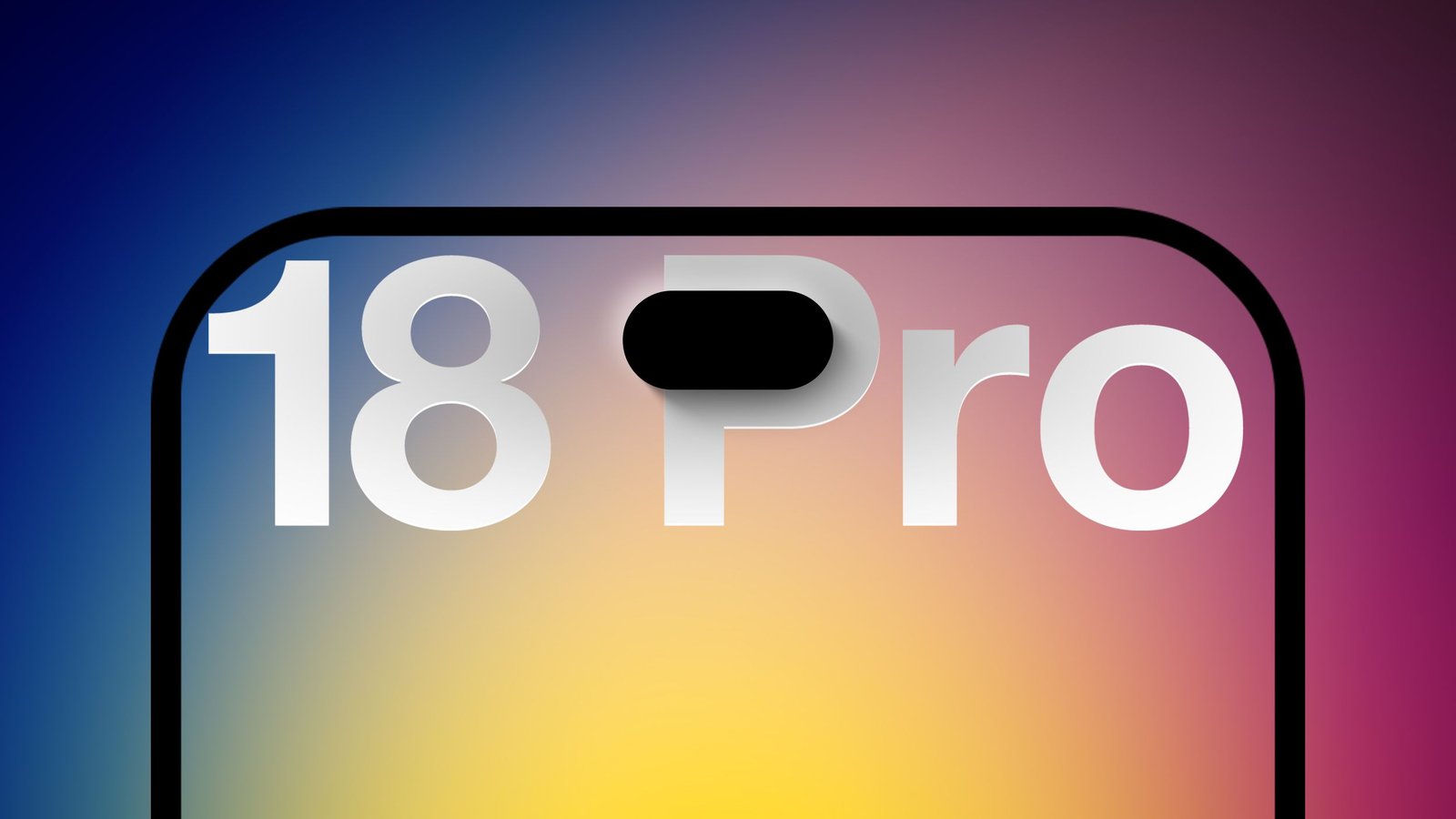
We’re only three months out from the launch of Apple’s premium next-generation smartphone lineup, and while we’re not expecting a sea change in terms of functionality, there are still several enhancements rumored to be coming to the iPhone 18 Pro and iPhone 18 Pro Max.
One thing worth noting is that Apple is reportedly planning a major change to its iPhone release cycle this year, adopting a two-phase rollout starting with the iPhone 18 series. That means the iPhone 18 Pro, iPhone 18 Pro Max, and the long-rumored foldable iPhone (“iPhone Ultra”) will be released in September 2026, followed by the iPhone 18, iPhone Air 2, and iPhone 18e in spring 2027.
Overall Design
iPhone 17 Pro Style
Rumors suggest the iPhone 18 Pro lineup will largely retain the same design as the iPhone 17 Pro models. Most rumors suggest the rear camera system will look identical to the current generation, featuring a raised “plateau” with three lenses arranged in a triangle – although recent dummies indicate a possible thickening of the plateau and the protrusion of individual lenses. Display sizes are also expected to remain unchanged, with the iPhone 18 Pro and iPhone 18 Pro Max continuing to use 6.3-inch and 6.9-inch panels, respectively (the same dimensions introduced with the iPhone 16 Pro series). iPhone 18 Pro models could drop the current two-tone look of the rear casing found on the iPhone 17 Pro in favor of a more seamless aesthetic, while Apple has apparently updated the back-glass “replacement process” to minimize the color difference between the Ceramic Shield 2 glass and the aluminum frame, resulting in a more unified appearance.
Next-Level Battery Life
Thicker Chassis
The iPhone 18 Pro Max will feature a bigger battery for continued best-in-class battery life, claims a Chinese leaker. The Weibo user known as “Digital Chat Station” said that the iPhone 18 Pro Max will have a battery capacity of 5,100 to 5,200 mAh. (The iPhone 17 Pro Max has the biggest iPhone battery to date at 5,088 mAh. Apple says it has a battery life of up to 39 hours.) According to another rumor, the body of the iPhone 18 Pro Max will be slightly thicker than the iPhone 17 Pro Max, raising the device’s weight to around 243 grams. That would make the iPhone 18 Pro Max approximately 3 grams more than the iPhone 14 Pro Max, which is currently the heaviest model Apple has produced. A larger battery is the most likely cause.
Smaller Dynamic Island
Under-Screen Face ID?
Rumors continue to circulate about whether the iPhone 18 Pro models will introduce under-display Face ID, but reports remain divided on when the technology will actually arrive. The feature would move the TrueDepth camera system beneath the display, eliminating the need for the current Dynamic Island cutout.
According to Wayne Ma of The Information, Apple is targeting a design without a Dynamic Island, replacing it with a single pinhole camera in the upper-left corner of the screen. However, other sources dispute that claim. Display analyst Ross Young believes under-display Face ID is possible for the iPhone 18 Pro, but says a smaller Dynamic Island will still be present. Bloomberg’s Mark Gurman has echoed this view, reporting that the new models will feature a slimmed-down Dynamic Island rather than removing it entirely. Apple is also said to be testing new camera miniaturization technology to reduce the size of the front-facing camera currently located within the Dynamic Island.
The Weibo leaker “Ice Universe” has claimed the Dynamic Island cutout on the iPhone 18 Pro models will be approximately 35% narrower than it is on the iPhone 17 Pro models. Specifically, they said it will have a width of around 13.5mm, down from around 20.7mm.
Meanwhile, Chinese leaker Instant Digital has offered yet another version of events, saying the Dynamic Island will shrink in size, but that under-display Face ID and camera technology won’t debut this year. The latest word on the subject is that Apple is weighing two options for the iPhone 18 Pro’s Dynamic Island, and a final decision has yet to be made. One option apparently retains the existing screen mold from the iPhone 17 Pro, while the other introduces a significantly smaller “Mini Dynamic Island” enabled by moving the Face ID receiver and transmitter components beneath the display.
Upgraded Display
LTPO+
The iPhone 18 Pro models will reportedly use LTPO+ display technology, which should be more power efficient than the current LTPO technology in the iPhone 17 series. Such an upgrade could also contribute to longer battery life (see above), since LPTO+ enables finer control of OLED light emission, potentially allowing the display to optimize its operation based on environmental conditions. In other words, it will know better when to up screen brightness or reduce it, depending on surrounding light sources. The panels are reportedly being supplied by Samsung Display and LG Display.
A20 Pro Chip
2nm Process
The iPhone 18 Pro models will use Apple’s A20 chip, based on TSMC’s 2nm process for power and efficiency improvements. A move to 2nm fabrication increases transistor density, which will enable higher performance. The A20 series is expected to deliver roughly a 15 percent speed gain and about 30 percent better efficiency compared with the A19 series used in Apple’s iPhone 17 models.
Apple’s A20 chip will be packaged with TSMC’s Wafer-Level Multi-Chip Module (WMCM) technology, suggesting at least some A20 chips will have RAM integrated directly onto the same wafer as the CPU, GPU, and Neural Engine, rather than sitting adjacent to the chip and connected via a silicon interposer. This could contribute to faster performance for both overall tasks and Apple Intelligence, and longer battery life from improved power efficiency.
C2 Modem
Replacing Qualcomm
Apple plans to include its next-generation C2 modem in the iPhone 18 Pro models, according to supply chain analyst Jeff Pu. The chip will succeed the C1 modem, which debuted in the lower-cost iPhone 16e as Apple’s first in-house cellular modem, and the C1X modem chip in the iPhone Air, which Apple says is up to 2× faster than the C1. The C2 is expected to bring faster speeds, improved power efficiency, and support for mmWave 5G in the United States – a feature missing from the C1 and C1X.
Apple’s modem roadmap is part of a long-term strategy to reduce reliance on Qualcomm, which currently supplies 5G modems for the rest of the iPhone lineup. The company has been working on developing its own cellular chips for years, aiming for deeper integration and greater control over power management and performance.
New Camera Sensor
Samsung-Made
Samsung is working on a new three-layer stacked image sensor, reportedly intended for the iPhone 18. The sensor, referred to as PD-TR-Logic, integrates three layers of circuitry, which would improve camera responsiveness, reduce noise, and increase dynamic range. The leak comes from a source known as “Jukanlosreve,” who claims the sensor is being developed specifically for Apple’s 2026 iPhone lineup. Sony has long been Apple’s sole image sensor supplier, so Samsung’s entry would be a big shift in the iPhone’s camera supply chain.
Variable Aperture
DSLR-Style
Apple intends to equip this year’s iPhone 18 Pro models with a variable aperture lens, according to reports. Weibo-based leaker Digital Chat Station claims the main rear camera – what Apple calls the 48-megapixel Fusion camera – on both iPhone 18 Pro models will offer variable aperture, which would be a first for the iPhone. A variable-aperture system physically adjusts the lens opening, letting more light in for low-light shots or narrowing the opening for brighter scenes and deeper depth of field.
The main cameras on the iPhone 15 Pro, 16 Pro, and 17 Pro all use a fixed ƒ/1.78 aperture, where the lens is permanently set to its widest setting. With a variable lens, the iPhone 18 Pro would allow users to manually shift the aperture, similar to on a DSLR camera. This would mean more control over depth of field, enabling sharper focus on subjects or smoother background blur. Industry analyst Ming-Chi Kuo said in November 2024 that Apple’s iPhone 18 Pro models will get the feature.
5G Satellite Internet
Non-Terrestrial Data
According to a report by The Information, Apple plans to add support for 5G networks that operate via satellites rather than Earth-based towers as early as next year. This advancement would allow future iPhones to gain full internet connectivity through satellite, not just limited emergency features.
If Apple meets the 2026 target, the first devices to feature 5G satellite internet would likely be the iPhone 18 Pro, iPhone 18 Pro Max, and the long-rumored foldable iPhone. Apple partners with Globalstar for its iPhone satellite features, but there is currently no service that delivers full 5G satellite internet directly to a smartphone. That said, Amazon and Globalstar announced in April a definitive merger agreement under which Amazon will acquire the satellite operator. Amazon’s Leo satellite network will power existing iPhone features – with scope for additional feature support as part of a forthcoming infrastructure upgrade.
Simplified Camera Control
New Design
Apple is reportedly working to simplify the Camera Control button’s design on iPhone 18 models in order to reduce costs. The current Camera Control button on iPhone 17 models uses both capacitive and pressure sensors beneath a sapphire crystal surface. The capacitive layer detects touch gestures, while the force sensor recognizes different pressure levels for taps, presses, and swipes.
However, according to the Weibo-based account Instant Digital, Apple will remove the capacitive sensing layer and retain only pressure sensing recognition in the second iteration to achieve all Camera Control functions on the iPhone 18. The simplified version is not about reducing functionality in the button, but about saving money. The current solution is said to be very expensive for Apple and is generating costly after-sales repairs.
We don’t expect Camera Control to go away anytime soon – Apple apparently sees it as a key feature, so much so that it has reportedly made deliberate engineering compromises to ensure that the first foldable iPhone features the button.
New Colors
Three in Testing
In February 2026, Bloomberg’s Mark Gurman reported that Apple is testing a deep red finish for the iPhone 18 Pro and iPhone 18 Pro Max. Rumors of purple and brown finishes have also circulated, but Gurman believes those are just variants of the same red idea. Since then, we’ve seen aligned rumors that the devices will come in light blue, dark cherry, dark gray, and silver.
The iPhone 14 Pro and iPhone 14 Pro Max were previously available in Deep Purple, and Apple has never released an iPhone in a genuinely brown color. According to a Chinese leaker, Apple’s iPhone 18 Pro models won’t come in black this year. If the rumor is true, it will be the second consecutive year Apple has ditched what was arguably its most classic color option for the Pro lineup.
iOS 27
Smarter Siri
The iPhone 18 Pro will ship with iOS 27, which brings the biggest Siri shake-up in the assistant’s history. Apple introduced Siri AI at WWDC in June – a rebuilt, more conversational version of Siri with onscreen awareness, personal context understanding, and broad world knowledge that lets it pull up-to-date answers from the web. It also gains its own standalone app for revisiting past conversations, an expanded Visual Intelligence mode, and writing tools that work across email, messages, and documents. Like the iPhone 17 Pro, the iPhone 18 Pro is expected to carry 12GB of RAM, so it should run the full range of Siri AI and Apple Intelligence features.
Tech
Strait of Hormuz reopening may take weeks

Stringer | Reuters
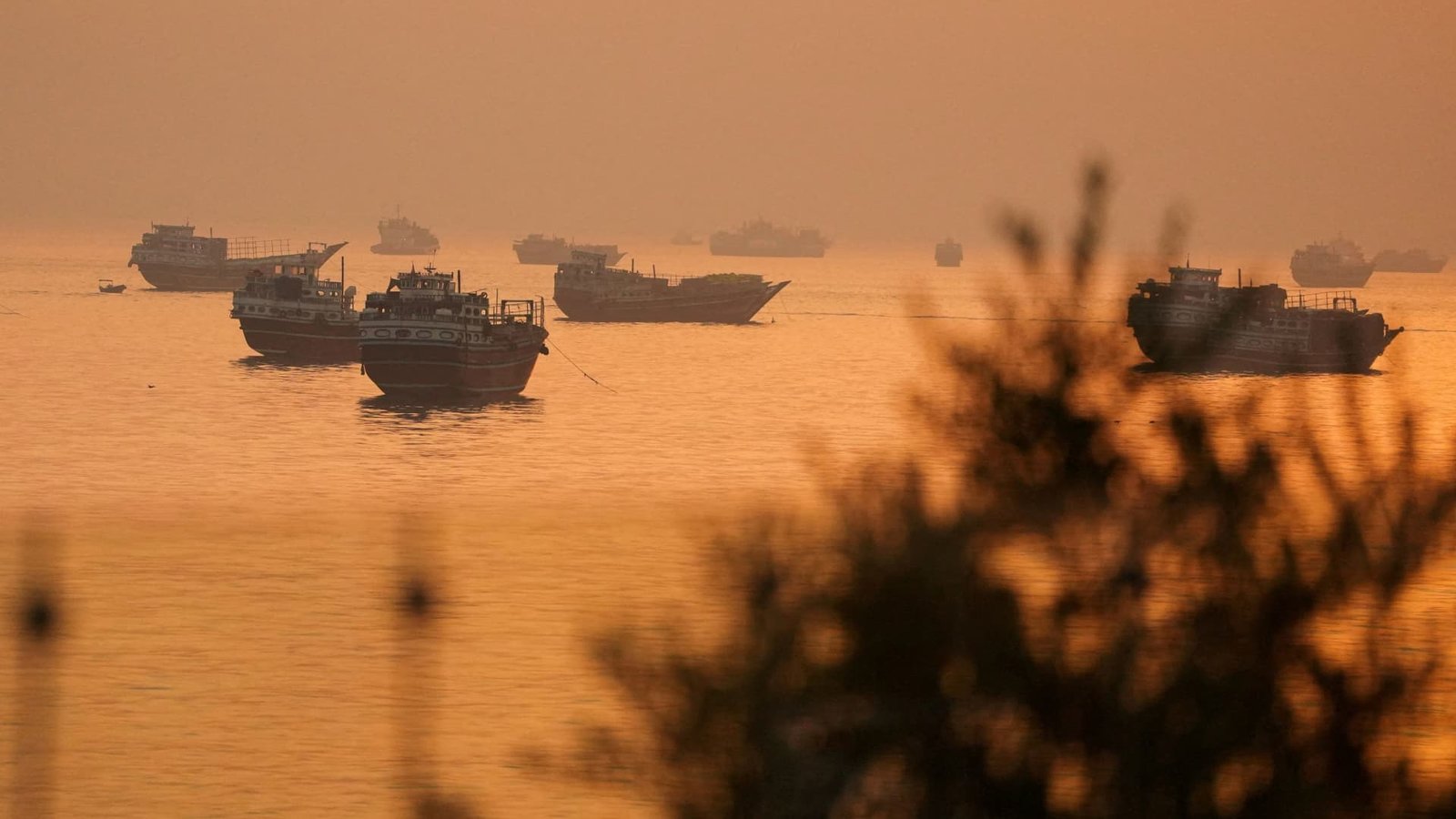
It will take weeks to clear the backlog of ships in the Strait of Hormuz, industry executives and shipping experts have warned, as the critical waterway is set to reopen.
Oil prices initially dipped below $80 per barrel on news that the U.S. and Iran had agreed on a deal to end their war, as traders looked to the supply of oil, LNG and other goods being restored after nearly four months of war caused a maritime traffic jam of ships unable or unwilling to transit the Strait.
U.S. President Donald Trump and Iranian President Masoud Pezeshkian signed the memorandum of understanding on Wednesday night. It calls for the full reopening of the Strait of Hormuz without tolls by Iran for at least 60 days.
But restoring enough physical supply to the market to keep prices at a stable sub-$80 level could take weeks, and in some cases months, market watchers have told CNBC.
Operators, port authorities and energy companies across the Gulf remain in a holding pattern, with key logistical and security questions still unresolved.
“The most likely scenario is a phased restart, with some form of traffic-management mechanism involving Iran and Oman,” Adam Sharpe, vice president of editorial at Lloyd’s List Intelligence, told CNBC.
“But the unresolved questions are significant: whether vessels need prior permission, whether Iran will impose service charges, whether foreign naval escorts are accepted, and whether mines or other residual risks require a clearance process.”
Why reopening the Strait of Hormuz is complicated
Even after a political agreement to reopen the Strait, industry participants say restarting traffic will be complex and staged.
“There is no precedent for restarting Hormuz after a disruption of this nature,” Sharpe said. “A cautious working assumption would be a gradual ramp-up rather than an immediate return to 100-plus daily transits.”
Before the war, Lloyd’s List Intelligence data showed weekly Strait of Hormuz cargo-vessel transits of roughly 650 to 770 vessels, equivalent to around 90 to 110 transits per day across both directions.
Economic intelligence provider QuantCube Technology told CNBC its shipping data has yet to show a meaningful increase in oil export departures from Saudi Arabia, the UAE or Iraq.
In Saudi Arabia’s Dammam region, which includes the Ras Tanura export complex, vessels have been loaded and sent offshore to wait, according to Alan Lemangnen, senior economist at QuantCube.
“Since June 8, tankers departing Dammam have spent significantly longer waiting at anchor before departure,” he told CNBC. “This suggests that a queue of vessels may have formed offshore rather than at port facilities.”
Most of the UAE’s successful crude flows through Hormuz involved “going dark,” in which ships turn off GPS systems to avoid detection. Kpler said dark shipping activity is likely to continue until Washington and Tehran reach a clear understanding on freedom of navigation.
How big is the Hormuz shipping backlog?
Even if energy supply flows recover quickly, supply-chain disruption could continue. In a note published Monday, Kpler estimated 118 tankers were stranded in the Persian Gulf.
Kpler analysts estimate the backlog could take 10 to 15 days to clear, but warned that this would not amount to a full recovery. The initial boost, they said in the note, would be “purely mechanical,” delivering “an early spike in transits without lifting underlying throughput.”
If hundreds of vessels are waiting to transit the Strait, prioritization becomes critical. Industry experts expect oil tankers and LNG carriers to receive priority access because of their importance to global markets, potentially leaving container shipments and other cargo facing longer delays.
“Prioritization may not be purely commercial,” Sharpe said. “Authorities may also consider vessel location, direction of travel, flag, ownership, perceived political risk, cargo type, safety condition, and whether a vessel has already submitted the required transit information.”
“The biggest uncertainty is whether this will be handled transparently or through ad hoc operational decisions,” he added.
Traders and manufacturers in the region are already reporting higher raw-material prices and shipment delays, underscoring how quickly disruptions in Hormuz ripple through regional economies.
Insurers and security checks matter
Before traffic can return to normal, naval forces need to certify safe transit corridors, which is expected to take at least several days. War-risk insurers must then reinstate coverage, without which vessels won’t move. Authorities in Oman, the UAE and Iran will also need to coordinate shipping lanes, convoy systems or transit windows, while ships and crews positioned for diversion or delay must be reactivated, refuelled and scheduled.
“Underwriters will want evidence of a stable and predictable operating environment: consistent safe transits, no interference, clarity on mine risk, and no renewed escalation,” Sharpe said. Pricing, he added, is likely to remain highly sensitive to vessel flag, ownership, Israeli or U.S. nexus, trading history and cargo.
“Underwriters will want evidence of a stable and predictable operating environment: consistent safe transits, no interference, clarity on mine risk, and no renewed escalation. Current pricing is likely to remain highly sensitive to flag, ownership, Israeli or US nexus, trading history and cargo. A durable reduction in additional premiums will depend on sustained historic transit volumes and confidence that the reopening is not reversible.”
Adam Sharpe
“A durable reduction in additional premiums will depend on sustained historic transit volumes and confidence that the reopening is not reversible,” he said.
There is also a security component, with Iran and the U.S. needing to coordinate on mine clearance, another process that could slow things down.
“Until there is full certainty that there are no mines, the process will be slow and would take a few weeks since only a small passage is then available safely,” Nikos Petrakakos, managing director at maritime investment manager Tufton, told CNBC over email. “Once clarity with mines is secured, then it could be less than a week. But I feel many will be cautious at first.”
Sharpe pointed to the Red Sea as a cautionary comparison, saying many operators remained reluctant to return even after de-escalatory signals that the Houthis had stopped firing on ships, without sustained proof of safety.
When could shipping through Hormuz normalize?
Kpler said most Middle Eastern production returns in weeks rather than months, but when that production can actually be exported is another question.
Much will depend on how quickly authorities, insurers and shipping companies can coordinate the reopening and restart the movement of goods. The initial 10- to 15-day clearing of the tanker backlog may create a visible spike in traffic, but a return to normal throughput could take longer if insurance premiums remain elevated, naval checks are slow or operators remain cautious.
What reopening means for oil prices
Goldman Sachs reduced its oil price forecast following Trump’s announcement of a deal, lowering its Brent forecast to $80 per barrel for the fourth quarter of 2026, from $90 previously, and to $75 for the 2027 average. But in the near term, prices could remain under pressure.
In a note published June 16, Goldman said “supply recovery might be stronger” and estimated that Gulf flows had already risen to 11 million barrels per day, with increases in both Hormuz flows and redirections.




Blue material peeling off bottom of Reflecting Pool after renovation
Some blue material at the bottom of the Lincoln Memorial Reflecting Pool is peeling off, days after it was painted...


How much hiking gear do you really need?
What's too much gear to hike with? What's not enough? How much gear do you really need? In this episode...


Andy Burnham wins Makerfield by-election | BBC News
Labour's Andy Burnham has won the Makerfield by-election, paving the way for him to challenge Keir Starmer as prime minister.


Labour’s Andy Burnham wins crucial Makerfield by-election. #UK #Politics #BBCNews


Tom Hanks roasts MS NOW’s ratings while appearing live on-air with reporter
Oscar-winning actor Tom Hanks took a swing out of left field Thursday to poke fun at MS NOW while appearing...


Curry Barker’s New Movie Lands at Universal Blumhouse Atomic Monster
Hollywood can finally stop obsessing over Obsession filmmaker Curry Barker‘s next movie. Universal Film Group, along with Blumhouse Atomic Monster,...


They got married during the Knicks parade
CNN's Meena Duerson followed a couple getting married at City Hall in New York during the same time as the...


‘Dungeon Crawler Carl’ TV Series Based On Books Ordered By Peacock
Peacock has given a straight-to-series order to Dungeon Crawler Carl, a live-action series adaptation of Matt Dinniman’s popular science fantasy...


In new interview, Trump makes eye-opening Iran war claims
Trump is defiant and defensive after signing a memorandum of understanding with Iran. CNN has the first clips from Trump's...

Blue paint on bottom of Reflecting Pool appears to be peeling away
The bottom of the pool was painted at the direction of President Donald Trump and refilled with water about two...
-

 Business5 days ago
How much of Musk’s wealth comes from government help? Virtually all of it
-

 LifestyleNews2 weeks ago
120 minutes of strength training per week may help extend lifespan
-

 Politics1 week ago
What to know about the stabbing that set off fiery riots in Northern Ireland
-

 Video6 days ago
Download fans say what they love about the festival. #DownloadFestival #BBCNews
-

 Video6 days ago
Why SpaceX IPO isn't about space. #SpaceX #ElonMusk #BBCNews
-

 HealthNews7 days ago
The people of Okinawa, Japan only eat until they are about 80 percent full, then stop — and the practice has been linked in multiple peer-reviewed studies to lower rates of cardiovascular disease, slo
-

 TravelNews6 days ago
My Paternal Instinct Should’ve Warned Me About Netflix’s Maternal Instinct
-

 Food6 days ago
Pope Leo’s plane was grounded. Then the King of Spain stepped in to help