

Tech
Qualcomm Is Copying Samsung Exynos 2600’s Heat Path Block For Snapdragon 8 Elite Gen 6 Pro, But Has Botched The Implementation


Imitation remains the highest form of flattery. After Samsung won plaudits for the Exynos 2600’s novel Heat Path Block (HPB) thermal technology, Qualcomm, whose recent chips iterations have resembled a veritable inferno when it comes to their runaway heat issues, now appears to be flattering Samsung by copying its HPB tech for the upcoming Snapdragon 8 Elite Gen 6 Pro, albeit sloppily so.
Qualcomm appears to be trying to tame the furnace-like credentials of its Snapdragon chips by emulating Samsung’s most innovative thermal solution
While clarifying that Qualcomm has prepared two and not six versions of its Snapdragon 8 Elite Gen 6 Pro chip for the upcoming Samsung Galaxy S27 series, the tipster Reptalica has just dropped a bombshell of sorts: Qualcomm’s flagship chip has implemented a version of Exynos 2600’s HPB tech, though the implementation “isn’t as effective.”
For the benefit of those who might not be aware, Exynos 2600 features a copper-based heat sink, dubbed Heat Path Block, which remains in direct contact with the AP.
Of course, the upcoming Exynos 2700 is expected to sport a new thermal solution, called Side-by-Side (SbS), where individual dies for the AP and the DRAM are stacked horizontally, and a copper-based heat sink, called Heat Path Block or HPB, is placed on top.
Meanwhile, based on a previous estimate, the non-binned version of the Snapdragon 8 Elite Gen 6 Pro can cost upwards of $300. This means that only the most premium of smartphones, such as the Galaxy S27 Ultra, will be able to sport the standard Snapdragon 8 Elite Gen 6 Pro, while others will either opt for the vanilla Snapdragon 8 Elite Gen 6 or a binned version.
Tech
Blue paint seen chipping off in Lincoln Memorial Reflecting Pool after algae turn it green


WASHINGTON — President Donald Trump’s makeover of the Lincoln Memorial Reflecting Pool ahead of America’s 250th anniversary celebrations is not going according to plan.
First, the project overshot Trump’s initial cost estimate of under $2 million — and has already topped $14.6 million, according to a federal spending database.
Then, the new Trump-branded “American flag blue” color was short-lived as algae turned the pool green, causing the administration to send crews to dump hydrogen peroxide into the expansive pool to deal with the problem.
In recent days, NBC News spotted some blue paint chipping off the surface, with strips of it peeling away and floating atop the pool for visitors and passers-by to see as the busy summer tourist season in the nation’s capital gets underway.
On the west side of the pool Thursday, a small section of the blue painted surface appeared to be lifting away, exposing the darker unpainted layer underneath. A strip of detached paint could be seen floating beneath the water’s surface.
Algae still remain visible along the edges of the pool despite ongoing cleaning efforts. The developing deterioration drew the attention of onlookers who stopped to take a closer look.
The Trump administration is hardly the first to struggle to clean up the Reflecting Pool. But the algae-infused green color has drawn significant attention in recent days after the president slammed the pool earlier this year as “filthy” and “dirty,” promising to make it “beautiful” and blue at minimal expense.
The Interior Department’s media office didn’t return an email seeking comment Friday.
Two days earlier, on Wednesday, the department’s X account posted that the “advanced nanobubbler technology very effectively killed the algae,” while taking a jab at the Obama administration’s attempts to clean the pool up.
“The Reflecting Pool water is crystal clear, and our National Park Service team is now vacuuming up the dead algae resting on the bottom of some parts of the Reflecting Pool—just like the destroyed Iranian Navy resting on the bottom of the Persian Gulf,” the Interior Department wrote.
Last week, Interior Secretary Doug Burgum posted a time warp of the blue paint being added to the pool’s surface.
Tech
Algae turns reflecting pool green after repainting. Here’s why : NPR

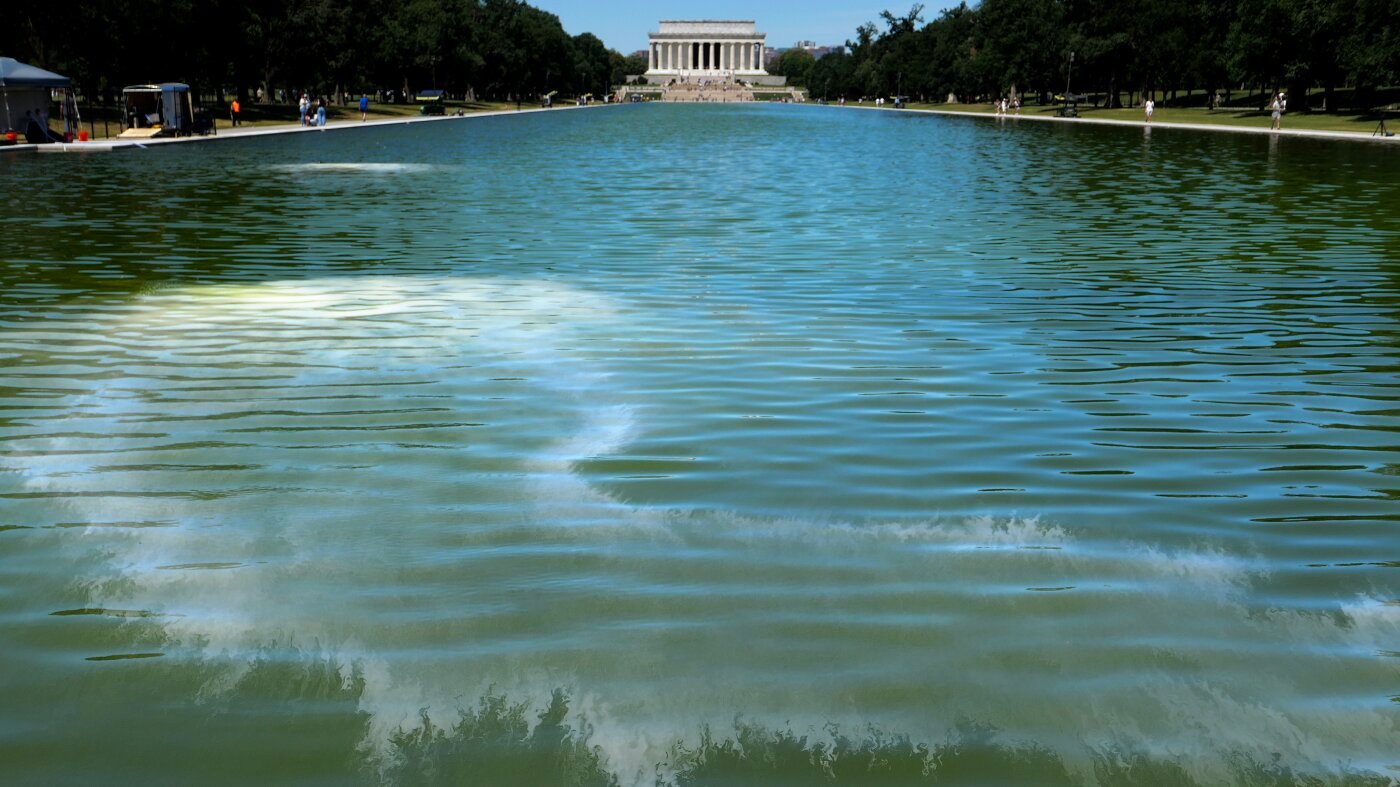
WASHINGTON — The Lincoln Memorial reflecting pool is once again making headlines, this week for turning green.
The Washington, D.C. landmark was refilled with water earlier this month after President Trump had its neutral grey bottom repainted “American flag blue.” The multi-million dollar project produced subtle results in the eyes of many observers, even as Trump and Secretary of the Interior Doug Burgum — whose agency managed the renovation — touted its success.
In recent days, however, the pool has taken on a verdant hue — the result of algae blooms that experts say are to be expected in these conditions.
“It’s called ‘New Pond Syndrome,'” says Steve Goodale, a Canadian swimming pool specialist known online as “Swimming Pool Steve.” “It’s a known thing that happens when you take a natural, clear body of water like this that sits in an open air environment and you try to start it up, very often you end up with green water almost immediately.”
Goodale says the process took longer — a matter of days — to unfold in this case likely due to the sheer size of the pool, which measures 2,030 feet long and has a surface area of approximately 338,000 square feet.
“Excellent conditions” for algae growth
Rosalina Stancheva Christova, a professor of aquatic ecology at George Mason University in Virginia, took water samples from the pool on Tuesday. She confirmed the algae belongs to the genus Desmodesmus, which she said is “growing in excessive amounts” but is not toxic or harmful.
Christova says this kind of common green algae is found all over the region, especially this time of year. The reflecting pool in particular provides “excellent conditions” for algae growth, she said: shallow, stagnant water, strong sunlight and no shade.
“It could happen every single summer,” she added. “But it seems that the disturbance of the pond during the renovations [is] accelerating this process.”
Christova said last month’s renovations may have affected the balance of nutrients in the pool, potentially accelerating the algae blooms. Goodale similarly views the resurfacing as one of several contributing factors.
“The new, darker interior surface is going to absorb more sunlight,” Goodale says. “It is going to result in water that’s warmer, and that ultimately is going to lead to more prolific algae growth.”
The Trump administration has said the algae came from residual material in supply lines that had lain dormant for weeks. Their growth was likely exacerbated by the extreme temperatures that hit D.C. last week, bringing heat index values to 95 degrees and above.
Algae has resurfaced in the reflecting pool periodically over the years — including immediately after it reopened from its last major renovation in 2012, forcing the National Park Service to drain it, refill it and recalibrate its ozone level. And in 2019, crews had to drain four million gallons from the pool to fix a broken water line that had algae growing in it.
An Interior Department spokesperson told NPR over email that algae and other contaminants have “long plagued the Reflecting Pool since 1922,” pointing to the Obama-era renovation as an example.
“Unlike under Obama and Biden, the National Park Service is actually maintaining the beautifully completed Reflecting Pool,” they added.
Responding with tiny bubbles and big vacuums
The Trump administration is using a mix of mitigation strategies, including pouring hydrogen peroxide into the water to kill the algae.
The Interior Department says hydrogen peroxide is a “milder treatment than chlorine and is used in spas and specialty pools like natural swimming pools,” adding “there are no harmful side effects to marine life or to the environment.”
Workers are also deploying what the department calls “high-tech nanobubble ozone technology” to neutralize algae and other pathogens in the pool. The department says that approach is validated by several universities and the National Oceanic & Atmospheric Administration.
Those ozone bubbles are so tiny the human eye can’t even see them, Goodale says.
“The best way to describe it is that the bubbles are neutrally buoyant, so they won’t just rise to the surface and disappear readily,” he explains. “They can last for weeks, if not months in the water, doing their oxidizing thing and keeping the algae at bay.”
‘A monumental effort’
Goodale says it’s more complicated than treating the average backyard swimming pool, since the reflecting pool — despite its name — is actually more akin to a “manmade shallow lake.” He says it’s hard to predict just how long it will take to completely solve the algae problem, calling it “a monumental effort, literally.”
The Interior Department posted on X Wednesday that the nanobubble technology had “very effectively killed the algae,” and National Park Service crews would spend several days vacuuming up the dead algae from the bottom of the pool.
But as of Thursday morning, much of the pool — especially in the center — was still bright green.
Work continued on both ends of the pool. Nanobubble machines deposited their tubes into the water, as mobile vacuuming systems known as “trash pumps” hummed loudly from the shore. Handfuls of workers stood either in the pool or on the edge maneuvering long-handled vacuums back and forth. Their contents, including pistachio-colored water, poured out of hoses laying in the nearby grass.
The work zones were marked off by orange cones, but passersby walking the length of the pool appeared relatively unfazed. Some stopped to peer down and snap pictures of the water itself — including sections of paint that had visibly peeled off — while others were more focused on getting a photo of the Washington Monument in the background.
Loay Hidmi was walking deliberately along the edge of the pool closest to the Lincoln Memorial, hands clasped behind his back, looking over the ledge. The relatively new D.C. resident is a civil engineer who specializes in water treatment, and has been coming by the pool all week to see the progress for himself. He estimates it’s about 80% of the way there.
“I’m taking pictures of it … for the last week and I can see the gradual change,” he said. “So I’m hopeful. But we’ll have to see if it gets sustained.”
What happens next?
Hidmi worries that the algae could come back, given the favorable conditions posed by the sunny, shallow pool.
He acknowledges that’s mostly an aesthetic concern, given how much the administration has just spent on repainting the pool, but says it also raises questions about their process.
“In water systems, when you fix something, you need to look at the step before it and the step after,” he said.
Goodale agrees. He says that when a water system is taken offline, the pipes still remain full of water — “they don’t just gravity-drain away” — and need to be flushed out before any refilling. And he says eliminating algae is no substitute for dealing with underlying filtration issues.
“That’s like the equivalent of mowing the lawn when perhaps it needs to be something else that addresses the source nitrates and phosphorus, so that it’s more like pulling the weeds out by the root,” he says.
In the meantime, Christova, the algae expert, would like to see the water monitored weekly.
“If we don’t have any control over algal growth, we don’t know what is growing,” she said, adding that not all types of algae are as harmless as the one currently blooming in the pool.
When asked about plans for maintenance and algae prevention, White House spokesperson Taylor Rogers told NPR: “Thanks to President Trump, new lining and industrial grade materials will permanently seal the Reflecting Pool, which previously leaked 16 million gallons per year and wasted countless taxpayer dollars.”
Even after the Obama-era renovation, the reflecting pool suffered from broken pipes and water leaks requiring costly refills, according to a Department of the Interior report from fiscal year 2023. It called for new expansion joints, supply and return lines with thicker walls, saying “an improved distribution system will ensure the water can be circulated through the treatment plant, filtered, and treated with ozone.”
This latest renovation does not appear to have addressed the pipe problems, even though it did involve replacing failing expansion joints, resealing the pool, removing truckloads of garbage and “fixing the water system, drainage and so much more,” as Trump wrote on Truth Social in May.
Along the way, the cost of the project grew from Trump’s initial $2 million price tag to at least $14 million. Federal contract records show the government is paying $1.7 million to an Ohio-based company for the nanobubble technology alone.
“The scope of the Project has been greatly enlarged as we became involved because we realized how important it would be to Washington, D.C., and the record number of visitors coming to our now very safe Capital for all of the upcoming events in celebration of our 250th Anniversary,” Trump wrote.
Tech
Lutnick’s Anthropic Crackdown Claims New Power Over AI Models


The Trump administration’s push to rein in Anthropic PBC, outlined in a recent Commerce Department order, relies on an unprecedented use of export control laws and raises legal questions about whether the US can dictate who can access artificial intelligence systems.
In ordering Anthropic to obtain US approval for foreign nationals to use its Fable 5 and Mythos 5 models, Commerce Secretary Howard Lutnick expanded the boundaries of laws governing transfers of sensitive technology to target the mere usage of cutting-edge AI models. That’s fueling concerns among developers and their customers about the government’s willingness to intervene in their operations on national security grounds.
Tech
Some local police have access to an ICE facial recognition app

Federal immigration officers often use facial recognition technology to identify immigrants in the field. Now, a newly revealed document from the Department of Homeland Security outlines plans to give local police working on its behalf the same type of technology.
The document, first reported earlier this month by the tech news outlet 404 media, is a Privacy Threshold Analysis, which is essentially a federal report assessing whether the privacy implications of a tool warrant further government study.
The tool in question is a mobile app called the ICE Task Force Module, which allows local police to scan the faces of people they stop in their communities.
The app then compares the facial scan against more than 250 million government records. Those include the State Department’s Visa records and records from the Traveler Verification Service, used by the Transportation Security Administration at airports to verify identities on international flights.
Once police scan a person’s face, the app then instructs an officer either to “not detain or arrest,” or it gives the officer a reference code to use to obtain more information from ICE.
The photos captured by the app are then stored in an internal DHS system for 15 years, the document states.
DHS declined to provide NPR with more insight about the app and how it is used. In a statement, the agency said ICE is committed to ensuring that the local police who partner with them have the tools needed to support ICE’s mass deportation mission.
Those local officers, called “ICE non-federal law enforcement officers” in the document, are likely participants in the federal 287(g) program. A subset of that program, the Task Force Model, gives local police the authority to arrest immigrants on ICE’s behalf during their routine police duties. There are around 1,300 police agencies participating in the Task Force Model nationwide.
The DHS analysis “raises more questions than I think it answers,” says Clare Garvie, deputy director of the Technology Law and Policy Program at New York University School of Law’s Policing Project.
For one, the document says the app launched last September, which suggests police are already using it.
It also seems to work similarly to Mobile Fortify, a facial recognition app that ICE and officers with Customs and Border Protection already use, but it’s unclear if the new app uses the same technology or something entirely its own.
Garvie says there are also questions about how and when police will deploy the app.
“It’s unclear to me whether a pre-existing stop based on some level of suspicion is required before law enforcement can use this app,” Garvie says. “Can they walk around taking photos of whoever as sort of a dragnet way to attempt to identify individuals who might be in the country unlawfully?”
That sort of surveillance already appears to be happening at the federal level: In places like Minnesota and Maine, community members observing ICE activity reported that federal immigration officers would take photos of their faces and license plates. They said the officers would often know personal information about them, including their names and where they live.
Privacy experts told NPR that allowing local police to conduct similar surveillance could create a chilling effect on freedom of speech, if people begin to worry they’ll face repercussions for attending protests, for instance, or for legally observing ICE activity in their communities.
Homeland Security Secretary Markwayne Mullin acknowledged at a congressional hearing this month that the agency has used facial recognition technology on protesters, and had been able to identify people who were present at protests in Oregon that were also at the recent protests outside the Delaney Hall Detention Facility in Newark, N.J.
What’s more, Garvie says, facial recognition technology is not always accurate, and there have been cases of people detained by ICE who were wrongly identified by the technology.
Patrick Eddington, a senior fellow in homeland security and civil liberties at the Cato Institute, a libertarian think tank, says giving police this capability magnifies its potential problems.
“This kind of technology which can impact individual rights, when it’s scaled, it can have potentially very, very large effects affecting lots and lots of people,” he says. “It’s like a Bill of Rights disaster pretty much waiting to happen.”
In its statement to NPR, DHS said its law enforcement methods are constitutional.
“Like other law enforcement agencies, ICE employs various forms of technology to investigate criminal activity and support law enforcement efforts while respecting civil liberties and privacy interests,” the statement said.
But Eddington says U.S. citizens will get caught up in this surveillance. Officers conducting immigration enforcement, whether they are federal or local, will not know a person’s citizenship status before they conduct a scan.
“It is conceivable that a photo taken by an ICE non-federal law enforcement officer using the TFM mobile application could be that of someone other than a removable individual, including U.S. citizens,” the DHS document states.
Because every photo taken through the app is kept for 15 years, Eddington says that suggests a long-term government record of citizens and immigrants alike.
The administration has repeatedly denied the existence of a database of protesters, despite instances in which federal agents have told community members observing them that their photo will end up in a database of “domestic terrorists.”
However, earlier this month, NPR reported on a previously unpublished letter sent to members of Congress in which former acting ICE director Todd Lyons indicates the agency gives itself wide latitude to collect information on the people its officers encounter.
“This app wouldn’t work if they didn’t have databases to pull people’s pictures from and compare against,” says Cooper Quintin, a senior staff technologist with the Electronic Frontier Foundation, a nonprofit that advocates for digital privacy. “They’re playing semantics. They’re certainly not being forthright. You know, do they have a database of protesters? Maybe they don’t call it that.”
He says allowing police to use this technology to do immigration enforcement is a significant expansion of ICE’s operations.
Tech
Blue paint on bottom of Reflecting Pool appears to be peeling away

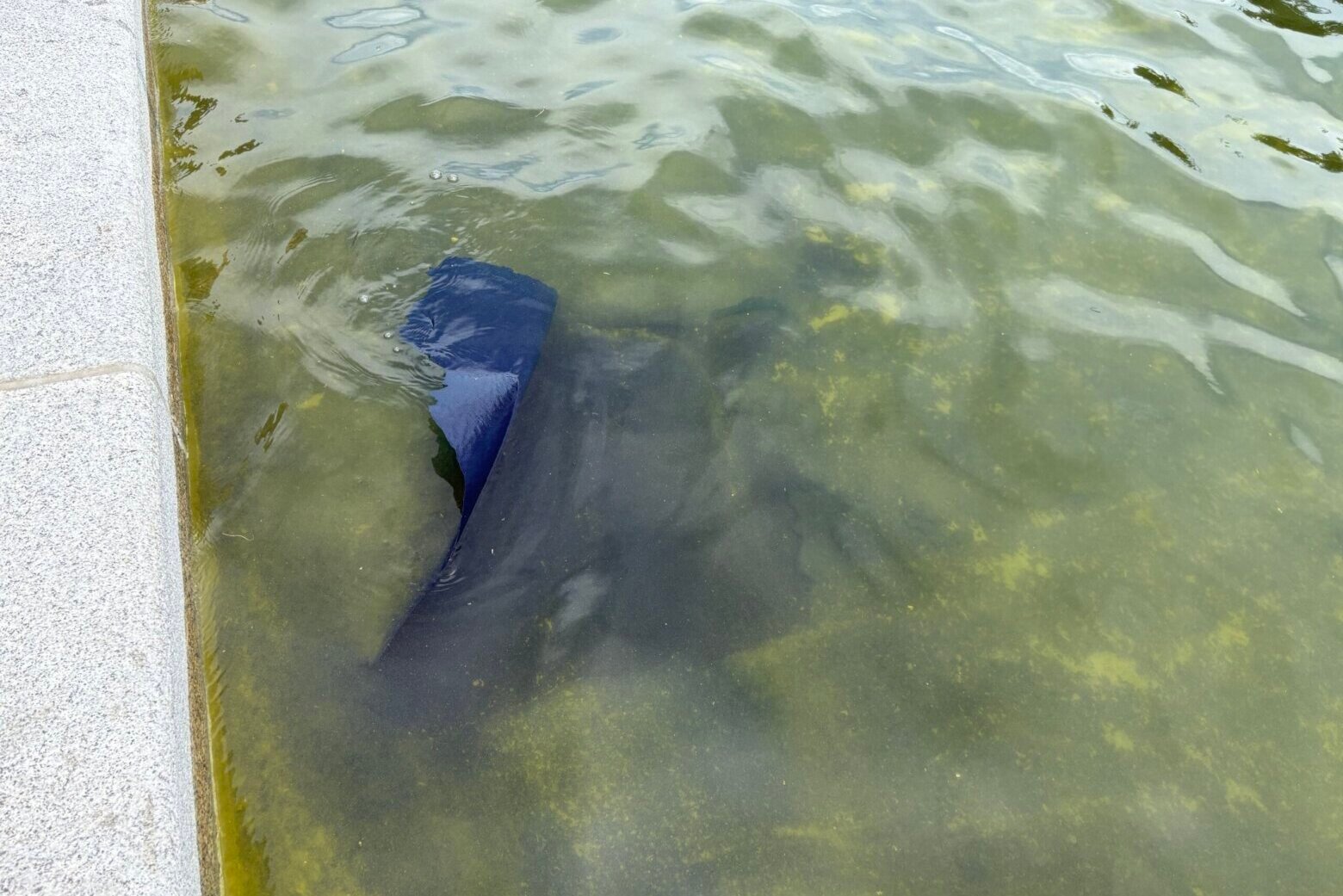
The bottom of the pool was painted at the direction of President Donald Trump and refilled with water about two weeks ago. Since then, algae that blooms in the Reflecting Pool every summer returned, making the pool green.
Crews have been scrubbing the algae out and using nanobubble ozone technology to try and clean the pool. Workers were recently seen dumping hydrogen peroxide in the water.
Thursday, some of the blue paint started lifting from the bottom. About half-way down the south side of the Reflecting Pool, a 2- to 3-foot section appeared to be peeling away near the pool’s edge. As the wind blew, the chunk rose above the water, ripping away from the bottom just a little bit more.
Derek Amspaugh visiting D.C. from Columbus, Ohio, stopped to take a look.
“It’s definitely concerning, yeah; you’re spending $11 million, you’d like to see quality work being done.”
The Trump administration has said the cost of the renovation is around $14 million.
John Ritter, who lives in Northern Virginia, suggested the issue could be emblematic of the Trump administration.
“It’s a bit of a metaphor, I think, for some of the other projects they are trying to do.”
It’s unclear whether the hydrogen peroxide, the scrubbing of the algae or the nanobubble technology being used has anything to do with the peeling.
As of Thursday afternoon, about a third of the pool looked clean and blue — the rest was the algae green color usually seen in the summer.
Get breaking news and daily headlines delivered to your email inbox by signing up here.
© 2026 WTOP. All Rights Reserved. This website is not intended for users located within the European Economic Area.


Hydration breaks are ‘like the Americanisation of football.’ #WorldCup #Football #BBCNews


Passenger describes people injured in Bedford train crash. #Bedford #Train #BBCNews


Meet Mexico’s new FIFA World Cup mascot Merlin the Duck! #FifaWorldCup #MerlinTheDuck #BBCNews


Trump comments spark diplomatic incident with Italy
In an interview with Italy's La7 TV, President Donald Trump claimed the country's Prime Minister Giorgia Meloni “begged” him for...


'A better brand': Democratic socialism popularity 'up like a rocket'
CNN chief data analyst Harry Enten examines what polling and prediction markets reveal about the recent rise of Democratic …


Passenger on Bedford train crash said ‘she’d lost a tooth’. #Bedford #Train #BBCNews


Why BookTok blew up over 'Hot Girls Read' trademark | Top Comment Podcast
The BookTok community has erupted after creator AllieRoseCo announced she had trademarked merchandise featuring the …


The world’s first ‘museum of AI arts’ opens in LA
Dataland, which calls itself the first museum dedicated to "AI arts" is opening in Los Angeles. But at a time...


Footage shows scene on board Bedford train after fatal crash. #Bedford #Train #BBCNews


Make sex education mandatory, says Labour MP. #College #Education #BBCNews
-

 Business6 days ago
How much of Musk’s wealth comes from government help? Virtually all of it
-

 Politics1 week ago
What to know about the stabbing that set off fiery riots in Northern Ireland
-

 LifestyleNews2 weeks ago
120 minutes of strength training per week may help extend lifespan
-

 Video1 week ago
Download fans say what they love about the festival. #DownloadFestival #BBCNews
-

 Video1 week ago
Why SpaceX IPO isn't about space. #SpaceX #ElonMusk #BBCNews
-

 HealthNews1 week ago
The people of Okinawa, Japan only eat until they are about 80 percent full, then stop — and the practice has been linked in multiple peer-reviewed studies to lower rates of cardiovascular disease, slo
-

 TravelNews1 week ago
My Paternal Instinct Should’ve Warned Me About Netflix’s Maternal Instinct
-

 Food7 days ago
Pope Leo’s plane was grounded. Then the King of Spain stepped in to help