

Tech
Trump unveils modified Qatari luxury jet meant for Air Force One


President Donald Trump has unveiled a new Boeing 747-8 jet for Air Force One that the Qatari government donated last year as an “unconditional” gift to the US.
The US military has finished modifications to the luxury jumbo jet, which has been valued at an estimated $400m (£300m).
“This plane was transformed into a flying White House at a level of luxury that nobody’s ever seen before,” Trump said in a speech at Joint Base Andrews on Friday.
The US Air Force said in a press release that the jet will begin initial commissioning flights – a “final exam” to test out the aircraft’s modifications – before it will be used to transport the president.
Modifications to the jet included upgrades in security, mission communications, logistics support, and advanced technology, the Air Force said. Any potential threats from the previously owned aircraft have been “neutralised”, it added.
The interiors of the aircraft have been minimally changed, and the exterior has received a fresh red, white, blue and gold paint job.
In May 2025, the Qatari royal family donated the luxury Boeing 747-8 to the US Department of Defense to be used as part of a fleet of planes dubbed Air Force One, which provides air transport for the president.
When news of the gift of the plane was revealed last year, it sparked backlash from both sides of the aisle, including from some Trump allies. Critics argued that accepting such a high-value donation posed a conflict of interest and may be unconstitutional.
While federal law indicates that US officials can only accept gifts under $480, the White House has insisted that accepting the aircraft is legal, and pledged that it will be donated to Trump’s presidential library once he leaves office.
“The workmanship of this plane is when you see it, you won’t believe it,” Trump said in his speech.
“Actually, the quality of woods, the quality of the materials, the quality of the engines – these engines are the finest, they’re the best in the world, nothing like it.”
“It’s really an honour,” the president added. “And I want to thank the Emir of Qatar.”
Prior to the addition of the Qatari jet, the Air Force One fleet included two 747-200B jets that have been in use since 1990. One of those older models appears to have now been phased out, according to White House communications director Steven Cheung.
“‘Well done, good and faithful servant'”, Cheung wrote on X, alongside a photo of the older plane. “The Last Ride,” he added.
The Air Force said the new jet will be used by the president on an interim basis until Boeing delivers its two long-promised VC-25B jets, which are meant for longer-term Air Force One use but have faced significant production delays.
Tech
Company owned by Trump donor won $1.7 million no-bid Reflecting Pool cleaning contract

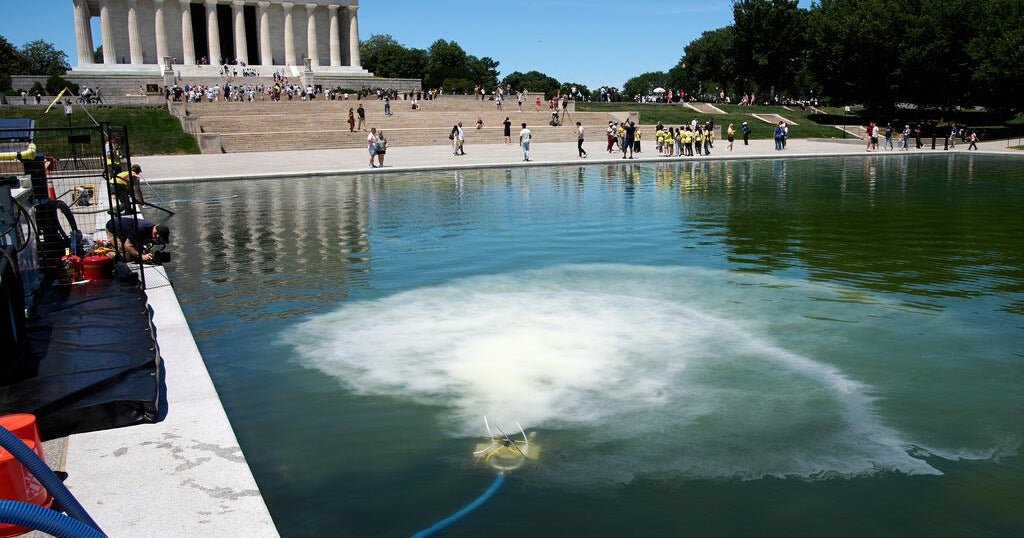
Washington — The federal government awarded a company owned by a Trump donor a $1.7 million contract to install a new water cleaning system for the Lincoln Memorial Reflecting Pool, federal records show, as President Trump pushes to overhaul the pool — and struggles with a bout of algae and a peeling paint job.
The no-bid contract to install a “Nano Bubble” filtration system went to Green Water Solutions, an Ohio-based company whose owner is listed on federal contracting documents as “JJ Cafaro Investment Trust.” The president and CEO of that trust is identified as John J. Cafaro on Federal Election Commission filings.
Cafaro has donated to several GOP candidates and conservative causes in recent years. He has donated extensively to Mr. Trump’s campaign and to Trump-linked groups, giving $250,000 to the Trump Victory fundraising committee at one point in 2020. FEC records show he also made donations to Democrats at various points.
A businessman and real estate developer, Cafaro pleaded guilty to campaign finance violations in 2010 over donations to his daughter’s congressional campaign. Nearly a decade earlier, he pleaded guilty to conspiring to bribe Democratic Rep. James Traficant, and cooperated with prosecutors.
Cafaro and his wife own a home in Palm Beach, Florida, less than a mile from the president’s Mar-a-Lago resort.
Green Water Solutions is also known as Greenwater Services. Inquiries to Cafaro did not yield a response, and the company referred CBS News to the National Park Service, a division of the Department of the Interior. The New York Times was first to report on Cafaro’s involvement in the Reflecting Pool project.
On its website, Green Water Solutions describes its specialty as purifying water to remove algae, bacteria and other contaminants using a system that injects ozone-infused “nano bubbles” into the water.
Federal contracting records show that the company received one other government contract: A $1 million contract in 2025 for a feasibility study on using its Nano Bubble system to treat sewage flows in the Tijuana River.
Green Water Solutions also appeared to do work on a Trump Organization property. On its LinkedIn page, the company posted photos of water treatment work it performed on a pond at the president’s golf club in Bedminster, New Jersey, more than a year ago.
Now, Green Water Solutions has been hired to take on the Lincoln Memorial Reflecting Pool, a century-old basin of shallow water that spans more than 300,000 square feet and has struggled with algae blooms for years. Mr. Trump has taken a personal interest in the Reflecting Pool’s overhaul, discussing the project at length, visiting the site and handpicking the color of an industrial-grade sealant that was installed on the pool’s stone floor: “American Flag Blue.”
Green Water Solutions was hired in April by the Department of the Interior to install a Nano Bubble system at the Reflecting Pool, replacing “the existing, failing filtration infrastructure.”
The contract was awarded without a full competitive bidding process. The government cited a contracting rule designed for projects of “unusual and compelling urgency,” pointing to the need to fix the Reflecting Pool in time for the nation’s 250th birthday on July 4. It also called the Nano Bubble system a “highly specialized and niche technology with limited domestic suppliers.”
White House spokesperson Taylor Rogers rebuffed any suggestion of a conflict of interest.
“This contract was awarded by the Department of Interior; the White House did not play any role in the selection process,” Rogers said. CBS News has reached out to the Interior Department for comment.
Cafaro on Friday told The Vindicator, a local newspaper in Youngstown, Ohio, that Mr. Trump “doesn’t know a thing about” his company’s work with the Reflecting Pool, saying he would “never talk to [the president] about it” because “you don’t do things to put friends in awkward positions.”
Cafaro also said, “I have no idea why this is an issue,” arguing “the system is working” to kill algae, and the public attention is driven by “people who don’t seem to like Trump.”
A separate $14.7 million no-bid contract was given to Virginia-based Atlantic Industrial Coatings to install sealant on the floor of the Reflecting Pool, federal contracting records show.
Several days ago, after water was pumped back into the Reflecting Pool, issues began to arise. A sheen of algae appeared in the water earlier this week, and by Thursday, the newly installed pool surface appeared to peel off in at least one location.
An Interior Department spokesperson said the algae bloom was caused by “residual algae” from stagnant water that sat in the pool’s supply lines, calling it “part of the normal startup process.” The department later said on X the Nano Bubble system “very effectively killed the algae.” CBS News has reached out to the department about the peeling sealant.
Work crews were then seen cleaning out algae and pouring hydrogen peroxide into the water. Also spotted in recent days: a Nano Bubble system.
Tech
Aura’s impressive e-ink photo frame doesn’t even look digital


What’s the most cliche possible gift you can give a relative? A digital photo frame, displaying a rotating slideshow of family photos. Now Aura has completely refreshed this product space with its gorgeous Aura Ink frame, which uses e-ink to create a display that doesn’t even look digital.
Digital frames have always been so popular (yet mostly disappointing) because there’s an undeniable allure to the idea of them — it feels like magic to imagine hanging artwork on your wall that you can change depending on your mood. In practice, these devices usually look clunky. You need to plug them in and figure out how to hide a bulky cord, and does anyone even want another bright screen in their home anyway? This problem was already on the Aura founders’ minds when they started the company 10 years ago, but color e-ink wasn’t feasible until now to use in a digital frame.
“E-ink is definitely next level,” co-founder and CTO Eric Jensen told TechCrunch. “We have people tell us that they hung it up, had friends over, and their friends were like, ‘How did you print that picture so quickly?’”
E-ink is the same technology that you see on e-readers, which lets you read a book without feeling the same strain that you get from staring at an LED screen for too long. But there aren’t that many color e-ink devices on the market aside from the Kindle Colorsoft, because the company that manufactures e-ink displays can only currently produce six colors: red, blue, green, yellow, white, and black.
It’s hard to imagine what your favorite family portraits and travel photos would look like with only six colors. But Aura has created a dithering algorithm — a technique that blends a limited color palette into patterns the eye reads as smooth gradients — that renders images close enough to the originals that its e-ink frame could finally go to market.
“I’m learning color theory from our chief scientists, and as far as I understand it, there’s not a good definition for how many colors this represents well,” Jensen said. “It’s all sort of theoretical and comes down to how people perceive it. Everyone’s a little different, so it’s actually taken a lot of testing with a lot of people in a lot of different spaces and different lighting conditions in order to get where we are today.”
All of Aura’s frames connect to the Aura app, which is where you can upload photos from your phone, web, email, iCloud, or Google Photos. I found the process to be pretty user-friendly — easy enough for a less tech-savvy relative to navigate, which matters for a product that lives or dies on whether non-technical users will actually set it up.
The app also has social features, so if your sister has a great new photo of her baby, she can upload it to your shared library and it will appear on your frame. (I didn’t try this, since I don’t know anyone else with an Aura frame, but if I did, I would probably use this feature to prank my family members with ridiculous photos. Am I a bad person?)
In addition to the 13.3-inch Ink frame, Aura also sent me its more classic, 12-inch LED Aspen frame as a point of comparison. But the LED frame surprised me with how good it looks in its own right (it feels like the Prada of digital frames). The lighting is about as unobtrusive as an LED screen can be, and it’s anti-glare, which makes the frame look way more premium. Aura’s frames also benefit by surrounding the LED screen with a paper-like matting display, which helps trick the eye into reading it as a printed photograph.
Aura says it designed its dithering algorithm for portraits of people, since users tend to highlight family photos. I’m a rebel, so I decided to load my frames with travel photos. When comparing the same photo on the Ink and the Aspen, it’s very clear that the colors aren’t exact, but as a digital photographer who isn’t that picky, I didn’t care very much. The distorted color palette almost seems like an artistic choice, even if I know it’s reflective of a technological limitation. But when I showed the two Aura frames to an analog film photographer who painstakingly studies the small color aberrations in his darkroom prints, he thought that the Ink frame needed some work. I disagree, but if you look at the photos below and are bothered that the white balance isn’t perfectly consistent across each of the three image from my phone, then you might not like the Ink frame.
By default, the Ink frame changes photos once per day, and it will usually do this change in the middle of the night, when you’re least likely to be paying attention. If you manually change the pictures via the app, do not be alarmed if the frame looks like it’s glitching — it takes about a minute for the hardware to run the dithering process and render the six-color, e-ink version of your image.
I am very bad with anything involving hammers and nails — all of the art in my apartment is hung up using Command strips — but mounting hardware that Aura includes feels sturdy. It’s easy to take the frame on and off the wall, but you probably only will need to take it down to charge the frame via USB-C once per month. (When the lights are off or you’re not in the room, the display will go to sleep, helping save battery.) I don’t think that the Ink frame looks too out of place, but if it does, maybe it’s because it’s surrounded by art made in other mediums. Or maybe it’s the black frame. Or I did a bad job at placement. Look, I can’t help that I added the Ink frame to a gallery wall that I assembled three years ago!
Tech
Blue paint seen chipping off in Lincoln Memorial Reflecting Pool after algae turn it green


WASHINGTON — President Donald Trump’s makeover of the Lincoln Memorial Reflecting Pool ahead of America’s 250th anniversary celebrations is not going according to plan.
First, the project overshot Trump’s initial cost estimate of under $2 million — and has already topped $14.6 million, according to a federal spending database.
Then, the new Trump-branded “American flag blue” color was short-lived as algae turned the pool green, causing the administration to send crews to dump hydrogen peroxide into the expansive pool to deal with the problem.
In recent days, NBC News spotted some blue paint chipping off the surface, with strips of it peeling away and floating atop the pool for visitors and passers-by to see as the busy summer tourist season in the nation’s capital gets underway.
On the west side of the pool Thursday, a small section of the blue painted surface appeared to be lifting away, exposing the darker unpainted layer underneath. A strip of detached paint could be seen floating beneath the water’s surface.
Algae still remain visible along the edges of the pool despite ongoing cleaning efforts. The developing deterioration drew the attention of onlookers who stopped to take a closer look.
The Trump administration is hardly the first to struggle to clean up the Reflecting Pool. But the algae-infused green color has drawn significant attention in recent days after the president slammed the pool earlier this year as “filthy” and “dirty,” promising to make it “beautiful” and blue at minimal expense.
The Interior Department’s media office didn’t return an email seeking comment Friday.
Two days earlier, on Wednesday, the department’s X account posted that the “advanced nanobubbler technology very effectively killed the algae,” while taking a jab at the Obama administration’s attempts to clean the pool up.
“The Reflecting Pool water is crystal clear, and our National Park Service team is now vacuuming up the dead algae resting on the bottom of some parts of the Reflecting Pool—just like the destroyed Iranian Navy resting on the bottom of the Persian Gulf,” the Interior Department wrote.
Last week, Interior Secretary Doug Burgum posted a time warp of the blue paint being added to the pool’s surface.
Tech
Algae turns reflecting pool green after repainting. Here’s why : NPR

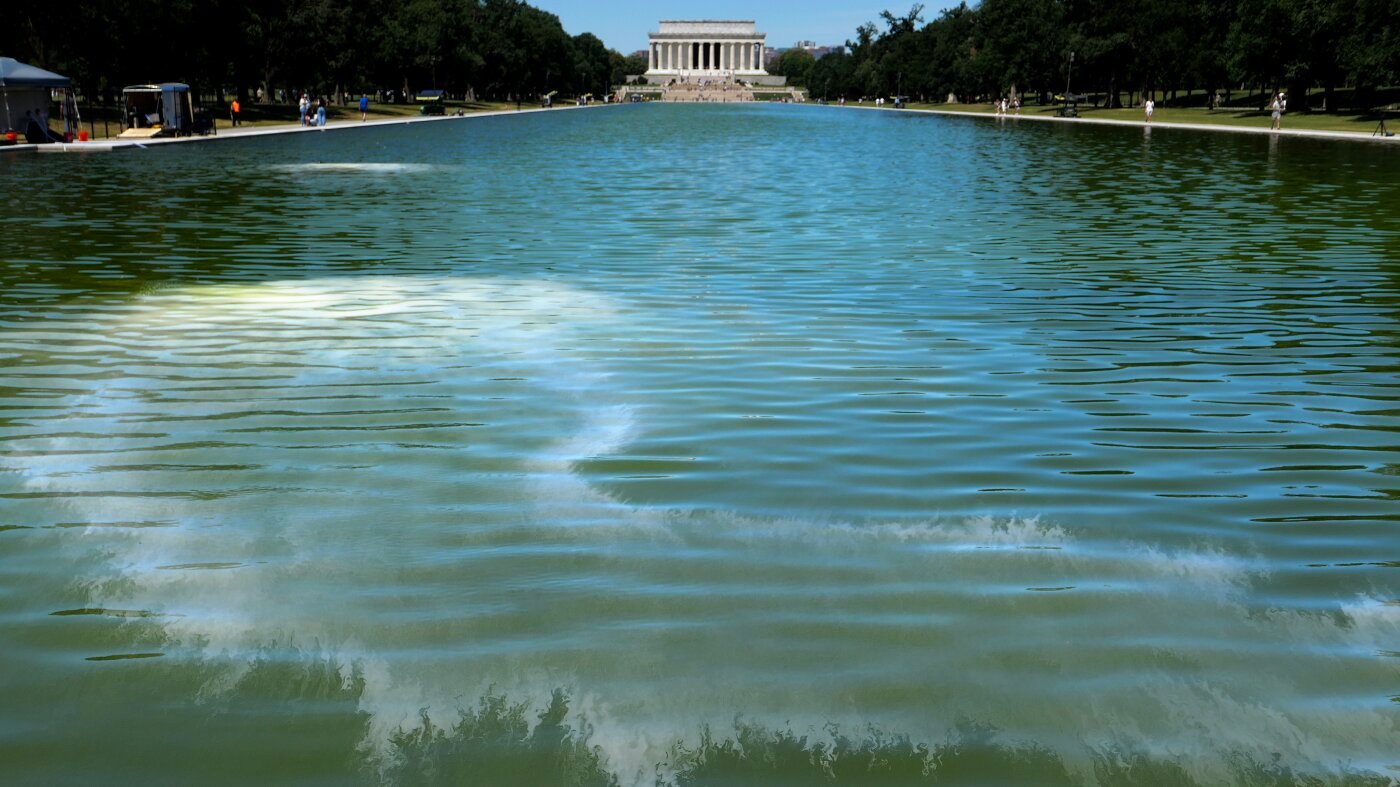
WASHINGTON — The Lincoln Memorial reflecting pool is once again making headlines, this week for turning green.
The Washington, D.C. landmark was refilled with water earlier this month after President Trump had its neutral grey bottom repainted “American flag blue.” The multi-million dollar project produced subtle results in the eyes of many observers, even as Trump and Secretary of the Interior Doug Burgum — whose agency managed the renovation — touted its success.
In recent days, however, the pool has taken on a verdant hue — the result of algae blooms that experts say are to be expected in these conditions.
“It’s called ‘New Pond Syndrome,'” says Steve Goodale, a Canadian swimming pool specialist known online as “Swimming Pool Steve.” “It’s a known thing that happens when you take a natural, clear body of water like this that sits in an open air environment and you try to start it up, very often you end up with green water almost immediately.”
Goodale says the process took longer — a matter of days — to unfold in this case likely due to the sheer size of the pool, which measures 2,030 feet long and has a surface area of approximately 338,000 square feet.
“Excellent conditions” for algae growth
Rosalina Stancheva Christova, a professor of aquatic ecology at George Mason University in Virginia, took water samples from the pool on Tuesday. She confirmed the algae belongs to the genus Desmodesmus, which she said is “growing in excessive amounts” but is not toxic or harmful.
Christova says this kind of common green algae is found all over the region, especially this time of year. The reflecting pool in particular provides “excellent conditions” for algae growth, she said: shallow, stagnant water, strong sunlight and no shade.
“It could happen every single summer,” she added. “But it seems that the disturbance of the pond during the renovations [is] accelerating this process.”
Christova said last month’s renovations may have affected the balance of nutrients in the pool, potentially accelerating the algae blooms. Goodale similarly views the resurfacing as one of several contributing factors.
“The new, darker interior surface is going to absorb more sunlight,” Goodale says. “It is going to result in water that’s warmer, and that ultimately is going to lead to more prolific algae growth.”
The Trump administration has said the algae came from residual material in supply lines that had lain dormant for weeks. Their growth was likely exacerbated by the extreme temperatures that hit D.C. last week, bringing heat index values to 95 degrees and above.
Algae has resurfaced in the reflecting pool periodically over the years — including immediately after it reopened from its last major renovation in 2012, forcing the National Park Service to drain it, refill it and recalibrate its ozone level. And in 2019, crews had to drain four million gallons from the pool to fix a broken water line that had algae growing in it.
An Interior Department spokesperson told NPR over email that algae and other contaminants have “long plagued the Reflecting Pool since 1922,” pointing to the Obama-era renovation as an example.
“Unlike under Obama and Biden, the National Park Service is actually maintaining the beautifully completed Reflecting Pool,” they added.
Responding with tiny bubbles and big vacuums
The Trump administration is using a mix of mitigation strategies, including pouring hydrogen peroxide into the water to kill the algae.
The Interior Department says hydrogen peroxide is a “milder treatment than chlorine and is used in spas and specialty pools like natural swimming pools,” adding “there are no harmful side effects to marine life or to the environment.”
Workers are also deploying what the department calls “high-tech nanobubble ozone technology” to neutralize algae and other pathogens in the pool. The department says that approach is validated by several universities and the National Oceanic & Atmospheric Administration.
Those ozone bubbles are so tiny the human eye can’t even see them, Goodale says.
“The best way to describe it is that the bubbles are neutrally buoyant, so they won’t just rise to the surface and disappear readily,” he explains. “They can last for weeks, if not months in the water, doing their oxidizing thing and keeping the algae at bay.”
‘A monumental effort’
Goodale says it’s more complicated than treating the average backyard swimming pool, since the reflecting pool — despite its name — is actually more akin to a “manmade shallow lake.” He says it’s hard to predict just how long it will take to completely solve the algae problem, calling it “a monumental effort, literally.”
The Interior Department posted on X Wednesday that the nanobubble technology had “very effectively killed the algae,” and National Park Service crews would spend several days vacuuming up the dead algae from the bottom of the pool.
But as of Thursday morning, much of the pool — especially in the center — was still bright green.
Work continued on both ends of the pool. Nanobubble machines deposited their tubes into the water, as mobile vacuuming systems known as “trash pumps” hummed loudly from the shore. Handfuls of workers stood either in the pool or on the edge maneuvering long-handled vacuums back and forth. Their contents, including pistachio-colored water, poured out of hoses laying in the nearby grass.
The work zones were marked off by orange cones, but passersby walking the length of the pool appeared relatively unfazed. Some stopped to peer down and snap pictures of the water itself — including sections of paint that had visibly peeled off — while others were more focused on getting a photo of the Washington Monument in the background.
Loay Hidmi was walking deliberately along the edge of the pool closest to the Lincoln Memorial, hands clasped behind his back, looking over the ledge. The relatively new D.C. resident is a civil engineer who specializes in water treatment, and has been coming by the pool all week to see the progress for himself. He estimates it’s about 80% of the way there.
“I’m taking pictures of it … for the last week and I can see the gradual change,” he said. “So I’m hopeful. But we’ll have to see if it gets sustained.”
What happens next?
Hidmi worries that the algae could come back, given the favorable conditions posed by the sunny, shallow pool.
He acknowledges that’s mostly an aesthetic concern, given how much the administration has just spent on repainting the pool, but says it also raises questions about their process.
“In water systems, when you fix something, you need to look at the step before it and the step after,” he said.
Goodale agrees. He says that when a water system is taken offline, the pipes still remain full of water — “they don’t just gravity-drain away” — and need to be flushed out before any refilling. And he says eliminating algae is no substitute for dealing with underlying filtration issues.
“That’s like the equivalent of mowing the lawn when perhaps it needs to be something else that addresses the source nitrates and phosphorus, so that it’s more like pulling the weeds out by the root,” he says.
In the meantime, Christova, the algae expert, would like to see the water monitored weekly.
“If we don’t have any control over algal growth, we don’t know what is growing,” she said, adding that not all types of algae are as harmless as the one currently blooming in the pool.
When asked about plans for maintenance and algae prevention, White House spokesperson Taylor Rogers told NPR: “Thanks to President Trump, new lining and industrial grade materials will permanently seal the Reflecting Pool, which previously leaked 16 million gallons per year and wasted countless taxpayer dollars.”
Even after the Obama-era renovation, the reflecting pool suffered from broken pipes and water leaks requiring costly refills, according to a Department of the Interior report from fiscal year 2023. It called for new expansion joints, supply and return lines with thicker walls, saying “an improved distribution system will ensure the water can be circulated through the treatment plant, filtered, and treated with ozone.”
This latest renovation does not appear to have addressed the pipe problems, even though it did involve replacing failing expansion joints, resealing the pool, removing truckloads of garbage and “fixing the water system, drainage and so much more,” as Trump wrote on Truth Social in May.
Along the way, the cost of the project grew from Trump’s initial $2 million price tag to at least $14 million. Federal contract records show the government is paying $1.7 million to an Ohio-based company for the nanobubble technology alone.
“The scope of the Project has been greatly enlarged as we became involved because we realized how important it would be to Washington, D.C., and the record number of visitors coming to our now very safe Capital for all of the upcoming events in celebration of our 250th Anniversary,” Trump wrote.
Tech
Qualcomm Is Copying Samsung Exynos 2600’s Heat Path Block For Snapdragon 8 Elite Gen 6 Pro, But Has Botched The Implementation

Imitation remains the highest form of flattery. After Samsung won plaudits for the Exynos 2600’s novel Heat Path Block (HPB) thermal technology, Qualcomm, whose recent chips iterations have resembled a veritable inferno when it comes to their runaway heat issues, now appears to be flattering Samsung by copying its HPB tech for the upcoming Snapdragon 8 Elite Gen 6 Pro, albeit sloppily so.
Qualcomm appears to be trying to tame the furnace-like credentials of its Snapdragon chips by emulating Samsung’s most innovative thermal solution
While clarifying that Qualcomm has prepared two and not six versions of its Snapdragon 8 Elite Gen 6 Pro chip for the upcoming Samsung Galaxy S27 series, the tipster Reptalica has just dropped a bombshell of sorts: Qualcomm’s flagship chip has implemented a version of Exynos 2600’s HPB tech, though the implementation “isn’t as effective.”
For the benefit of those who might not be aware, Exynos 2600 features a copper-based heat sink, dubbed Heat Path Block, which remains in direct contact with the AP.
Of course, the upcoming Exynos 2700 is expected to sport a new thermal solution, called Side-by-Side (SbS), where individual dies for the AP and the DRAM are stacked horizontally, and a copper-based heat sink, called Heat Path Block or HPB, is placed on top.
Meanwhile, based on a previous estimate, the non-binned version of the Snapdragon 8 Elite Gen 6 Pro can cost upwards of $300. This means that only the most premium of smartphones, such as the Galaxy S27 Ultra, will be able to sport the standard Snapdragon 8 Elite Gen 6 Pro, while others will either opt for the vanilla Snapdragon 8 Elite Gen 6 or a binned version.


USA beats Australia to secure spot in World Cup knockout rounds
After defeating Australia 2-0, the United States will move on to the knockout rounds of the 2026 World Cup. CNN's...


What time is Brazil vs Haiti? World Cup lineups, live updates, channel
Editor’s note: Follow all of Friday’s World Cup action live! PHILADELPHIA — Carlo Ancelotti heard the reactions and post‑match analysis...


As Trump threatens Iran, the peace plan finds setbacks
Trump says Iran must reach a deal or the US will do things that "won't make them happy". Meanwhile, teams...

Company owned by Trump donor won $1.7 million no-bid Reflecting Pool cleaning contract
Washington — The federal government awarded a company owned by a Trump donor a $1.7 million contract to install a...


One dead and 11 very seriously injured in Bedford train crash | BBC News
One person has died after two trains collided in Bedford, UK, according to British Transport Police. The East of England...


Brazil vs. Haiti prediction, odds, line, start time: 2026 World Cup picks, best bets
Brazil can take a big step toward the knockout stage on Friday when they take on Haiti in a battle...


Central Park horse carriage rides suspended following fatal accident
Central Park horse carriages have been temporarily banned days after an 18-year-old man was killed when he got off one...


Hydration breaks are ‘like the Americanisation of football.’ #WorldCup #Football #BBCNews


Passenger describes people injured in Bedford train crash. #Bedford #Train #BBCNews


Meet Mexico’s new FIFA World Cup mascot Merlin the Duck! #FifaWorldCup #MerlinTheDuck #BBCNews
-

 Business6 days ago
How much of Musk’s wealth comes from government help? Virtually all of it
-

 Politics1 week ago
What to know about the stabbing that set off fiery riots in Northern Ireland
-

 LifestyleNews2 weeks ago
120 minutes of strength training per week may help extend lifespan
-

 Video1 week ago
Download fans say what they love about the festival. #DownloadFestival #BBCNews
-

 Video1 week ago
Why SpaceX IPO isn't about space. #SpaceX #ElonMusk #BBCNews
-

 HealthNews1 week ago
The people of Okinawa, Japan only eat until they are about 80 percent full, then stop — and the practice has been linked in multiple peer-reviewed studies to lower rates of cardiovascular disease, slo
-

 TravelNews1 week ago
My Paternal Instinct Should’ve Warned Me About Netflix’s Maternal Instinct
-

 Food7 days ago
Pope Leo’s plane was grounded. Then the King of Spain stepped in to help