

Food
Newsom declares state of emergency in Los Angeles for Boyle Heights warehouse fire

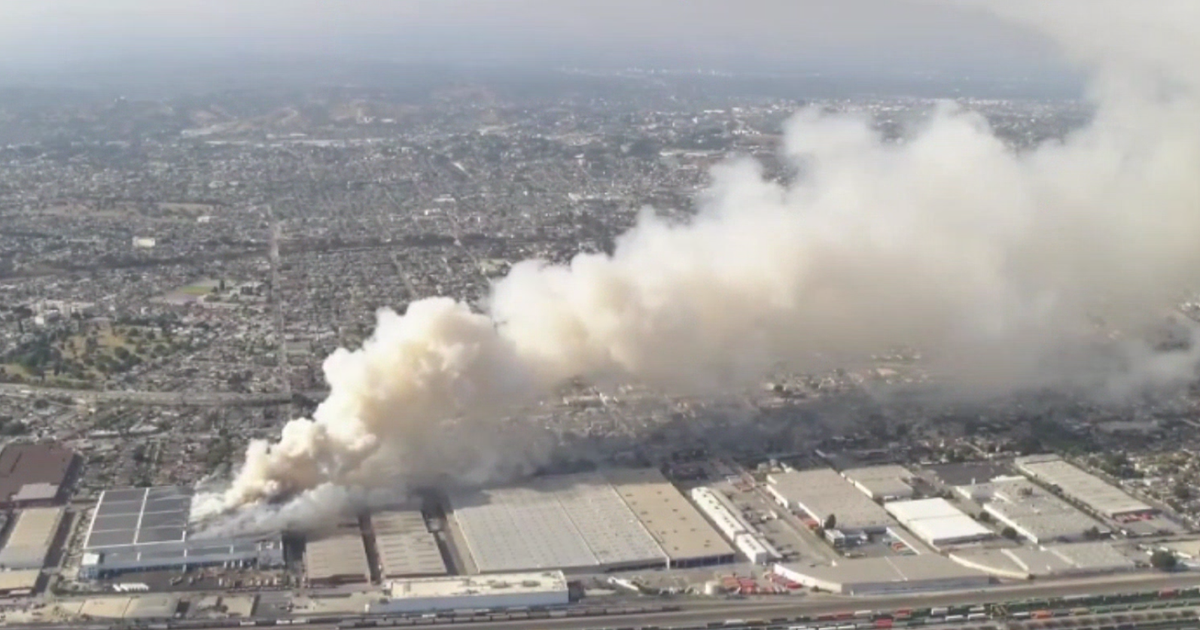
Firefighters faced renewed challenges Saturday at a large Boyle Heights cold storage facility fire, where conditions remain highly complex as Gov. Gavin Newsom and Mayor Karen Bass declared a local emergency to support response efforts.
The fire was first reported on Wednesday afternoon at the 500,000-square-foot Lineage Big Bear facility at 1400 S. Los Palos Street, which is used to store frozen foods.
“The best way to describe this is like a giant cooler,” said LA Fire Chief Jamie Moore, who added that the structure was built with corrugated steel walls filled with dense foam insulation and reinforced interior steel panels.
The building also used ammonia in its refrigeration system to maintain extremely low temperatures for frozen food storage, which may have fueled the fire on its initial day of burning.
“Imagine your refrigerator having a fire. And so, you have the shell of the outside and the shell on the inside,” Moore said during a news conference on Saturday afternoon. “What protects everything from the weather, or whatever the temperature is on the outside, is the rubber. … If you can imagine, that’s exactly what’s happening here.”
He said that with the help of water-dropping helicopters, LAFD crews have controlled the fire to approximately half of the building. The unaffected half, however, is filled with food that has begun to thaw as they had to turn off the refrigeration system and remove ammonia from inside. He said that the internal temperature of the building remains at around 45 degrees because of the insulation.
Moore said the nature of the materials inside has made the fire difficult to control, as the foam insulation continues to burn slowly once ignited.
Crews have relied on continuous helicopter water drops since the start of the incident to keep the structure cooled and prevent further escalation. Officials have also used large aerial ladder pipes, directing thousands of gallons of water per minute onto the building to contain the blaze.
“We stepped up our game. I reached out to the county and we started using contract helicopters,” Moore said. “Our contract helicopters … drop about 3,000 gallons of water at one time. On top of that, we’re able to incorporate blaze tamer gel, which is a fire retardant gel, which is gonna help encapsulate the smoke … and smother the fire.”
So far, he said that the process has been effective as they’ve helped cool things down and further mitigate the fire burning the roof.
At around 5:10 p.m. on Sunday, aerial footage showed another flare-up in the fire on the roof of the building. Another massive plume of smoke extended into the air as the fire appeared to be burning down the exterior wall and onto a lower roof.
85 million pounds of frozen food complicate firefighting efforts
With an estimated 85 million pounds of frozen food still inside the facility, firefighters say access is extremely limited due to zero visibility and unstable interior conditions.
“All that food is slowly beginning to rot. It’s no longer frozen. It’s warming up and it’s going to start to spoil,” Moore said. “Initially it was reported to us that the majority of that product was bread and wheat products. However, we’re slowly learning as we get into this building that it’s far from that; there’s a lot of meat products.”
Moore said that chicken, beef, pork and fish were being stored inside.
Officials stressed that crews are not entering the building or attempting to manually remove product. Instead, they are working to isolate unaffected areas while evaluating how to safely remove remaining goods before spoilage creates additional biohazard concerns.
“What we are trying to do now is to figure out the uninvolved area – how we can remove that food before it starts spoiling and becoming a biohazard concern,” Moore added.
Authorities said hazardous material risks have largely been mitigated, but the situation is now shifting toward potential biohazard issues as food inside the facility remains unrecovered. Officials emphasized that the priority is determining how to safely manage and remove the stored product while maintaining containment.
No injuries reported; no evacuation or shelter-in-place orders issued
Despite the severity of the incident, officials noted that no firefighters or civilians have been injured. Residents were advised that while smoke may be irritating—particularly for those sensitive to air quality—there is currently no order for evacuation or shelter-in-place, despite a similar order already having been issued and lifted twice since the fire’s ignition.
“If you are sensitive to smoke, please be cognizant of that and try to stay indoors,” cautioned Moore. “But there is nothing in the air that is so dangerous that we have to do evacuations or even shelter-in-place.”
Mayor Karen Bass said her chief concern was for the public’s safety and health.
“We’re not concerned in terms of the fire spreading or anything like that. But we are concerned about the biohazard smoke. No smoke is good, but especially the smoke that could be toxic because of the chemicals that were needed to keep the food frozen in the facility,” Bass said.
Two shelter locations have opened to support anyone affected by the fire, including at the Pecan Recreation Center, which is located at 145 S. Pecan Street, Los Angeles, CA 90033 and City Terrace Park, which is located at 1126 N. Hazard Avenue, Los Angeles, CA 90063.
“We are going to be distributing masks and air filters, thank you to the Red Cross and our other partners,” said Bass, who said she anticipates talking to Governor Newsom later in the day to issue a joint emergency declaration.
“The Governor will be prepared to respond to our State of the Emergency when that is ready with whatever resources we need to do what the Chief described, which is moving the toxic materials away from here and disposing of them in a way that we will avert a major environmental disaster,” Bass said. “This is about prevention. This is about protecting our public’s health.”
Bass, Newsom issue emergency declaration for resources
By Saturday night, both the mayor and Gov. Gavin Newsom had issued emergency declarations, citing the scale and complexity of the incident.
The declaration is intended to provide the city with greater flexibility to coordinate emergency response efforts, secure additional resources, conduct environmental remediation, and seek state and federal assistance.
“While the LAFD continues making progress, this is a major, multi-jurisdictional incident. I’m issuing an emergency declaration to ensure the City has the resources it needs as this operation continues and to keep the community safe,” said Mayor Bass. “The City and County have opened spaces for families seeking relief from the smoke, and we will continue working around the clock and doing everything possible to put this fire out completely.”
During Saturday afternoon’s news conference, Bass said that the joint state of emergency was filed with Newsom’s office.
She said that the Emergency Operations Center has been activated and that they’ve asked Newsom to waive regulations that could hinder response and recovery efforts, and that recovery assistance be made available through the state.
“We basically told the governor that we will be in touch from the county and the city in terms of ongoing requests for mutual aid as well as monetary assistance so that we can get this job done,” Bass said. “Our concern, obviously, is putting out the fire, but to learn what was in this storage center … really presents an entirely different picture.”
LA County Supervisor Hilda Solis also spoke at Saturday’s conference.
“I’m deeply concerned about the impact on our residents,” Solis said. “The radius of the fire extends to about 2.5 miles. In unincorporated East Los Angeles we’re talking about 250,000 households. That’s why this is important.”
Gov. Newsom’s office shared a statement regarding the emergency proclamation late Sunday night, which they said would enable the state to further support the ongoing local response.
“California is mobilizing to support Los Angeles as firefighters and emergency personnel continue their work to contain this fire and protect surrounding communities,” Newsom’s statement said. “While local officials continue to lead this response, the State of California is prepared to help safeguard public health, support emergency operations, and assist impacted residents. We are coordinating closely with our local partners, deploying specialized expertise, and pre-positioning critical supplies so communities have the support they need both now and throughout recovery.”
Among the resources being deployed to Los Angeles were 5.5 million N95 respirator masks, commercial-grade air purifiers for evacuation centers, bottled water and emergency supplies and additional air quality monitoring equipment.
Additionally, California Office of Emergency Services Fire and Rescue Branch leaders with “specialized technical expertise” are en route to work with local officials to provide consultation on suppression strategies and operational considerations, according to the release.
Residents question long-term health impacts
As suppression efforts continued, residents voiced concerns about the potential long-term environmental and health impacts on the surrounding community.
On Saturday afternoon, South Coast Air Quality Management District officials said that a particle pollution advisory was extended until at least 12:30 p.m. Sunday. They said that after the fire’s reignition on Friday night, sensors showed that PM2.5 levels were unhealthy.
Two smoke relief centers have been opened for people impacted by the incident. They can be found at:
Pecan Recreation Center at 145 S. Pecan Street
City Terrace Park at 1126 N. Hazard Avenue
Lineage, the building’s tenant and operator, released a statement indicating that the fire may have originated from work being performed by a third-party contractor handling solar panels on the roof.
“Lineage is the tenant-operator of this building,” the company said in a statement. “At this time, we believe the fire began while testing was being conducted by contractors of the third-party owner of the solar array located on the facility’s roof. This facility is not used for the storage of hazardous materials. It primarily serves as a temperature-controlled storage facility for frozen food before it makes its way to Greater Los Angeles area communities and beyond. Our understanding from LAFD and AQMD is that there have been no measurable ammonia concentrations recorded in the community since the fire started. Additionally, Lineage has proactively taken additional steps to pump out the ammonia and transport it offsite, removing the possibility of ammonia posing a risk to the community. This facility and the supply chain it connects with employ hundreds of local jobs. We are grateful that no team members at the facility were harmed.”
Meanwhile, fire crews continue to monitor the structure and adjust tactics as they work to contain the long-burning industrial fire and reduce environmental and health impacts to surrounding communities. Authorities cautioned that extinguishing the fire could take days or even weeks.
“I do want to be transparent to the public: this work is far from over. Because of the massive scale of this cold storage facility, deep pockets of smoldering fire remain buried under structural debris and solar panels,” said Los Angeles County Fire Chief Jon O’Brien. “Our city firefighting brothers and sisters are executing a meticulous, deeply challenging operation to bring the fire under control. Because of this, incident operations will continue into the foreseeable future.”
Food
What we know about the Boyle Heights warehouse fire
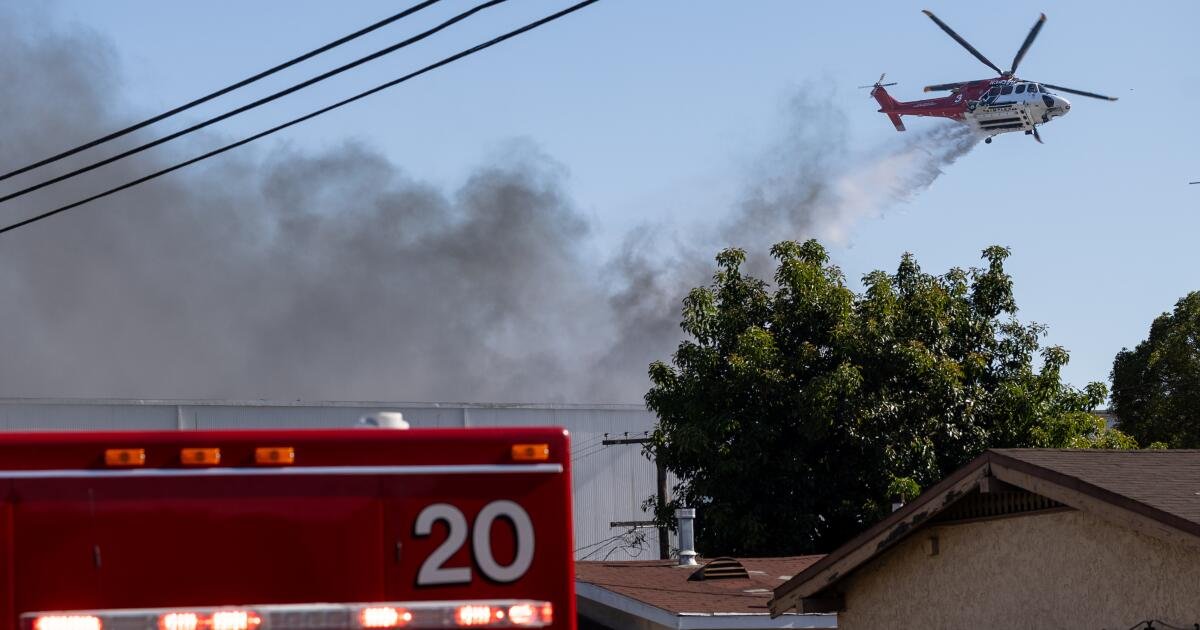
Los Angeles declared a state of emergency due to a stubborn warehouse fire in Boyle Heights that has burned for days.
Here’s a rundown of what we know:
What do we know about the cause of the fire?
Lineage Logistics, the tenant-operator of the building, said in a statement that it believes the fire began while third-party contractors were testing the solar array on the roof.
What does a state of emergency mean?
The declaration activates the city’s emergency response structure, directs departments to assess damages and costs, and requests state assistance to support firefighting, cleanup, environmental monitoring and community recovery efforts. As of Saturday afternoon, the state has not declared an emergency.
Why has it been so hard to put out?
The fire broke out Wednesday and has burned for fourdays.
The 500,000-square-foot commercial building stores 85 million pounds of frozen food “like a giant cooler,” said Los Angeles Fire Department Chief Jamie Moore. The corrugated steel walls are filled with very dense foam that is burning slowly and emitting gases despite ongoing water drops from helicopters.
LAFD Chief Deputy Jon O’Brien said Saturday that deep pockets of smoldering fire remain buried under structural debris and solar panels.
The building is so big and the flames are in such hard-to-reach areas that firefighters have needed to get creative with their approach, using water-dropping helicopters and other heavy equipment.
What are the air quality and health impacts?
Moore cautioned people with lung issues or smoke sensitivity to avoid outdoor activities, but said crews have mitigated hazardous materials at the site. However they remain concerned about biohazards potentially posed by spoiled food.
L.A. County Health Officer Muntu Davis said the main public health concern was smoke and fine particles that can cause irritation of the ear, nose, throat and lungs, as well as exacerbate heart and lung conditions.
Sensitive individuals were encouraged to wear well-fitting N95 and P100 masks, and to register for emergency notifications at alertla.org.
What about the battery risk?
Officials have spoken of the possibility of lithium-ion batteries within the building. Batteries are often used to store energy produced by solar panels, although officials could not immediately confirm whether that was the case in Boyle Heights.
However, they said the building does house about 60 forklifts that run on lithium-ion batteries, although those are “currently unburned.” The threat posed by the batteries was at least mitigated when 56 of the forklifts were moved or isolated from the flames in a dangerous operation, LAFD Battalion Chief Nicholas Ferrari said.
Food
Colombia’s brutal internal conflict is defining its presidential election

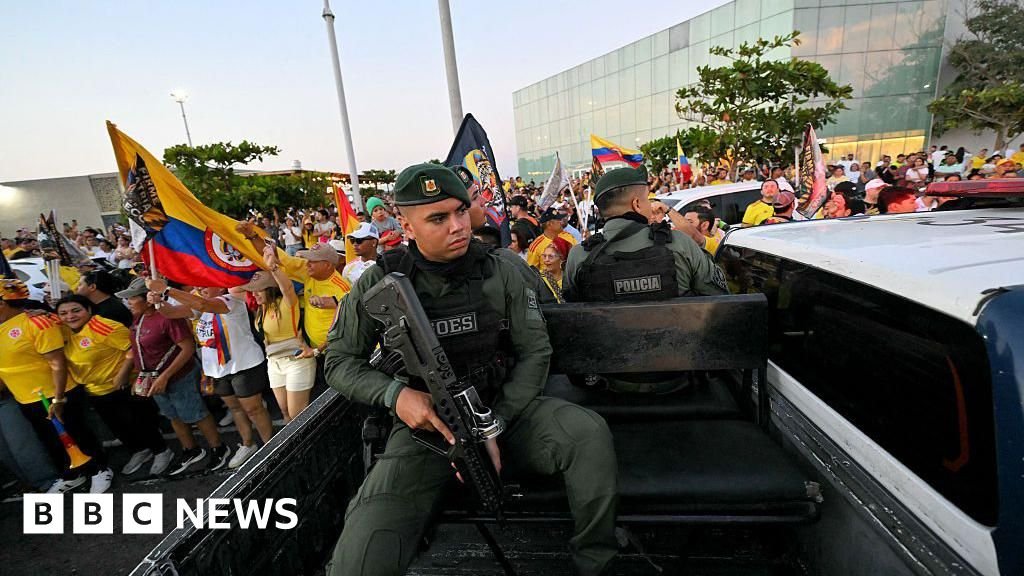
Colombia’s escalating, brutal internal conflict is defining its presidential election
“My brother was murdered for not paying an extortion payment…in front of his children,” Edilma Martinez Flores said at a support centre for displaced people in Bogotá.
She fled her home on the outskirts of Cali, in the south-west, after armed criminal groups handed out leaflets ordering residents to leave or face violence.
“We had no choice but to leave our things behind. They started placing bombs along the routes people travel.”
Edilma is far from alone, and experiences like hers are why insecurity is dominating voters’ minds in Sunday’s key presidential election.
Colombia’s six decades of conflict between armed groups, the state and cartels has killed hundreds of thousands of people.
It isn’t new, but illegal armed groups have roughly doubled their membership in the last five years.
These include Revolutionary Armed Forces of Colombia (FARC) dissident factions, the National Liberation Army (ELN) and the Clan del Golfo, who have expanded their control of rural areas key to drug trafficking and illegal mining.
A brutal offensive between the ELN and FARC dissidents near the Venezuela-Colombia border last year displaced tens of thousands of people.
The two presidential candidates have starkly different visions for tackling this violence, in a campaign marked by the assassination of a presidential candidate, homicides, kidnappings and bombings.
Left-wing senator Iván Cepeda is seen as the “architect” of the current president Gustavo Petro’s “total peace” strategy, prioritising negotiation with armed groups. Critics say it has failed and let armed groups exploit ceasefires to expand their control. Supporters argue it prevents a larger loss of life.
He also played a key role in the 2016 peace deal which disarmed thousands of FARC fighters.
He has pledged “social transformations that the country urgently cries out for” while promising to “take stock” of the peace strategy and “make the necessary changes”.
His challenger is a conservative outsider, right-wing businessman and lawyer Abelardo de la Espriella, who calls himself El Tigre (The Tiger in English). He’s been endorsed by Donald Trump, and is a US citizen. The signature outfit for him and his supporters is the Colombian football shirt, which the left has accused him of politicising.
He has promised 10 mega-prisons, a tough military crackdown, and an end to negotiations with armed groups, saying he has the “balls” to take them on.
“Any criminal who does not surrender will be taken down,” he has promised.
For many Colombians, how this issue is tackled will have a huge impact on their lives.
Isabelita Mercado Pineda, a government advisor for peace, victims and reconciliation in Bogotá, says forced displacement rose 300% between 2024 and 2025.
“We have not seen displacements like this for the last two decades,” she added.
She said it has been driven by factors including rising cocaine production, the army failing to occupy territories left by the FARC after it demobilised in 2016, leaving voids for armed groups to fill, and a “failure” of the government’s strategy that she argued provides criminal groups with “carrot but not enough stick”.
The support centre for victims in Bogotá shows the scale of this issue. Erin Gamboa from the Chocó region on the Pacific Coast said his half-brother was taken by FARC guerillas and they have not heard from him since.
“My region is heavily contested, criminal gangs fight over the territory,” he said, outlining how paramilitaries, guerillas and the FARC fight over illegal mining and cocaine trafficking sites.
Another couple, who wanted to remain anonymous, said their small food delivery business was contacted by a man claiming to be from the FARC. He began extorting their children, demanding 5 million pesos (about $1,500; £1,100).
Through tears, the woman described how crime has grown “so much” and you “can’t go out in peace anymore”.
Trump’s endorsement of de la Espriella, criticised by the left as foreign interference, comes as the US takes a more interventionist stance towards criminal groups in Latin America.
Trump said the election would determine Colombia’s relationship with the US, adding that “if Abelardo wins…[Colombia] will have the total support and strength of the United States behind him”, and called Cepeda a “radical left Marxist”.
De la Espriella grew up on Colombia’s Caribbean coast where he retains strong regional support.
Maria Luisa Sanchez, a childhood family friend and neighbour, said de la Espriella has “achieved everything he has set out in life, he is a man with very strong convictions”.
“He has that character, courage, it’s what we need for Colombia, a person … who is tough on drug-trafficking, tough on guerillas.”
Supporter Sandra Caballero, from a village outside of Barranquilla, said he “will work with the United States to fight drug trafficking and doesn’t plan to speak with criminals – which has not given results in four years”.
“He wants to change taxes to help companies generate more jobs and invest in security and health.”
Cepeda, on the other hand, has the lead among younger voters in Colombia.
“Cepeda’s proposal for security not only contemplates the coercive forces of the state to stop crime, but also takes into account the structural roots of insecurity – the lack of state presence, poverty, inequality, many young people belonging to criminal groups,” student Catalina La Grande said.
“We don’t want to repeat security models from previous governments that have left thousands of victims and not solved the problems. We believe in negotiated security: combining repression [of armed groups] with social programmes.”
With two very different candidates on the ballot, Sunday’s election will make it far more divided.
Additional reporting by Vanessa Silva and Nathalie Jimenez
Food
L.A. declares state of emergency over Boyle Heights fire
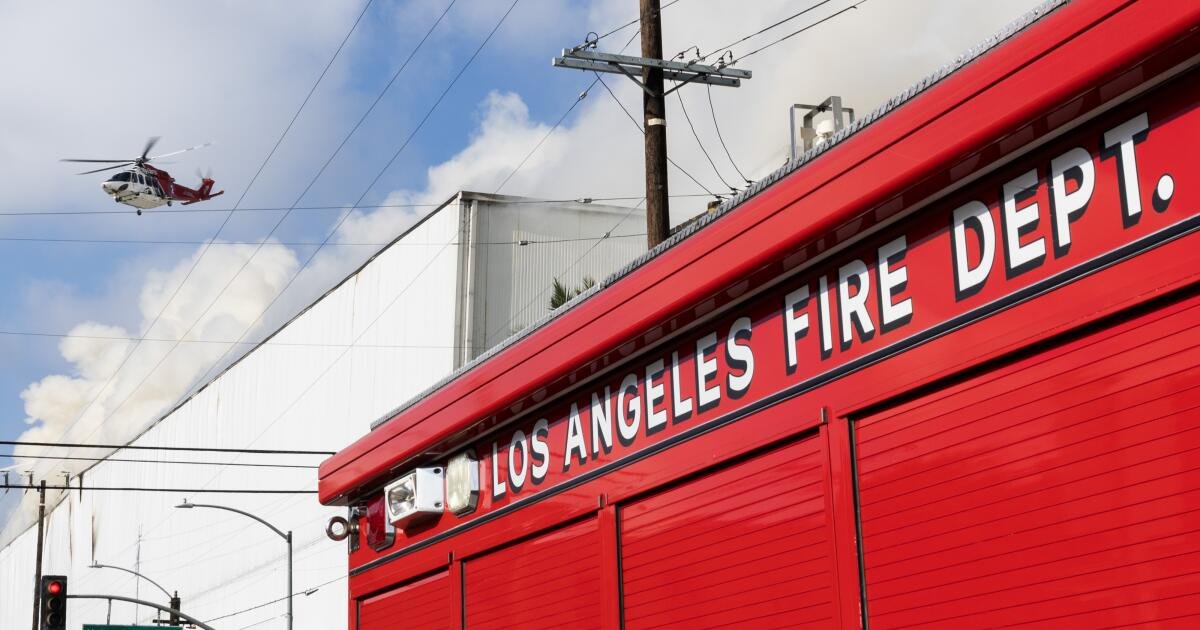
L.A. city officials on Saturday declared a local emergency as firefighters continue to battle a stubborn warehouse fire in Boyle Heights that has sent plumes of irritating smoke across the region.
“While the [Los Angeles Fire Department] continues making progress, this is a major, multi-jurisdictional incident,” Mayor Karen Bass said in a statement. “I’m issuing an emergency declaration to ensure the city has the resources it needs as this operation continues and to keep the community safe.”
The declaration activates the city’s emergency response structure, directs departments to assess damages and costs, and requests state assistance to support firefighting, cleanup, environmental monitoring and community recovery efforts.
Los Angeles Fire Department Chief Jamie Moore described the blaze that broke out Wednesday as a “very unique fire, a very unique challenge for the Los Angeles Fire Department, for the city of Los Angeles, but also for the County of Los Angeles,” at a Saturday morning press conference.
The 500,000-square-foot commercial building at 1400 S. Los Palos St. stores 85 million pounds of frozen food “like a giant cooler,” he said. The corrugated steel walls are filled with dense foam that is burning slowly and emitting gases despite ongoing water drops from helicopters.
The building is also topped with solar panels that have caught fire.
Moore cautioned people with lung issues or smoke sensitivity to avoid outdoor activities, but said crews have mitigated hazardous materials at the site, including ammonia. However, officials remain concerned about biohazards potentially posed by spoiled food, including bread, poultry, pork and beef.
“Imagine the food inside your refrigerator with no power, no refrigerant, starting to rot, and then opening up your refrigerator door, that’s about where we are now,” Moore said. “So, once we get this fire put out, the challenge that we have before us is the removal of all that product.”
A shelter-in-place order for residents was lifted on Friday, but many across the region on social media reported smoke smells, haze and poor air quality in the San Gabriel Valley, Northeast Los Angeles, Glendale, Burbank, downtown Los Angeles and many other areas.
Some said the smoke was as bad, if not worse, as during the Eaton fire that burned in Altadena in January 2025.
The city opened a smoke respite shelter at Pecan Recreation Center at 145 S. Pecan St., while the county opened one in City Terrace Park at 1126 N. Hazard Ave.
Bass, who joined Moore and other local officials at two City Terrace Park press conferences, said she has reached out to Gov. Gavin Newsom for additional support.
Lineage Logistics is the tenant-operator of the building. In a statement issued late Friday night, company officials said they believe the fire began while third-party contractors were testing the solar array on the roof.
“Lineage’s top priority is the health and safety of the community, and we are continuing to work closely with the Los Angeles Fire Department and other agencies to provide any assistance we can,” the statement said. “We are grateful to Los Angeles’ remarkable firefighters for their ongoing and brave efforts.”
The company said the facility is not used for the storage of hazardous materials, and that there have been no measurable ammonia concentrations recorded in the community since the fire started. Additionally, “Lineage has proactively taken additional steps to pump out the ammonia and transport it offsite, removing the possibility of ammonia posing a risk to the community.”
L.A. County health officer Muntu Davis said the main public health concern was smoke and fine particles that can cause irritation of the ear, nose, throat and lungs, as well as exacerbate heart and lung conditions.
Sensitive individuals were encouraged to wear well-fitting N95 and P100 masks, and to register for emergency notifications at alertla.org.
Will Barrett, assistant vice president for nationwide clean air policy with the American Lung Assn., told The Times that it can be hard to pinpoint exactly what is in the smoke while crews are still working to contain the evolving health risk, but that the most important thing is to avoid exposure.
“Much like recent industrial and wildfire incidents, the makeup of the smoke can include toxic chemicals, fine particles and other serious risks to lung health depending on fire conditions and what is burned,” he said.
On its own, particle pollution can increase the risk of asthma attacks, heart attacks and other medical emergencies, and other chemicals in the air can cause both near- and long-term harms, he said.
Another concern is the possibility that there were lithium-ion batteries within the structure. Batteries are often used to store energy produced by solar panels, although officials could not immediately confirm whether that was the case in Boyle Heights. However, they said the building does house about 60 forklifts that run on lithium-ion batteries, although those are “currently unburned.”
Low-level toxic fumes measured on Thursday included hydrogen fluoride, a byproduct produced by burning lithium-ion batteries, LAFD spokesperson Lyndsey Lantz told The Times.
“It is likely that there were some involved at some point,” she said. “We just don’t have confirmation of where they were or what part of the building they were responsible for.”
The multiday effort has been full of challenges for firefighters with fiery flare-ups.
The fire initially grew into a huge inferno, creating a pillar of thick, black smoke that could be seen for miles. It then reached an ammonia line, triggering several small explosions and a dramatic image of flames shooting through the building’s roof as crews evacuated the area to avoid the fumes.
That caused officials to announce a shelter-in-place order, which was lifted, only to be reinstated on Thursday after a different section of the building caught fire. That new shelter-in-place order was lifted Friday just before 11:30 a.m.
The smoke from the fire also triggered a special particle pollution advisory from the South Coast Air Quality Management District. It was to remain in effect until 12:30 p.m. Saturday.
AQMD officials said they have dispatched air quality inspectors to the area and have been responding to public complaints. The district has also deployed stationary monitors at Eastman Avenue Elementary and Robert Louis Stevenson Middle School to measure hourly particulate matter concentrations.
Additionally, the U.S. Environmental Protection Agency is deploying specialized monitors at various locations around the facility and in the community to measure volatile organic compounds and various other air toxins.
“Residents have lived through days of smoke, shelter-in-place orders, disruptions to daily life, and ongoing questions about what this means for their health and well-being,” Councilmember Ysabel Jurado, who represents Boyle Heights, said during the afternoon press conference. She said she will continue pushing for resources and support for the community. “Boyle Heights deserves clear information, direct support, and full accountability throughout the response, cleanup and recovery process.”
Chief Deputy Jon O’Brien with the Los Angeles County Fire Department said Saturday that deep pockets of smoldering fire remain buried under structural debris and solar panels.
“Our city firefighting brothers and sisters are executing a meticulous, deeply challenging operation to bring the fire under control,” he said.
Last month, Southland residents experienced an industrial incident involving an overheated storage tank of methyl methacrylate at the GKN Aerospace facility in Garden Grove, triggering fears of an explosion or toxic release.
The event led to the evacuation of about 50,000 people.
The near-disaster was a reminder of Southern California’s long history of industrial development, and how close many such facilities are to homes and communities throughout the region.
Assemblymember Jessica Caloza (D-Los Angeles), who represents East L.A., pointed out during the press conference that East L.A. also experienced an oil spill last month.
It occurred when a crew laying fiber-optic cable ruptured a pipeline carrying crude oil from Kern County to the Port of Los Angeles, causing a hazardous-material incident, The Times reported.
“Communities like East L.A., like Boyle Heights, immigrant Latino communities — hardworking, everyday working-class people — bear the brunt of air pollution, of environmental hazards, of all these things that for some reason keep happening in the same neighborhoods,” she said.
Food
Emergency declaration issued for Boyle Heights fire

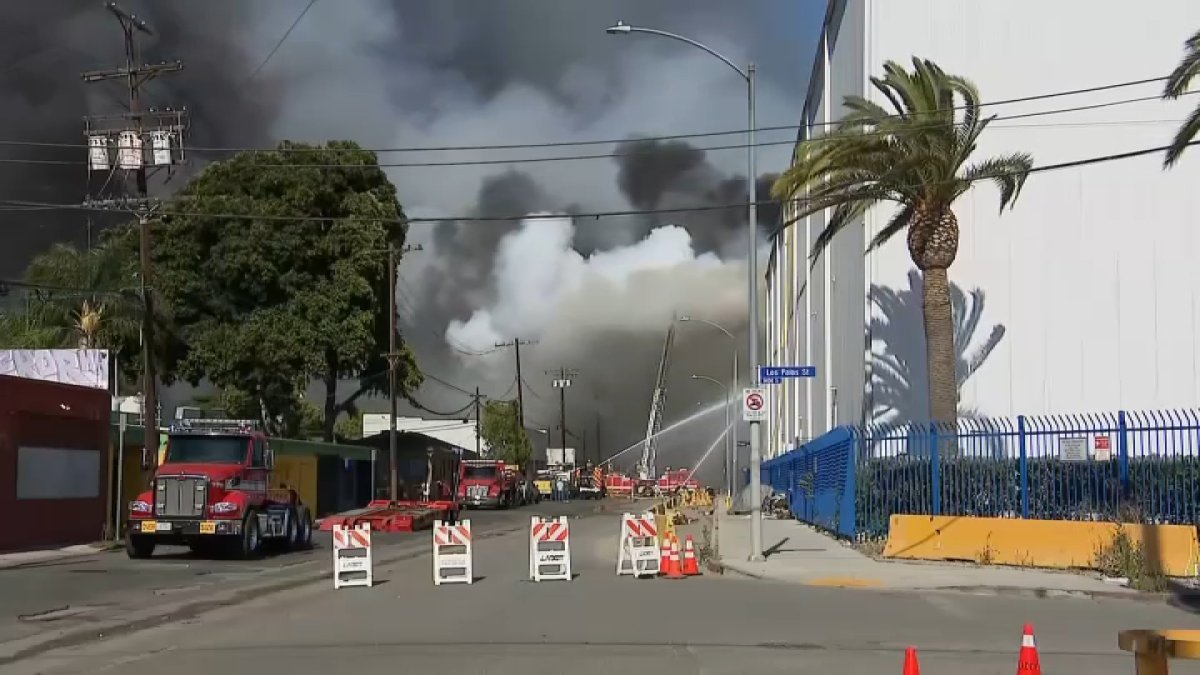
Los Angeles Mayor Karen Bass on Saturday issued an emergency declaration in connection with the ongoing commercial fire burning in Boyle Heights.
“We’re going to declare a joint state of emergency,” the mayor said in an interview with NBCLA. “We’re in contact with the governor because this has escalated to a problem where we are very concerned about the health of the community.”
With an emergency declaration in place, the city will be granted state resources that will help relieve the local resources that have been used against the commercial fire. Los Angeles Fire Department Chief Jaime Moore said LA firefighters have been tasked with not only responding to the blaze in Boyle Heights, but also other community emergencies in their respective domains.
“We clearly need resources from the state to allow us to take the steps that are needed to make sure that this area is safe,” Bass said.
Bass and Moore have expressed concern that because the fire is at a frozen food storage facility, the food is decaying and creates the possibility of a biohazard. According to Moore, Lineage, the facility where the fire is burning, houses frozen bread and meat products, and if those products decay any further, it may create biohazardous conditions.
“I wouldn’t say it’s potentially dangerous; it would be unpleasant,” the LAFD chief said. “It would be a horrible odor, but what we’re looking at is what those gases would produce or create. We’ve already mitigated the hazardous materials portion by removing the ammonia and other chemicals that were used as refrigerants … now, it’s really what’s going to happen when this food starts decomposing?”
To further give the public a better understanding of the biohazard concern, Bass likened the situation in Boyle Heights to when food rots during a power outage.
“The gas that that emits, that’s the biohazard that we’re worried about,” she said.
The stubborn blaze began burning on Wednesday and caused a shelter-in-place to be issued for neighboring residents. It was lifted that same evening as the firefight looked optimistic, but flare-ups occurred on Thursday and crews have continued to fight the fire since as smoke from the blaze impacted the region’s air quality.
Bass said she expects the emergency declaration to be issued in the afternoon after further discussions with Gov. Gavin Newsom.
As a result of the blaze, two shelter locations have been opened for those affected:
Food
Moscow oil refinery attack brings Russia’s war with Ukraine closer to home
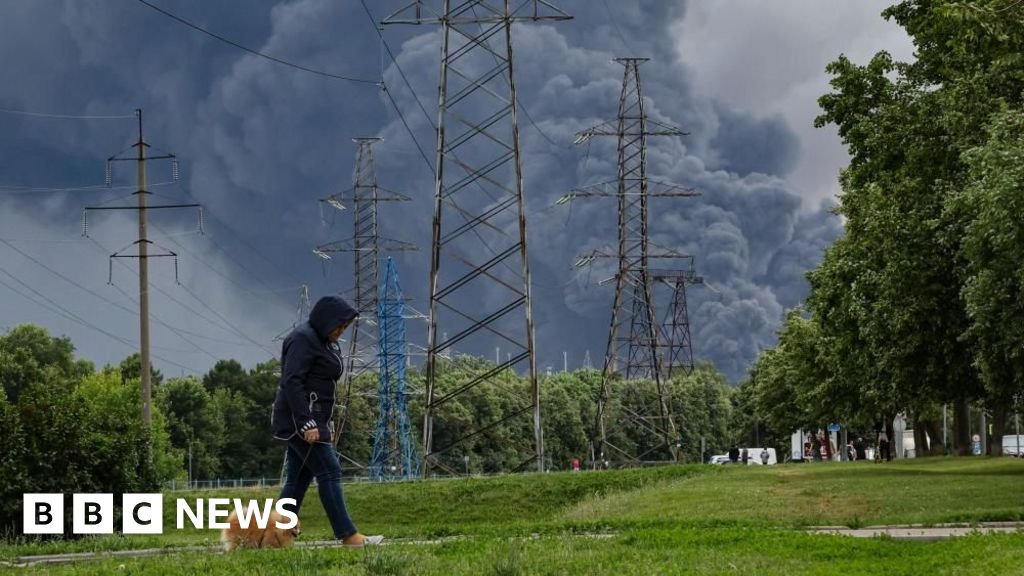
There are moments when life in Moscow feels completely normal. Thursday morning wasn’t one of them.
In the south-east of the city an oil refinery had been hit during a Ukrainian drone attack – even from a distance the sight was surreal.
Thick smoke billowing from the direction of the facility had turned the sky dark. Like a giant black shroud, it hung over the Moscow skyline.
As extraordinary and eye-catching this was, so was the reaction of people near the refinery.
Paying minimal attention to the huge clouds of smoke, an angler sat by the side of a pond, staring out across the water as he carried on fishing.
At the playground opposite, children were having fun on the swings.
Shoppers were heading to and from a supermarket, as if this was just another Thursday.
I realised then that my sense of what’s normal in Moscow and what’s not, needed updating.
For so long, the war on Ukraine felt very distant to people in the Russian capital. Many pretended it wasn’t happening at all, but that’s harder to do as the front line creeps closer to the city.
Over the past year-and-a-half, Muscovites have woken to news that army generals in Moscow have been assassinated, and drones have been targeting the capital.
In a sense, abnormal is already the new normal.
Thursday’s attack was one of the largest aerial assaults on the Moscow region since Russia’s full-scale invasion of Ukraine.
As well as damage to the oil refinery, shopping centres and residential buildings were hit, too. According to the governor of the Moscow region, an eight-year-old girl was killed in a fire caused by one of the drone strikes.
“I’m not totally surprised by what happened,” says Slava, who lives in an apartment block opposite the oil refinery. “But I didn’t expect such a big attack.”
“I heard explosions and saw lots of smoke. It’s the kind of thing you normally see in the movies. I saw it from my apartment window.”
But another local resident, Nadezhda, saw nothing normal in what’s happening.
“It took us four years to win World War Two, even though our soldiers had little food and water,” she told me.
“Today we have all the resources we need. But this war goes on. I’m shocked.”
How do the Russian authorities respond to people like Nadezhda, to Russians struggling to understand why the Kremlin’s so-called “special military operation” is taking so long, and how it can be that the war has come to their city?
Russian officials regularly accuse the West of prolonging the war in Ukraine, blaming European leaders and Nato for supporting Kyiv.
But on Thursday, President Vladimir Putin said nothing about the drone assault. The news bulletins on Russian TV channels barely mentioned it.
When Russian newspapers reported the story the following day, I detected a common thread in their coverage: a coordinated message, perhaps, for the domestic audience.
It can be summed up as this: “However bad it is for us, Ukraine’s suffering more”.
“Our attacks are doing far more damage to Ukraine than Ukraine is doing to us,” declared the ultra-pro-Kremlin Komsomolskaya Pravda.
“Our strikes to demilitarise Ukraine are far more powerful and effective than Ukrainian attacks,” wrote the tabloid Moskovsky Komsomolets.
The narrative was almost identical in the government paper Rossiyskaya Gazeta: “Our attacks on defence enterprises working for the Ukrainian army are much more powerful than those which Russians, unfortunately, are having to deal with.”
“Our strikes on Ukrainian infrastructure linked to the military-industrial complex are far more effective and produce more results,” commented business daily Kommersant.
When the Kremlin finally reacted, it had a similar message.
“You should look for more footage coming out of various cities in Ukraine,” Putin’s spokesman Dmitry Peskov told reporters.
“Footage showing the results of strikes carried out by our armed forces is impressive. These strikes will continue.”
There is no sign that Ukrainian drone attacks on Russian cities have given Putin pause for thought. From his recent speeches and statements, the Kremlin leader seems determined to continue Russia’s assault on Ukraine, confident that in this war of attrition his country will prevail.
But there are signs that long-range Ukrainian strikes – particularly on Russian oil facilities – are increasing the pressure on the Russian economy. Petrol shortages and rationing have been reported in some parts of the country, and prices have been rising at the pumps.
“It’s our government that must decide what to do. All we can do is watch.”


US-Iran talks to begin in Switzerland as Tehran says it closed Strait of Hormuz | BBC News
Direct talks between the US and Iran are set to begin in Switzerland despite the Iranian military saying it has...


Astronomical summer has officially started across Northern Hemisphere. #Solstice #BBCNews
In Taylor Swift’s beach town, every clue becomes a wedding rumor
WESTERLY, R.I. (AP) — When a large tent appeared next door to Taylor Swift’s Watch Hill estate this week, it...

Newsom declares state of emergency in Los Angeles for Boyle Heights warehouse fire
Firefighters faced renewed challenges Saturday at a large Boyle Heights cold storage facility fire, where conditions remain highly complex as...


Luxury Kushner Project Collides With Albanian Discontent
For more than three weeks protesters have gathered peacefully in Tirana, the capital of Albania, cheered on by Americans who...


Humanoids join Dragon Boat Festival traditions in China
Humanoid robots are joining the Dragon Boat Festival fun in China's Sichuan province. The holiday has been celebrated for over...


free candy, drops blue and brown pieces
(NewsNation) — M&M’s is embracing the “Make America Healthy Again” movement with a new product set to launch this summer....


TV Schedule: What To Watch The Week Of June 21, 2026
Every day, TVLine’s What to Watch column spotlights new and returning English-language shows (and select movies) premiering or airing fresh...


Fed Chair Kevin Warsh’s sentiments on data over party shows he is no Trump loyalist
Nearly every Democrat in the Senate opposed Kevin Warsh’s nomination as Fed chair mainly because they said he would be...


Tesla driver says it was on Autopilot before fatal Texas home crash
A driver told Harris County investigators that his Tesla was on Autopilot before it left a residential road in Katy,...
-

 Business1 week ago
How much of Musk’s wealth comes from government help? Virtually all of it
-
 Politics1 week ago
What to know about the stabbing that set off fiery riots in Northern Ireland
-

 Video1 week ago
Download fans say what they love about the festival. #DownloadFestival #BBCNews
-

 Video1 week ago
Why SpaceX IPO isn't about space. #SpaceX #ElonMusk #BBCNews
-

 HealthNews1 week ago
The people of Okinawa, Japan only eat until they are about 80 percent full, then stop — and the practice has been linked in multiple peer-reviewed studies to lower rates of cardiovascular disease, slo
-

 Food1 week ago
Pope Leo’s plane was grounded. Then the King of Spain stepped in to help
-

 TravelNews1 week ago
My Paternal Instinct Should’ve Warned Me About Netflix’s Maternal Instinct
-

 Video1 week ago
Claire Danes has the cutest stories about young Kirsten Dunst on 'Little Women' set