

Business
Soaring Household Debt Is a Warning to the US Economy: SocGen
America’s swelling debt pile bodes ill for the the US economy, Société Générale said.
In a recent note to clients, the European Bank flagged a concerning trend that’s taken hold in the US in recent years: the rise in household debt and the concurrent decline in household savings.
Total liabilities among US households swelled to a record $19.9 trillion at the end of the first quarter, according to Fed data, a sign that Americans are continuing to borrow and fund their spending.
Yet, the personal savings rate is hovering near a record low, shrinking to 2.6% in April, according to the Bureau of Economic Analysis.
The trend might be the result of the so-called wealth effect, a phenomenon where Americans spend more because they feel wealthier as the price of assets like stocks and real estate rise, Albert Edwards, a SocGen strategist and famed market permabear, said.
The market has soared amid the unrelenting enthusiasm for AI, with the tech trade making a red-hot comeback after stumbling earlier this year.
The problem is that, if one assumes consumers are shelling out more due to their rising wealth on paper, economic growth is increasingly exposed to the AI trade. Consumer spending makes up around 70% of US GDP, according to one analysis from the Boston Fed last year.
Measures of household income growth, meanwhile, have started to fall. Personal income excluding transfers contracted $16.5 trillion in April, down around $200 billion from its peak in 2025.
“The US consumer currently resembles the Wile E. Coyote character, running off the cliff and suspended in thin air briefly, before collapsing,” Edwards said, referring to the potential for consumer spending to see a sharp drop if Americans were motivated to save more, such as if stock prices were to take a beating.
“It doesn’t take a Fed PhD economist to tell us that if the US saving ratio (SR) stops falling, consumer spending will grow in line with income, which is falling. And woe betide the economy if the SR actually rises back to more normal levels,” he added.
Edwards also pointed to the declining efficiency of debt to boost economic growth. The credit intensity of GDP — a measure of how much debt is needed to boost GDP growth by a set unit — rose to 3.73 last year, the most debt needed to fuel growth in at least the last 70 years, according to an analysis from Bespoke Investment.
“This makes the economy all the more vulnerable should investors doubt the pot of gold at the end of the AI rainbow. Watch this debt-laden space,” Edwards added.
Business
With Roku, Fox just won the streaming wars for the right


In the span of a single week, two deals reshaped the future of American media by concentrating something more valuable than content itself: control over how Americans find and consume it. As conservative billionaires effectively monopolize the future of content beyond cable, we are witnessing the corporate takeover of the American democratic square, rubber-stamped by a captured regulatory apparatus.
On Monday, Fox Corporation announced a $22 billion acquisition of Roku, the connected-television platform that sits inside half of all U.S. homes with broadband internet. Days earlier, Donald Trump‘s Justice Department waved through David Ellison’s $111 billion bid to merge Paramount with Warner Bros. Discovery, giving the son of Oracle billionaire Larry Ellison control over both CBS News and CNN. Paramount swiftly vowed to finalize the merger “as soon as possible.”
The scale of this quiet coup is staggering. For most of the past decade, the streaming wars were framed as a contest over content. Disney poured tens of billions into Disney+. Warner Bros. Discovery bet big on HBO Max. Paramount launched Paramount+ and nearly every major media company raced to create a direct-to-consumer service capable of competing with Netflix. Fox, by contrast, largely sat it out. It didn’t chase prestige television. It stuck with what it already had: news and sports. The deal would combine Fox’s news, sports and advertising businesses with Roku’s connected television platform. Fox says the combined company would become the third-largest television business in America by viewing share.
The Fox-Roku deal is not primarily about hardware. Roku still sells streaming sticks and smart televisions, but devices account for a relatively small portion of its business. The company increasingly operates as a connected-TV advertising platform built on an operating system that sits between viewers and content providers. That interface is not neutral. It is curated, ranked, monetized and constantly optimized using first-party data that tracks what people watch, when they watch it and how they respond to ads. In practical terms, Roku controls the television home screen. It can privilege its own content. Fox already owns Tubi, the free ad-supported streaming channel it acquired in 2020 for $440 million, which has grown into an advertising juggernaut accounting for roughly five percent of streaming viewership in the U.S. Now, with Roku’s operating system, Fox controls the discovery layer for every competitor streaming on that platform.
The billionaire takeover of our newsrooms is accelerating, and the political calculations behind it are flagrant.
For years, right-wing media dominance relied on the structural welfare state of basic cable. Millions of Americans with traditional cable packages have effectively subsidized Fox News through carriage fees, regardless of whether they watch the network. But that golden goose is dying. The Pew Research Center estimates that cable and satellite TV households were down to only 36 percent of the population in 2025; that number stood at a staggering 85 percent just a decade earlier. The cord-cutting revolution was supposed to democratize television, liberating citizens from corporate gatekeepers. Instead, it has laid the groundwork for an even more insidious form of control.
The Ellison deal deserves equal scrutiny and has received far less. The Justice Department’s senior leadership reportedly shut down the antitrust review before lawyers in the division could make their final recommendation — an intervention that is extraordinary by any historical standard. This allowed David Ellison, who took control of CBS only last August, to proceed toward ownership of both that network and CNN, giving him influence over what would amount to a Fox News-lite news operation at one outlet and a nominally centrist news outlet at another.
The billionaire takeover of our newsrooms is accelerating, and the political calculations behind it are flagrant. Ellison has spent months actively seeking to ingratiate himself with the Trump administration. The cozy, transactional nature of this new media elite was laid bare when Ellison, who held a lavish banquet for Donald Trump in April, was spotted rubbing shoulders with the Kushners at Washington’s elite Cafe Milano the night before a UFC spectacle on the White House South Lawn, streamed exclusively on his Paramount+. The warning signs are already there. Paramount reportedly refused to air an advertisement from the Freedom of the Press Foundation critical of its leadership and merger, citing a “conflict of interest.” That is what consolidation looks like in practice.
On one side, Fox controls distribution, data and a massive advertising engine. On the other, Ellison consolidates content production across multiple major networks. Between them sits a shrinking field of competitors, many of whom are financially weaker, structurally disadvantaged or dependent on access to platforms they do not control. The broader pattern is not subtle. Jeff Bezos still owns The Washington Post. Elon Musk owns one of the largest social media platforms in the country and has turned it into a right-wing echo chamber. Meanwhile, fewer outlets are willing to challenge power and have an incentive to avoid controversy.
Conservative billionaires are not winning the information wars because their ideas are more compelling. They are winning because they understand that in the attention economy, the chokepoint is distribution. He who controls the pipe controls the message. The Murdochs figured this out with satellite television. The Ellisons are figuring it out with streaming consolidation. And now Fox has figured it out with the operating system of connected television itself.
Business
Drinking on the roof is a summer classic. Why are the bars always so bad?


Picture your ideal night out. Does it involve long lines, slow elevators, choosy bouncers? Dress codes, cover charges, per-person minimums? Bland, watered-down or sugared-up drinks, possibly in plastic cups, costing north of $25? No? Then however strong the siren call of the rooftop drinkery inexplicably becomes all over again each summer, it sounds like you, in fact, do not want to go to a bar on top of a building. Because nice views aside, that’s often how the evening unfolds.
Yet so many of us keep riding that elevator to the top floor. Rooftop bars open in droves every summer, new ones joining the ranks each year. Media outlets and social media accounts rush to deliver yet another roundup of this year’s best. With all the hype, how do rooftop bars get away with being so unbelievably mid?
“Rooftop bars benefit from having a certain category of ‘unique offering,’ ” says Ben Potts, partner at Miami-based consultancy Unfiltered Hospitality. “It’s not exclusive to rooftop bars—if you’re on the water in a place that doesn’t have a lot of waterfront access, if you have a mountain view at the top of a ski lift—there are certain places that just because of their unique positioning, they’re endlessly busy.”
Of these location-as-a-theme bars, rooftop spots tend to be in urban areas. From tourists to office workers, people want that easy access to al fresco drinks and those vistas. The popularity of rooftop bars has grown with the rise of social media, as an increasing number of bar-goers prioritize good photo backdrops over all else. Many have become surprisingly willing to tolerate service snafus and mediocre drinks in a way they wouldn’t back down on the ground, just because it’s #magichour. But once you’ve done your photo shoot, shouldn’t there be a nice place to hang out, especially at those prices?
“Altitude cannot be the whole proposition,” says Bobby Carey, co-founder of Singapore-based hospitality consultancy Studio Ryecroft. “At their best, rooftop bars are some of the most cinematic rooms in hospitality. They give people a reason to look up from the table, feel the city around them, and turn an ordinary drink into a memory. At their worst, they become viewing platforms with a liquor license.”
The main issues for the majority of rooftop bars are the entrance and service chokepoints—from elevator lines to bar lines—the often subpar beverages, and the marked-up prices that are sometimes coupled with cover charges or per-person food-and-drink minimums. Some of these are inevitable. There are real challenges specific to running a sky-high bar.
Others are more cynical, or just plain lazy.
Even the best rooftop bars must endure limitations on the physical means guests have to reach them. There’s not much that can be done about elevator capacities. Potts says storage space can also be tight for some of these bars, making it hard to keep too wide of a range of ingredients handy.
Staffing is an obstacle, notes Meaghan Dorman, bar director of Dear Irving, an award-winning cocktail bar with three locations in Manhattan, one a rooftop: “True rooftop bars are very seasonal, so it’s hard to retain quality staff and set the standards.” Dear Irving is open year-round, so it benefits from growing a core team. A bar with a revolving door of employees who never settle in can translate to service never really hitting a speedy, efficient groove, and a team who can’t learn from guests and evolve.
Then there’s that rooftop-bar price math.
“The science of pricing on menus is a very interesting one,” Potts says. “It’s always some combination of the costs of the products itself and what your competitors are charging for similar products at their establishments serving a similar demographic.” There’s a bit of “Let’s see what we can get away with” here. A hotel with a ground-floor bar might charge $23 for a martini, but $25 at its rooftop bar. If they’re at capacity each night, they reason no one’s getting sticker shock and they try $27—then maybe $30. A “rooftop premium” can be as much as 25 percent. Carey points out this isn’t always just a cash grab, though.
“Rooftop spaces often carry high commercial expectations because they are trophy locations within a hotel or development,” he says. “They can also involve more complicated build costs, structural requirements, outdoor-grade furniture, weatherproofing, drainage, shade, wind management, security, [elevator] management, higher staffing, greater refrigeration pressure, more ice demand, and more volatile revenue because bad weather” can shut the bar down.
Fair enough. Still, Dorman says, the average bar guest is getting too savvy to tolerate too drastic of a gouge. People are willing to pay more for the total package: good views, good drinks, good service, good vibes. But many of them know what an Aperol spritz costs and draw the line at $30.
It should be noted that often, guests themselves are part of the problem, simply because they continue to line up for these bars, signaling that this is what they want from a night out. As long as an overpriced, jam-packed, blah bar is doing numbers, why would they invest in improvements? The “best rooftop bars” roundups keep sending tourists and office workers sky-high, the subsequent crowds keep editors commissioning those roundups, and so the world turns.
Then there are the guests who take advantage of rooftop bars. Studio Ryecroft designed the rooftop venue Paradise Lost at Siam@Siam Design Hotel in Bangkok as a “neo-tropical, dystopian sanctuary in the sky: pink and yellow canopy, Bangkok skyline, a slightly surreal holiday-at-the-end-of-the-world,” per Carey.
“Early guest behavior was very image-led. We had people arriving with suitcases of clothes, changing outfits, shooting content, ordering one drink and leaving,” he says. The team refined their concept to target a more cocktail-driven guest, but many rooftop bars just accept this as reality. They expect people to show up, order one drink so they can snap ’grams, and bounce. It doesn’t feel worth it to put too much intention into the drinks or service.
The bars that refuse to embrace this fate and work to overcome those rooftop-related challenges are the rare destinations that are actually good. There are measures some rooftop bars take to try to weed out those camera-happy patrons—that’s where cover charges, per-person food-and-drink minimums, and dress codes come in. But Dear Irving is a unique example of what happens when a rooftop bar is simply treated like a street-level bar with the same attention paid to interesting cocktails, quality ingredients, and dialed-in service.
“Other than just being 21-plus, we’ve always wanted to be very welcoming,” Dorman says. “We specifically don’t work with promoters because we don’t want one night to be very different from another. We don’t have a dress code, and we have security on weekends but no bouncers.”
Dorman sees Dear Irving as being an ambassador to New York’s indie food and drink scene: They’re in Times Square, so have the opportunity to introduce tourists to interesting flavors. Dear Irving’s original location in Gramercy is acclaimed for Dorman’s creative cocktails.
Nothing got lost in translation when the concept opened 40 stories up. There’s a perfect Gibson, a Negroni riff with aquavit, an upgraded gin and tonic, etc.—all for $20 to $21. The glassware is in fact glass, not plastic, uncontrolled crowds don’t block the views, and nothing is sticky.
Illustrating just how much of an anomaly a thoughtfully executed rooftop bar is, and how stereotypically lacking the experience is at the vast majority of these drinking destinations, there is indeed a negative connotation attached to the “rooftop bar” label within the industry.
“Among serious bar people, rooftops often carry suspicion,” Carey says. “That reputation is not always fair, but it exists for a reason. Too many rooftops have been allowed to trade on their address, floor number, or backdrop.”
This gives some operators pause about whether they even want to call themselves “rooftop bars” even when they are very clearly on a roof.
“We thought about calling it a penthouse bar, but I thought that sounded oddly … too sexy?” Dorman says. “Ultimately, the rooftop term is good because it attracts people and businesses need people, but it’s also tough because we have to overcome those poor-quality-service expectations.”
In Manhattan’s Financial District, Overstory frequently gets grouped into rooftop-bar features. This is despite the fact it is literally not a rooftop bar—it’s near the top of a tall building and has a wraparound terrace—as well as its experience feeling worlds away from all that label conjures.
“My first reaction is a wince,” says Overstory bar director Harrison Ginsberg of those roundups. “When people refer to it as a rooftop bar, it does the space a little bit of a disservice. Overstory year-round focuses on the interior of the space and our elevated cocktail program. We never set out to open a rooftop space.” Despite the Infatuation’s claim that “the real reason to come to Overstory … is the huge outdoor terrace,” Ginsberg considers those views a mere extension of the memorable experience the bar fosters. It seems industry insiders agree: Overstory ranks on the prestigious World’s 50 Best Bars list, and its martini steals the spotlight from the terrace among true cocktail enthusiasts.
To communicate that Overstory is a world-class cocktail bar that just happens to have some stunning outdoor seating, too, the team focuses on the drinks and interior space, not views, on social media. The accolades the bar has received have helped attract more food- and beverage-seeking guests over those there to take photos and leave. Overstory did implement a $75-per-person minimum to put an end to that issue; Ginsberg explains this is to save spots for those who actually want to linger and enjoy the menu.
Whether you call Overstory a rooftop bar or not, it’s another member of the small club of excellent bars that conveniently offer gorgeous vistas. It’s proof you don’t have to settle for margarita mix and dirty outdoor furniture to take in the city skyline—but you do have to be picky. Look for the bars that don’t solely post those views on Instagram, and check menus out ahead of time.
“Dismissing the whole rooftop category is lazy,” Carey notes. “A great rooftop can introduce a much broader audience to better drinks. It can be commercially powerful, socially generous, and culturally memorable. It just has to be operated like a real bar.”
Business
The ‘magic number’ for a comfortable retirement just got bigger


Retirement planners sometimes speak of a “magic number”: a rough estimate of how much money an American might need to retire in comfort.
Not surprisingly, the number keeps rising.
Americans now need $1.46 million to retire comfortably, according to the 2026 edition of a well-known financial planning survey from Northwestern Mutual.
The magic number is intended as a “guidepost” for retirement planning, and not as a specific savings goal, said John Roberts, executive vice president and chief field officer at Northwestern Mutual.
It’s also a goal few Americans have reached.
Nearly half of non-retirees surveyed said they do not think they will be financially prepared for retirement when the time comes, according to the 2026 Planning & Progress Study.
And roughly half of all Americans surveyed said it is likely they could outlive their savings. Running out of money in retirement is a perennial fear among older Americans.
The new Northwestern Mutual findings, released in April, draw from surveys of 4,375 adults in January.
“There seems to be a widening gap between what we all expect we’re going to need and what we actually have,” Roberts said, speaking to USA TODAY in March.
In four previous years, the retirement magic number has ranged as low as $1.25 million (in 2022). It has not ranged higher than $1.46 million.
The Northwestern Mutual survey comes at a moment when Americans are coping with years of cumulative inflation. A retiree in 2026 can expect to pay more than ever, for example, for long-term care expenses such as assisted living and skilled nursing.
Is $1.46 million a realistic retirement savings goal?
Not many Americans retire with $1.46 million in savings. The typical household in the 65-74 age range has about $200,000 in retirement accounts, according to the 2022 federal Survey of Consumer Finances.
Few, if any, retirement planners would suggest that every retiree needs $1.46 million to make ends meet. Most Americans retire with nowhere near $1 million in savings. Many retire comfortably on Social Security income alone.
A more attainable retirement planning goal suggests that you aim to save 10 times your annual income by age 67. For the typical American household, that would work out to a little over $800,000 in savings, based on a median household income of $83,730 in 2024.
According to the Northwestern Mutual survey, few of us have met that goal.
Within Generation X, the cohort nearing retirement, only about 13% of survey respondents said they had saved 10 times their income or more. A majority of Gen Xers said they have saved four times their income or less toward retirement.
Not surprisingly, only 49% of Gen Xers said they think they will be financially prepared for retirement. Half of Gen Xers plan to continue working in retirement.
If any group of Americans is on track for retirement, it might be Generation Z, the cohort whose oldest members are nearing 30.
According to the Northwestern Mutual survey, nearly three-quarters of Gen Z already have saved more than one year of income toward retirement. The average Gen-Zer started saving for retirement at age 22. The typical Gen Xer, by contrast, started saving at age 32.
“The good news is, Gen Z [is] … putting away money earlier,” Roberts said.
Business
Yet Another Piece of AI-Pilled Speculative Fiction Has Gone Dangerously Viral
Once again, AI people are letting a work of fiction seep into their brains. This time it’s a piece of speculative fiction for Europeans called “Europe 2031.” Before that, it was Citrini Research’s ”The 2028 Global Intelligence Crisis,” a story about white collar unemployment that caused stocks to dip. Before that, it was AI 2027 in which a superintelligent AI kills humanity. The sitting Vice President of the United States says he read that one.
Europe 2031 was written by eight people referring to themselves as “a small group of AI researchers, think-tankers, and investors who have spent their careers at the intersection of frontier AI and European policy.”
The power these documents have is not good for the world. I have some authority about this topic—a very small amount—because I wrote a book of hypothetical scenarios and managed to get it published in several countries.
Speculative writing starts from some apocalyptic ending, and then the writer works backwards. This is because fiction is a cheat. You toss out reality, and only write the steps it would take to get to your destination. You can be completely upfront about what you’re doing, but readers will still think you’re predicting the future.
I told my readers not to base decisions on what I wrote, and that gaming things out is just a mental habit that helps me control my own anxiety, but people who read my hypotheticals still tell me I scared them. Worse: they ask me for advice.
My lesson is that the written word is the best medium for scaring people, and that ideas that scare people are sticky.
So with that in mind, what’s scaring people now is a piece of speculative fiction about Europe not taking AI independence seriously enough. It starts as all good cheesy sci-fi should, with the kind of show-don’t-tell intro they teach you in college writing seminars:
Caroline splashes cold water on her face and looks at herself in the bathroom mirror. Her hands are shaking. She grips the edge of the sink and waits for it to pass. Through the small high window she can see a slice of Washington sky, flat and bright.
Oh God, what’s going to happen to poor Caroline?? Answer: She fails to convince Europe to act in time, and ends up bitter, disillusioned, and financially dependent on a billionaire friend after quitting her job. Oh, and her mom dies.
Zooming out, Europe is defenseless as AI powered hackers make mincemeat of its outdated safeguards. The European economy and probably the EU itself are looking at almost certain death after the continent is shut out of the AI race. The two big bullies, the U.S. and China, hold all the cards.
“Even in 2026, the continent could still have changed course, had it shown the courage and political will to take drastic measures,” the authors write toward the end of Europe 2031.
According to the Guardian, the story has fed “a feverish discussion of the urgency for EU tech sovereignty” amid the G7 talks. Members of the European parliament have read it, and unofficial U.K.-German diplomatic talks have been informed by it. That’s frightening.
My take on speculative stories is that they are lies that can nonetheless clear away mental fog, particularly if the situation proposed is one people already talk about without much reflection on what it might take to get there. But much better writers than me have regretted parts of their speculations. For instance, Kim Stanley Robinson reportedly felt remorse after seeming to endorse crypto as part of a climate change solution in his book Ministry for the Future.
So remember, kids: stories are lies first and foremost, and should always be treated as such.
Business
Airbus Wants Near-10,000 Mile Nonstop Flights, And This Is The Plane To Do It

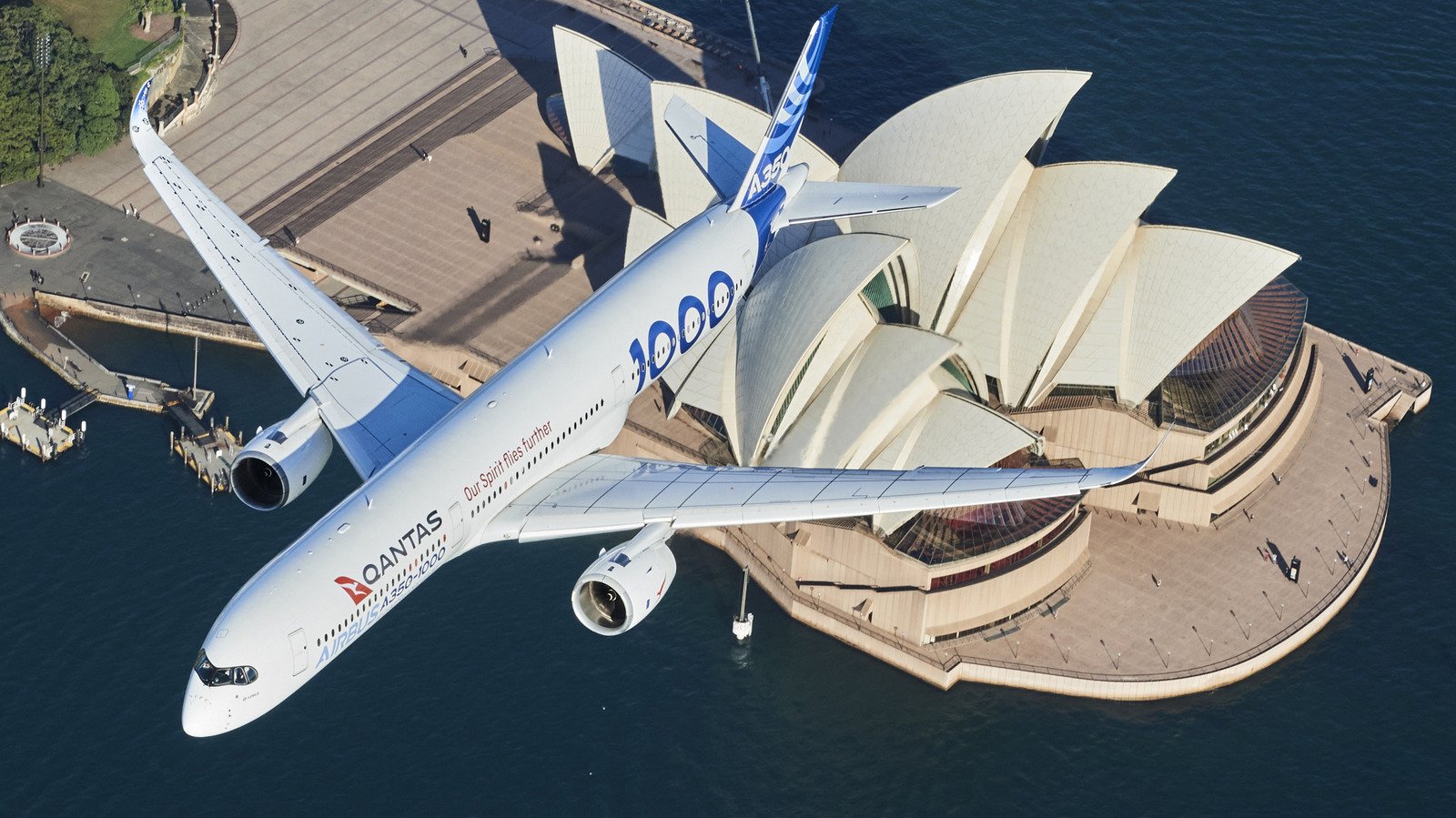
For now, the longest nonstop flights available commercially all take around 18 or 19 hours to complete, and they cover distances ranging approximately between 7,000 and 9,500 miles. These routes connect such far-distant places as New York City and Singapore, London to Perth, and Auckland to New York City. There’s no denying that these long-haul flights cover massive distances, but there are still a couple popular routes that most commercial planes simply can’t cover on a nonstop flight. Qantas Airways and Airbus have teamed up to try and fill this long-anticipated niche, and their newly developed Project Sunrise planes are poised to pull it off.
Project Sunrise is named after the 33-hour nonstop flights Qantas ran between Sri Lanka and Western Australia during World War II. The project began in 2017 as Qantas sought the technology necessary to complete the 10,000-nautical-mile (11,000-mile) routes between Sydney, Australia and NYC, and between London and Sydney without stopping. Either route is estimated to take about 22 hours, and Qantas hasn’t yet unveiled which route it will choose to run first, though the plan is to eventually get both NYC-to-Sydney and London-to-Sydney up and running.
Airbus and Qantas completed the first experimental flight of the new A350-1000ULR in June 2026 outside Toulouse, France, where two pilots and a flight engineer motored around in the experimental craft for nearly four hours to collect data. Tests of this first ultra-long-range version of the A350-1000 are expected to last for two months, and if all goes well, the final product should be ready for commercial flights by April 2027. Maybe by then, Republicans’ war to make gas expensive will be over, in which case this long-awaited nonstop route might actually be accessible(-ish) to the average person.
While you might expect the world’s longest-range commercial aircraft to also be one of the largest planes you can fly on, that’s not the case. The Airbus A380 still holds that record and is capable of carrying up to 853 passengers. Instead of increasing plane size to try to fit more fuel, the Project Sunrise planes use the same baseline as the A350-1000. In its standard configuration, the A350-1000 seats up to 480 passengers, but Project Sunrise’s A350-1000ULR is slated to have seats for only 238 passengers. This means increased space and comfort for passengers on such a long flight, but removing seats has the added benefit of freeing up weight that can be allocated to more fuel.
The layout will include 140 economy-class seats, 40 premium economy seats, 52 business-class seats, and six first-class suites, which you have to imagine will be among the bougiest in the skies. According to Airbus, there will also be a “Wellbeing Zone” where passengers can walk and stretch throughout the flight.
Some people say the future of aviation might be boring, but on this Airbus you’ll at least get to pace nervously for 22 hours. What allows the A350-1000ULR to reach the long-awaited 10,000-nautical-mile range is the addition of a 20,000-liter (or 5,283-gallon) fuel tank in the rear center of the fuselage. The development of the ULR variant has also increased the A350-1000’s maximum take-off weight from 319 metric tons to 322 metric tons, which will help account for a good chunk of that extra fuel weight.
Assuming all goes according to plan, Project Sunrise will offer the world’s first nonstop commercial flights at this distance, making travel to and from Australia significantly more comfortable, if not necessarily cheaper or quicker.




What we know so far about the Bedford train crash | BBC News
A train driver was killed and 100 people injured when two East Midlands Railway services to London St Pancras collided...


The best of Neil deGrasse Tyson: Aliens, UFOs, asteroids & more
Astrophysicist Neil deGrasse Tyson speaks with CNN over the years about a wide variety of otherworldy topics including aliens, …


New discovery could reshape how we understand Stonehenge | BBC News
Archaeologists believe they have discovered an earlier, much simpler version of Stonehenge about 3 miles (5km) away from the …


Mitt Romney says he'd "give it all" for one more day with his dad
CNN's Jake Tapper sat down with former Republican Senator Mitt Romney for a conversation about lessons learned from his …


David Hockney farewelled in private funeral with just two mourners in attendance
The funeral of David Hockney has taken place in private with just his partner and great nephew in attendance, his...


France bans some outdoor drinking as heat wave threatens Europe
France put emergency services and military forces on wildfire alert, restricted public alcohol consumption and canceled some outdoor sports events...


How Kevin Warsh has set out to remake the Fed
Chip Somodevilla | Getty Images Federal Reserve Chairman Kevin Warsh’s first big announced changes point toward a quiet revolution, with...


Dementia May Have Turned Doctor Into a Predator
The story of an Indiana small-town doctor who went from medical missionary and Sunday school teacher to convicted predator gets...


Sen. Mark Kelly recalls late father’s abuse
Democratic Sen. Mark Kelly opens up to CNN's Jake Tapper about how he broke the cycle of violence perpetuated by...


Can Sparkling Water Increase Your Risk Of Colorectal Cancer?
LOADINGERROR LOADING It seems as though every day another product is linked to a higher risk of cancer. Growing evidence...
-

 Business1 week ago
How much of Musk’s wealth comes from government help? Virtually all of it
-

 Politics1 week ago
What to know about the stabbing that set off fiery riots in Northern Ireland
-

 Video1 week ago
Download fans say what they love about the festival. #DownloadFestival #BBCNews
-

 Video1 week ago
Why SpaceX IPO isn't about space. #SpaceX #ElonMusk #BBCNews
-

 HealthNews1 week ago
The people of Okinawa, Japan only eat until they are about 80 percent full, then stop — and the practice has been linked in multiple peer-reviewed studies to lower rates of cardiovascular disease, slo
-

 Food1 week ago
Pope Leo’s plane was grounded. Then the King of Spain stepped in to help
-

 TravelNews1 week ago
My Paternal Instinct Should’ve Warned Me About Netflix’s Maternal Instinct
-

 Video1 week ago
Claire Danes has the cutest stories about young Kirsten Dunst on 'Little Women' set