

Food
An unusual strategy helps some tropical butterflies live 25 times longer than their relatives


ATLANTA — Since most butterflies live a short time, fluttering between colorful flowers for a few weeks before dying, a few rare exceptions have stumped scientists. Now, some long-lived tropical butterfly species are shedding light on the secrets of longevity.
Butterflies belonging to the Heliconius genus, which inhabit the tropical rainforests of South and Central America, have lifespans that vary wildly. The Dione juno butterfly lives for 14 days after reaching adulthood, while Heliconius hewitsoni lives for 348 days — nearly 25 times longer.
Other Heliconius species also have impressively lengthy lives, enduring between 106 to 277 days, according to a study on the phenomenon published Tuesday in the journal Nature Communications. Some scientists have speculated that Heliconius’ extended adulthood is due to the insects consuming an enhanced diet, rather than relying purely on carbohydrates like other butterflies.
But the exact reasons behind this unexpected longevity have been unclear, which is what inspired Dr. Jessica Foley, the study’s lead author and a postdoctoral scholar at Tufts University’s Jean Mayer USDA Human Nutrition Research Center on Aging in Boston, to take an in-depth look at the intriguing butterfly genus.
“We see vast differences in lifespan across the animal kingdom — adult mayflies famously live only for a day, whereas some whales and sharks can live for hundreds of years,” Foley wrote in an email. “I’m interested in the evolutionary basis of these kinds of lifespan differences because they might hold insights relevant for healthy aging in humans.”
Foley and her colleagues discovered that while nutrition has its part to play, some Heliconius have also evolved an anti-aging mechanism the researchers are still unraveling, and how it could be a model for understanding human longevity.
Evolving a special diet
Studying the “extreme agers” of the animal kingdom is an uphill task for scientists, especially if they have to wait centuries for a species to reach what is considered old, Foley said.
Lesser-studied Heliconius butterflies presented the perfect case study since researchers could observe their entire life cycle in about a year. Only one other known butterfly, Myscelia cyanaris, lives longer than Heliconius, with a maximum lifespan of 380 days, but there is little data to suggest why.
Foley and her collaborators combined an expansive dataset to look at lifespan and aging patterns across the Heliconius genus, using information collected from commercial butterfly houses and mark, release and recapture studies, as well as controlled experiments.
The authors wanted to see whether removing an unusual food source from the diets of these butterflies would shorten their lifespan, she added.
Most adult butterflies feed exclusively on flower nectar, fueled only by carbohydrates rather than the amino acids and lipids — used for egg and sperm needed to reproduce — they received from plant material as caterpillars before metamorphosing.
“The general evolutionary strategy is to reproduce as much as they can until those resources are spent, which doesn’t take very long for these small insects,” Foley said of the lipids and amino acids. “They usually die soon after this finite resource is used up.”
However, most Heliconius species have adapted to feed on pollen, even as adults, which could provide the insects with more energy, the authors concluded. Pollen also contains lipids, which help with energy storage but also boost immunity.
The authors closely studied the relationship between Heliconius and pollen to see what health benefits the butterflies gained from their diets.
“I wanted to understand the real extent of this lifespan extension in Heliconius, to understand whether it was also accompanied by slowed physiological aging, and to figure out whether they would still show a lifespan extension — indicating evolved mechanisms of longevity — even without the pollen,” Foley said.
Of the 28 Heliconius species the researchers studied, only six were non-pollen-feeding, and they lived between 14 to 98 days. But the team’s observations showed that even when pollen was withheld, the Heliconius butterflies still lived much longer than their non-pollen feeding relatives.
An evolutionary mystery
The team also used a unique device to measure age-related decline in older butterflies with a grip-strength test. They built a device called “The Pullinator,” or a perch lined with sandpaper that was attached to a lightweight wooden base.
“We placed this on a lab balance, zeroed the balance, and then gently held a butterfly by the wings and lowered it until it grasped the perch,” Foley said. “We then tugged until it let go — but as the butterfly tugged, the balance would drop negative, and we could use the maximum negative reading as an indication of how much weight the butterfly could carry before it let go.”
The Heliconius hecale butterfly species, which can live up to 277 days, showed little or no physiological decline during the grip-strength test, while the closely related Dryas iulia, which doesn’t feed on pollen and lives for 98 days, showed signs of age-related decline. Heliconois hecale also maintained body mass and muscle function for longer, even when deprived of pollen.
The findings showed that overall, many pollen-feeding Heliconius species had longer lifespans and slower rates of aging, suggesting that nutrition is an important factor. Pollen-derived amino acids also help the butterflies continually produce more eggs as adults, lengthening their reproductive lifespans, Foley said.
But given that permanently removing pollen from the diets of the butterflies seemed to have no negative impact on their longevity, the researchers suspect that, much like the insects evolved a pollen-based diet, they have also evolved to live longer.
“We show that these butterflies do have evolved mechanisms of longevity, and that they also seem to have evolved a delayed physiological decline, making them excellent new models for studying the mechanisms allowing for long life,” Foley said. “However, we do not yet know what these mechanisms are.”
Longevity in the animal kingdom
Foley’s colleagues are interested in investigating the more mysterious longevity mechanisms of Heliconius, as well as the butterflies’ robust cognition — they have large brains and impressive long-term memory, even as they age, she said.
Studying worms, flies and yeast has enabled scientists to better understand how the mechanisms of aging work in humans. Looking at more examples from the animal kingdom can be used to identify solutions that evolution has found for the problem of aging, Foley said.
The new research shows that Heliconius can be a potential model insect group for studying increased longevity, including adaptations that could slow aging and have potential applicability to humans, said Dr. Jaret C. Daniels, curator and interim associate director for the McGuire Center for Lepidoptera and Biodiversity at the Florida Museum of Natural History. Daniels was not involved in the study.
“This study reinforces the utility of many insect groups and important model organisms for various fields of research,” Daniels said in an email. “Since many insects are often overlooked or underappreciated/undervalued by humans, studies like this can help change that perspective.”
Food
Boyle Heights Warehouse Fire Spreads Smoke Across Los Angeles

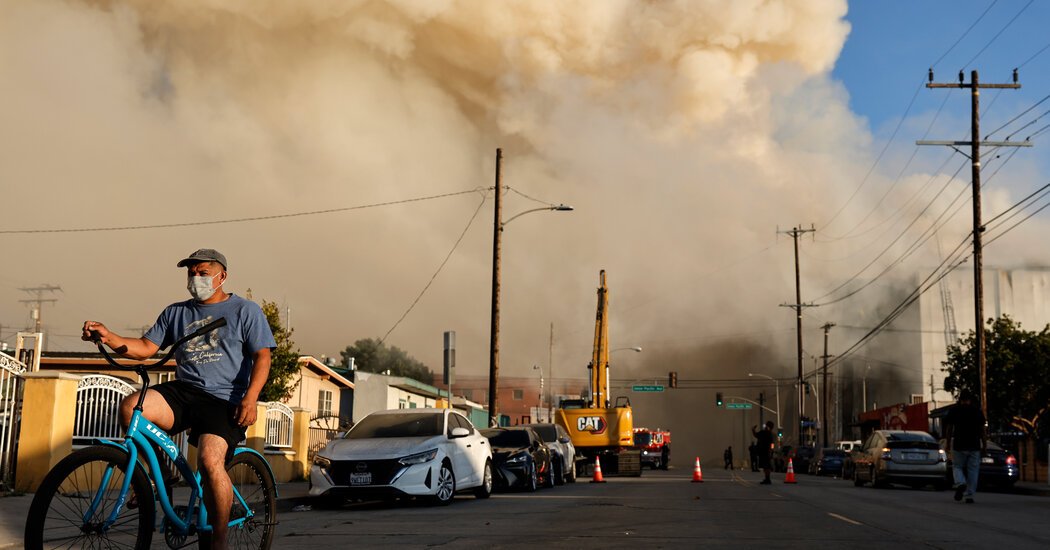
Smoke spread over the Los Angeles region on Sunday as a fire at a cold-storage warehouse in the Boyle Heights neighborhood continued to smolder for a fifth day.
Firefighters are making progress at stopping the blaze, and the smoke may soon begin to clear, a spokesman for the Los Angeles Fire Department said on Sunday afternoon.
Air quality in central Los Angeles and the San Gabriel Valley continued to be affected by particulates in the smoke. The South Coast Air Quality Management District extended a warning about poor air quality until midday on Monday and indicated that the wind could disperse smoke as far as Riverside and Orange Counties.
In a statement, the air quality agency said that particulates had reached “very unhealthy” levels in some areas on Saturday night and Sunday. The agency was expecting the most significant smoke effects north and east of the fire, and in the San Gabriel Valley and parts of the western Inland Empire.
Major sporting events on Sunday, including the World Cup match between Belgium and Iran at SoFi Stadium and the Los Angeles Dodgers game against the Baltimore Orioles at Dodger Stadium, continued as scheduled.
The blaze at the Boyle Heights warehouse, east of downtown Los Angeles, broke out on Wednesday afternoon and has been challenging to fight because the building’s walls are thick and insulated, like a freezer. Firefighters have also needed to extract ammonia, which was used as a refrigerant, and millions of gallons of frozen food.
Thank you for your patience while we verify access. If you are in Reader mode please exit and log into your Times account, or subscribe for all of The Times.
Thank you for your patience while we verify access.
Already a subscriber? Log in.
Want all of The Times? Subscribe.
Food
Freed from Cambodia’s scam compounds, trafficking victims face a new crisis


PHNOM PENH, Cambodia — All over this Southeast Asian city are vestiges of the multibillion-dollar online scam industry, which thrived here for more than half a decade until a recent government crackdown.
There are luxurious high-rise towers overlooking the Mekong River, where entire floors are now deserted following police raids that cleared out the illicit operations hidden there. Disintegrating cardboard boxes and bits of Styrofoam litter the entrance of a branch of Prince Supermarket, after its parent company—the massive Cambodian conglomerate Prince Holding Group—was slapped with U.S. sanctions for allegedly running industrial-scale scam compounds.
But the crackdown has created a secondary crisis: thousands of stranded foreign workers transported to Cambodia by the online scam operators and forced to work as hostage employees are now roaming the streets of Phnom Penh, after being freed when the scam operations closed. NGOs, including Amnesty International, say many of the workers are victims of human trafficking. They are now at the center of a silent humanitarian crisis in Cambodia, aid workers say, left with few options and abandoned amid the highly-publicized government crackdown.
“The government has only addressed half of this problem,” said Mark Taylor, a consultant on human trafficking issues who previously led a USAID-backed program in Cambodia. “But it is totally ignoring what fueled that problem,” he added, namely the tens of thousands of vulnerable migrants that were lured into the scam industry and are now at risk of being re-trafficked.
Cambodia was an epicenter of the global scam industry until late last year, when foreign pressure pushed the government to mount a large-scale crackdown on these operations. The scams, which operate online, work by convincing victims to put their money into fraudulent investment schemes. As victims keep depositing funds, they see profits, convincing them to put more in – until, one day, all their money evaporates.
The FBI and others have termed these schemes “pig-butchering” scams, and according to the agency’s Internet Crime Complaint Center, Americans were defrauded of more than $20 billion last year through these types of scams. This number has been growing every year, according to the FBI’s data.
Behind these online operations was a system of coercion.
More than two dozen migrants from Indonesia, Uganda, Ghana and Sierra Leone NPR interviewed recounted similar stories: they were offered jobs with decent wages, free accommodation and food, only to find themselves held against their will and forced to meet strict quotas as scam workers.
Shuiab, a 24-year-old Ugandan man, said he was promised $850 a month as a delivery driver before being taken to a compound hidden behind a casino and forced to scam Americans. Another man, Wilson, said he was electrocuted for failing to meet his quotas. NPR is identifying both men by their first names only because they fear reprisals.
“They have a place called the black room,” Wilson said, referring to the owners of the scam centers. “Inside that black room, they can do anything to you.”
United Nations agencies, Amnesty International and other organizations have long documented the use of forced labor and torture within this industry. In a report on the Cambodian government’s scam crackdown this June, Amnesty International said it had interviewed 73 people released from compounds in recent months, and determined all were victims of human trafficking.
Last October, the U.S. sanctioned a massive Cambodian conglomerate called Prince Holding Group and indicted its chairman, Chen Zhi, for allegedly directing “forced-labor” scam compounds in the country and laundering billions in criminal proceeds. In January, Chen was extradited from Cambodia to China, where he was born, with a bag over his head.
Chen’s lawyers have denied any wrongdoing and are fighting the case in U.S. courts.Beijing has continued to extradite several other alleged Chinese scam kingpins from Cambodia – bosses who were once thought to be untouchable, researchers with knowledge of these organized crime groups said. Alongside the police raids, the downfall of these tycoons put pressure on scam companies, which have relocated from Cambodia in recent months, researchers and former scam workers said.
The collapse of these tycoons quickly emptied the infrastructure they left behind. Some of the scam compounds in Cambodia were like cities themselves, massive and self-contained, with supermarkets, karaoke bars, barber shops, pharmacies, and other services inside them. One site, which NPR visited in March after it was emptied out, could accommodate 20,000 workers, according to the UK government which sanctioned its owners later that month.
With every compound that closed, tens of thousands of migrants were released onto the streets – without money, support, shelter, or even access to free food or water, according to aid workers. Instead, they’ve been met by a hostile bureaucracy. The Cambodian government has insisted that they pay fines for overstaying their visa, but those fines – $10 a day – can add up to thousands.
Embassies are working on behalf of their citizens to get the Cambodian government to waive the overstay fines, but the process is slow. While the stranded migrants wait, there is only one shelter for victims of trafficking in Cambodia that they can stay in, but it is full, with a waitlist of hundreds.
In recent weeks, NGOs helping the workers say the Cambodian authorities have stepped up detention of migrants for visa violations, cramming them in overcrowded detention facilities.
“Rather than identifying and supporting trafficking victims, Cambodian authorities have consistently treated people fleeing or being released from scamming compounds as irregular migrants – detaining them in substandard immigration detention facilities without access to lawyers or embassies,” the Amnesty report said, adding this is “in direct violation of…international obligations.”
In response to questions from NPR, Interior Ministry spokesman Touch Sokhak rejected the criticism, saying authorities have “rescued” hundreds of thousands of scam workers, including trafficking victims, and repatriated them “with the utmost care, in accordance with the law.”
But accounts from inside Cambodia’s detention system tell a starkly different story. In a text message shared with NPR by aid workers, a former scam worker described conditions inside one facility: free drinking water is available for only one hour a day and otherwise costs $2. He asked not to be named for fear of reprisal.
Food
Newsom declares state of emergency in Los Angeles for Boyle Heights warehouse fire

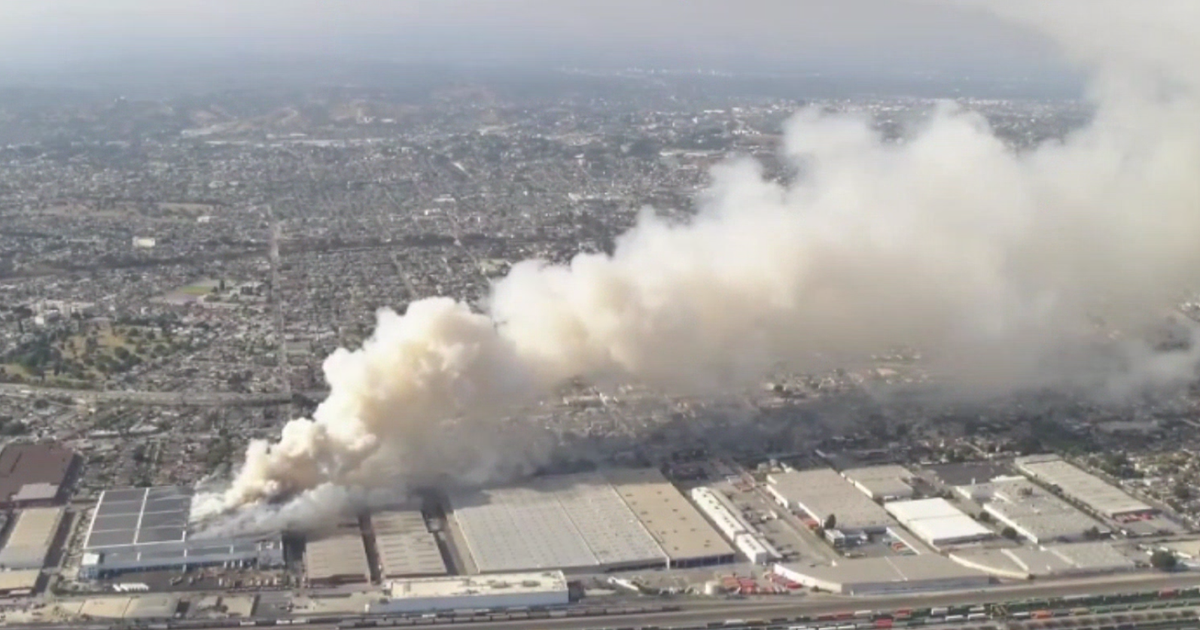
Firefighters faced renewed challenges Saturday at a large Boyle Heights cold storage facility fire, where conditions remain highly complex as Gov. Gavin Newsom and Mayor Karen Bass declared a local emergency to support response efforts.
The fire was first reported on Wednesday afternoon at the 500,000-square-foot Lineage Big Bear facility at 1400 S. Los Palos Street, which is used to store frozen foods.
“The best way to describe this is like a giant cooler,” said LA Fire Chief Jamie Moore, who added that the structure was built with corrugated steel walls filled with dense foam insulation and reinforced interior steel panels.
The building also used ammonia in its refrigeration system to maintain extremely low temperatures for frozen food storage, which may have fueled the fire on its initial day of burning.
“Imagine your refrigerator having a fire. And so, you have the shell of the outside and the shell on the inside,” Moore said during a news conference on Saturday afternoon. “What protects everything from the weather, or whatever the temperature is on the outside, is the rubber. … If you can imagine, that’s exactly what’s happening here.”
He said that with the help of water-dropping helicopters, LAFD crews have controlled the fire to approximately half of the building. The unaffected half, however, is filled with food that has begun to thaw as they had to turn off the refrigeration system and remove ammonia from inside. He said that the internal temperature of the building remains at around 45 degrees because of the insulation.
Moore said the nature of the materials inside has made the fire difficult to control, as the foam insulation continues to burn slowly once ignited.
Crews have relied on continuous helicopter water drops since the start of the incident to keep the structure cooled and prevent further escalation. Officials have also used large aerial ladder pipes, directing thousands of gallons of water per minute onto the building to contain the blaze.
“We stepped up our game. I reached out to the county and we started using contract helicopters,” Moore said. “Our contract helicopters … drop about 3,000 gallons of water at one time. On top of that, we’re able to incorporate blaze tamer gel, which is a fire retardant gel, which is gonna help encapsulate the smoke … and smother the fire.”
So far, he said that the process has been effective as they’ve helped cool things down and further mitigate the fire burning the roof.
At around 5:10 p.m. on Sunday, aerial footage showed another flare-up in the fire on the roof of the building. Another massive plume of smoke extended into the air as the fire appeared to be burning down the exterior wall and onto a lower roof.
85 million pounds of frozen food complicate firefighting efforts
With an estimated 85 million pounds of frozen food still inside the facility, firefighters say access is extremely limited due to zero visibility and unstable interior conditions.
“All that food is slowly beginning to rot. It’s no longer frozen. It’s warming up and it’s going to start to spoil,” Moore said. “Initially it was reported to us that the majority of that product was bread and wheat products. However, we’re slowly learning as we get into this building that it’s far from that; there’s a lot of meat products.”
Moore said that chicken, beef, pork and fish were being stored inside.
Officials stressed that crews are not entering the building or attempting to manually remove product. Instead, they are working to isolate unaffected areas while evaluating how to safely remove remaining goods before spoilage creates additional biohazard concerns.
“What we are trying to do now is to figure out the uninvolved area – how we can remove that food before it starts spoiling and becoming a biohazard concern,” Moore added.
Authorities said hazardous material risks have largely been mitigated, but the situation is now shifting toward potential biohazard issues as food inside the facility remains unrecovered. Officials emphasized that the priority is determining how to safely manage and remove the stored product while maintaining containment.
No injuries reported; no evacuation or shelter-in-place orders issued
Despite the severity of the incident, officials noted that no firefighters or civilians have been injured. Residents were advised that while smoke may be irritating—particularly for those sensitive to air quality—there is currently no order for evacuation or shelter-in-place, despite a similar order already having been issued and lifted twice since the fire’s ignition.
“If you are sensitive to smoke, please be cognizant of that and try to stay indoors,” cautioned Moore. “But there is nothing in the air that is so dangerous that we have to do evacuations or even shelter-in-place.”
Mayor Karen Bass said her chief concern was for the public’s safety and health.
“We’re not concerned in terms of the fire spreading or anything like that. But we are concerned about the biohazard smoke. No smoke is good, but especially the smoke that could be toxic because of the chemicals that were needed to keep the food frozen in the facility,” Bass said.
Two shelter locations have opened to support anyone affected by the fire, including at the Pecan Recreation Center, which is located at 145 S. Pecan Street, Los Angeles, CA 90033 and City Terrace Park, which is located at 1126 N. Hazard Avenue, Los Angeles, CA 90063.
“We are going to be distributing masks and air filters, thank you to the Red Cross and our other partners,” said Bass, who said she anticipates talking to Governor Newsom later in the day to issue a joint emergency declaration.
“The Governor will be prepared to respond to our State of the Emergency when that is ready with whatever resources we need to do what the Chief described, which is moving the toxic materials away from here and disposing of them in a way that we will avert a major environmental disaster,” Bass said. “This is about prevention. This is about protecting our public’s health.”
Bass, Newsom issue emergency declaration for resources
By Saturday night, both the mayor and Gov. Gavin Newsom had issued emergency declarations, citing the scale and complexity of the incident.
The declaration is intended to provide the city with greater flexibility to coordinate emergency response efforts, secure additional resources, conduct environmental remediation, and seek state and federal assistance.
“While the LAFD continues making progress, this is a major, multi-jurisdictional incident. I’m issuing an emergency declaration to ensure the City has the resources it needs as this operation continues and to keep the community safe,” said Mayor Bass. “The City and County have opened spaces for families seeking relief from the smoke, and we will continue working around the clock and doing everything possible to put this fire out completely.”
During Saturday afternoon’s news conference, Bass said that the joint state of emergency was filed with Newsom’s office.
She said that the Emergency Operations Center has been activated and that they’ve asked Newsom to waive regulations that could hinder response and recovery efforts, and that recovery assistance be made available through the state.
“We basically told the governor that we will be in touch from the county and the city in terms of ongoing requests for mutual aid as well as monetary assistance so that we can get this job done,” Bass said. “Our concern, obviously, is putting out the fire, but to learn what was in this storage center … really presents an entirely different picture.”
LA County Supervisor Hilda Solis also spoke at Saturday’s conference.
“I’m deeply concerned about the impact on our residents,” Solis said. “The radius of the fire extends to about 2.5 miles. In unincorporated East Los Angeles we’re talking about 250,000 households. That’s why this is important.”
Gov. Newsom’s office shared a statement regarding the emergency proclamation late Sunday night, which they said would enable the state to further support the ongoing local response.
“California is mobilizing to support Los Angeles as firefighters and emergency personnel continue their work to contain this fire and protect surrounding communities,” Newsom’s statement said. “While local officials continue to lead this response, the State of California is prepared to help safeguard public health, support emergency operations, and assist impacted residents. We are coordinating closely with our local partners, deploying specialized expertise, and pre-positioning critical supplies so communities have the support they need both now and throughout recovery.”
Among the resources being deployed to Los Angeles were 5.5 million N95 respirator masks, commercial-grade air purifiers for evacuation centers, bottled water and emergency supplies and additional air quality monitoring equipment.
Additionally, California Office of Emergency Services Fire and Rescue Branch leaders with “specialized technical expertise” are en route to work with local officials to provide consultation on suppression strategies and operational considerations, according to the release.
Residents question long-term health impacts
As suppression efforts continued, residents voiced concerns about the potential long-term environmental and health impacts on the surrounding community.
On Saturday afternoon, South Coast Air Quality Management District officials said that a particle pollution advisory was extended until at least 12:30 p.m. Sunday. They said that after the fire’s reignition on Friday night, sensors showed that PM2.5 levels were unhealthy.
Two smoke relief centers have been opened for people impacted by the incident. They can be found at:
Pecan Recreation Center at 145 S. Pecan Street
City Terrace Park at 1126 N. Hazard Avenue
Lineage, the building’s tenant and operator, released a statement indicating that the fire may have originated from work being performed by a third-party contractor handling solar panels on the roof.
“Lineage is the tenant-operator of this building,” the company said in a statement. “At this time, we believe the fire began while testing was being conducted by contractors of the third-party owner of the solar array located on the facility’s roof. This facility is not used for the storage of hazardous materials. It primarily serves as a temperature-controlled storage facility for frozen food before it makes its way to Greater Los Angeles area communities and beyond. Our understanding from LAFD and AQMD is that there have been no measurable ammonia concentrations recorded in the community since the fire started. Additionally, Lineage has proactively taken additional steps to pump out the ammonia and transport it offsite, removing the possibility of ammonia posing a risk to the community. This facility and the supply chain it connects with employ hundreds of local jobs. We are grateful that no team members at the facility were harmed.”
Meanwhile, fire crews continue to monitor the structure and adjust tactics as they work to contain the long-burning industrial fire and reduce environmental and health impacts to surrounding communities. Authorities cautioned that extinguishing the fire could take days or even weeks.
“I do want to be transparent to the public: this work is far from over. Because of the massive scale of this cold storage facility, deep pockets of smoldering fire remain buried under structural debris and solar panels,” said Los Angeles County Fire Chief Jon O’Brien. “Our city firefighting brothers and sisters are executing a meticulous, deeply challenging operation to bring the fire under control. Because of this, incident operations will continue into the foreseeable future.”
Food
What we know about the Boyle Heights warehouse fire
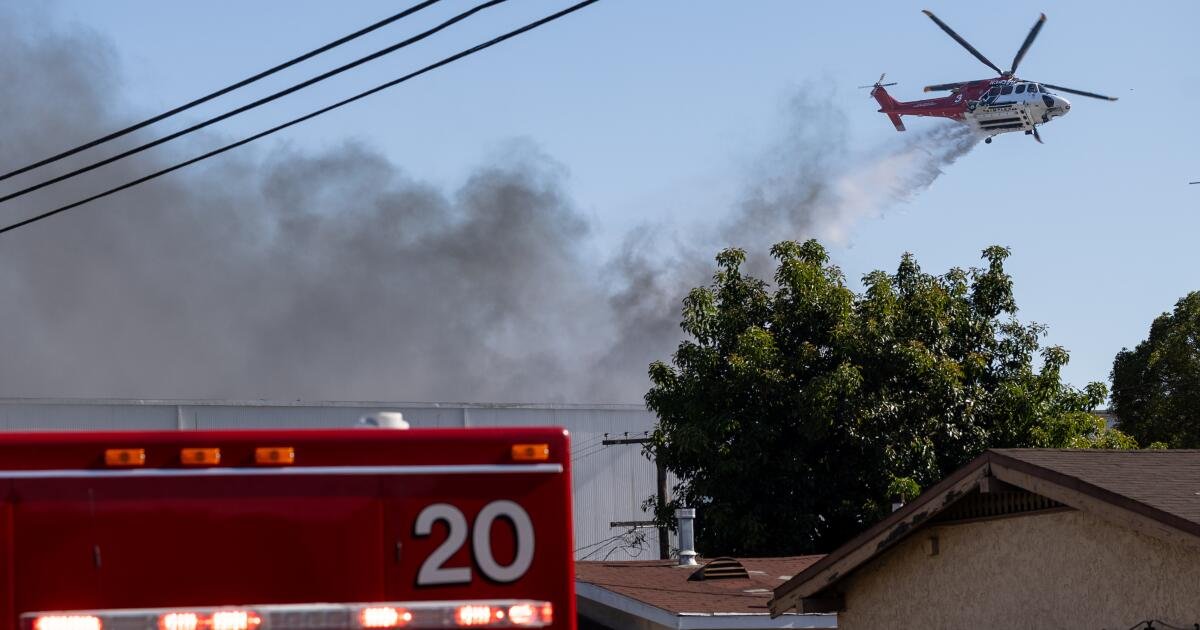
Los Angeles declared a state of emergency due to a stubborn warehouse fire in Boyle Heights that has burned for days.
Here’s a rundown of what we know:
What do we know about the cause of the fire?
Lineage Logistics, the tenant-operator of the building, said in a statement that it believes the fire began while third-party contractors were testing the solar array on the roof.
What does a state of emergency mean?
The declaration activates the city’s emergency response structure, directs departments to assess damages and costs, and requests state assistance to support firefighting, cleanup, environmental monitoring and community recovery efforts. As of Saturday afternoon, the state has not declared an emergency.
Why has it been so hard to put out?
The fire broke out Wednesday and has burned for fourdays.
The 500,000-square-foot commercial building stores 85 million pounds of frozen food “like a giant cooler,” said Los Angeles Fire Department Chief Jamie Moore. The corrugated steel walls are filled with very dense foam that is burning slowly and emitting gases despite ongoing water drops from helicopters.
LAFD Chief Deputy Jon O’Brien said Saturday that deep pockets of smoldering fire remain buried under structural debris and solar panels.
The building is so big and the flames are in such hard-to-reach areas that firefighters have needed to get creative with their approach, using water-dropping helicopters and other heavy equipment.
What are the air quality and health impacts?
Moore cautioned people with lung issues or smoke sensitivity to avoid outdoor activities, but said crews have mitigated hazardous materials at the site. However they remain concerned about biohazards potentially posed by spoiled food.
L.A. County Health Officer Muntu Davis said the main public health concern was smoke and fine particles that can cause irritation of the ear, nose, throat and lungs, as well as exacerbate heart and lung conditions.
Sensitive individuals were encouraged to wear well-fitting N95 and P100 masks, and to register for emergency notifications at alertla.org.
What about the battery risk?
Officials have spoken of the possibility of lithium-ion batteries within the building. Batteries are often used to store energy produced by solar panels, although officials could not immediately confirm whether that was the case in Boyle Heights.
However, they said the building does house about 60 forklifts that run on lithium-ion batteries, although those are “currently unburned.” The threat posed by the batteries was at least mitigated when 56 of the forklifts were moved or isolated from the flames in a dangerous operation, LAFD Battalion Chief Nicholas Ferrari said.
Food
Colombia’s brutal internal conflict is defining its presidential election


Colombia’s escalating, brutal internal conflict is defining its presidential election
“My brother was murdered for not paying an extortion payment…in front of his children,” Edilma Martinez Flores said at a support centre for displaced people in Bogotá.
She fled her home on the outskirts of Cali, in the south-west, after armed criminal groups handed out leaflets ordering residents to leave or face violence.
“We had no choice but to leave our things behind. They started placing bombs along the routes people travel.”
Edilma is far from alone, and experiences like hers are why insecurity is dominating voters’ minds in Sunday’s key presidential election.
Colombia’s six decades of conflict between armed groups, the state and cartels has killed hundreds of thousands of people.
It isn’t new, but illegal armed groups have roughly doubled their membership in the last five years.
These include Revolutionary Armed Forces of Colombia (FARC) dissident factions, the National Liberation Army (ELN) and the Clan del Golfo, who have expanded their control of rural areas key to drug trafficking and illegal mining.
A brutal offensive between the ELN and FARC dissidents near the Venezuela-Colombia border last year displaced tens of thousands of people.
The two presidential candidates have starkly different visions for tackling this violence, in a campaign marked by the assassination of a presidential candidate, homicides, kidnappings and bombings.
Left-wing senator Iván Cepeda is seen as the “architect” of the current president Gustavo Petro’s “total peace” strategy, prioritising negotiation with armed groups. Critics say it has failed and let armed groups exploit ceasefires to expand their control. Supporters argue it prevents a larger loss of life.
He also played a key role in the 2016 peace deal which disarmed thousands of FARC fighters.
He has pledged “social transformations that the country urgently cries out for” while promising to “take stock” of the peace strategy and “make the necessary changes”.
His challenger is a conservative outsider, right-wing businessman and lawyer Abelardo de la Espriella, who calls himself El Tigre (The Tiger in English). He’s been endorsed by Donald Trump, and is a US citizen. The signature outfit for him and his supporters is the Colombian football shirt, which the left has accused him of politicising.
He has promised 10 mega-prisons, a tough military crackdown, and an end to negotiations with armed groups, saying he has the “balls” to take them on.
“Any criminal who does not surrender will be taken down,” he has promised.
For many Colombians, how this issue is tackled will have a huge impact on their lives.
Isabelita Mercado Pineda, a government advisor for peace, victims and reconciliation in Bogotá, says forced displacement rose 300% between 2024 and 2025.
“We have not seen displacements like this for the last two decades,” she added.
She said it has been driven by factors including rising cocaine production, the army failing to occupy territories left by the FARC after it demobilised in 2016, leaving voids for armed groups to fill, and a “failure” of the government’s strategy that she argued provides criminal groups with “carrot but not enough stick”.
The support centre for victims in Bogotá shows the scale of this issue. Erin Gamboa from the Chocó region on the Pacific Coast said his half-brother was taken by FARC guerillas and they have not heard from him since.
“My region is heavily contested, criminal gangs fight over the territory,” he said, outlining how paramilitaries, guerillas and the FARC fight over illegal mining and cocaine trafficking sites.
Another couple, who wanted to remain anonymous, said their small food delivery business was contacted by a man claiming to be from the FARC. He began extorting their children, demanding 5 million pesos (about $1,500; £1,100).
Through tears, the woman described how crime has grown “so much” and you “can’t go out in peace anymore”.
Trump’s endorsement of de la Espriella, criticised by the left as foreign interference, comes as the US takes a more interventionist stance towards criminal groups in Latin America.
Trump said the election would determine Colombia’s relationship with the US, adding that “if Abelardo wins…[Colombia] will have the total support and strength of the United States behind him”, and called Cepeda a “radical left Marxist”.
De la Espriella grew up on Colombia’s Caribbean coast where he retains strong regional support.
Maria Luisa Sanchez, a childhood family friend and neighbour, said de la Espriella has “achieved everything he has set out in life, he is a man with very strong convictions”.
“He has that character, courage, it’s what we need for Colombia, a person … who is tough on drug-trafficking, tough on guerillas.”
Supporter Sandra Caballero, from a village outside of Barranquilla, said he “will work with the United States to fight drug trafficking and doesn’t plan to speak with criminals – which has not given results in four years”.
“He wants to change taxes to help companies generate more jobs and invest in security and health.”
Cepeda, on the other hand, has the lead among younger voters in Colombia.
“Cepeda’s proposal for security not only contemplates the coercive forces of the state to stop crime, but also takes into account the structural roots of insecurity – the lack of state presence, poverty, inequality, many young people belonging to criminal groups,” student Catalina La Grande said.
“We don’t want to repeat security models from previous governments that have left thousands of victims and not solved the problems. We believe in negotiated security: combining repression [of armed groups] with social programmes.”
With two very different candidates on the ballot, Sunday’s election will make it far more divided.
Additional reporting by Vanessa Silva and Nathalie Jimenez


The signs are growing that UK PM Keir Starmer is due to set out a plan to stand down. #BBCNews
Subscribe to our channel here: https://bbc.in/bbcnews For the latest news download the BBC News app or visit BBC.com/news …


Is UK PM Keir Starmer about to resign? #BBCNews


The Way Home Series Finale Ending Explained
The Landry family took one last dip in the pond on Sunday with the heartbreaking, century spanning series finale of...
Australia sells advanced radar technology to Canada in record $1.7 billion deal
SYDNEY, June 22 (Reuters) – Australia said on Monday it will sell advanced radar technology capable of detecting long-range missiles...
Inside Nicole Kidman’s star-studded NYC birthday celebration with daughters Sunday and Faith
Nicole Kidman made sure her 59th birthday was one to remember! The Hollywood actress spent the day in New York...


World Cup viewers gather at FIFA Fan Fest in Atlanta
World Cup fans attend the FIFA's Fan Fest, a sixteen day festival in Atlanta. CNN's Rafael Romo talks to attendees.


I Know Why the Tech Broligarchs Went Full MAGA
President Donald Trump has pulled fringe tech figures out of the shadows and into the corridors of power, inspiring others...


Couple fights for their child’s place in a vanishing community
As India's Zoroastrian community faces demographic collapse, one family is going to the Supreme Court seeking official …
Man falls to his death during Goose concert at Madison Square Garden
A 51-year-old man fell to his death during a Goose concert at Madison Square Garden on Saturday night, police said....


Breaking Down Every ‘House of the Dragon’ Character After the Season 3 Premiere
In its return Sunday night, House of the Dragon wasted no time jumping back into the action. That’s because this...
-

 Business1 week ago
How much of Musk’s wealth comes from government help? Virtually all of it
-

 Politics1 week ago
What to know about the stabbing that set off fiery riots in Northern Ireland
-

 Video1 week ago
Download fans say what they love about the festival. #DownloadFestival #BBCNews
-

 Video1 week ago
Why SpaceX IPO isn't about space. #SpaceX #ElonMusk #BBCNews
-

 HealthNews1 week ago
The people of Okinawa, Japan only eat until they are about 80 percent full, then stop — and the practice has been linked in multiple peer-reviewed studies to lower rates of cardiovascular disease, slo
-

 Food1 week ago
Pope Leo’s plane was grounded. Then the King of Spain stepped in to help
-

 TravelNews1 week ago
My Paternal Instinct Should’ve Warned Me About Netflix’s Maternal Instinct
-

 Video1 week ago
Claire Danes has the cutest stories about young Kirsten Dunst on 'Little Women' set